
Articles | Volume 30, issue 3
https://doi.org/10.5194/hess-30-659-2026
© Author(s) 2026. This work is distributed under
the Creative Commons Attribution 4.0 License.
the Creative Commons Attribution 4.0 License.
https://doi.org/10.5194/hess-30-659-2026
© Author(s) 2026. This work is distributed under
the Creative Commons Attribution 4.0 License.
the Creative Commons Attribution 4.0 License.
Technical note
| 
05 Feb 2026
Technical note |
| 05 Feb 2026
| 05 Feb 2026
Technical note: Literature based approach to estimate future snow

WSL Institute for Snow and Avalanche Research SLF, Davos, Switzerland
Christoph Marty
WSL Institute for Snow and Avalanche Research SLF, Davos, Switzerland
Related authors
Leah Gaillard Festa, Bettina Richter, Lars Mewes, Matthias Jaggi, and Benjamin Walter
EGUsphere, https://doi.org/10.5194/egusphere-2026-4846, https://doi.org/10.5194/egusphere-2026-4846, 2026
This preprint is open for discussion and under review for The Cryosphere (TC).
Short summary
Short summary
We studied snow changes through winter using the SnowMicroPen, which precisely measures snow density and specific surface area. Based on 10 years of daily measurements, we tracked how these properties evolved throughout winter. We found that the RHOSSA parametrization, developed from one winter, performs well across a wider range of conditions. Accounting for instrument biases and temperature effects improves the results and the use of this unique time series.
Stephanie Mayer, Martin Hendrick, Adrien Michel, Bettina Richter, Jürg Schweizer, Heini Wernli, and Alec van Herwijnen
The Cryosphere, 18, 5495–5517, https://doi.org/10.5194/tc-18-5495-2024, https://doi.org/10.5194/tc-18-5495-2024, 2024
Short summary
Short summary
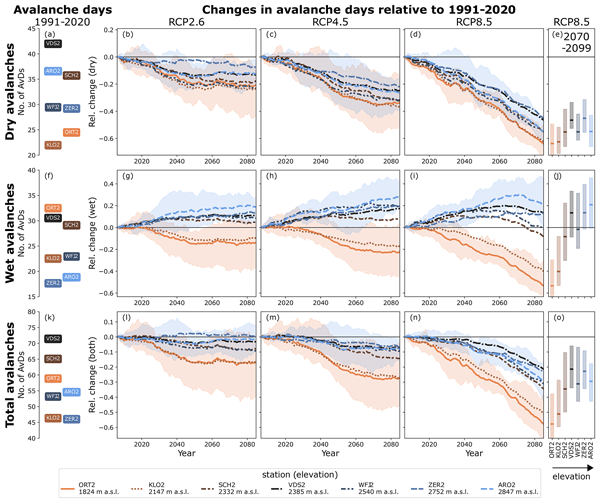
Understanding the impact of climate change on snow avalanche activity is crucial for safeguarding lives and infrastructure. Here, we project changes in avalanche activity in the Swiss Alps throughout the 21st century. Our findings reveal elevation-dependent patterns of change, indicating a decrease in dry-snow avalanches alongside an increase in wet-snow avalanches at elevations above the current treeline. These results underscore the necessity to revisit measures for avalanche risk mitigation.
Leah Gaillard Festa, Bettina Richter, Lars Mewes, Matthias Jaggi, and Benjamin Walter
EGUsphere, https://doi.org/10.5194/egusphere-2026-4846, https://doi.org/10.5194/egusphere-2026-4846, 2026
This preprint is open for discussion and under review for The Cryosphere (TC).
Short summary
Short summary
We studied snow changes through winter using the SnowMicroPen, which precisely measures snow density and specific surface area. Based on 10 years of daily measurements, we tracked how these properties evolved throughout winter. We found that the RHOSSA parametrization, developed from one winter, performs well across a wider range of conditions. Accounting for instrument biases and temperature effects improves the results and the use of this unique time series.
Harsh Beria, Sven Kotlarski, Adrien Michel, Jan Magnusson, and Christoph Marty
EGUsphere, https://doi.org/10.5194/egusphere-2026-3478, https://doi.org/10.5194/egusphere-2026-3478, 2026
Short summary
Short summary
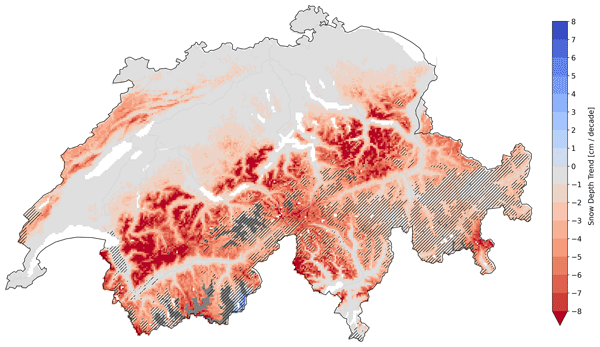
Snow is a vital water store for Switzerland, supporting hydropower, winter tourism, and aquatic ecosystems. Using the latest Swiss climate projections, we project future snow water across Switzerland at high spatial resolution. By the end of this century under high emission scenarios, low-lying regions are projected to become nearly snow-free, while even high mountains lose much of their snow. These results can support planning for future Alpine water resources under a warming climate.
Christoph Marty, Adrien Michel, Tobias Jonas, Cynthia Steijn, Regula Muelchi, and Sven Kotlarski
The Cryosphere, 19, 4391–4407, https://doi.org/10.5194/tc-19-4391-2025, https://doi.org/10.5194/tc-19-4391-2025, 2025
Short summary
Short summary
This work presents the first long-term (since 1962), daily, 1 km gridded dataset of snow depth and water storage for Switzerland. Its quality was assessed by comparing yearly, monthly, and weekly values to a higher-quality model and in situ measurements. Results show good overall performance, though some limitations exist at low elevations and short timescales. Despite this, the dataset effectively captures trends, offering valuable insights for climate monitoring and elevation-based changes.
Adrien Michel, Johannes Aschauer, Tobias Jonas, Stefanie Gubler, Sven Kotlarski, and Christoph Marty
Geosci. Model Dev., 17, 8969–8988, https://doi.org/10.5194/gmd-17-8969-2024, https://doi.org/10.5194/gmd-17-8969-2024, 2024
Short summary
Short summary
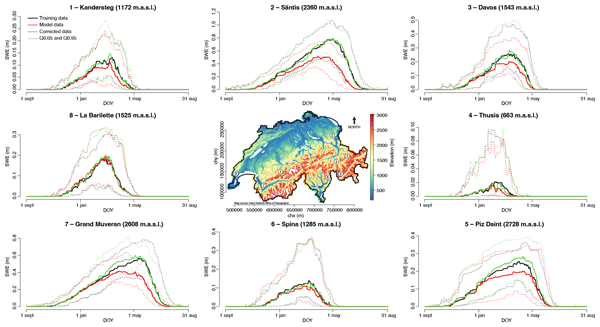
We present a method to correct snow cover maps (represented in terms of snow water equivalent) to match better-quality maps. The correction can then be extended backwards and forwards in time for periods when better-quality maps are not available. The method is fast and gives good results. It is then applied to obtain a climatology of the snow cover in Switzerland over the past 60 years at a resolution of 1 d and 1 km. This is the first time that such a dataset has been produced.
Matthew Switanek, Gernot Resch, Andreas Gobiet, Daniel Günther, Christoph Marty, and Wolfgang Schöner
The Cryosphere, 18, 6005–6026, https://doi.org/10.5194/tc-18-6005-2024, https://doi.org/10.5194/tc-18-6005-2024, 2024
Short summary
Short summary
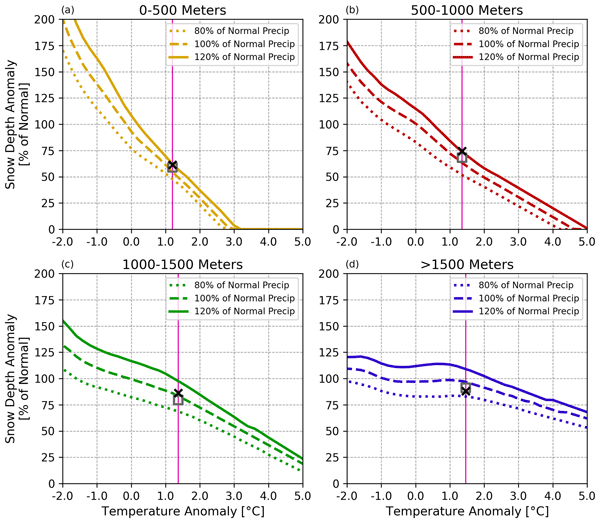
Snow depth plays an important role in water resources, mountain tourism, and hazard management across the European Alps. Our study uses station-based historical observations to quantify how changes in temperature and precipitation affect average seasonal snow depth. We find that the relationship between these variables has been surprisingly robust over the last 120 years. This allows us to more accurately estimate how future climate will affect seasonal snow depth in different elevation zones.
Stephanie Mayer, Martin Hendrick, Adrien Michel, Bettina Richter, Jürg Schweizer, Heini Wernli, and Alec van Herwijnen
The Cryosphere, 18, 5495–5517, https://doi.org/10.5194/tc-18-5495-2024, https://doi.org/10.5194/tc-18-5495-2024, 2024
Short summary
Short summary
Understanding the impact of climate change on snow avalanche activity is crucial for safeguarding lives and infrastructure. Here, we project changes in avalanche activity in the Swiss Alps throughout the 21st century. Our findings reveal elevation-dependent patterns of change, indicating a decrease in dry-snow avalanches alongside an increase in wet-snow avalanches at elevations above the current treeline. These results underscore the necessity to revisit measures for avalanche risk mitigation.
Johannes Aschauer, Adrien Michel, Tobias Jonas, and Christoph Marty
Geosci. Model Dev., 16, 4063–4081, https://doi.org/10.5194/gmd-16-4063-2023, https://doi.org/10.5194/gmd-16-4063-2023, 2023
Short summary
Short summary
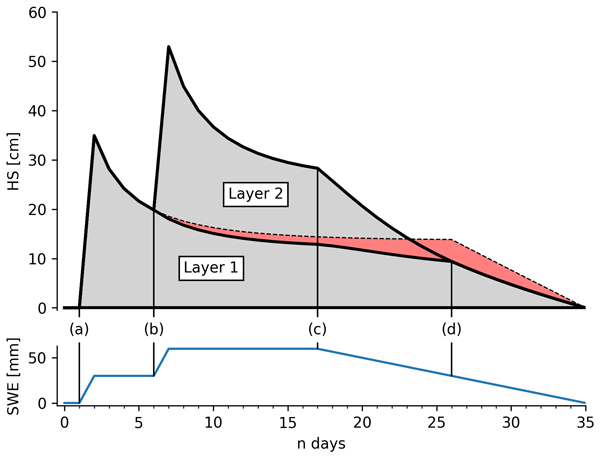
Snow water equivalent is the mass of water stored in a snowpack. Based on exponential settling functions, the empirical snow density model SWE2HS is presented to convert time series of daily snow water equivalent into snow depth. The model has been calibrated with data from Switzerland and validated with independent data from the European Alps. A reference implementation of SWE2HS is available as a Python package.
Moritz Buchmann, Gernot Resch, Michael Begert, Stefan Brönnimann, Barbara Chimani, Wolfgang Schöner, and Christoph Marty
The Cryosphere, 17, 653–671, https://doi.org/10.5194/tc-17-653-2023, https://doi.org/10.5194/tc-17-653-2023, 2023
Short summary
Short summary
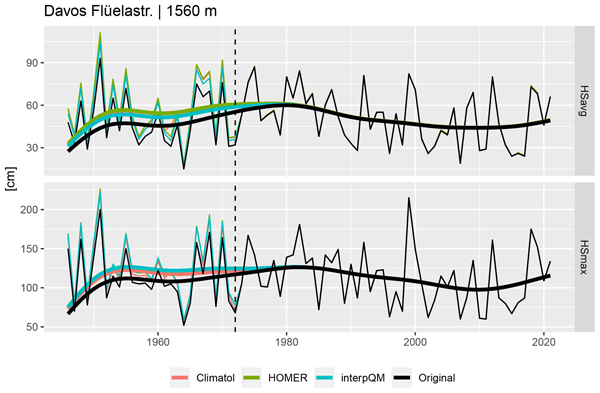
Our current knowledge of spatial and temporal snow depth trends is based almost exclusively on time series of non-homogenised observational data. However, like other long-term series from observations, they are susceptible to inhomogeneities that can affect the trends and even change the sign. To assess the relevance of homogenisation for daily snow depths, we investigated its impact on trends and changes in extreme values of snow indices between 1961 and 2021 in the Swiss observation network.
Moritz Buchmann, John Coll, Johannes Aschauer, Michael Begert, Stefan Brönnimann, Barbara Chimani, Gernot Resch, Wolfgang Schöner, and Christoph Marty
The Cryosphere, 16, 2147–2161, https://doi.org/10.5194/tc-16-2147-2022, https://doi.org/10.5194/tc-16-2147-2022, 2022
Short summary
Short summary
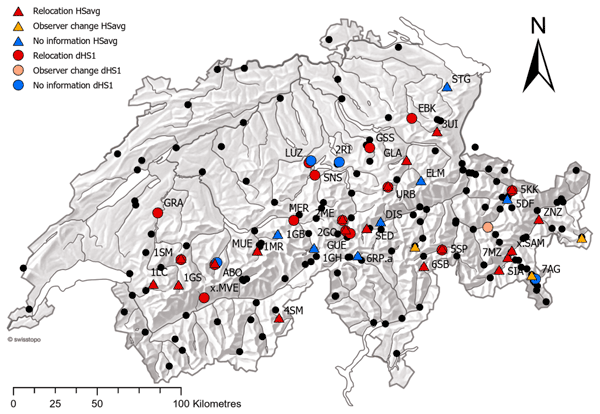
Knowledge about inhomogeneities in a data set is important for any subsequent climatological analysis. We ran three well-established homogenization methods and compared the identified break points. By only treating breaks as valid when detected by at least two out of three methods, we enhanced the robustness of our results. We found 45 breaks within 42 of 184 investigated series; of these 70 % could be explained by events recorded in the station history.
Yves Bühler, Peter Bebi, Marc Christen, Stefan Margreth, Lukas Stoffel, Andreas Stoffel, Christoph Marty, Gregor Schmucki, Andrin Caviezel, Roderick Kühne, Stephan Wohlwend, and Perry Bartelt
Nat. Hazards Earth Syst. Sci., 22, 1825–1843, https://doi.org/10.5194/nhess-22-1825-2022, https://doi.org/10.5194/nhess-22-1825-2022, 2022
Short summary
Short summary
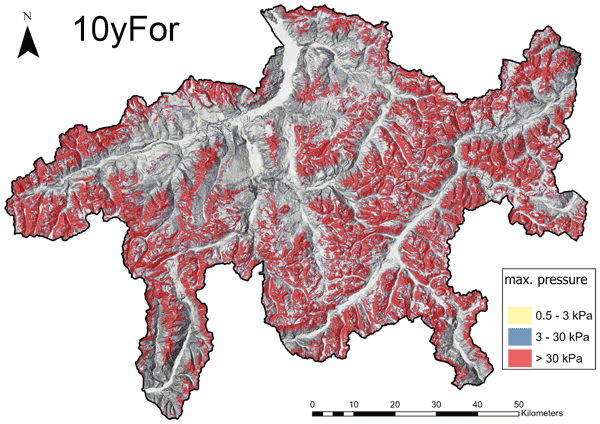
To calculate and visualize the potential avalanche hazard, we develop a method that automatically and efficiently pinpoints avalanche starting zones and simulate their runout for the entire canton of Grisons. The maps produced in this way highlight areas that could be endangered by avalanches and are extremely useful in multiple applications for the cantonal authorities, including the planning of new infrastructure, making alpine regions more safe.
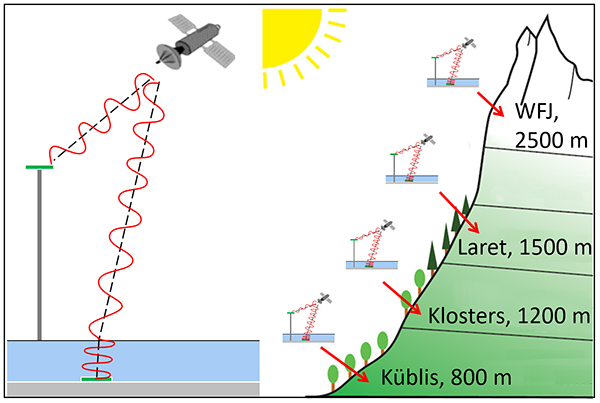
Achille Capelli, Franziska Koch, Patrick Henkel, Markus Lamm, Florian Appel, Christoph Marty, and Jürg Schweizer
The Cryosphere, 16, 505–531, https://doi.org/10.5194/tc-16-505-2022, https://doi.org/10.5194/tc-16-505-2022, 2022
Short summary
Short summary
Snow occurrence, snow amount, snow density and liquid water content (LWC) can vary considerably with climatic conditions and elevation. We show that low-cost Global Navigation Satellite System (GNSS) sensors as GPS can be used for reliably measuring the amount of water stored in the snowpack or snow water equivalent (SWE), snow depth and the LWC under a broad range of climatic conditions met at different elevations in the Swiss Alps.
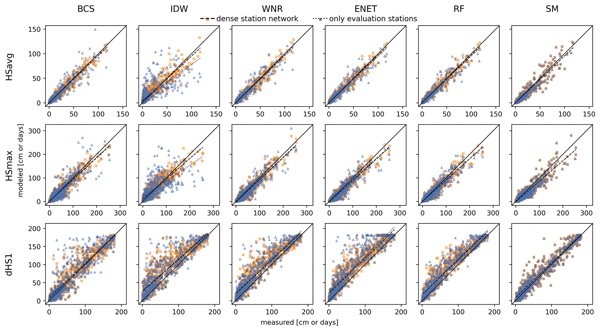
Johannes Aschauer and Christoph Marty
Geosci. Instrum. Method. Data Syst., 10, 297–312, https://doi.org/10.5194/gi-10-297-2021, https://doi.org/10.5194/gi-10-297-2021, 2021
Short summary
Short summary
Methods for reconstruction of winter long data gaps in snow depth time series are compared. The methods use snow depth data from neighboring stations or calculate snow depth from temperature and precipitation data. All methods except one are able to reproduce the average snow depth and maximum snow depth in a winter reasonably well. For reconstructing the number of snow days with snow depth ≥ 1 cm, results suggest using a snow model instead of relying on data from neighboring stations.

Moritz Buchmann, Michael Begert, Stefan Brönnimann, and Christoph Marty
The Cryosphere, 15, 4625–4636, https://doi.org/10.5194/tc-15-4625-2021, https://doi.org/10.5194/tc-15-4625-2021, 2021
Short summary
Short summary
We investigated the impacts of local-scale variations by analysing snow climate indicators derived from parallel snow measurements. We found the largest relative inter-pair differences for all indicators in spring and the smallest in winter. The findings serve as an important basis for our understanding of uncertainties of commonly used snow indicators and provide, in combination with break-detection methods, the groundwork in view of any homogenization efforts regarding snow time series.
Cited articles
Broust, G., Buisson, S., Couble, M., Eymard, E., Grosso, J., Konarski, F., Lacroix, P., Lecomte, I., Prache, O., Roigt, P., Vicier, L., Vicier, J., and Dufour, A.: Small mid-mountain ski resorts facing climate change: the testimony of Saint-su-Touvet, Chartreuse, France, Proceedings of the International Snow Science Workshop, Tromsø, Norway, https://arc.lib.montana.edu/snow-science/objects/ISSW2024_O5.5.pdf (last access: 22 January 2026), 629–634, 2024. a
CH2011: Swiss Climate Change Scenarios CH2011, C2SM, MeteoSwiss, ETH, NCCR Climate, and OcCC, Zurich, Switzerland, ISBN: 978-3-033-03065-7, 2011. a
Fiddes, J., Aalstad, K., and Lehning, M.: TopoCLIM: rapid topography-based downscaling of regional climate model output in complex terrain v1.1, Geosci. Model Dev., 15, 1753–1768, https://doi.org/10.5194/gmd-15-1753-2022, 2022. a, b
Frei, C.: Interpolation of temperature in a mountainous region using nonlinear profiles and non-Euclidean distances, Int. J. Climatol., 34, 1585–1605, https://doi.org/10.1002/joc.3786, 2014. a
López-Moreno, J. I., Pomeroy, J. W., Alonso-González, E., Morán-Tejeda, E., and Revuelto, J.: Decoupling of warming mountain snowpacks from hydrological regimes, Environ. Res. Lett., 15, 114006, https://doi.org/10.1088/1748-9326/abb55f, 2020. a
Marty, C., Michel, A., Jonas, T., Steijn, C., Muelchi, R., and Kotlarski, S.: SPASS – new gridded climatological snow datasets for Switzerland: potential and limitations, The Cryosphere, 19, 4391–4407, https://doi.org/10.5194/tc-19-4391-2025, 2025. a
MeteoSwiss and ETH Zurich: Climate CH2025 – Scientific Report, Federal Office of Meteorology and Climatology MeteoSwiss, Zurich, https://doi.org/10.18751/climate/scenarios/ch2025/sr/1.0/, 2025. a
Morin, S., Verfaillie, D., Lafaysse, M., Déqué, M., Eckert, N., Lejeune, Y., and Soubeyroux, J.-M.: Linking variations of meteorological and snow conditions in the frenchmountain regions to global temperature levels, in: Proceedings of International Snow Science Workshop, Innsbruck, Austria, 481–487, https://arc.lib.montana.edu/snow-science/objects/ISSW2018_P06.3.pdf (last access: 22 January 2026), 2018. a, b, c, d
Ranzi, R., Colosio, P., and Galeati, G.: Climatology of snow depth and water equivalent measurements in the Italian Alps (1967–2020), Hydrol. Earth Syst. Sci., 28, 2555–2578, https://doi.org/10.5194/hess-28-2555-2024, 2024. a
Richter, B. and Marty, C.: Literature based approach to estimate future snow, EnviDat [data set], https://doi.org/10.16904/envidat.719, 2025. a
Richter, B., van Herwijnen, A., Rotach, M. W., and Schweizer, J.: Sensitivity of modeled snow stability data to meteorological input uncertainty, Nat. Hazards Earth Syst. Sci., 20, 2873–2888, https://doi.org/10.5194/nhess-20-2873-2020, 2020. a
Schmucki, E., Marty, C., Fierz, C., and Lehning, M.: Simulations of 21st century snow response to climate change in Switzerland from a set of RCMs, Int. J. Climatol., 35, 3262–3273, https://doi.org/10.1002/joc.4205, 2015. a, b, c, d
Schmucki, E., Marty, C., Fierz, C., Weingartner, R., and Lehning, M.: Impact of climate change in Switzerland on socioeconomic snow indices, Theor. Appl. Climatol., 127, 875–889, https://doi.org/10.1007/s00704-015-1676-7, 2017. a, b
Verfaillie, D., Lafaysse, M., Déqué, M., Eckert, N., Lejeune, Y., and Morin, S.: Multi-component ensembles of future meteorological and natural snow conditions for 1500 m altitude in the Chartreuse mountain range, Northern French Alps, The Cryosphere, 12, 1249–1271, https://doi.org/10.5194/tc-12-1249-2018, 2018. a, b, c, d, e, f
Willibald, F., Kotlarski, S., Grêt-Regamey, A., and Ludwig, R.: Anthropogenic climate change versus internal climate variability: impacts on snow cover in the Swiss Alps, The Cryosphere, 14, 2909–2924, https://doi.org/10.5194/tc-14-2909-2020, 2020. a, b, c
Willibald, F., Kotlarski, S., Ebner, P. P., Bavay, M., Marty, C., Trentini, F. V., Ludwig, R., and Grêt-Regamey, A.: Vulnerability of ski tourism towards internal climate variability and climate change in the Swiss Alps, Sci. Total Environ., 784, 147054, https://doi.org/10.1016/j.scitotenv.2021.147054, 2021. a, b
Short summary
We developed a literature-based approach for projecting future snow depths, which was applied to four measurement stations in Switzerland under a +2 °C temperature scenario, revealing significant declines in snow depths. Validation against published data shows that the approach captures key trends in snow loss. This resource-efficient method provides a practical tool for estimating climate change related snow depth declines, which are lacking highly resolved climate projections.
We developed a literature-based approach for projecting future snow depths, which was applied to...


