
the Creative Commons Attribution 4.0 License.
the Creative Commons Attribution 4.0 License.
 | 26 Oct 2026
Integrating surface-active layer-permafrost hydrological processes: A systematic review and research framework
Guangxi Ding

Shiqiang Zhang
Bingfeng Yang
Junhao Cui
Feiteng Wang
Jianfeng Yang
Climate warming has accelerated permafrost degradation, leading to significant challenges in water circulation and transformation. Since the early 21st century, especially during the last ten years, permafrost hydrology has garnered substantial attention, yielding a wealth of research outcomes. However, a comprehensive and systematic understanding of the permafrost hydrology remains limited. This study synthesised current knowledge through a comprehensive systematic review and established a Surface-Active layer-Permafrost (SAP) framework that integrated three critical domains: surface hydrological processes, hydrological functions of the active layer, and the hydrological effects of permafrost changes. The SAP framework reveals that permafrost hydrological responses are governed by a causal chain linking climate warming to permafrost degradation, active layer thickening, altered hydraulic properties, enhanced subsurface connectivity, and can ultimately increase baseflow and modified runoff partitioning in many regions. Regarding surface hydrological processes in permafrost regions, this study examined the impacts of freeze–thaw cycles on surface runoff from multiple perspectives, including the influence of slope hydrological processes, river channel dynamics, basin- to regional-scale permafrost hydrology, and the hydrological consequences of thermokarst formation. For hydrological processes within the active layer, the study identified the hydrological role of the active layer, key factors influencing its hydrological behaviour, and the interactions between suprapermafrost water and soil water. Concerning the hydrological impacts of permafrost thaw, this study investigated the transformation dynamics between surface and groundwater in permafrost regions by analysing the effects of climate change through increased baseflow, groundwater recharge, and subsurface runoff. The current state, trends, and challenges in permafrost hydrology research were summarised, and a holistic overview was provided. Finally, future research directions were outlined, emphasising three key areas: the application of novel observational methods, integrated surface-subsurface investigations, and the ecological and environmental impacts of permafrost hydrological changes.
- Article
(5870 KB) - Full-text XML
-
Supplement
(613 KB) - BibTeX
- EndNote


Among the environmental elements influenced by global change, the cryosphere is at the forefront and exhibits the most rapid, pronounced, and indicative responses. It is also the most direct and sensitive component of the climate system (Ding and Xiao, 2013; Cui et al., 2023) and is widely recognised as a critical link in the interactions among multiple spheres of the climate system (IPCC, 2007; Li et al., 2022). Within the cryosphere, permafrost has garnered increasing attention owing to its extensive distribution and profound influence on hydrological processes. These influences encompass the regulation of soil moisture, runoff generation, and groundwater dynamics across cold regions (Yang et al., 2000; Hinzman et al., 2005; Woo et al., 2008; Woo, 2012, 2019; Kalyuzhnyi and Lavrov, 2012; Wang and Zhang, 2016; Ding et al., 2017, 2020a; Qin et al., 2024). Widespread permafrost warming and degradation govern these influences, altering water balance and hydrological connectivity at basin to continental scales (Liljedahl et al., 2016; Walvoord and Kurylyk, 2016; AMAP, 2017; Rogger et al., 2017; Chen et al., 2019; Lafrenière and Lamoureux, 2019; Zhao et al., 2019; Hiyama et al., 2021a; Makarieva et al., 2021; Ehlers et al., 2022; Jin et al., 2022a; Jin et al., 2025). This transformation is manifested in the rapid hydrological reorganization of permafrost landscapes, where water tracks serve as critical conduits that modulate water and sediment flux across hillslopes under warming conditions (van Meerveld, 2024; Del Vecchio and Evans, 2025).
Permafrost is predominantly distributed in the high-latitude and high-altitude regions of the Northern Hemisphere, where its hydrological impacts are most pronounced. In high-altitude regions of Asia, particularly the Tibetan Plateau, permafrost plays a critical role in shaping hydrological processes in mountainous basins (Qin et al., 2024; Wang et al., 2024a; Xiao et al., 2025a). The seasonal freeze–thaw cycle of the active layer controls infiltration capacity, soil water storage, and the partitioning of rainfall and snowmelt into surface runoff versus subsurface flow. In addition, the permafrost table acts as a near-impermeable boundary that restricts vertical percolation and promotes lateral subsurface flow (Qin et al., 2024; Yang and Kane, 2021). Permafrost degradation alters hydrological connectivity by creating new flow paths through talik formation and by modifying surface drainage patterns, and the substantial volume of water stored as ground ice – estimated globally at approximately 36.6×10³ km3 (Zhang et al., 1999), equivalent to five times the annual discharge of the Amazon River – represents a long-term water reservoir that, upon thaw, can contribute to river discharge and groundwater recharge. On the Tibetan Plateau, the permafrost ice content is estimated at 12.7×10³ km3 (Zhao et al., 2019), with a water equivalent of 12 times the annual discharge of the Yangtze River, of which approximately 3330 km3 is stored within the shallow permafrost layer (2–10 m depth) (Zou et al., 2024). Changes in permafrost can therefore induce significant alterations in water circulation and hydrological processes, through both direct (ground ice meltwater release) and indirect (altered flow paths and connectivity) pathways, profoundly affecting regional ecology and water resources (Guo et al., 2025).
Over the past several decades, permafrost has undergone substantial global changes including widespread increases in temperature, reductions in extent, thinning of layers, deepening of the active layer, and increased thermokarst activity (Cheng et al., 2019; van Huissteden, 2020; IPCC, 2022; Zhao et al., 2010, 2019, 2020, 2023; Jin et al., 2022a). These changes have exerted notable impacts on hydrological processes, such as increased winter runoff, enhanced river discharge, and altered streamflow regimes (Ye et al., 2009, 2012; Niu et al., 2011; AMAP, 2017; Chen et al., 2019; Tang et al., 2019; Song et al., 2020a; Tananaev and Lotsari, 2022; Jin et al., 2022b; Qin et al., 2024). Many of these findings, however, rely on indirect methods and thus carry considerable uncertainty. Direct observational constraints remain limited, particularly for subsurface processes and ground ice dynamics (Wang et al., 2018a).
The hydrological effects of permafrost are multifaceted and encompass changes in soil moisture, hydrological connectivity, seasonal runoff distribution, surface runoff generation and concentration processes, and groundwater storage (Walvoord and Kurylyk, 2016). This study adopts a framework comprising three coupled domains to synthesize these effects, which correspond to the main sections of this review: (1) Surface hydrological processes in permafrost regions, which examines how the frozen surface layer influences runoff generation and concentration; (2) Hydrological functions of the active layer, which focuses on the role of the seasonally thawed layer in regulating infiltration, storage, and subsurface flow; and (3) Hydrological effects of permafrost change, which addresses the long-term impacts of permafrost degradation on water resources and runoff regimes.
The relationship between permafrost and hydrological processes is inherently complex and multifaceted, influencing water dynamics from the surface down through the active layer to the permafrost table. While surface runoff in permafrost regions can be directly observed through slope-scale hydrological experiments (Chen et al., 2014), processes occurring within the active layer and permafrost remain difficult to capture through direct measurements. As a result, indirect approaches – including statistical analysis, numerical modeling, geophysical exploration, and isotope tracers – have become the primary tools for investigating these subsurface hydrological dynamics (Wu et al., 2005; Painter et al., 2013; Karra et al., 2014; Li et al., 2016, 2020; Ding et al., 2017; Gibson et al., 2019; Langford et al., 2020; Song et al., 2020b; Sun et al., 2020; Gao et al., 2021, 2022; Gao and Coon, 2022; Xu and Gao, 2022; Kizyakov et al., 2024). Since the early 21st century, and particularly over the past decade, substantial progress made in permafrost hydrology research has been driven by the development and refinement of these innovative methodologies. Here, we synthesize existing knowledge through a comprehensive systematic review. This study provides a holistic overview of the current understanding of permafrost hydrology, focusing on surface hydrological processes, active layer dynamics, and the hydrological impacts of permafrost change. By integrating these perspectives, we present a comprehensive framework to elucidate the complex interactions and feedback mechanisms that characterize hydrological systems influenced by permafrost.
To ensure transparency and reproducibility, this review followed a systematic approach in the literature search, screening, extraction, and synthesis.
2.1 Search strategy and data sources
Four databases were consulted: Web of Science, Scopus, Google Scholar, and the Chinese National Knowledge Infrastructure (CNKI). The search covered the period from 1986–2025, with a particular focus on studies published after 2015 to capture recent advances in the field. Core search terms were used in various combinations, including “permafrost”, “active layer”, “hydrology”, “runoff”, “baseflow”, “thermokarst”, “surface water–groundwater interaction”, and “climate change”. Boolean operators (AND, OR) were applied to refine the search. For example, (“permafrost” OR “frozen ground”) AND (“hydrology” OR “runoff” OR “baseflow”) was used to identify studies focusing on hydrological responses. In the Chinese databases, equivalent Chinese terms were employed (e.g., “ ”, “
 ”, “
 ”, “
 ”, “
 ”). To minimize publication bias, no restrictions were placed on study outcomes (i.e., positive, negative, or non-significant results were all considered). In addition to database searches, the reference lists of key review articles and the included studies were manually screened to identify potentially relevant publications not captured by the electronic search (snowball sampling).
2.2 Study selection and screening
Studies were selected based on several considerations. Priority was given to peer-reviewed articles, books, and major reports (e.g., from AMAP, IPCC) that focused on hydrological processes in permafrost-affected regions (including high-latitude and high-altitude areas). The screening process was conducted in two stages. In the first stage, titles and abstracts were evaluated against the inclusion criteria, leading to the exclusion of a large number of records that were clearly off-topic (e.g., permafrost engineering studies lacking hydrological components). The full texts of the remaining records were then assessed in the second stage, during which further records were excluded, primarily due to the absence of quantitative hydrological data or only incidental relevance to permafrost conditions. Ultimately, 215 peer-reviewed studies were retained for the formal evidence synthesis, and their full list is provided in Table S1 in the Supplement. In addition, Table S2 in the Supplement lists seven other items cited in the main text – conference abstracts, methodological references, and non-permafrost comparative/background studies – which were not included among the 215 studies used for the formal evidence synthesis.
2.3 Categorization and data extraction
The selected studies were categorized according to spatial scale (including plot, hillslope, watershed, and regional scales), permafrost type (continuous, discontinuous, sporadic, and isolated), hydrological process focus (surface runoff, active layer processes, and permafrost thaw impacts), and methodology (field observations, numerical modeling, isotopic tracers, and geophysical techniques). This categorization scheme follows established frameworks for synthesizing permafrost hydrological research (Walvoord and Kurylyk, 2016; Tananaev et al., 2020) and ensures comparability across studies.
For each included study, key information was extracted and recorded in a standardized spreadsheet. This information included study location and climatic setting; permafrost characteristics (type, ground ice conditions, active layer thickness); observed hydrological variables and their temporal resolution; quantitative results (e.g., contribution percentages, trend magnitudes, statistical significance); methods used; and reported uncertainties and limitations.
2.4 Synthesis workflow
The synthesis followed a four-stage procedure, moving from individual study coding to the development of a cross-cutting framework.
We began by coding and thematically grouping the extracted information. An initial coding scheme was developed iteratively during a first reading of 30 key papers, and was then applied to capture hydrological process type (e.g., infiltration, runoff generation, baseflow, groundwater–surface water interaction), controlling factors (permafrost type, climate, topography, vegetation), reported mechanisms, quantitative relationships, and stated uncertainties. These codes were later aggregated into higher-level themes corresponding to the three SAP domains: surface processes, active layer functions, and permafrost degradation effects. The coding scheme was refined through co-author discussion; a second researcher independently coded a random sample of 20 studies, yielding an inter-coder agreement of >85 %.
After the initial coding, we synthesised the evidence within each thematic group by first summarising consensus findings and then flagging divergences. Where multiple studies reported comparable metrics (e.g., ground ice melt contribution to runoff), we compiled the values to identify ranges and patterns. These compiled results are presented in a summary table (Table 1) in the results section. Contradictory results were examined in relation to differences in permafrost type, climate, topography, or methodology, and are discussed in Sect. 5.3.3. To reduce interpretation bias, we followed a narrative synthesis approach, consistent with systematic review guidelines for environmental sciences (Haddaway and Bayliss, 2015).
In the third stage, we integrated qualitative and quantitative evidence. Where comparable metrics existed, we summarised quantitative data (percentages, trend magnitudes). Qualitative evidence – descriptions of processes and conceptual models – was used to explain the observed patterns and to define the boundary conditions under which the reported responses occur. Where quantitative evidence was sparse or inconsistent, we gave more weight to qualitative information in building the conceptual framework.
Finally, we conducted a cross-cutting synthesis that brought together findings from the three domains and examined interactions among surface, active layer, and permafrost processes. This integration underpins the SAP framework presented in Sect. 6, which links climate forcing to hydrological responses via permafrost degradation, changing hydraulic properties, enhanced subsurface connectivity, and modified runoff partitioning. We did not perform a formal meta-analysis, owing to the heterogeneity in study design, metrics, and spatial scale across the literature. Nonetheless, the structured categorisation and data extraction allowed for a consistent and transparent synthesis that supports the proposed framework.
Surface freeze–thaw cycles significantly influence the generation and concentration of surface runoff, altering the runoff coefficients, particularly during the spring thaw and autumn freeze periods. These effects operate across hillslope, channel, and basin scales, and constitute the primary focus of the following discussion on surface hydrological processes. .
3.1 Snowmelt and rainfall surface runoff generation
Spring snowmelt is a primary driver of surface runoff in permafrost catchments. During the early thaw phase, the shallow thaw front and cold soil temperatures cause infiltrating meltwater to refreeze, greatly reducing infiltration capacity (Bayard et al., 2005). As a result, meltwater accumulates at the surface or within the uppermost soil layers and flows overland, generating saturation-excess runoff that dominates the early spring hydrograph (Wang et al., 2009, 2017). This mechanism is particularly pronounced in continuous permafrost regions where the frozen substrate acts as a near-impermeable barrier.
In summer, surface runoff becomes intermittent and is largely limited to high-intensity rainfall events. Observations on the Tibetan Plateau show that summer runoff events typically last less than 24 h and are often absent when antecedent soil moisture is low (Gao et al., 2018a). During this period, the active layer has deepened, increasing infiltration capacity and reducing the proportion of rainfall that becomes surface runoff. However, when rainfall intensity exceeds the soil infiltration rate – a condition that can occur even in a thawed active layer – infiltration-excess (Hortonian) overland flow can occur locally, especially on sparsely vegetated or compacted surfaces (Zhang et al., 2017a).
The relative dominance of saturation-excess versus infiltration-excess surface runoff thus shifts seasonally: saturation-excess prevails in spring and autumn when the active layer is either partially frozen or freezing, while infiltration-excess becomes more relevant during summer storms on soils with limited infiltration capacity. This seasonality is modulated by soil properties, vegetation cover, and the depth of the thaw front.
3.2 Hillslope hydrological processes
Permafrost strongly influences how water moves across hillslopes. Because the permafrost table restricts vertical percolation, water that does not evaporate or transpire is forced to flow laterally near the surface, creating shallow subsurface flow paths that can emerge as surface runoff in downslope areas (Aas et al., 2019; Tananaev and Lotsari, 2022; Del Vecchio et al., 2024). Watersheds in permafrost regions exhibit lower drainage densities than those in non-permafrost regions, likely because frozen soil inhibits channel development. Climate warming is expected to lower the incision thresholds and promote the growth of channel networks in permafrost landscapes (Nitzbon et al., 2020; Tananaev and Lotsari, 2022; Del Vecchio et al., 2024). Thawing permafrost, melting ground ice, and changing hydrological regimes can expand channel networks and enhance hydrological connectivity (Rowland, 2023). Studies on the Niaqunguk River watershed in Nunavut, Canada have revealed that the hillslope structure and thaw processes create distinct fill-and-spill domains. Surface and subsurface domains influence sporadic hillslope-stream connections during periods of sufficient rainfall and saturation (Chiasson-Poirier et al., 2020). Observations from 11 headwater streams in Alaska have shown that hillslopes with continuous permafrost have shallower flow paths and higher evapotranspiration rates than non-permafrost hillslopes, underscoring the role of permafrost in sustaining surface soil moisture and promoting surface runoff generation (Sjöberg et al., 2021). These findings indicate that freeze–thaw processes are closely linked to hillslope hydrological connectivity and runoff patterns.
In addition, water tracks – unchannelized depressions that concentrate surface and subsurface flow down hillslopes – represent an important but understudied component of permafrost hillslope hydrology (Del Vecchio and Evans, 2025). These features dominate hillslope hydrology in some permafrost landscapes, serving as critical conduits that modulate water and sediment flux from uplands to stream channels (Tananaev et al., 2020; Del Vecchio and Evans, 2025). Water tracks occupy a flow regime transitional between purely hillslope drainage and fluvial channels, and their hydrological behavior is strongly influenced by permafrost conditions, including active layer thickness, ground ice content, and subsurface hydraulic connectivity (Sjoberg et al., 2021; Del Vecchio and Evans, 2025). Under warming conditions, permafrost degradation can enhance water track development by increasing subsurface flow and connectivity, potentially accelerating the delivery of water, sediment, and nutrients to streams (Rowland, 2023). However, the global occurrence, morphology, climate relationships, and geomorphic roles of water tracks remain understudied, representing an important avenue for future research.
3.3 River channel morphology and hydrological processes
Seasonal changes in channel morphology are becoming more pronounced in permafrost-controlled valleys, with important implications for hydrological connectivity, flow routing, and sediment transport. Higher low bank and reduced high bank retreat rates lead to accelerated floodplain subsidence (Tananaev and Lotsari, 2022). Permafrost degradation weakens riverbanks, increasing lateral channel mobility, although large Arctic rivers have experienced a decrease in lateral migration over the past half-century due to indirect effects such as bank shrubification and reduced overland flow (Ielpi et al., 2023). In the Low Arctic, permafrost thaw and talik formation alter streamflow regimes, with riparian shrub expansion indicating widespread change (Liljedahl et al., 2020). Aufeis (icing) formed from groundwater discharge is an important component of water storage and can influence channel processes. Although aufeis is primarily a winter phenomenon, its spring melt can contribute to channel scour, sediment transport, and modification of channel geometry (Yoshikawa et al., 2007). For example, winter aufeis volumes account for 27 %–30 % of the annual groundwater discharge in the Arctic Kuparuk River (Yoshikawa et al., 2007), representing a substantial water flux that, when released in spring, can affect channel stability and floodplain inundation. These findings underscore the stable, long-term, and continuous contribution of aufeis to surface-water recharge.
3.4 Large-scale permafrost hydrological processes
The presence or absence of permafrost significantly influences soil water storage capacity on a large scale (basin to regional scales, typically ), determining whether water cycles are driven by hydrological or ecological processes (Ding et al., 2000; Young-Robertson et al., 2021). At smaller scales (plot to hillslope), hydrological processes are primarily controlled by local factors such as soil properties, vegetation, and microtopography. At larger watershed to regional scales, the integrative effects of permafrost distribution, climate gradients, and landscape heterogeneity become dominant factors, leading to emergent hydrological behaviors that are not simply the sum of local-scale processes (Tananaev et al., 2020; Shirley et al., 2022). In continuous permafrost regions, hydrological processes are primarily controlled by the active layer depth and soil water storage capacity (Fig. 1a). In discontinuous permafrost zones, hydrological processes exhibit a transitional shift from being dominated by active layer thickness and soil water storage capacity to increasing ecological regulation (Fig. 1b), with varying hydrological-ecological linkages contingent upon the degree of permafrost degradation. In sporadic or isolated permafrost and seasonal frost regions, ecological processes play a significant role in influencing the surface runoff capacity (Fig. 1c). In low-gradient watersheds underlain by continuous permafrost, evapotranspiration often exceeds precipitation during the summer months, leading to the drying of extensive wetlands and the fragmentation of drainage networks (Kane et al., 2003). The modelling results indicate that rapid permafrost thaw can lead to soil drying, surface warming, and reduced relative humidity in the Arctic–Subarctic regions (Kim et al., 2024). Land-cover changes resulting from permafrost degradation have a substantial impact on runoff. For example, studies in northwestern Canada have shown that land-cover change is the single most important factor contributing to increased runoff, accounting for approximately 35 % of the total increase (Connon et al., 2014). Increased rainfall accelerates permafrost thaw, with observations in Alaska indicating that each additional centimetre of rain leads to 0.7±0.1 cm of additional thaw, particularly in disturbed and wetland sites (Douglas et al., 2020). Permafrost thaw can also alter river discharge, but the sign and magnitude of change are region-dependent. Arctic-wide studies have reported significant changes in water export, spring freshet, and summer stream intermittency (Feng et al., 2021).
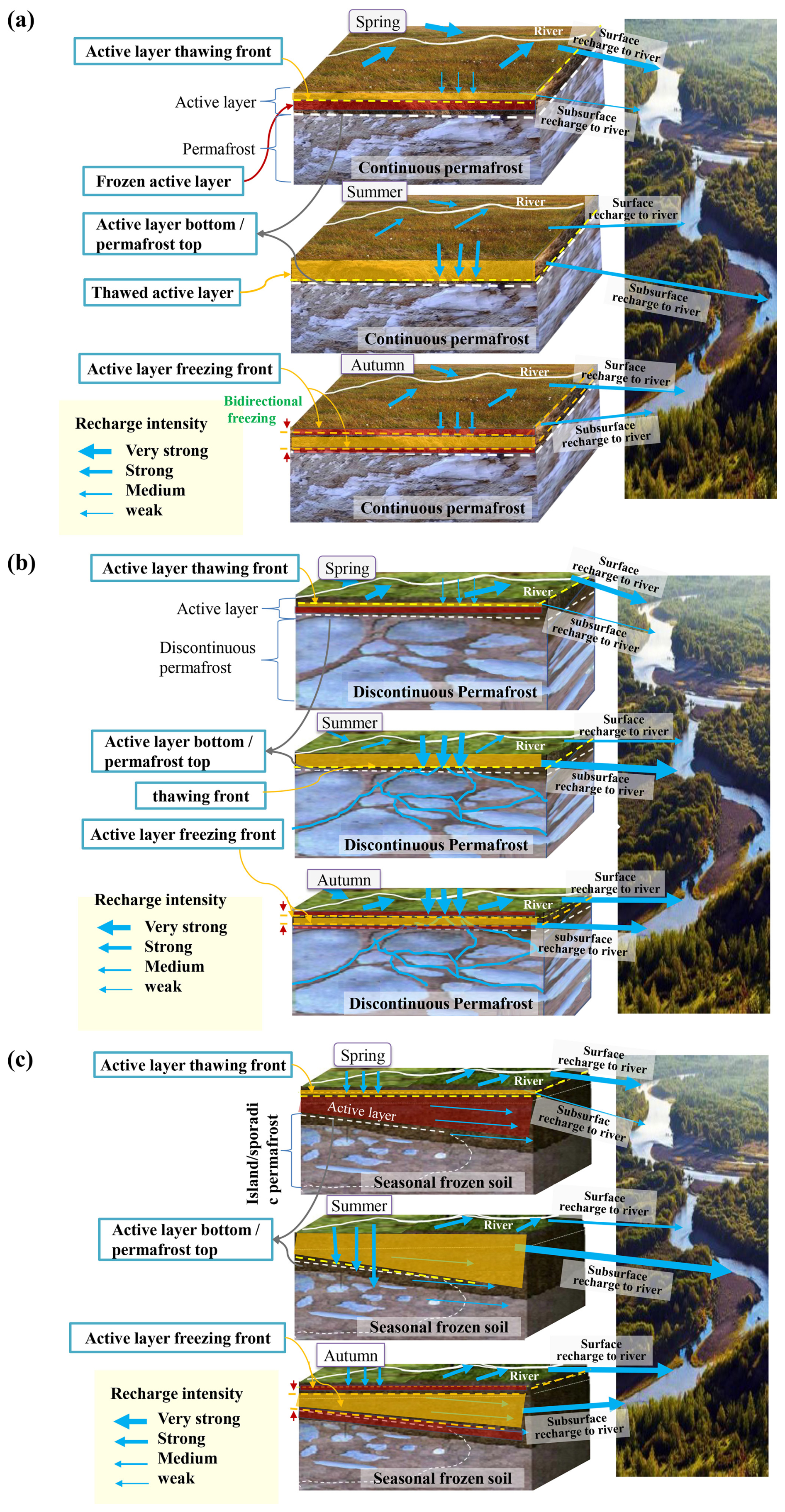
Figure 1Impact of freeze–thaw cycles on surface hydrological processes. (a) Dominance of active layer depth and soil water storage capacity, (b) Transition from dominance of active layer depth and soil water storage capacity to ecological dominance, and (c) Ecological dominance. Symbols: Yellow dashed lines denote thaw fronts; Orange dashed lines denote freezing fronts. Dark red areas denote the frozen active layer; Dark orange areas denote the thawed active layer. Blue arrows denote water movement.
Surface runoff generation in permafrost regions is controlled by freeze–thaw cycles through their seasonal modulation of infiltration capacity. Saturation-excess overland flow dominates in spring and autumn, when the active layer is partially frozen, whereas infiltration-excess overland flow occurs during summer storms on soils with limited infiltration capacity. The presence of a frozen layer near the surface restricts infiltration and promotes overland flow; as the active layer thaws, infiltration capacity increases, surface runoff diminishes, and subsurface flow is enhanced. The relative dominance of these runoff mechanisms depends on permafrost type (continuous versus discontinuous), soil properties, vegetation cover, and precipitation intensity. The timing and magnitude of surface runoff responses to permafrost degradation remain poorly constrained, particularly in mountainous regions where observational data are sparse.
In permafrost regions, the freeze–thaw cycles of the active layer not only influence the generation and concentration of surface runoff but also modulate subsurface flow and interflow within the active layer, ultimately affecting the recharge and runoff processes of suprapermafrost water (Ding et al., 2020b, c; Qin et al., 2024). Suprapermafrost water is primarily recharged by surface snowmelt and rainfall infiltration (Chang et al., 2015; Yang et al., 2017; Cao et al., 2021b), as well as by soil water migration driven by temperature gradients (Ma et al., 2021a; Hilbich et al., 2022).
4.1 Hydrological role of the active layer
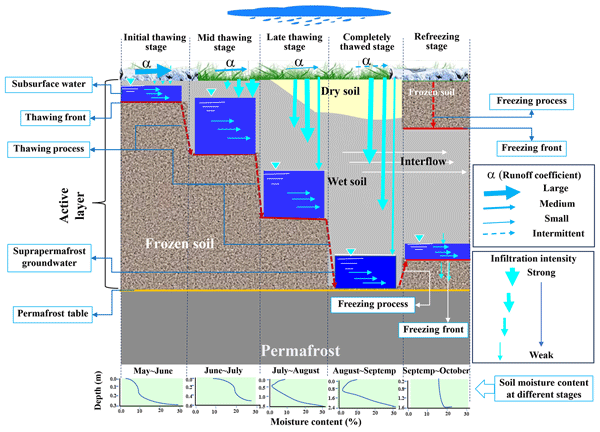
Studies have demonstrated that the annual processes within the active layer exert significant hydrological impacts (Cooper et al., 2011; Lacelle and Vasil'chuk, 2013; Wang et al., 2017; Gao et al., 2018b; Ding et al., 2020b; Cao et al., 2021a; Qin et al., 2024). Water within the active layer comprises surface snowmelt, rainfall infiltration, soil water, and suprapermafrost water (Chang et al., 2015; Yang et al., 2017; Cao et al., 2018; Xiao et al., 2025b; Grewal et al., 2025). Rainfall infiltration serves as the primary driver of soil hydrological processes, with the freeze–thaw front acting as the main limiting factor (Xu et al., 2024). Figure 2 shows the hydrological dynamics within the active layer in different freezing-thawing periods. During spring, as the surface temperature rises above zero, the active layer begins to thaw, which coincides with snowmelt. In the initial thaw phase, the shallow thaw front and low soil temperatures caused infiltrating snowmelt to refreeze, significantly reducing infiltration rates. During this stage, the still-frozen portion of the active layer functioned as an impermeable barrier, leading to high surface runoff coefficients and substantial snowmelt runoff. In the mid-thaw phase, as soil temperatures increase and the thaw front deepens, water from surface snowmelt and soil thaw accumulates above the thaw front, forming shallow groundwater within the active layer. As the active layer deepens, the soil infiltration capacity increases, allowing snowmelt or rainfall to rapidly infiltrate. This process elevates soil moisture levels and triggers a rapid increase in shallow groundwater levels. Groundwater storage and flow capacity generally increase with active layer depth, although the relationship may be nonlinear and is modulated by factors such as soil texture, organic matter content, and ground ice distribution (Wang et al., 2017; Sjoberg et al., 2021). Consequently, subsurface runoff gradually increases, and surface runoff coefficients decrease as the active layer deepens. In the late thaw phase, as the active layer continues to deepen, the soil pore space expands, and precipitation infiltration becomes the primary source of groundwater recharge, replacing meltwater. This shift has led to the formation of precipitation-dominated subsurface runoff. During this stage, groundwater levels gradually decrease, and the upper soil layers begin to dry. By September, the active layer is fully thawed, and suprapermafrost water accumulates above the permafrost table. The height of the suprapermafrost water table is strongly influenced by the amount of precipitation recharge during the earlier stages. From the mid-thaw to the completely thawed stage, the available storage capacity within the suprapermafrost zone increases with active layer deepening. Where recharge does not keep pace with enhanced lateral drainage, a portion of the stored water is progressively released as baseflow, leading to a deepening of the water table (i.e., an increase in water table depth below the ground surface) over the thaw season. Yet, the water-table response to active-layer deepening is not universal and may be offset by local meltwater supply.
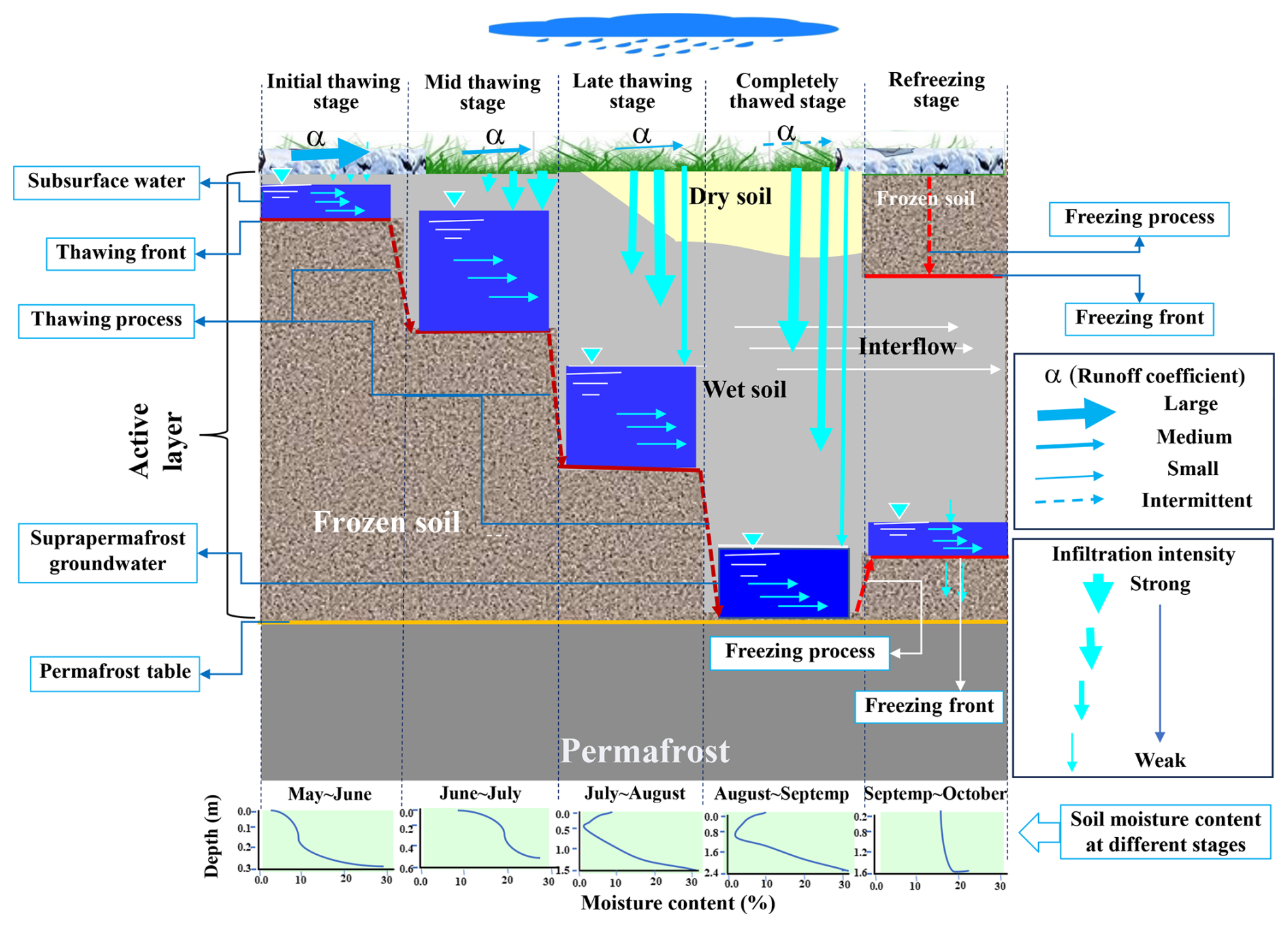
Figure 2Hydrological processes within the active layer across different freeze–thaw periods (adapted from Ding et al., 2020b; Qin et al., 2024).
The impact of the active layer on surface runoff is most pronounced during the spring thaw and autumn freeze periods (Qin et al., 2024). During the spring thaw, surface snowmelt or precipitation often generates runoff through saturation-excess overland flow, which dominates surface runoff in the early thaw phase. In the mid-thaw phase, as the soil infiltration capacity increases, the surface runoff transitioned from saturation-excess to infiltration-excess overland flow. During the late and fully thawed phases, soil drying allows rapid precipitation infiltration, making surface runoff intermittent and limited to heavy rainfall events. In autumn, as the surface begins to freeze, soil infiltration decreases, and surface runoff reverts to saturation-excess overland flow (Wang et al., 2017; Zhang et al., 2017a; Gao et al., 2022). Driven by the temperature gradient, unfrozen water in the active layer migrates from bottom to top during the freezing stage. These dynamics demonstrate that runoff generation in permafrost regions involves multiple mechanisms controlled by temperature, and exhibits distinct seasonal variations. Observations and simulations of small watersheds on the Tibetan Plateau have revealed distinct seasonal hydrological dynamics (Cao et al., 2021b). During the spring flood period, the soil temperature and moisture at depths above 65 cm play a dominant role. In contrast, during the summer dry period, the soil moisture above 40 cm is negatively correlated with runoff, whereas deep soil temperature and moisture are the primary controlling factors. Air temperature and precipitation are the main drivers of hydrological processes during the summer flood period (Li et al., 2009; Chang et al., 2024; Xu et al., 2024). During the spring thaw, saturation-excess overland flow accounts for 66 %–85 % of the total spring runoff, and interflow within the active layer contributes 14 %–34 % (Wang et al., 2017). In the autumn runoff recession period, suprapermafrost groundwater runoff decreases rapidly as the active layer freezes, leading to an increase in the proportion of subsurface to total runoff and higher surface runoff coefficients (Bai et al., 2012; Wang et al., 2017). In the northern wetlands of Canada, the storage capacity in continuous permafrost regions increases during summer as evaporation reduces the peat moisture content (Roulet and Woo, 1986). The subsurface flow remains minimal owing to low hydraulic gradients and conductivity (Quinton et al., 2009). Consequently, when the water table lies within the peat layer, the contribution of wetlands to streamflow is negligible. However, during intense storms, when the water table rises above the ground surface, streamflow increases rapidly owing to the surface flow across the wetlands (Carpino et al., 2025; Lhosmot et al., 2025).
The active layer acts as a dynamic hydrological regulator. Its seasonal thaw progression controls the partitioning between surface and subsurface flow, with threshold behavior related to ground ice content. The active layer is the critical interface that mediates water exchange between the surface and the permafrost.
4.2 Key factors influencing hydrological processes in the active layer
The primary factors influencing the hydrological processes in the active layer include permafrost type, underlying surface characteristics, topography, and soil composition. Understanding the hydrological processes in permafrost regions requires an integrated analysis of both water and heat balance relationships (Wang et al., 2017; Zhang et al., 2017b; Gao et al., 2021, 2022). Permafrost type exerts a first-order control. In continuous permafrost, the active layer is typically shallow and the permafrost table acts as a near-impermeable boundary, promoting lateral subsurface flow (Yoshikawa et al., 2006). In discontinuous and sporadic permafrost, the permafrost table is deeper and discontinuous, allowing more vertical connectivity and deeper groundwater circulation (Evans et al., 2015; Song et al., 2022). Topography modifies these effects: slope angle and aspect influence solar radiation, thaw depth, and drainage pathways. Hillslope position affects water accumulation and flow path development, with convergent areas often exhibiting deeper active layers and enhanced subsurface flow (Sjöberg et al., 2021; Chiasson-Poirier et al., 2020). Underlying surface characteristics – including geology, organic layer thickness, and land cover – determine surface infiltration capacity and heat transfer. For example, peat plateaus with thick organic layers insulate permafrost, while exposed mineral soils promote deeper thaw (Quinton and Baltzer, 2013). Soil composition, particularly texture and organic matter content, directly influences hydraulic conductivity and water-holding capacity. Soil physical properties play critical roles in regulating soil water and heat dynamics in these regions (Zhang et al., 2017b; Yang et al., 2019a).
Observations indicate that as vegetation cover decreases, soil moisture decreases at depths of 0.2–0.6 m in the active layer but increases at depths of 0.6–0.8 m. In seasonally frozen ground, soil moisture increases with depth throughout the profile (0.2–1.0 m). Thus, changes in vegetation cover significantly alter the soil water and heat processes, although the effects differ between permafrost and seasonal frost (Hu et al., 2009). Observations and simulations have demonstrated that the initial, stable, and cumulative soil infiltration rates are strongly influenced by the underlying surface types. The highest initial and stable infiltration rates were observed in the alpine desert steppes, whereas the lowest rates were observed in the alpine meadows. Within the same underlying surface, the infiltration parameters increase with vegetation cover, whereas soil moisture and infiltration rates exhibit opposite trends (Wang et al., 2014; Hu et al., 2018). Soil organic matter plays a dual role by providing both insulating and water-retaining effects. Its content in the active layer not only mitigates deepening, but also significantly influences water movement (Roulet and Woo, 1986; Karra et al., 2014; Hu et al., 2015; Kalyuzhnyi and Lavrov, 2017; Tananaev et al., 2022). Simulations of soil moisture in permafrost regions revealed that despite increases in net atmospheric surface water flux (P-ET), most models predict long-term drying of surface soils (0–20 cm) owing to active layer deepening or permafrost thaw (Liu et al., 2020). This suggests that future increases in precipitation may not fully offset the effects of active-layer deepening on surface soil moisture reduction (Andresen et al., 2020). In summary, water movement within the active layer is a complex process shaped by the interactions between water and heat dynamics, active-layer thickness, permafrost type, soil composition, and vegetation cover.
4.3 Interactions between suprapermafrost water and soil water
The interaction between suprapermafrost water and soil water is a critical component of hydrological processes in permafrost regions. Hydrological dynamics within the active layer are not only driven by freeze–thaw phase changes but are also closely linked to unconfined groundwater dynamics. During freeze–thaw cycles, surface and subsurface runoff undergo redistribution and transformation, resulting in frequent short-term fluctuations in surface and subsurface storage (Tananaev et al., 2020; Cao et al., 2021a, b). Simulations in the source region of the Lancang River demonstrated that cold-season warming increases liquid soil moisture in seasonally frozen ground, whereas warm-season warming primarily drives active layer thickening, increasing the liquid water content in permafrost. Cold-season warming has a greater impact because of its significant role in accelerating permafrost degradation (Xu and Gao, 2022). For liquid soil moisture, increases during cold months are attributed to rising soil temperatures and enhanced soil ice melting, whereas changes during warm months result from competition between positive precipitation and negative soil temperature effects (Cuo et al., 2015). These findings highlight the interdependence of suprapermafrost water and soil water-heat dynamics (Cao et al., 2018; Du et al., 2019; Yi et al., 2021). The interflow within the active layer migrates downward and accumulates above the permafrost table. This accumulated suprapermafrost water not only generates subsurface runoff through gravitational drainage but also interacts with permafrost through water exchange. Infiltration of groundwater from the surface carries heat, leading to the partial thawing of permafrost, whereas a portion of the groundwater freezes and is incorporated into permafrost (Wang et al., 2017, 2018d; Yang et al., 2017; Gao et al., 2018a; Zhao et al., 2019; Halla et al., 2021; Ma et al., 2021b; Hilbich et al., 2022). Under long-term stable conditions, the amounts of thawed permafrost and frozen groundwater remain balanced. Studies on the Tibetan Plateau have revealed that active-layer water accounts for 59 %–87 % of the ground ice near the permafrost table, whereas permafrost water contributes 13 %–41 %, which indicates that the active layer plays a significant role in ground ice formation, with alpine meadows contributing less (59 %–69 %) than alpine steppes (70 %–87 %) (Wang et al., 2018c). Simulations of daily runoff in the Yenisei River, the largest Arctic river in central Siberia, demonstrated that subsurface runoff within the active layer significantly contributes to river recharge (Fabre et al., 2017), underscoring the critical role of subsurface runoff in sustaining river flow. Permafrost hydrology is significantly influenced by suprapermafrost water, as a portion of ground ice is melted and integrated into the active layer hydrological processes. The seasonal dynamics and movement of suprapermafrost water are primarily regulated by soil temperature, whereas its phase changes depend on deep soil moisture and the sources of suprapermafrost water recharge. The relationship between active layer soil temperature and suprapermafrost water table dynamics can be effectively characterised by the Boltzmann function (Chang et al., 2015).
The active layer functions as a dynamic regulator of hydrological partitioning, controlling the division between surface and subsurface flow through seasonal freeze–thaw dynamics. Its influence is mediated by permafrost type, soil composition, vegetation cover, and topography. Thickening of the active layer increases storage capacity and hydraulic conductivity, promoting subsurface flow and baseflow generation, while thermal-hydrological coupling at the active layer–permafrost interface governs water exchange. The regulatory strength of the active layer is most pronounced in continuous permafrost and varies with soil texture and ground ice content. Quantitative relationships between active layer properties and hydrological responses remain poorly constrained, particularly the thresholds at which changes in the active layer trigger significant shifts in runoff generation.
As climate warming intensifies, permafrost degradation accelerates. This degradation inevitably releases ground ice as liquid water, which subsequently participates in the transformation and cycling of surface and groundwater. Unlike glacial or snowmelt, the volume of water released from permafrost thaw is difficult to measure directly, and its impact on runoff and water resources within watersheds remains poorly understood.
5.1 Transformation relationships between surface water and groundwater in permafrost regions
In permafrost regions, the exchange between surface water and groundwater differs fundamentally from that in temperate zones because permafrost acts as a low-permeability barrier that limits vertical hydraulic connectivity. Rather than being a continuous process, this exchange is strongly compartmentalised in both space and time. During the thaw season, surface water can interact with suprapermafrost groundwater – the shallow aquifer above the permafrost table – whereas exchange with subpermafrost groundwater beneath the permafrost is largely prevented, except where taliks (local unfrozen zones) provide vertical pathways. This vertical separation defines the hydrologic behaviour of permafrost landscapes, and understanding how it may change under climate warming has become a priority research topic.
The active layer is widely recognised as the main domain for surface water–groundwater interaction. Following spring thaw and summer rainfall, infiltrating water recharges the suprapermafrost aquifer, which is later released as baseflow during dry periods and through the winter months (Chang et al., 2015; Wang et al., 2017; Qin et al., 2024). This seasonal cycle – from surface water to suprapermafrost storage and back to streamflow – operates on an annual timescale, with residence times in the suprapermafrost aquifer generally ranging from years to decades (Walvoord et al., 2012; Wang et al., 2023). The efficiency of this exchange depends mainly on active-layer depth, soil hydraulic properties, and the timing of freeze–thaw events. Warmer and longer thaw seasons tend to favour infiltration and increase suprapermafrost water storage, thereby enhancing the surface-water-to-groundwater component in summer and the groundwater-to-stream discharge component in winter (Chen et al., 2019; Ding et al., 2020a). This seasonal exchange pattern has been documented across a range of permafrost environments.
In contrast, the transformation between surface water and subpermafrost groundwater is much more restricted and occurs predominantly through taliks. These unfrozen zones, which commonly develop beneath lakes, river channels, and disturbed surfaces, create local pathways through the otherwise impermeable permafrost layer. Geophysical and isotopic studies indicate that open taliks can convey subpermafrost water upwards into surface water bodies, and conversely, allow surface water to infiltrate into deeper aquifers (Tananaev et al., 2022; Walvoord et al., 2012). However, this deeper exchange operates on much longer timescales – typically on the order of 103−104 years for subpermafrost flow systems (Walvoord et al., 2012) – and thus represents a slow but persistent component of the water cycle that is often neglected in routine hydrological assessments. In thermokarst areas, springs fed by ground-ice meltwater offer direct evidence of a transformation pathway from permafrost ice to surface water, linking ground ice, groundwater, and surface flow (Hiyama et al., 2021b; Gagarin et al., 2022). The presence and continuity of taliks therefore control whether surface water and subpermafrost groundwater are hydraulically connected, and the ongoing expansion of taliks under a warming climate is likely to enhance this deeper exchange.
Climate warming and associated permafrost thaw are progressively modifying these exchange relationships. Thickening of the active layer increases the storage capacity of the suprapermafrost aquifer and extends the seasonal window for water exchange, which in turn raises baseflow and winter runoff (Walvoord and Striegl, 2007; Walvoord et al., 2012; Wang et al., 2019; Song et al., 2022). Concurrently, talik formation and expansion gradually breach the hydraulic separation between suprapermafrost and subpermafrost aquifers, allowing previously isolated deep groundwater to contribute to surface flow (Kurylyk and Walvoord, 2021). This shift from a compartmentalised to a more integrated hydrological system is among the most significant consequences of permafrost degradation for water routing. In the Yukon River Basin, for example, long-term records show a steady increase in the groundwater fraction of streamflow, consistent with growing connectivity to deeper aquifers (Walvoord and Striegl, 2007). Similarly, in the source region of the Yellow River, permafrost degradation has been associated with a falling suprapermafrost water table and wetland shrinkage, suggesting that changes in surface-groundwater partitioning are affecting both water availability and ecosystem function (Jin et al., 2022b).
Regional differences in these exchange processes are pronounced. In continuous permafrost, the permafrost table forms a near-impermeable boundary, and exchange is essentially restricted to the active layer. In discontinuous and sporadic permafrost zones, where permafrost coverage is patchy, the exchange pathways are more heterogeneous: some locations exhibit strong vertical connectivity through taliks, while others remain hydraulically isolated. This spatial diversity complicates regional assessments, but it also implies that the hydrological response to warming will be uneven. In lowland Arctic settings, permafrost degradation generally enhances groundwater discharge and raises baseflow (Evans et al., 2020; Koch et al., 2024). In mountainous terrain, however, the response is less clear because steep slopes, coarse deposits, and rock glaciers introduce additional storage and release mechanisms that are still poorly understood (Arenson et al., 2022). In the Andes, recent geophysical surveys have revealed that ice-rich permafrost is more extensive than previously thought, and its thaw may contribute substantially to streamflow in ways that have not yet been quantified (Hilbich et al., 2022; Halla et al., 2021). On the Tibetan Plateau, the spatial pattern of permafrost thaw correlates with variations in water-yield capacity and drainage connectivity, indicating that the conversion of ground ice to runoff is controlled locally by permafrost type and topography (Wan et al., 2019; Niu et al., 2023).
To summarise, existing studies have identified a coherent set of mechanisms governing surface water–groundwater exchange in permafrost regions: seasonal active-layer dynamics, talik-mediated vertical connectivity, and gradual ground-ice melt. Exchange pathways are vertically separated by the permafrost table, and the degree of cross-talik connection depends on the distribution and continuity of unfrozen zones. Climate warming is progressively enhancing hydraulic connectivity between surface water and deeper groundwater systems, with clear implications for baseflow, winter runoff, and water chemistry. Nevertheless, major uncertainties remain, especially in mountainous areas, where the rates and pathways of ground-ice melt contribution to streamflow are not well constrained. Future work should focus on quantifying exchange fluxes across a range of permafrost types and landscape units, and on developing predictive approaches that can handle the nonlinear, threshold-driven responses likely to accompany continued warming.
5.2 Thermokarst as a manifestation of permafrost degradation and its hydrological impacts
With ongoing climate warming, thermokarst processes in permafrost regions have intensified and are primarily characterised by changes in thermokarst lakes and ponds. In the Arctic, the northward expansion of beavers into tundra regions has resulted in the formation of numerous beaver ponds that exhibit hydrological and ecological effects similar to those of thermokarst lakes and ponds (Tape et al., 2022). Current research indicates that changes in thermokarst lakes are highly heterogeneous, with certain regions experiencing an increase in their number and extent (Farquharson et al., 2019; Zhou et al., 2024a), whereas others have shown a decline (Liu et al., 2023). On the Tibetan Plateau, thermokarst lakes are predominantly developed in warm permafrost regions (Liu et al., 2023; Zhou et al., 2024a), whereas thermokarst features are extensively distributed in the extremely cold permafrost areas of the High Arctic (Farquharson et al., 2019; Jorgenson et al., 2022). Despite these regional variations, the hydrological impacts of thermokarsts are profound. Thermokarst processes modify surface water dynamics, enhance water exchange between the surface and the atmosphere, influence soil water infiltration, and facilitate the transformation between surface water and groundwater (Fig. 3).
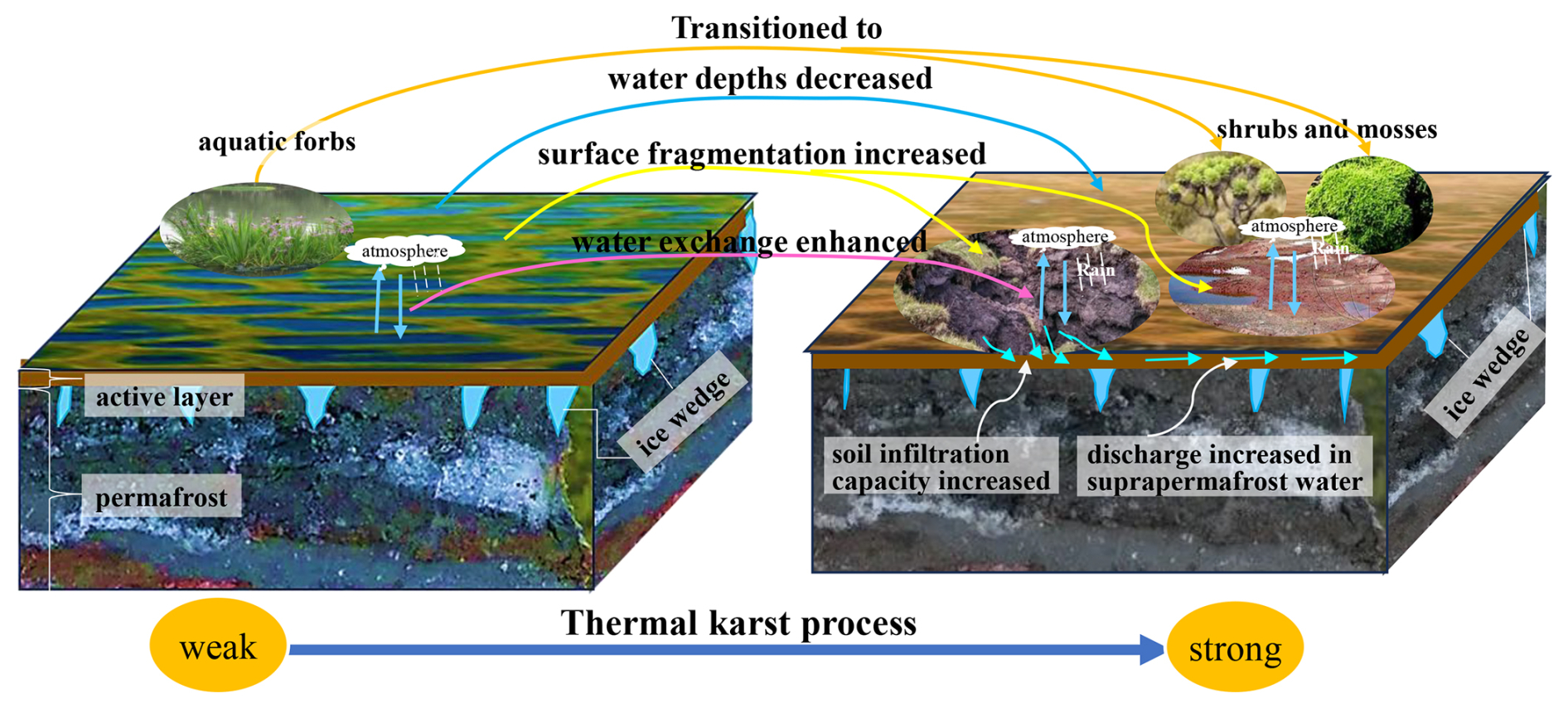
5.2.1 Rapid changes in surface cover and hydrological processes
Thermokarst processes can induce dramatic and rapid alterations in surface cover with profound hydrological and ecological consequences. For example, thermokarst activity has significantly transformed the Tanana Flats of central Alaska, increasing the area of large fens by 26 % between 1949 and 2018 (Jorgenson et al., 2020). Similarly, in the Canadian High Arctic, above-average summer warmth triggered rapid landscape responses, including substantial subsidence, owing to limited thermal buffering from overlying ecosystem components and near-surface ground ice (Farquharson et al., 2019). In the peaty-silty lowlands of Canada, a thaw settlement of 2–4 m has disrupted drainage patterns, resulting in widespread soil flooding and the accumulation of new bog peat (Jorgenson et al., 2013). Conversely, in the headwater area of the Yellow River, the number of water bodies larger than 0.36 ha decreased by 40 %, accompanied by a 25 % reduction in total surface area from 1986–2015 (Șerban et al., 2021). These examples highlight the rapid and far-reaching impacts of thermokarst activity on hydrological, ecological, and biogeochemical processes.
5.2.2 Enhanced connectivity between permafrost and surface water
Long-term water balance analyses indicate that, in Arctic thermokarst regions, groundwater recharge primarily occurs through taliks, with surface processes dominated by evapotranspiration during the thaw period and snow control during the freeze period (Lindborg et al., 2013). Observations and surveys have documented a rapid increase in the number of thermokarst lakes on the Tibetan Plateau from 1969–2010, which was largely driven by the expansion of both small ponds and large lakes (Luo et al., 2015). Research has demonstrated that under climate warming, the expansion of thermokarst lakes is closely linked to increased suprapermafrost water runoff (Lindborg et al., 2013; Yang et al., 2016, 2017; Pan et al., 2017; Gao et al., 2018a, b). Stable isotope analyses and modelling studies have revealed significant hydrological connections between precipitation, river water, thermokarst lakes, and permafrost ice melt (Yang et al., 2017). Data from 2011–2012 highlighted that ground-ice melt contributed approximately 61 % of the water in thermokarst lakes (Yang et al., 2016), emphasising the critical role of permafrost degradation in lake development on the Tibetan Plateau. Despite these advancements, the hydrological relationships between subpermafrost, suprapermafrost, and surface water remain poorly understood, particularly as permafrost degradation intensifies. Thus, the hydrological interactions between thawed zones and permafrost require further investigation (Fig. 2).
5.2.3 Enhanced hydrological connectivity by thermokarst
Thermokarst activity significantly enhanced hydrological connectivity. During the ice-free season, precipitation and active-layer hydrology are the primary drivers of hydrological change. However, under ice cover, the hydrology of thermokarst lakes is predominantly controlled by the thawing of surrounding permafrost and the melting of its ground ice (Yang et al., 2019b; Șerban et al., 2021). Thermokarst lakes induce notable changes in the soil infiltration processes. Specifically, the initial infiltration rate decreased as the impact of the thermokarst intensified, whereas the stable and cumulative infiltration rates gradually increased in the surface layer at depths of 10 and 20 cm. These parameters initially decreased and then increased, showing a significant correlation with soil texture. Furthermore, the cumulative infiltration changes align with a steady infiltration rate (Wang et al., 2014). In the Taiga Plain, permafrost is predominantly associated with peatlands. The thawing of this permafrost expands the extent of thermokarst wetlands, often at the expense of the treed peatlands underlying the permafrost. This thaw-induced land cover change enhances landscape-scale hydrological connectivity, increases basin-scale runoff and annual streamflow, and promotes wetter conditions (Connon et al., 2014; Wright et al., 2022). Additionally, the rapid drainage of thaw lakes has been identified as a potential issue in many circumpolar Arctic regions (Pohl et al., 2009). Areas with taliks experience more rapid thawing of the underlying permafrost than areas without taliks (Connon et al., 2018). These processes result in the formation of new thermokarst lakes and the drainage of existing lakes, along with significant changes in seasonal hydrology. For example, in northwestern Siberia, the continuous-to-sporadic permafrost underlying the tundra and taiga landscapes of the Nadym and Pur river basins has significantly warmed in recent decades. Both basins exhibit reduced discharge variability, reflecting substantial changes in their hydrological storage-discharge dynamics due to permafrost thaw, which also alters their thermokarst lakes (Karlsson et al., 2011). Moreover, recent reductions in pond and lake areas in discontinuous permafrost regions have been linked to increased subsurface drainage and connectivity (Smith et al., 2010, 2012; Derksen et al., 2018).
5.3 Climate change impacts on permafrost hydrology: Runoff responses
Significant changes have been observed in the ratio of maximum to minimum monthly runoff (). Early studies investigating the relationship between permafrost degradation and runoff changes suggest that the intensity of permafrost thaw alone cannot fully explain the observed increases in runoff across large Eurasian rivers. Instead, increased precipitation has been identified as a plausible explanation (McClelland et al., 2004). Further research has confirmed that precipitation increases are the primary driver of runoff changes, whereas permafrost thaw depth primarily affects runoff coefficients and recession processes by altering the soil water storage capacity (Yamazaki et al., 2006; Wang and Zhang, 2016). Using the maximum-to-minimum monthly runoff ratio (), subsequent studies have analysed changes in Siberian rivers and found a negative correlation between the mean annual temperature and this ratio, but a positive correlation with the recession coefficient. These findings indicate that changes in the active layer and permafrost conditions have already begun to influence the regional hydrological processes (Ye et al., 2009, 2011; Li et al., 2010). Analysis of annual hydrological processes in basins with varying permafrost coverage revealed that permafrost significantly affected intra-annual runoff distribution. Specifically, higher permafrost coverage resulted in steeper runoff hydrographs. This highlights the critical role of permafrost coverage in understanding hydrological impacts (Ye et al., 2012).
5.3.1 Temporal trends: increasing winter runoff and baseflow
Winter runoff, to which baseflow often contributes substantially, has generally increased in many permafrost regions, although trends vary. As the active layer thaws, increased infiltration of snowmelt and rainfall during the warm season recharges suprapermafrost water (Song et al., 2022). A portion of this groundwater contributes to surface rivers through subsurface flow and becomes part of the surface water. Studies in China have documented increased winter baseflow in permafrost regions across the northeast (Liu et al., 2003; Duan et al., 2017), northwest (Niu et al., 2011; Qin et al., 2017; Chen et al., 2018; Gao et al., 2018b; Wang et al., 2018b), central Tibetan Plateau (Cuo et al., 2015; Gagarin et al., 2022), and surrounding mountainous regions such as the Himalayas and the source of the Yellow River (Ma et al., 2020; Song et al., 2020a, 2022; Yang et al., 2023; Fan et al., 2024). Similar trends have been observed in Arctic and subarctic regions, including northwestern Canada (Jacques and Sauchyn, 2009), northern Eurasian rivers (Smith et al., 2007; Wang et al., 2021a, b), and the Yukon River Basin (Walvoord and Striegl, 2007), where baseflow increases linked to permafrost degradation are widespread (McClelland et al., 2004; Smith et al., 2007; Bense et al., 2009; Jacques and Sauchyn, 2009; Walvoord et al., 2012; Evans et al., 2015; Rogger et al., 2017; Crites et al., 2020). On the northern slopes of the Qilian Mountains, winter runoff (November–March) has increased significantly, with the most pronounced changes occurring in areas with notable permafrost degradation (Gao et al., 2018b). Similar findings from Canada suggest that permafrost influences surface-groundwater interactions, even in low-permeability sediments in the discontinuous permafrost zone near Umiujaq in Nunavik (Québec). Permafrost degradation is expected to increase stream baseflow, particularly in winter (Lemieux et al., 2020). Isotopic studies in the Arctic have also shown that the declining suprapermafrost water tables increase soil storage capacity, enhancing groundwater contributions to rivers during the winter months as seasonal freeze depths decrease (Streletskiy et al., 2015; Crites et al., 2020; Kurylyk and Walvoord, 2021). Research indicates that winter baseflow and its contribution to annual discharge were lower in continuous permafrost catchments than in discontinuous catchments, with general increase from 1970–2016. Analyses and simulations of runoff changes in Russia revealed that reductions in freeze depth and changes in freeze–thaw processes led to significant increases in winter runoff, with increases ranging from 50 %–120 %. Of this increase, 56 % was attributed to changes in the freezing front, 38 % to thawing processes, and 6 % to increased autumn soil moisture (Kalyuzhnyi and Lavrov, 2012). In the source region of the Yellow River, changes in the active-layer thickness and thaw depth were strongly correlated with runoff, with each 1 m increase in the active layer and thaw depth increasing winter runoff by approximately 150 and 400 m3 s−1, respectively (Feng, 2020). Observations and simulations suggest that the baseflow increases are driven by factors such as increased suprapermafrost water, active-layer thickening (lowering of the permafrost table), increased deep groundwater flow from unfrozen zones beneath rivers, and enhanced vertical connectivity between recharge areas and valleys (Bense et al., 2009; Ge et al., 2011; Walvoord et al., 2012). Model results further indicate that open lake taliks enhance groundwater flux through suprapermafrost and subpermafrost aquifers, as well as through deep talik systems, by providing vertical flow conduits (Walvoord et al., 2012). Overall, permafrost thinning, active-layer thickening, and rising ground temperatures promote surface water infiltration, increase soil water storage capacity, enhance suprapermafrost water recharge, and boost groundwater flow. Simultaneously, the heat carried by liquid water influences the permafrost, collectively contributing to the increased winter runoff (Chen et al., 2019; Ding et al., 2020a).
Increased winter runoff results in smoother annual hydrographs and extended runoff periods (Cuo et al., 2015; Qin et al., 2017; Gao et al., 2018a; Wang et al., 2018b; Chen et al., 2019). Studies of four major rivers flowing into the Arctic found that winter and spring runoff increased, whereas summer runoff decreased, a trend closely linked to earlier snowmelt and permafrost thaw (Bring et al., 2016). However, some studies have reported that winter baseflow increases may be offset by other factors. For example, in some regions of the Tibetan Plateau, permafrost degradation has been associated with a decline in suprapermafrost water tables and reductions in wetland and lake areas (Jin et al., 2022b). Even in the subarctic Canadian Shield, increased late autumn rains, rather than permafrost degradation, may drive winter flow enhancement (Spence et al., 2015). Further comparisons of different permafrost types revealed that in catchments underlain by continuous permafrost, active-layer thickening correlates with baseflow increases, whereas in catchments with less extensive permafrost (e.g. discontinuous, sporadic, and isolated), baseflow increases may result from wholesale permafrost loss and vertical talik expansion, enhancing regional groundwater circulation (Evans et al., 2020). These findings underscore the complexity of permafrost impacts on runoff, which depends on surface conditions, active-layer composition and lithology, permafrost thermal state, climate response, and topography, among other factors. Thus, many questions remain unanswered (Adam and Lettenmaier, 2008; Andresen et al., 2020; Arenson et al., 2022; Koch et al., 2022).
5.3.2 Spatial patterns and controls: Increasing discharge and recharge to surface runoff
In recent decades, groundwater discharge into rivers has increased across the circumpolar region and Tibetan Plateau, a trend widely attributed to permafrost thaw (Smith et al., 2007; Walvoord and Striegl, 2007; Jacques and Sauchyn, 2009; O'Donnell et al., 2012; Walvoord et al., 2012; Lindborg et al., 2013; Evans et al., 2015; Wang et al., 2018d, 2024b; Wan et al., 2019; Jiang, 2020; Song et al., 2020a; Sun et al., 2020; Ma et al., 2020, 2021b; Nan et al., 2025). Permafrost degradation alters landforms and subsurface hydraulic properties, with active-layer deepening enabling water to infiltrate and circulate more freely and deeply (Vonk et al., 2019). These activated groundwater systems can provide new conduits for flushing Arctic basins and transporting nutrients to basin outlets (Kurylyk and Walvoord, 2021). Quantitative estimates from various permafrost regions are summarized in Table 1.
Table 1Quantitative synthesis of reported permafrost thaw contributions to runoff and baseflow.
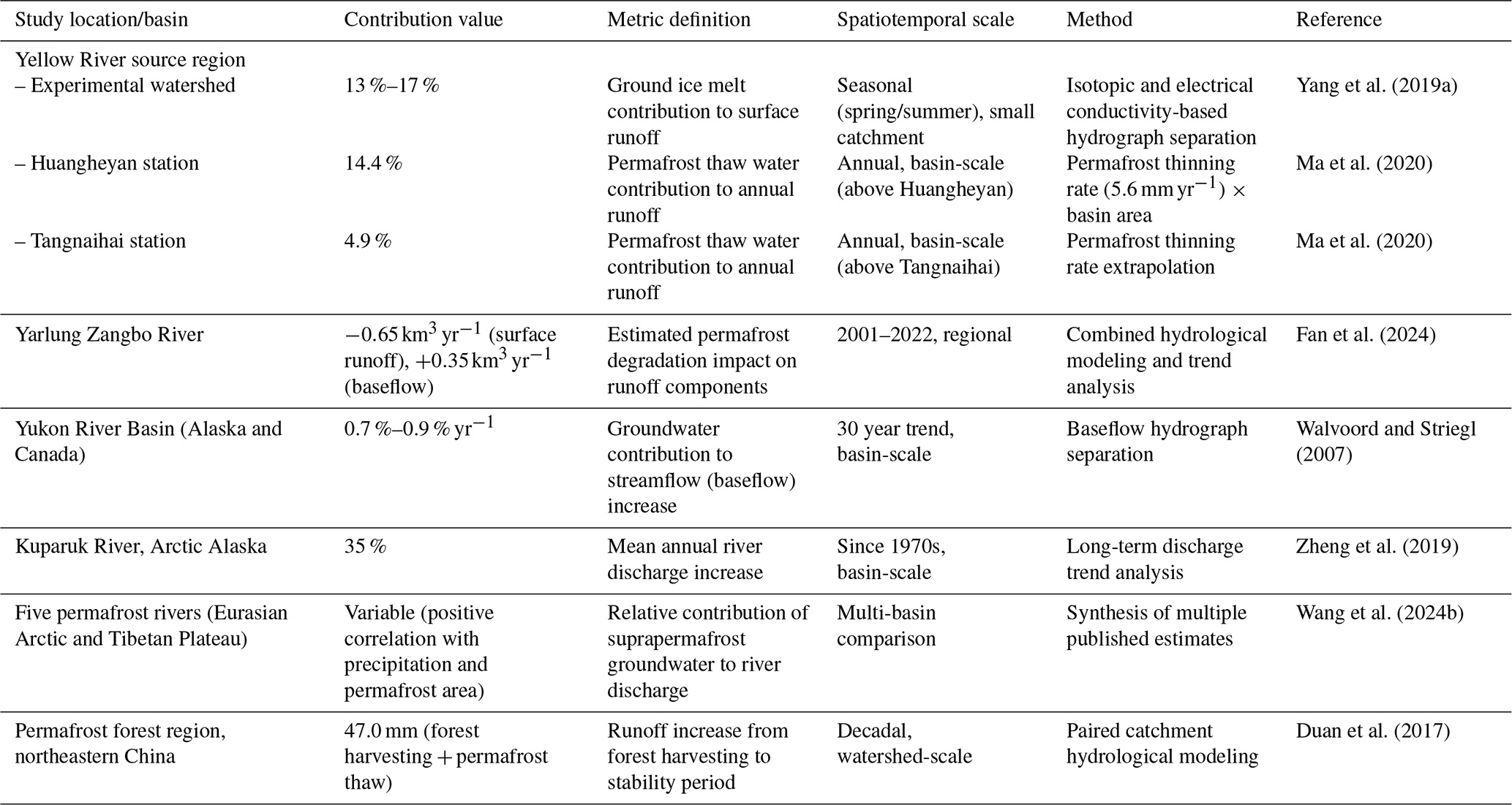
Research in the source region of the Yellow River indicates that permafrost degradation and active-layer deepening have led to a decline in the suprapermafrost water table, resulting in a reduction in the area of wetlands and lakes. This has introduced the concept of the maximum suprapermafrost groundwater table depth necessary to maintain the ecological security in permafrost regions, defined as the minimum water table that ssupports the normal growth of alpine grassland vegetation (Jin et al., 2022b). In the Arctic, surface waters in continuous permafrost regions are influenced by short flow paths and shallow suprapermafrost aquifers, which are highly sensitive to climatic changes. Continued warming and permafrost thaw may promote the deepening of shallow subsurface aquifers and formation of shallow taliks, potentially enhancing the resilience of Arctic freshwater ecosystems (Koch et al., 2024).
Because of observational challenges, research on the impact of permafrost thaw on the recharge of subsurface runoff from the active layer remains limited. However, recent studies employing isotopic and modelling approaches have provided preliminary insights. For example, in the upper reaches of the Heihe River in the Qilian Mountains, thaw-induced runoff was estimated to contribute approximately 20 % of the mountain outflow, a proportion exceeding that from glacial meltwater in that basin (Li et al., 2016). These results underscore the non-negligible hydrological impact of permafrost change in mountainous regions, particularly in basins with low glacial coverage. Modelling studies further indicate that permafrost degradation can increase surface runoff, baseflow, and subsurface runoff, with the magnitude of change scaling with permafrost coverage within a basin. Surface runoff, baseflow, and groundwater levels are more sensitive to permafrost degradation than vadose zone soil moisture, interflow, and deeper subsurface runoff (Sun et al., 2020; Ahmed et al., 2022). In permafrost forest regions, simulations demonstrate that the combined effects of forest harvesting and permafrost thaw on runoff changes dominate over the effects of climate change alone (Duan et al., 2017).
Beyond changes in runoff volume, permafrost degradation exerts long-term regulatory effects on runoff regimes. Variations in permafrost coverage within basins substantially alter intra-annual runoff processes. In alpine permafrost, permafrost loss has been observed to reduce flood peaks and increase runoff during recession periods (Rogger et al., 2017). Permafrost degradation and active-layer thickening can enhance deep infiltration and deep interflow and may expand subsurface water storage capacity, thereby increasing baseflow in some regions. In such settings, these changes are reflected in increased winter runoff and a slower autumn recession, resulting in reduced seasonal variability in stream discharge (Ye et al., 2009; Walvoord et al., 2012; Rogger et al., 2017; Chen et al., 2019; Ding et al., 2020b; Halla et al., 2021; Hiyama et al., 2021a, b; Gagarin et al., 2022; Hilbich et al., 2022; Tananaev and Lotsari, 2022). As permafrost thaws, the permafrost table lowers, and the active layer deepens, the seasonal freezing depth may decrease, creating additional space for soil moisture migration and transformation, which can play a critical role in winter runoff dynamics (Liu et al., 2003; Kalyuzhnyi and Lavrov, 2012, 2016, 2017). However, these responses are not universal; increased storage and infiltration may also reduce surface runoff or seasonal runoff, and the net hydrological effect depends on permafrost type, topography, geology, precipitation, and evapotranspiration (Gao et al., 2016). The gradual melting of ground ice stored within the permafrost also provides a sustained source of water to rivers, contributing to multi-year runoff regulation. Despite these insights, quantitative assessments of permafrost thaw contributions to runoff remain limited. Results obtained through modelling and isotopic methods (Painter et al., 2013; Karra et al., 2014; Ding et al., 2017, 2020a; Li et al., 2020; Song et al., 2020b; Sun et al., 2020), often lack robust validation, highlighting the need for improved observational constraints.
Despite the considerable uncertainties in the aforementioned studies, they provided compelling evidence of the impact of permafrost degradation on river runoff recharge. These studies collectively demonstrate that permafrost degradation influences the subsurface runoff to varying degrees. This influence is most prominently observed in the direct recharge of rivers through permafrost degradation, with the recharge volume being non-negligible and reaching significant levels in certain basins. Notably, recharge from permafrost degradation to surface and subsurface runoff is long-term, continuous, and relatively stable. Its significance extends beyond the volume of recharge, encompassing its critical role in regulating hydrological processes at seasonal, annual, multiyear, and long-term scales. However, research on this aspect remains limited and represents a key area for future investigation.
5.3.3 Mechanisms controlling baseflow responses and regional variability
The contrasting runoff trends observed across permafrost regions – such as the consistent increases in Arctic rivers versus the more variable responses on the Tibetan Plateau – reflect differences in the underlying controls. These differences arise from the interplay of several key mechanisms, which can be grouped according to their dominant hydrological pathways.
A primary control is exerted by active layer thickening and permafrost table lowering. In continuous permafrost, deepening of the active layer increases the storage volume for infiltrated water and promotes lateral subsurface flow, contributing to baseflow increases (Shojae Ghias et al., 2017; Evans et al., 2020; Koch et al., 2024). This mechanism is most effective in low-relief landscapes where shallow flow paths can connect efficiently to stream channels. In discontinuous and sporadic permafrost, talik formation and expansion introduce an additional domain of vertical connectivity. Taliks (unfrozen zones within or below permafrost) allow water to penetrate deeper, recharging both suprapermafrost and subpermafrost aquifers. Depending on whether a talik acts as a conduit to streams or as a storage reservoir, baseflow may either increase or decrease (Walvoord et al., 2012; Kurylyk and Walvoord, 2021). These vertical and lateral connectivity changes are often accompanied by shifts in subsurface hydraulic connectivity at the landscape scale. In some settings, thawing ice wedges and thermokarst development enhance hydrological connectivity, leading to increased runoff (Liljedahl et al., 2016); in others, the loss of permafrost may reduce surface connectivity while deepening groundwater flow paths, with variable net effects on streamflow (Wright et al., 2022).
The direct contribution of ground ice melt to runoff is generally small on an annual basis – typically less than 10 % of total discharge in most basins – but can be significant in specific seasons or for certain water quality constituents (Yang et al., 2019a; Ma et al., 2020). The importance of this mechanism scales with ground ice content and thaw rates, and it may become increasingly relevant in regions with ice-rich permafrost. Superimposed on these cryospheric controls are interactions with precipitation and evapotranspiration. Changes in these climatic variables often co-occur with permafrost degradation, complicate the attribution of runoff trends. In the Arctic, increased precipitation tends to amplify the baseflow signal (McClelland et al., 2004), whereas on the Tibetan Plateau, increased evapotranspiration may offset permafrost-induced baseflow gains in some basins (Song et al., 2022).
Finally, topographic and geological constraints modulate the expression of these mechanisms. Mountainous regions with steep slopes and thin deposits typically exhibit a muted baseflow response to permafrost degradation because subsurface storage is limited and flow paths are short (Arenson et al., 2022). In contrast, basins with thick unconsolidated sediments, such as the Yukon Flats in Alaska, show strong baseflow responses owing to the development of deep groundwater flow systems (Walvoord et al., 2012).
In many permafrost regions, permafrost degradation has been associated with increased baseflow and winter runoff, reduced seasonal variability in stream discharge, and enhanced surface water–groundwater interactions, although the magnitude and even direction of these changes are modulated by permafrost type, topography, geology, and climate. The primary mechanisms linking permafrost degradation to hydrological change include active layer thickening, talik formation, ground ice melt, and enhanced subsurface connectivity. Regional responses diverge: Arctic lowlands underlain by continuous permafrost exhibit consistent baseflow increases, whereas mountainous regions on the Tibetan Plateau show more variable responses, owing to complex topography, limited talik development, and competing evapotranspiration effects. Quantitative estimates of permafrost thaw contributions to runoff remain highly uncertain, constrained by observational limitations, methodological heterogeneity, and the difficulty of isolating permafrost effects from other drivers of hydrological change.
Under the persistent influence of climate warming, permafrost changes are intensifying, and their impacts on hydrological processes are becoming increasingly pronounced. The preceding sections have presented permafrost hydrology from the perspective of three coupled domains. Here we synthesize these domains into an integrated Surface-Active layer-Permafrost (SAP) framework.
Figure 4 presents a conceptual diagram of the SAP framework. The framework is organized around a causal chain that links climate forcing to hydrological responses. Starting from the left, climate warming and associated changes in precipitation drive permafrost degradation, manifested as permafrost warming, thinning, and the formation of taliks. These changes lead to thickening of the active layer and alteration of subsurface hydraulic properties, including increased storage capacity and enhanced hydraulic conductivity. Enhanced subsurface connectivity may, in turn, promote increased baseflow and modify the seasonal partitioning of runoff in some region. In other settings, however, greater storage and infiltration, together with enhanced evapotranspiration, may reduce surface runoff or seasonal runoff, and the net hydrological response may be positive, negative, or negligible depending on local conditions.
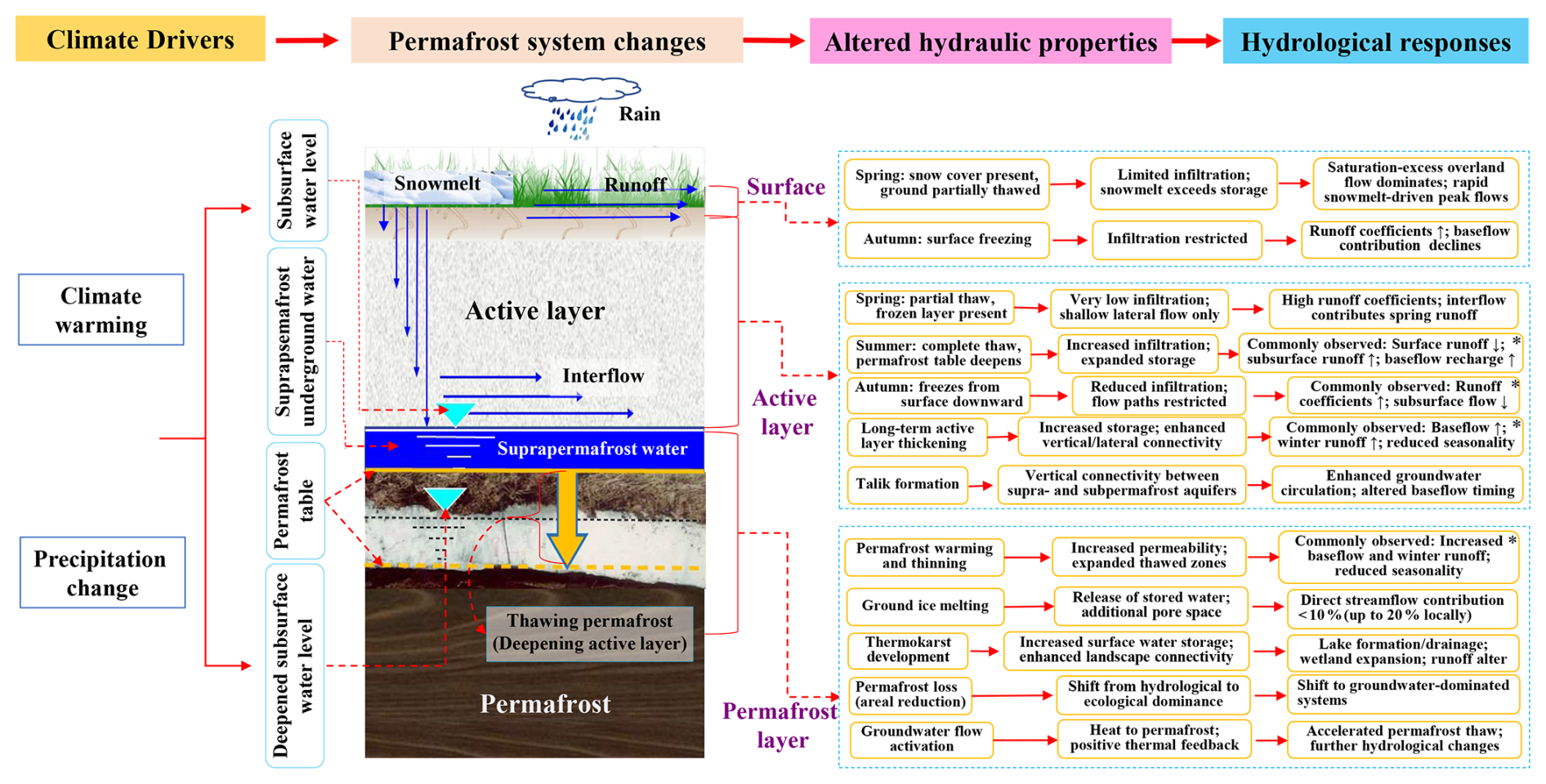
Figure 4Schematic diagram of the Surface-Active layer-Permafrost (SAP) integrated hydrological system. Within the hydraulic–property and hydrological–response components of the diagram, solid arrows and labels depict the commonly observed or dominant responses reported in many permafrost regions, rather than a uniform or inevitable response. These responses are not universal, and may be positive, negative, or negligible. The direction and magnitude of these hydrological responses depend on permafrost type, active-layer dynamics, talik development and continuity, ground-ice content, soil texture, topography, geology, precipitation, evapotranspiration, and vegetation. * Asterisked labels indicate region-dependent responses, and the corresponding hydrological variables may exhibit opposite changes or no significant change in other regions.
In the SAP framework, S, A, and P are not independent components. S represents surface and near-surface runoff generation. A is the seasonally thawed active layer, which regulates infiltration, storage, and lateral flow. P represents permafrost and associated subsurface conditions, including the permafrost table, ground ice, taliks, and deeper thermal–hydraulic changes. These conditions define or modify the lower boundary and hydrological connectivity of A. The active layer is therefore a key interface in the coupled S–A–P system. Freeze–thaw processes strongly modulate the partitioning between surface runoff and subsurface flow, whereas permafrost degradation can alter storage capacity, hydraulic connectivity, and baseflow generation.
The framework highlights four key coupling points that mediate the translation of permafrost change into hydrological response. First, the seasonal freeze–thaw cycle of the active layer controls the balance between infiltration and surface runoff. During spring thaw, the presence of a shallow frozen layer restricts infiltration, favoring saturation-excess overland flow; during autumn freeze, surface freezing similarly reduces infiltration capacity. Second, the threshold behavior of hydraulic conductivity in relation to ice content creates a nonlinear response. For example, laboratory gas-permeability measurements on sandy soils indicate that when volumetric ice content exceeds approximately 40 %, hydraulic conductivity drops sharply, forcing meltwater toward surface runoff; below this threshold, subsurface flow dominates (Chuvilin et al., 2016). The quantitative thresholds may shift with soil texture, pore structure, and ice distribution, and should not be treated as universal constants across all permafrost terrains. Third, the development of taliks establishes vertical connectivity between suprapermafrost and subpermafrost aquifers, enabling deeper groundwater circulation and altering the timing and magnitude of baseflow contributions. Fourth, ground ice serves as a long-term water reservoir, with gradual melt providing sustained baseflow support over multi-year timescales.
The SAP framework also clarifies apparent contradictions. For instance, increased storage capacity due to active layer thickening might seem to imply reduced discharge, yet observations often show increased baseflow. This apparent contradiction can be explained by recognizing that enhanced connectivity – through talik formation and the integration of previously isolated storage volumes – can transform stored water into active flow paths (Walvoord et al., 2012; Kurylyk and Walvoord, 2021). In many regions, as permafrost degrades, the system shifts from a storage-dominated to a flow-dominated regime. Similarly, the seasonal pattern of runoff coefficients is bi-directional: coefficients decrease during spring thaw as infiltration capacity increases with active layer deepening, and increase during autumn freeze as surface freezing restricts infiltration. This seasonal behavior reflects the active layer's role as a dynamic regulator.
The framework also emphasizes the spatial interconnectivity among hydrological components. Surface water, suprapermafrost groundwater, and water released from permafrost degradation form a coupled system in which changes in one component propagate through the others. The active layer serves as the critical interface linking surface and permafrost processes, modulating fluxes of water and energy across the landscape. A systems-based approach that accounts for these interconnections is therefore essential for understanding the dynamic hydrological responses of permafrost regions to ongoing environmental change.
7.1 Long-term observations and new methodologies as the foundation for understanding permafrost hydrology
Field observations serve as the cornerstone of permafrost hydrological research. However, there is a notable lack of comprehensive, interdisciplinary observational systems that integrate permafrost, hydrology, hydrogeology, and ecology. The importance of field observations is self-evident because reliable results for mechanistic understanding, process analysis, model simulation, statistical analysis, remote sensing data interpretation, and isotopic methods ultimately depend on robust observational data. Although global permafrost monitoring, and ecological and hydrological observation networks exist, high-altitude regions present significant observational challenges. This has resulted in sparse or non-existent coverage in these critical areas. Furthermore, existing observation sites are often department-specific or focus on isolated elements and lack the integrated, interdisciplinary systems necessary to address complex scientific questions.
Isotopic methods and geophysical exploration techniques have become indispensable tools for analysing the relationship between permafrost and hydrology. However, improving their reliability and reducing uncertainty remain key challenges for future research. Isotopic and geophysical methods play pivotal roles in quantifying ground-ice volume, estimating permafrost thaw-water recharge, tracing water sources, and identifying runoff components. Furthermore, the results derived from these methods often lack direct observational validation, raising concerns regarding their reliability and uncertainty. To address these limitations, multimethod approaches, such as combining isotopic analysis with modelling, can provide mutual validation and enhance the robustness of the findings. Additionally, as permafrost degradation increases groundwater recharge into rivers, the biogeochemical composition of river water undergoes significant changes. Leveraging biogeochemical indicators to identify the connections between permafrost thaw and changes in river runoff may offer a promising avenue for future research. For example, studies have demonstrated that dissolved organic matter (DOM) concentrations are highest in stream-draining watersheds with extensive underlying permafrost, whereas nitrate concentrations are highest in stream-draining catchments with less permafrost (Jones and Harms, 2014). This suggests that the DOM concentration could serve as a potential indicator of permafrost-related hydrological impacts, providing a novel pathway for future investigations.
Modelling has become a widely used tool for studying the hydrological impacts of permafrost change. However, significant challenges remain in parameter acquisition, process understanding, surface-groundwater coupling, and the validation of the results. Various models incorporating permafrost thermal-hydrological processes have emerged as effective tools for permafrost hydrology research and are now widely applied, representing the mainstream approach. Complexity in coupled heat-water equations, parametrization uncertainties, and data deficits for model validation are the three key challenges in permafrost change simulation. Current models exhibit high sensitivity to the parametrization of unfrozen water content (wu); however, observational data for wu remain scarce and challenging to upscale (Sun et al., 2025). For instance, in the Mackenzie Basin model, discrepancies in wu schemes induce ±25 % deviations in simulated summer peak flows (Elshamy et al., 2025). Abrupt processes such as thermokarst development are largely absent in existing models, yet satellite observations indicate they contribute to over 40 % of land subsidence in the Yangtze River headwaters. While active-layer thickening significantly impacts baseflow by altering groundwater pathways, resolving these processes necessitates coupled surface-subsurface hydrological models – currently constrained by computational demands. Theoretically, hydrological changes and permafrost thawing under the influence of climate change are causally linked. However, because of the limited understanding of hydrogeological processes in the permafrost and active layer, scarcity of historic observational data, and necessary simplifications in model structures and processes for cryosphere hydrogeological modelling, process-based simulations often face substantial limitations (Kurylyk and Walvoord, 2021; Abdelhamed et al., 2022). Furthermore, the heterogeneity of permafrost and variability in thawing patterns and rates make the relationship between different permafrost thawing modes and hydrological changes highly context-dependent (Walvoord and Kurylyk, 2016). Recent advancements in permafrost hydrogeological modelling have led to the development of several mainstream groundwater models, such as SUTRA, FEFLOW, and HYDRUS, which offer advanced capabilities for simulating processes in aquifers experiencing dynamic freeze–thaw cycles (Kurylyk and Walvoord, 2021).
Recent methodological innovations are fundamentally reshaping observational and predictive capabilities in permafrost hydrology. Machine learning techniques now enable high-resolution parameterization of previously intractable processes, particularly through deep learning architectures applied to remote sensing data (Chen et al., 2024). Zwieback et al. (2025) proposed an InSAR-based approach for estimating ground ice near the permafrost table in sparsely vegetated terrain underlain by continuous permafrost. Concurrently, microfluidic experimentation has emerged as a transformative laboratory paradigm, with etched silicon chips replicating cryogenic pore networks at micrometer scales. The microcosms directly visualize ice-lens growth dynamics during freeze–thaw cycles. When coupled with X-ray microtomography, this approach has revealed hysteresis in hydraulic conductivity-ice saturation relationships that violate classical frozen soil models, explaining field observations of delayed runoff response after thaw events (Mirzaei et al., 2025).
Despite these advances, key hydrological fluxes remain poorly observed within the SAP framework. These include: (1) subsurface flow in deep active layers and taliks, where direct measurement is limited by logistical constraints; (2) ground ice melt rates, which are difficult to quantify at the watershed scale; (3) winter groundwater discharge, especially under ice cover; and (4) vertical water fluxes between suprapermafrost and subpermafrost aquifers. Current observational methods are limited by sparse spatial coverage, high cost, and inability to capture transient processes. Emerging techniques – such as distributed temperature sensing (DTS) for continuous monitoring of subsurface flow, advanced geophysics (ERT/IP) for 3-D mapping of ice content and water pathways, isotope-enabled models for source partitioning, and remote sensing (InSAR, UAV) for monitoring thaw subsidence and lake dynamics – hold promise for addressing these gaps (Ding et al., 2017; Wan et al., 2019; Tang, 2025), but require coordinated deployment and integration.
7.2 Integrated surface-subsurface research as the path to systematically and accurately revealing permafrost hydrological change mechanisms and impacts
Research on permafrost hydrology has primarily focused on either the hydrological effects of surface or active layer freeze–thaw processes or the contribution of permafrost degradation to runoff. However, there is a notable lack of integrated research examining the impact of permafrost change on hydrological processes from a comprehensive SAP perspective (Fig. 4). Research on the relationship between permafrost changes and hydrological processes spans a wide range of topics, including surface freeze–thaw cycles, active layer dynamics, and the impacts of permafrost degradation on subsurface and surface runoff. Over the past decade, the widespread application of isotopic and geophysical methods, coupled with advancements in modelling and remote sensing, has significantly advanced the field of permafrost hydrology (Grewal et al., 2025). Nevertheless, most studies have focused on isolated aspects of the surface, active layer, or permafrost hydrology rather than adopting a holistic approach (Walvoord and Kurylyk, 2016; Bring et al., 2016; Tananaev et al., 2020; Kurylyk and Walvoord, 2021; Qin et al., 2024; Xiao et al., 2025b).
In surface hydrology, the annual freeze–thaw cycle of the active layer significantly influences snowmelt and rainfall runoff processes, with the most pronounced effects occurring during the spring thaw and autumn freeze periods (Mohammed et al., 2021; Chang et al., 2024). However, the full coupling relationship between active-layer thawing and surface hydrological processes remains poorly understood. On a multi-year timescale, as permafrost thaws and the active layer deepens, previously stable surface hydrological processes may undergo substantial or even abrupt changes (Luo et al., 2025; Spence et al., 2025). Whether a threshold active-layer depth exists to trigger such changes remains unknown. In terms of active-layer hydrological processes, the formation of subsurface runoff and its contribution to river recharge are poorly understood. It is important to distinguish between active layer hydrological processes and suprapermafrost hydrological processes. Active layer hydrology encompasses infiltration, soil moisture redistribution, and interflow within the seasonally thawed zone. The suprapermafrost aquifer, perched immediately above the permafrost table, receives recharge from the active layer and provides the primary baseflow contribution to streams in winter. Recent studies have begun to quantify this linkage: observations from permafrost catchments on the Qinghai-Xizang Plateau indicate that suprapermafrost water can contribute 57 % to 66 % of channel runoff variations, highlighting the dominant role of active-layer hydrology in streamflow generation (Qin et al., 2024). However, the specific pathways through which subsurface flow forms and recharges rivers remain largely unresolved. Similarly, the transformation between liquid and solid water in the suprapermafrost layer remains a critical knowledge gap. Regarding the hydrological impacts of permafrost degradation, the contribution of permafrost thaw to subsurface runoff and river recharge has attracted increasing attention (Xu et al., 2024). However, research in this area is still in its early stages, with significant uncertainties in both the hydrological processes and quantitative assessments (Ahmed et al., 2024; Zhou et al., 2024b).
Although research on permafrost hydrology has expanded significantly, integrated studies from a SAP system perspective under changing environmental conditions remain limited. In permafrost regions, surface water, suprapermafrost groundwater, and water released from permafrost degradation are interconnected and mutually influential (Grewal et al., 2025). Understanding these dynamic hydrological processes requires a comprehensive approach based on water and heat balance theory (Shojae Ghias et al., 2017; Fortier et al., 2023). This approach should examine the impacts of freeze–thaw cycles on surface runoff, active layer changes on subsurface runoff, and permafrost degradation on river recharge (Ahmed et al., 2024; Grewal et al., 2025). The active layer serves as a critical link in the SAP hydrological chain. Future research should investigate these changes and their hydrological effects to determine the mechanisms and interactions within the SAP system. Such efforts can provide a more holistic understanding of permafrost hydrology and its response to environmental change.
Overall, the hydrological impacts of permafrost changes can be organized within the coupled S–A–P domains: (1) surface hydrological processes; (2) active-layer hydrological functions, including suprapermafrost groundwater processes; and (3) permafrost-related subsurface changes and their hydrological effects, with thermal–hydrological interactions at the active layer–permafrost interface as a key mechanism.. Temporally, these impacts encompass intra-annual hydrological processes driven by freeze–thaw cycles and multi-year hydrological changes resulting from permafrost degradation and active layer thickening (Fig. 4). Whether examined spatially or temporally, changes in the surface and subsurface hydrological processes induced by permafrost dynamics form an integrated hydrological system. Therefore, it is essential to study permafrost hydrology from a systemic perspective by recognising the interconnected and interdependent nature of these processes.
7.3 Ecological and environmental effects of permafrost hydrological changes as a key focus area for future research
Permafrost degradation triggers profound and far-reaching hydrological changes, with significant ecological and environmental implications. One of the most critical projected consequences of permafrost thaw is the transition of the Arctic terrestrial freshwater system from surface-water-dominated to groundwater-dominated (Frey and McClelland, 2009). On the Tibetan Plateau, permafrost degradation can disrupt the hydrological-ecological balance between suprapermafrost groundwater and alpine vegetation. This raises the question of the maximum suprapermafrost groundwater table depth necessary to maintain ecological security in permafrost regions or, specifically, the minimum groundwater depth required to sustain alpine grassland vegetation (Jin et al., 2022b). Accompanying this transition, mineral-rich groundwater may become a significant contributor to the streamflow, complementing the currently dominant contribution of mineral-poor surface waters (Frey and McClelland, 2009). These shifts highlight the need for future research focusing on the ecological and environmental effects of permafrost hydrological changes, particularly in the context of climate warming and its cascading impacts on freshwater systems and ecosystems.
Permafrost hydrology is intricately linked to the carbon and nitrogen cycles, vegetation dynamics, aquatic ecosystems, and chemical transport (Ma et al., 2019; Varner et al., 2022). Changes in permafrost hydrology not only alter water transformation and cycling but also release previously “frozen” nutrients and chemicals, thereby influencing the carbon and nitrogen cycles, terrestrial and aquatic ecosystems, river sediment dynamics, and chemical processes. These changes are primarily driven by shifts in soil moisture distribution, suprapermafrost groundwater recharge, subsurface runoff, and groundwater levels, which subsequently affect surface landscapes, vegetation, carbon and nitrogen cycles, and the transport of chemicals and nutrients (Frey and McClelland, 2009; O'Donnell et al., 2012, 2019, 2024; Drake et al., 2018; Gandois et al., 2019; Liljedahl et al., 2020; Hirst et al., 2022; Mann et al., 2022; Skovsholt et al., 2020; Rowland, 2023). Consequently, the ecological and environmental effects driven by changes in the permafrost hydrology represent a critical area for future research with far-reaching implications. These effects are closely tied to water, ecological, climate, and environmental security, making them a key focus that requires significant attention.
Data will be made available upon request (Jia Qin, qinjia418@lzb.ac.cn).
The supplement related to this article is available online at https://doi.org/10.5194/hess-30-6549-2026-supplement.
JQ and GD conceptualized the study and outlines of the article. GD prepared the manuscript with contributions from all co-authors.
The contact author has declared that none of the authors has any competing interests.
Publisher's note: Copernicus Publications remains neutral with regard to jurisdictional claims made in the text, published maps, institutional affiliations, or any other geographical representation in this paper. The authors bear the ultimate responsibility for providing appropriate place names. Views expressed in the text are those of the authors and do not necessarily reflect the views of the publisher.
Cordial thanks are extended to the editor, the associate editor, and reviewers for their critical and constructive comments, which greatly improved the quality of the manuscript.
This research has been supported by the National Natural Science Foundation of China (grant nos. 42330512 and 42671194) and the Science and Technology Projects of Xizang Autonomous Region, China (grant no. XZ202501JD0006).
This paper was edited by Fuqiang Tian and reviewed by four anonymous referees.
Aas, K. S., Martin, L., Nitzbon, J., Langer, M., Boike, J., Lee, H., Berntsen, T. K., and Westermann, S.: Thaw processes in ice-rich permafrost landscapes represented with laterally coupled tiles in a land surface model, The Cryosphere, 13, 591–609, https://doi.org/10.5194/tc-13-591-2019, 2019.
Abdelhamed, M. S., Elshamy, M. E., Wheater, H. S., and Razavi, S.: Hydrologic-land surface modelling of the Canadian sporadic-discontinuous permafrost: initialization and uncertainty propagation, Hydrol. Process., 36, e14509, https://doi.org/10.1002/hyp.14509, 2022.
Adam, J. C. and Lettenmaier, D. P.: Application of new precipitation and reconstructed streamflow products to streamflow trend attribution in northern Eurasia, J. Climate, 21, 1807–1828, https://doi.org/10.1175/2007JCLI1535.1, 2008.
Ahmed, N., Wang, G., Booij, M., Marhaento, H., Prodhan, F., Ali, S., Munir, S., Zia-Ur-Rehman, M., and Hashmi, M.: Variations in hydrological variables using distributed hydrological model in permafrost environment, Ecol. Indic., 145, 1–10, https://doi.org/10.1016/j.ecolind.2022.109609, 2022.
Ahmed, N., Lu, H. S., Yu, Z. B., Adeyeri, O. E., Iqbal, M. S., and Su, J. B.: A distributed modeling approach to water balance implications from changing land cover dynamics in permafrost environments, GeoSus., 5, 561–576, https://doi.org/10.1016/j.geosus.2024.06.004, 2024.
AMAP: Snow, Water, Ice and Permafrost in the Arctic (SWIPA) 2017, Arctic Monitoring and Assessment Programme, Oslo, Norway, xiv + 269 pp., ISBN 978-82-7971-101-8, https://www.amap.no/documents/doc/snow-water-ice-and-permafrost-in-the-arctic-swipa-2017/1610 (last access: 17 November 2025), 2017.
Andresen, C. G., Lawrence, D. M., Wilson, C. J., McGuire, A. D., Koven, C., Schaefer, K., Jafarov, E., Peng, S., Chen, X., Gouttevin, I., Burke, E., Chadburn, S., Ji, D., Chen, G., Hayes, D., and Zhang, W.: Soil moisture and hydrology projections of the permafrost region – a model intercomparison, The Cryosphere, 14, 445–459, https://doi.org/10.5194/tc-14-445-2020, 2020.
Arenson, L. U., Harrington, J. S., Koenig, C. E. M., and Wainstein, P. A.: Mountain permafrost hydrology – a practical review following studies from the Andes, Geosciences, 12, 48, https://doi.org/10.3390/geosciences12020048, 2022.
Bai, W., Wang, G., and Liu, G.: Effects of elevated air temperatures on soil thermal and hydrologic processes in the active layer in an alpine meadow ecosystem of the Qinghai-Tibet Plateau, J. Mt. Sci., 9, 243–255, https://doi.org/10.1007/s11629-012-2117-z, 2012.
Bayard, D., Stähli, M., Parriaux, A., and Flühler, H.: The influence of seasonally frozen soil on the snowmelt runoff at two Alpine sites in southern Switzerland, J. Hydrol., 309, 66–84, https://doi.org/10.1016/j.jhydrol.2004.11.012, 2005.
Bense, V. F., Ferguson, G., and Kooi, H.: Evolution of shallow groundwater flow systems in areas of degrading permafrost, Geophys. Res. Lett., 36, L22401, https://doi.org/10.1029/2009GL039225, 2009.
Bring, A., Fedorova, I., Dibike, Y., Hinzman, L., Mård, J., Mernild, S. H., Prowse, T., Semenova, O., Stuefer, S. L., and Woo, M. K.: Arctic terrestrial hydrology: a synthesis of processes, regional effects and research challenges, J. Geophys. Res.-Biogeo., 121, 621–649, https://doi.org/10.1002/2015JG003131, 2016.
Cao, W., Sheng, Y., Wu, J., Chou, Y., Peng, E., and Gagarin, L.: Soil hydrological process and migration mode influenced by the freeze–thaw process in the activity layer of permafrost regions in Qinghai-Tibet Plateau, Cold Reg. Sci. Technol., 184, 103236, https://doi.org/10.1016/j.coldregions.2021.103236, 2021a.
Cao, W., Sheng, Y., Wu, J., and Peng, E.: Differential response to rainfall of soil moisture infiltration in permafrost and seasonally frozen ground in Kangqiong small basin on the Qinghai-Tibet Plateau, Hydrolog. Sci. J., 66, 525–543, https://doi.org/10.1080/02626667.2021.1883619, 2021b.
Carpino, O., Wright, S., and Guo, J.: Detecting forest-wetland changes in northwestern Canada's discontinuous permafrost region using Landsat trend analysis, Ecohydrol., 18, e2759, https://doi.org/10.1002/eco.2759, 2025.
Chang, J., Wang, G., Li, C., and Mao, T.: Seasonal dynamics of suprapermafrost groundwater and its response to the freeing-thawing processes of soil in the permafrost region of Qinghai-Tibet Plateau, Sci. China Earth Sci., 58, 727–738, https://doi.org/10.1007/s11430-014-5009-y, 2015.
Chang, Z., Gao, H., Yong, L., Wang, K., Chen, R., Han, C., Demberel, O., Dorjsuren, B., Hou, S., and Duan, Z.: Projected future changes in the cryosphere and hydrology of a mountainous catchment in the upper Heihe River, China, Hydrol. Earth Syst. Sci., 28, 3897–3917, https://doi.org/10.5194/hess-28-3897-2024, 2024.
Chen, R., Wang, G., Yang, Y., Liu, J., Han, C., Song, Y., Liu, Z., and Kang, E.: Effects of cryospheric change on alpine hydrology: Combining a model with observations in the upper reaches of the Hei River, China, J. Geophys. Res.-Atmos., 123, 3414–3442, https://doi.org/10.1002/2017JD027876, 2018.
Chen, R. S., Song, Y. X., Kang, E. S., Han, C. T., Liu, J. F., Yang, Y., Qing, W. W., and Liu, Z. W.: A Cryosphere-Hydrology Observation System in a Small Alpine Watershed in the Qilian Mountains of China and Its Meteorological Gradient, Arct. Antarct. Alp. Res., 46, 505–523, https://doi.org/10.1657/1938-4246-46.2.505, 2014.
Chen, R. S., Zhang, S. Q., and Yang, Y.: Impacts of cryospheric changes on runoff in cold regions of western China, Science Press, Beijing, ISBN 978-7-03-058136-5, https://book.sciencereading.cn/shop/book/Booksimple/show.do?id=B7B0EFBD1BF367BAEE053020B0A0AD0E6000 (last access: 15 November 2025), 2019 (in Chinese).
Chen, Y., Liu, S., Wang, L., Mittermeier, M., Bernier, M., and Ludwig, R.: Retrieving freeze–thaw states using deep learning with remote sensing data in permafrost landscapes, Int. J. Appl. Earth Obs., 126, 103616, https://doi.org/10.1016/j.jag.2023.103616, 2024.
Cheng, G. D., Zhao, L., Li, R., Wu, X. D., Sheng, Y., Hu, G. J., Zou, D. F., Jin, H. J., and Wu, Q. B.: Characteristics, changes, and impacts of permafrost on the Qinghai-Tibet Plateau, Chinese Sci. Bull., 64, 2783–2795, https://doi.org/10.1360/TB-2019-0191, 2019.
Chiasson-Poirier, G., Franssen, J., Lafrenière, M. J., Fortier, D., and Lamoureux, S. F.: Seasonal evolution of active layer thaw depth and hillslope-stream connectivity in a permafrost watershed, Water Resour. Res., 56, e2019WR025828, https://doi.org/10.1029/2019WR025828, 2020.
Chuvilin, E. M., Grebenkin, S. I., and Sacleux, M.: Influence of moisture content on permeability of frozen and unfrozen soils, Earth's Cryosphere, XX, 66–72, https://earthcryosphere.ru/archive/2016_3/eng_2016_3/08.Chuvilin_3_2016_eng.pdf (last access: 11 November 2025), 2016.
Connon, R., Devoie, É., Hayashi, M., Veness, T., and Quinton, W.: The influence of shallow taliks on permafrost thaw and active layer dynamics in subarctic Canada, J. Geophys. Res.-Earth, 123, 281–297, https://doi.org/10.1002/2017JF004469, 2018.
Connon, R. F., Quinton, W. L., Craig, J. R., and Hayashi, M.: Changing hydrologic connectivity due to permafrost thaw in the lower Liard River valley, NWT, Canada, Hydrol. Process., 28, 4163–4178, https://doi.org/10.1002/hyp.10206, 2014.
Cooper, R., Hodgkins, R., Wadham, J., and Tranter, M.: The hydrology of the proglacial zone of a high-Arctic glacier(Finsterwalderbreen, Svalbard): Sub-surface water fluxes and complete water budget, J. Hydrol., 406, 88–96, https://doi.org/10.1016/j.jhydrol.2011.06.008, 2011.
Crites, H., Kokelj, S. V., and Lacelle, D.: Icings and groundwater conditions in permafrost catchments of northwestern Canada, Sci. Rep., 10, 3283, https://doi.org/10.1038/s41598-020-60322-w, 2020.
Cui, T., Li, Y., Yang, L., Nan, Y., Li, K., Tudaji, M., Hu, H., Long, D., Shahid, M., Mubeen, A., He, Z., Yong, B., Lu, H., Li, C., Ni, G., Hu, C., and Tian, F.: Non-monotonic changes in Asian Water Towers' streamflow at increasing warming levels, Nat. Commun., 14, 1176, https://doi.org/10.1038/s41467-023-36804-6, 2023.
Cuo, L., Zhang, Y., Bohn, T. J., Zhao, L., Li, J., Liu, Q., and Zhou, B.: Frozen soil degradation and its effects on surface hydrology in the northern Tibetan Plateau, J. Geophys. Res.-Atmos., 120, 8276–8298, https://doi.org/10.1002/2015JD023193, 2015.
Del Vecchio, J. and Evans, S. G.: Climate and hydrogeological controls onwater tracks in permafrost landscapes, Rev. Geophys., 63, e2024RG000854, https://doi.org/10.1029/2024RG000854, 2025.
Del Vecchio, J., Palucis, M. C., and Meyer, C. R.: Permafrost extent sets drainage density in the Arctic, P. Natl. Acad. Sci. USA, 121, e2307072120, https://doi.org/10.1073/pnas.2307072120, 2024.
Derksen, C., Burgess, D., Duguay, C., Howell, S., Mudryk, L., Smith, S., Thackeray, C., and Kirchmeier-Young, M.: Changes in snow, ice, and permafrost across Canada, in: Canada's Changing Climate Report, edited by: Bush, E. and Lemmen, D. S., Government of Canada, Ottawa, 194–260, https://changingclimate.ca/CCCR2019/ (last access: 17 November 2025), 2018.
Ding, Y., Zhang, S., Chen, R., Han, T., Han, H., Wu, J., Li, X., Zhao, Q., Shangguan, D., Yang, Y., Liu, J., Wang, S., Qin, J., and Chang, Y.: Hydrological basis and discipline system of cryohydrology: From a perspective of cryospheric science, Front. Earth Sci.-Switz., 8, 574707, https://doi.org/10.3389/feart.2020.574707, 2020c.
Ding, Y. J. and Xiao, C. D.: Challenges in the study of cryospheric changes and their impacts, Adv. Earth Sci., 28, 1067–1076, https://doi.org/10.11867/j.issn.1001-8166.2013.10.1067, 2013.
Ding, Y. J., Ye, B. S., Liu, S. Y., Shen, Y. P., Wang, S. L., and Yang, M. X.: Large-scale permafrost hydrological monitoring on the Qinghai-Tibet Plateau, Chinese Sci. Bull., 45, 208–213, https://doi.org/10.3321/j.issn:0023-074X.2000.02.020, 2000.
Ding, Y. J., Zhang, S. Q., and Chen, R. S.: Introduction to Cold Region Hydrology, Science Press, Beijing, ISBN 978-7-03-052069-2, https://book.sciencereading.cn/shop/book/Booksimple/show.do?id=B542DF3823A58024CE053020B0A0A82CF000 (last access: 13 November 2025), 2017 (in Chinese).
Ding, Y. J., Zhang, S. Q., and Chen, R. S.: The Principles of Cryohydrology, Science Press, Beijing, ISBN 978-7-03-065851-7, https://book.sciencereading.cn/shop/book/Booksimple/show.do?id=BAD37895CB6C52BABE053010B0A0AD4F4000 (last access: 13 November 2025), 2020a (in Chinese).
Ding, Y. J., Zhang, S. Q., Wu, J. K., Zhao, Q. D., and Li, X. Y.: Recent progress on studies on cryospheric hydrological processes changes in China, Adv. Water Sci., 31, 690–702, https://doi.org/10.14042/j.cnki.32.1309.2020.05.006, 2020b.
Douglas, T. A., Turetsky, M. R., and Koven, C. D.: Increased rainfall stimulates permafrost thaw across a variety of Interior Alaskan boreal ecosystems, npj Clim. Atmos. Sci., 3, 28, https://doi.org/10.1038/s41612-020-0130-4, 2020.
Drake, T. W., Tank, S. E., Zhulidov, A. V., Holmes, R. M., Gurtovaya, T., Spencer, R. G. M.: Increasing alkalinity export from large Russian Arctic rivers, Environ. Sci. Technol., 52, 8302–8308, https://doi.org/10.1021/acs.est.8b01051, 2018.
Du, X., Fang, M., Lv, H., Cheng, T., Hong, P., and Liu, C.: Effect of snowmelt infiltration on groundwater recharge in a seasonal soil frost area: A case study in Northeast China, Environ. Monit. Assess., 191, 151, https://doi.org/10.1007/s10661-019-7285-7, 2019.
Duan, L., Man, X., Kurylyk, B. L., Cai, T., and Li, Q.: Distinguishing streamflow trends caused by changes in climate, forest cover, and permafrost in a large watershed in northeastern China, Hydrol. Process., 31, 1938–1951, https://doi.org/10.1002/hyp.11160, 2017.
Ehlers, T. A., Chen, D., Appel, E., Bolch, T., Chen, F., Diekmann, B., Giese, M., Guggenberger, G., Lai, H. W., Li, X., Liu, J., Liu, Y., Ma, Y., Miehe, G., Mosbrugger, V., Mulch, A., Piao, S., Schwalb, A., Thompson, L. G., Su, Z., Sun, H., Yao, T., Yang, X., Yang, K., and Zhu, L.: Past, present, and future geo-biosphere interactions on the Tibetan Plateau and implications for permafrost, Earth-Sci. Rev., 234, 104197, https://doi.org/10.1016/j.earscirev.2022.104197, 2022.
Elshamy, M., Pomeroy, J. W., Pietroniro, A., Wheater, H., Abdelhamed, M., and Davison, D.: Land surface hydrological modelling of the Mackenzie River Basin: Parametrization to simulate streamflow and permafrost dynamics, J. Hydrol., 659, 133134, https://doi.org/10.1016/j.jhydrol.2025.133134, 2025.
Evans, S. G., Ge, S., and Liang, S.: Analysis of groundwater flow in mountainous, headwater catchments with permafrost, Water Resour. Res., 51, 9564–9576, https://doi.org/10.1002/2015WR017732, 2015.
Fabre, C., Sauvage, S., Tananaev, N., Srinivasan, R., Teisserenc, R., and Sánchez Pérez, J. M.: Using modeling tools to better understand permafrost hydrology, Water, 9, 418, https://doi.org/10.3390/w9060418, 2017.
Fan, L., Ji, F., Kuang, X., Guo, Z., Zhang, R., and Zheng, C.: Impacts of permafrost degradation on streamflow in the northern Himalayas, Sci. China Earth Sci., 67, 1990–2000, https://doi.org/10.1007/s11430-023-1297-4, 2024.
Farquharson, L. M., Romanovsky, V. E., Cable, W. L., Walker, D. A., Kokelj, S. V., and Nicolsky, D.: Climate change drives widespread and rapid thermokarst development in very cold permafrost in the Canadian High Arctic, Geophys. Res. Lett., 46, 6681–6689, https://doi.org/10.1029/2019GL082187, 2019.
Feng, D., Gleason, C. J., Lin, P., Yang, X., Pan, M., and Ishitsuka, Y.: Recent changes to Arctic river discharge, Nat. Commun., 12, 6917, https://doi.org/10.1038/s41467-021-27228-1, 2021.
Feng, Y. Q.: Research on glacier and permafrost changes and their ecological and hydrological effects on the Qinghai-Tibet Plateau, PhD Thesis, China University of Geosciences (Beijing), https://doi.org/10.27493/d.cnki.gzdzy.2020.000100, 2020.
Fortier, P., Young, N. L., Lemieux, J. M., Walvoord, M. A., and Fortier, R.: Long-term, high-resolution permafrost monitoring reveals coupled energy balance and hydrogeologic controls on talik dynamics near Umiujaq (Nunavik, Québec, Canada), Water Resour. Res., 59, e2022WR032456, https://doi.org/10.1029/2022WR032456, 2023.
Frey, K. E. and McClelland, J. W.: Impacts of permafrost degradation on Arctic river biogeochemistry, Hydrol. Process., 23, 169–182, https://doi.org/10.1002/hyp.7196, 2009.
Gagarin, L., Wu, Q., Cao, W., and Jiang, G.: Icings of the Kunlun Mountains on the Northern Margin of the Qinghai-Tibet Plateau, Western China: Origins, Hydrology and Distribution, Water, 14, 2396, https://doi.org/10.3390/w14152396, 2022.
Gandois, L., Hoyt, A. M., Hatté, C., Jeanneau, L., Teisserenc, R., Liotaud, M., and Tananaev, N.: Contribution of Peatland Permafrost to Dissolved Organic Matter along a Thaw Gradient in North Siberia, Environ. Sci. Technol., 53, 14165–14174, https://doi.org/10.1021/acs.est.9b03735, 2019.
Gao, B. and Coon, E. T.: Evaluating simplifications of subsurface process representations for field-scale permafrost hydrology models, The Cryosphere, 16, 4141–4162, https://doi.org/10.5194/tc-16-4141-2022, 2022.
Gao, B., Yang, D., Qin, Y., Wang, Y., Li, H., Zhang, Y., and Zhang, T.: Change in frozen soils and its effect on regional hydrology, upper Heihe basin, northeastern Qinghai–Tibetan Plateau, The Cryosphere, 12, 657–673, https://doi.org/10.5194/tc-12-657-2018, 2018b.
Gao, H., Wang, J., Yang, Y., Pan, X., Ding, Y., and Duan, Z.: Permafrost Hydrology of the Qinghai-Tibet Plateau: A Review of Processes and Modeling, Front. Earth Sci.-Switz., 8, 576838, https://doi.org/10.3389/feart.2020.576838, 2021.
Gao, H., Han, C., Chen, R., Feng, Z., Wang, K., Fenicia, F., and Savenije, H.: Frozen soil hydrological modeling for a mountainous catchment northeast of the Qinghai–Tibet Plateau, Hydrol. Earth Syst. Sci., 26, 4187–4208, https://doi.org/10.5194/hess-26-4187-2022, 2022.
Gao, T., Zhang, T., Cao, L., Kang, S., and Mika, S.: Reduced winter runoff in a mountainous permafrost region in the northern Tibetan Plateau, Cold Reg. Sci. Technol., 126, 36–43, https://doi.org/10.1016/j.coldregions.2016.03.007, 2016.
Gao, T., Zhang, T., Guo, H., Hu, Y., Shang, J., and Zhang, Y.: Impacts of the active layer on runoff in an upland permafrost basin, northern Tibetan Plateau, PLoS One, 13, e0192591, https://doi.org/10.1371/journal.pone.0192591, 2018a.
Ge, S., McKenzie, J., Voss, C., and Wu, Q.: Exchange of groundwater and surface-water mediated by permafrost response to seasonal and long term air temperature variation, Geophys. Res. Lett., 38, L14402, https://doi.org/10.1029/2011GL047911, 2011.
Gibson, J. J., Yi, Y., and Birks, S. J.: Isotopic tracing of hydrologic drivers including permafrost thaw status for lakes across Northeastern Alberta, Canada: A 16 year, 50-lake assessment, J. Hydrol. Reg. Stud., 24, 100643, https://doi.org/10.1016/j.ejrh.2019.100643, 2019.
Grewal, A. S., Harman, C. J., and Carey, S. K.: Water storage and release in permafrost catchments: Insights from hydrometrics, end-member mixing, and water age characterization, Water Resour. Res., 61, e2024WR038957, https://doi.org/10.1029/2024WR038957, 2025.
Guo, L. M., Wang, G. X., Song, C. L., Sun, S. Q., Li, J. L., Li, K., Huang, P., and Ma, J. P.: Hydrological changes caused by integrated warming, wetting, and greening in permafrost regions of the Qinghai-Tibetan Plateau, Water Resour. Res., 61, e2024WR038465, https://doi.org/10.1029/2024wr038465, 2025.
Haddaway, N. R. and Bayliss, H. R: Clarification on the applicability of systematic reviews, Front. Ecol. Environ., 13, 129, https://doi.org/10.1890/15.WB.003, 2015.
Halla, C., Blöthe, J. H., Tapia Baldis, C., Trombotto Liaudat, D., Hilbich, C., Hauck, C., and Schrott, L.: Ice content and interannual water storage changes of an active rock glacier in the dry Andes of Argentina, The Cryosphere, 15, 1187–1213, https://doi.org/10.5194/tc-15-1187-2021, 2021.
Hilbich, C., Hauck, C., Mollaret, C., Wainstein, P., and Arenson, L. U.: Towards accurate quantification of ice content in permafrost of the Central Andes – Part 1: Geophysics-based estimates from three different regions, The Cryosphere, 16, 1845–1872, https://doi.org/10.5194/tc-16-1845-2022, 2022.
Hinzman, L. D., Kane, D. L., and Woo, M. K.: Permafrost hydrology, in: Encyclopedia of Hydrological Sciences, edited by: Anderson, M. G. and McDonnell, J. J., Wiley, Chichester, 2679–2693, https://doi.org/10.1002/0470848944.hsa178, 2005.
Hirst, C., Mauclet, E., Monhonval, A., Tihon, E., Ledman, J., Schuur, E. A. G., and Opfergelt, S.: Seasonal changes in hydrology and permafrost degradation control mineral element-bound DOC transport from permafrost soils to streams, Global Biogeochem. Cy., 36, e2021GB007105, https://doi.org/10.1029/2021GB007105, 2022.
Hiyama, T., Yang, D., and Kane, D.: Permafrost Hydrology: Linkages and Feedbacks, in: Arctic Hydrology, Permafrost and Ecosystems, edited by: Yang, D. and Kane, D., Springer, Cham, 471–491, https://doi.org/10.1007/978-3-030-50930-9_16, 2021a.
Hiyama, T., Dashtseren, A., Asai, K., Kanamori, H., Iijima, Y., and Ishikawa, M.: Groundwater age of spring discharges under changing permafrost conditions: the Khangai Mountains in central Mongolia, Environ. Res. Lett., 16, 015008, https://doi.org/10.1088/1748-9326/abd1a1, 2021b.
Hu, G., Zhao, L., Li, R., Wu, T., Pang, Q., Xiao, Y., Qiao, Y., and Shi, J.: Modeling hydrothermal transfer processes in permafrost regions of Qinghai-Tibet Plateau in China, Chinese Geogr. Sci., 25, 713–727, https://doi.org/10.1007/s11769-015-0733-6, 2015.
Hu, G. J., Tian, L. M., Zhao, L., Wu, X. D., Li, R., Wu, T. H., Zhu, X. F., Du, E. J., Wang, Z. W., Hao, J. M., Li, W. P., and Wang, S. H.: Soil infiltration processes of different underlying surfaces in the permafrost region on the Tibetan Plateau, Hydrolog. Sci. J., 63, 1733–1744, https://doi.org/10.1080/02626667.2018.1500745, 2018.
Hu, H., Wang, G., Wang, Y., Liu, G., Li, B., and Ren, D.: Response of soil heat-water processes to vegetation cover on the typical permafrost and seasonally frozen soil in the headwaters of the Yangtze and Yellow Rivers, Chinese Sci. Bull., 54, 1225–1233, https://doi.org/10.1007/s11434-008-0532-x, 2009.
Ielpi, A., Lapôtre, M. G. A., Finotello, A., and Roy-Léveillée, P.: Large sinuous rivers are slowing down in a warming Arctic, Nat. Clim. Change, 13, 375–381, https://doi.org/10.1038/s41558-023-01620-9, 2023.
IPCC: Climate Change 2007: Impacts, Adaptation and Vulnerability, Contribution of Working Group II to the Fourth Assessment Report of the Intergovernmental Panel on Climate Change, edited by: Parry, M. L., Canziani, O. F., Palutikof, J. P., van der Linden, P. J., and Hanson, C. E., Cambridge University Press, Cambridge, UK, New York, 976 pp., https://www.ipcc.ch/report/ar4/wg2/ (last access: 13 November 2025), 2007.
IPCC: Summary for Policymakers, in: IPCC Special Report on the Ocean and Cryosphere in a Changing Climate, edited by: Pörtner, H.-O. et al., Cambridge University Press, Cambridge, 3–36, https://doi.org/10.1017/9781009157964.001, 2022.
Jacques, J.-M. S., and Sauchyn, D. J.: Increasing winter baseflow and mean annual streamflow from possible permafrost thawing in the Northwest Territories, Canada, Geophys. Res. Lett., 36, L01401, https://doi.org/10.1029/2008GL035822, 2009.
Jiang, J.: Quantifying the influence of groundwater discharge induced by permafrost degradation on lake water budget in Qinghai-Tibet Plateau: using 222Rn and stable isotopes, J. Radioanal. Nucl. Ch., 323, 1125–1134, https://doi.org/10.1007/s10967-020-07025-8, 2020.
Jin, H., Huang, Y., Bense, V., Ma, Q., Marchenko, S., Shepelev, V., Hu, Y., Liang, S., Spektor, V., Jin, X., Li, X., and Li, X.: Permafrost degradation and its hydrogeological impacts, Water, 14, 372, https://doi.org/10.3390/w14030372, 2022a.
Jin, J., Li, Z., Zhu, L., Shu, Z. K., Xie, K., Liu, Y. L., and Zhang, J. Y.: Evolution, modeling, and prospects of hydrological processes in high-altitude cold regions, Adv. Water Sci., 36, 959–973, https://www.sciengine.com/AWSci/doi/10.14042/j.cnki.32.1309.2025.06.006 (last access: 18 December 2025), 2025(in Chinese).
Jin, X., Jin, H., Luo, D., Sheng, Y., Wu, Q., Wu, J., Wang, W., Huang, S., Li, X., Liang, S., Wang, Q., He, R., Serban, R., Ma, Q., Gao, S., and Yan, L.: Impacts of permafrost degradation on hydrology and vegetation in the source area of the Yellow River on northeastern Qinghai-Tibet Plateau, southwest China, Front. Earth Sci.-Switz., 10, 845824, https://doi.org/10.3389/feart.2022.845824, 2022b.
Jones, J. and Harms, T.: Long-term trends in stream biogeochemistry and hydrology in watersheds underlain with discontinuous permafrost in the boreal forest of Alaska, AGU Fall Meeting Abstracts, https://www.semanticscholar.org/paper/Long-Term-Trends-in-Stream-Biogeochemistry-and-in-Jones/9d7f3882bf1c6e51e696387f41f703ab54ca2a18 (last access: 18 November 2025), 2014.
Jorgenson, M. T., Harden, J., Kanevskiy, M., O’Donnell, J., Wickland, K., Ewing, S., Manies, K., Zhuang, Q., Shur, Y., Striegl, R., and Koch, J.: Reorganization of vegetation, hydrology and soil carbon after permafrost degradation across heterogeneous boreal landscapes, Environ. Res. Lett., 8, 035017, https://doi.org/10.1088/1748-9326/8/3/035017, 2013.
Jorgenson, M. T., Douglas, T. A., Liljedahl, A. K., Roth, J. E., Cater, T. C., Davis, W. A., Frost, G. V., Miller, P. F., and Racine, C. H.: The roles of climate extremes, ecological succession, and hydrology in repeated permafrost aggradation and degradation in fens on the Tanana Flats, Alaska, J. Geophys. Res.-Biogeo., 125, e2020JG005824, https://doi.org/10.1029/2020JG005824, 2020.
Jorgenson, M. T., Kanevskiy, M. Z., Jorgenson, J. C., Liljedahl, A., Shur, Y., Epstein, H., Kent, K., Griffin, C. G., Daanen, R., Boldenow, M., Orndahl, K., Witharana, C., and Jones, B. M.: Rapid transformation of tundra ecosystems from ice-wedge degradation, Global Planet. Change, 216, 103921, https://doi.org/10.1016/j.gloplacha.2022.103921, 2022.
Kalyuzhnyi, I. L. and Lavrov, S. A.: Basic physical processes and regularities of winter and spring river runoff formation under climate warming conditions, Russ. Meteorol. Hydro., 37, 47–56, https://doi.org/10.3103/S1068373912010074, 2012.
Kalyuzhnyi, I. L. and Lavrov, S. A.: Variability of frost depth in the Volga River basin and its impact on runoff formation in winter and spring under climate change, Russ. Meteorol. Hydro., 41, 487–496, https://doi.org/10.3103/S1068373916070062, 2016.
Kalyuzhnyi, I. L. and Lavrov, S. A.: Mechanism of the influence of soil freezing depth on winter runoff, Water Resour., 44, 604–613, https://doi.org/10.1134/S0097807817040078, 2017.
Kane, D. L., Gieck, R. E., and Bowling, L. C.: Impacts of surficial permafrost landforms on surface hydrology, in: Permafrost: Proceedings of the Eighth International Conference on Permafrost, 21–25 July 2003, Zurich, Switzerland, edited by: Phillips, M., Springman, S. M., and Arenson, L. U., Swets and Zeitlinger, Lisse, 507–511, http://www.arlis.org/docs/vol1/ICOP/55700698/Pdf/Chapter_090.pdf (last access: 15 November 2025), 2003..
Karlsson, J. M., Lyon, S. W., and Destouni, G.: Arctic hydrology shifts with permafrost thawing and thermokarst lake changes, AGU Fall Meeting Abstracts, C31B-07, https://urn.kb.se/resolve?urn=urn:nbn:se:su:diva-71465 (last access: 18 November 2025), 2011.
Karra, S., Painter, S. L., and Lichtner, P. C.: Three-phase numerical model for subsurface hydrology in permafrost-affected regions (PFLOTRAN-ICE v1.0), The Cryosphere, 8, 1935–1950, https://doi.org/10.5194/tc-8-1935-2014, 2014.
Kim, I. W., Timmermann, A., Kim, J. E., Rodgers, K. B., Lee, S. S., Lee, H., and Wieder, W. R.: Abrupt increase in Arctic–Subarctic wildfires caused by future permafrost thaw, Nat. Commun., 15, 7868, https://doi.org/10.1038/s41467-024-51471-x, 2024.
Kizyakov, A. I., Korotaev, M. V., Wetterich, S., Opel, T., Pravikova, N. V., Fritz, M., Lupachev, A. V., Günther, F., Shepelev, A. G., Syromyatnikov, I. I., Fedorov, A. N., Zimin, M. V., and Grosse, G.: Characterizing Batagay megaslump topography dynamics and matter fluxes at high spatial resolution using a multidisciplinary approach of permafrost field observations, remote sensing and 3D geological modeling, Geomorphology, 455, 109183, https://doi.org/10.1016/j.geomorph.2024.109183, 2024.
Koch, J., Sjöberg, Y., O'Donnell, J., Carey, M. P., Sullivan, P. F., and Terskaia, A.: Sensitivity of headwater streamflow to thawing permafrost and vegetation change in a warming Arctic, Environ. Res. Lett., 17, 044074, https://doi.org/10.1088/1748-9326/ac5f2d, 2022.
Koch, J. C., Connolly, C. T., Baughman, C., Repasch, M., Best, H., and Hunt, A.: The dominance and growth of shallow groundwater resources in continuous permafrost environments, P. Natl. Acad. Sci. USA, 121, e2317873121, https://doi.org/10.1073/pnas.2317873121, 2024.
Kurylyk, B. L. and Walvoord, M. A.: Permafrost hydrogeology, in: Arctic Hydrology, Permafrost and Ecosystems, edited by: Yang, D. and Kane, D. L., Springer, Cham, 493–523, https://doi.org/10.1007/978-3-030-50930-9_17, 2021.
Lacelle, D. and Vasil'chuk, Y. K.: Recent progress (2007–2012) in permafrost isotope geochemistry, Permafrost Periglac., 24, 138–145, https://doi.org/10.1002/ppp.1768, 2013.
Lafrenière, M. J. and Lamoureux, S. F.: Effects of changing permafrost conditions on hydrological processes and fluvial fluxes, Earth-Sci. Rev., 191, 212–223, https://doi.org/10.1016/j.earscirev.2019.02.018, 2019.
Langford, J. E., Schincariol, R. A., Nagare, R. M., Quinton, W. L., and Mohammed, A. A.: Transient and Transition Factors in Modeling Permafrost Thaw and Groundwater Flow, Groundwater, 58, 258–268, https://doi.org/10.1111/gwat.12903, 2020.
Lemieux, J.-M., Fortier, R., Murray, R., Dagenais, S., Cochand, M., Delottier, H., Therrien, R., Molson, J., Pryet, A., and Parhizkar, M.: Groundwater dynamics within a watershed in the discontinuous permafrost zone near Umiujaq (Nunavik, Canada), Hydrogeol. J., 28, 833–851, https://doi.org/10.1007/s10040-020-02110-4, 2020.
Lhosmot, A., Hould Gosselin, G., Helbig, M., Fouché, J., Ryu, Y., Detto, M., Connon, R., Quinton, W., Moore, T., and Sonnentag, O.: Multi-scale water balance analysis of a thawing boreal peatland complex near the southern permafrost limit in northwestern Canada, Hydrol. Earth Syst. Sci., 29, 4871–4892, https://doi.org/10.5194/hess-29-4871-2025, 2025.
Li, P., Zhang, Z., and Liu, J.: Dominant climate factors influencing the Arctic runoff and association between the Arctic runoff and sea ice, Acta Oceanol. Sin., 29, 10–20, https://doi.org/10.1007/s13131-010-0058-3, 2010.
Li, T. B., Wang, G. X., Hu, H. C., Liu, G. S., Ren, D. X., and Wang, Y. B.: Hydrological Process in a Typical Small Permafrost Watershed at the Headwaters of Yangtze River, J. Glaciol. Geocryol., 31, 82–88, https://doi.org/10.7522/j.issn.1000-0240.2009.0012, 2009.
Li, X. Y., Wang, N. L., Ding, Y. J., Hawkings, J., Yde, J. C., Raiswell, R., Liu, J. T., Zhang, S. Q., Kang, S. C., Wang, R. J., Liu, Q., Liu, S. Y., Bol, R., You, X. N., and Li, G. Y.: Globally elevated chemical weathering rates beneath glaciers, Nat. Commun., 13, 407, https://doi.org/10.1038/s41467-022-28032-1, 2022.
Li, Z., Feng, Q., Wang, Q. J., Yong, S., Cheng, A., and Li, J.: Contribution from frozen soil meltwater to runoff in an inland river basin under water scarcity by isotopic tracing in northwestern China, Glob. Planet. Change, 136, 41–51, https://doi.org/10.1016/j.gloplacha.2015.12.002, 2016.
Li, Z. X., Li, Z. J., Feng, Q., Zhang, B. J., Gui, J., Xue, J., and Gao, W. D.: Runoff dominated by supra-permafrost water in the source region of the Yangtze River using environmental isotopes, J. Hydrol., 582, 124506, https://doi.org/10.1016/j.jhydrol.2019.124506, 2020.
Liljedahl, A. K., Boike, J., Daanen, R. P., Fedorov, A. N., Frost, G. V., Grosse, G., Hinzman, L. D., Iijma, Y., Jorgenson, J. C., Matveyeva, N., Necsoiu, M., Raynolds, M. K., Romanovsky, V. E., Schulla, J., Tape, K. D., Walker, D. A., Wilson, C. J., Yabuki, H., and Zona, D.: Pan-Arctic ice-wedge degradation in warming permafrost and its influence on tundra hydrology, Nat. Geosci., 9, 312–318, https://doi.org/10.1038/ngeo2674, 2016.
Liljedahl, A. K., Timling, I., Frost, G. V., and Daanen, R. P.: Arctic riparian shrub expansion indicates a shift from streams gaining water to those that lose flow, Commun. Earth Environ., 1, 50, https://doi.org/10.1038/s43247-020-00050-1, 2020.
Liu, J., Hayakawa, N., Lu, M., Dong, S., and Yuan, J.: Hydrological and geocryological response of winter streamflow to climate warming in Northeast China, Cold Reg. Sci. Technol., 37, 15–24, https://doi.org/10.1016/S0165-232X(03)00012-0, 2003.
Liu, L., Zhang, W., Lu, Q., Jiang, H., Tang, Y., Xiao, H., and Wang, G.: Hydrological impacts of near-surface soil warming on the Tibetan Plateau, Permafrost Periglac., 31, 324–336, https://doi.org/10.1002/ppp.2049, 2020.
Liu, W. H., Zhou, G. H., Liu, H. R., Li, Q. P., Xie, C. W., Li, Q., Zhao, J. Y., and Zhang, Q.: Large-scale characteristics of thermokarst lakes across the source area of the Yellow River on the Qinghai-Tibetan Plateau, J. Mt. Sci., 20, 1589–1604, https://doi.org/10.1007/s11629-022-7693-y, 2023.
Luo, D. L., Liu, J., Chen, F. F., and Li, S. Z.: Observed talik development triggers a tipping point in marginal permafrost of the Qinghai-Xizang Plateau, Geosci. Front., 16, 102122, https://doi.org/10.1016/j.gsf.2025.102122, 2025.
Luo, J., Niu, F., Lin, Z., Liu, M., and Yin, G.: Thermokarst lake changes between 1969 and 2010 in the Beilu River Basin, Qinghai–Tibet Plateau, China, Sci. Bull., 60, 556–564, https://doi.org/10.1007/s11434-015-0730-2, 2015.
Ma, F., Chen, J., Zhan, L., Zhang, X., Yan, J., and Wang, W.: New insights into water cycle in permafrost region of northern Greater Khingan Mountains, China, J. Radioanal. Nucl. Ch., 330, 631–642, https://doi.org/10.1007/s10967-021-08013-2, 2021a.
Ma, Q., Jin, H., Yu, C., and Bense, V. F.: Dissolved organic carbon in permafrost regions: A review, Sci. China Earth Sci., 62, 349–364, https://doi.org/10.1007/s11430-018-9309-6, 2019.
Ma, Q., Jin, H. J., Bense, V. F., Luo, D. L., Marchenko, S. S., Harris, S. A., and Lan, Y. C.: Impacts of degrading permafrost on streamflow in the source area of Yellow River on the Qinghai-Tibet Plateau, China, Adv. Clim. Change Res., 10, 225–239, https://doi.org/10.1016/j.accre.2020.02.001, 2020.
Ma, R., Sun, Z. Y., Chang, Q. X., Ge, M. Y., and Zhao, P.: Control of the interactions between stream and groundwater by permafrost and seasonal frost in an alpine catchment, Northeastern Tibet Plateau, China, J. Geophys. Res.-Atmos., 126, e2020JD033689, https://doi.org/10.1029/2020JD033689, 2021b.
Makarieva, O. M., Nesterova, N. V., Ostashov, A. A., Zemlyanskova, A. A., Tumskoy, V. E., Gagarin, L. A., Ekaykin, A. A., Shikhov, A. N., Olenchenko, V. V., and Khristoforov, I. I.: Perspectives of the development of complex interdisciplinary hydrological and geocryological research in the North-East of Russia, Vestn. St. Petersburg Univ., Earth Sci., 66, 74–90, https://doi.org/10.21638/spbu07.2021.105, 2021.
Mann, P. J., Strauss, J., Palmtag, J., Dowdy, K., Ogneva, O., Fuchs, M., Bedington, M., Torres, R., Polimene, L., and Overduin, P., Mollenhauer, G., Grosse, G., Rachold, V., Sobczak, W. V., Spencer, R. G. M., and Juhls, B.: Degrading permafrost river catchments and their impact on Arctic Ocean nearshore processes, Ambio, 51, 439–455, https://doi.org/10.1007/s13280-021-01666-z, 2022.
McClelland, J. W., Holmes, R. M., Peterson, B. J., and Stieglitz, M.: Increasing river discharge in the Eurasian Arctic: Consideration of dams, permafrost thaw, and fires as potential agents of change, J. Geophys. Res.-Atmos., 109, D18102, https://doi.org/10.1029/2004JD004583, 2004.
Mirzaei, F., Jaiswal, M., Younas, D., Kaestner, A., Scheidl, K., Chattopadhyay, B., Mathiesen, R. R., and Breiby, D. W.: 4D imaging of frost heave and ice lens growth in silt using neutron and X-ray computed tomography, Appl. Phys. Lett., 126, 174103, https://doi.org/10.1063/5.0254006, 2025.
Mohammed, A. A., Cey, E. E., Hayashi, M., Callaghan, M. V., Park, Y., Miller, K., and Frey, S. K.: Dual-permeability modeling of preferential flow and snowmelt partitioning in frozen soils, Vadose Zone J., 20, e20101, https://doi.org/10.1002/vzj2.20101, 2021.
Nan, Y., Tian, F., McDonnell, J., Ni, G., Tian, L., Li, Z., Yan, D., Xia, X., Wang, T., Han, S., and Li, K.: Glacier meltwater has limited contributions to the total runoff in the major rivers draining the Tibetan Plateau, npj Clim. Atmos. Sci., 8, 155, https://doi.org/10.1038/s41612-025-01060-6, 2025.
Nitzbon, J., Westermann, S., Langer, M., Martin, L. C. P., Strauss, J., Laboor, S., and Boike, J.: Fast response of cold ice-rich permafrost in northeast Siberia to a warming climate, Nat. Commun., 11, 2201, https://doi.org/10.1038/s41467-020-15725-8, 2020.
Niu, F., Jiao, C., Luo, J., He, J., and He, P.: Three-dimensional numerical modeling of ground ice ablation in a retrogressive thaw slump and its hydrological ecosystem response on the Qinghai-Tibet Plateau, China, Int. J. Disast. Risk Sc., 14, 566–585, https://doi.org/10.1007/s13753-023-00503-z, 2023.
Niu, L., Ye, B., and Li, J.: Effect of permafrost degradation on hydrological processes in typical basins with various permafrost coverage in Western China, Sci. China Earth Sci., 54, 615–624, https://doi.org/10.1007/s11430-010-4073-1, 2011.
O'Donnell, J. A., Aiken, G. R., Walvoord, M. A., and Butler, K. D.: Dissolved organic matter composition of winter flow in the Yukon River basin: Implications of permafrost thaw and increased groundwater discharge, Global Biogeochem. Cy., 26, GB0E06, https://doi.org/10.1029/2012GB004341, 2012.
O'Donnell, J. A., Carey, M. P., Koch, J. C., Xu, X. M., Poulin, B. A., Walker, J., and Zimmerman, C. E.: Permafrost hydrology drives the assimilation of old carbon by stream food webs in the Arctic, Ecosystems, 23, 435–453, https://doi.org/10.1007/s10021-019-00413-6, 2019.
O'Donnell, J. A., Carey, M. P., Koch, J. C., Baughman, C., Hill, K., Zimmerman, C. E., Sullivan, P. F., Dial, R., Lyons, T., Cooper, D. J., and Poulin, B. A.: Metal mobilization from thawing permafrost to aquatic ecosystems is driving rusting of Arctic streams, Commun. Earth Environ., 5, 268, https://doi.org/10.1038/s43247-024-01446-z, 2024.
Painter, S. L., Moulton, J. D., and Wilson, C. J.: Modeling challenges for predicting hydrologic response to degrading permafrost, Hydrogeol. J., 21, 221–224, https://doi.org/10.1007/s10040-012-0917-4, 2013.
Pan, X., Yu, Q., You, Y., Chun, K. P., Shi, X., and Li, Y.: Contribution of supra-permafrost discharge to thermokarst lake water balances on the northeastern Qinghai-Tibet Plateau, J. Hydrol., 555, 621–630, https://doi.org/10.1016/j.jhydrol.2017.10.046, 2017.
Pohl, S., Marsh, P., Onclin, C., and Russell, M.: The summer hydrology of a small upland tundra thaw lake: implications to lake drainage, Hydrol. Process., 23, 2536–2546, https://doi.org/10.1002/hyp.7238, 2009.
Qin, J., Ding, Y. J., and Han, T. D.: Identification of the factors influencing the baseflow in the permafrost region of the northeastern Qinghai-Tibet Plateau, Water, 9, 666, https://doi.org/10.3390/w9090666, 2017.
Qin, J., Ding, Y., Shi, F., Cui, J., Chang, Y., Han, T., and Zhao, Q.: Links between seasonal suprapermafrost groundwater, the hydrothermal change of the active layer, and river runoff in alpine permafrost watersheds, Hydrol. Earth Syst. Sci., 28, 973–987, https://doi.org/10.5194/hess-28-973-2024, 2024.
Quinton, W. L. and Baltzer, J. L.: The active-layer hydrology of a peat plateau with thawing permafrost (Scotty Creek, Canada), Hydrogeol. J., 21, 201–220, https://doi.org/10.1007/s10040-012-0935-2, 2013.
Quinton, W. L., Hayashi, M., and Chasmer, L. E.: Peatland hydrology of discontinuous permafrost in the Northwest Territories: Overview and synthesis. Can. Water Resour. J., 34, 311–327, https://doi.org/10.4296/cwrj3404311, 2009.
Rogger, M., Chirico, G. B., Hausmann, H., Krainer, K., Brückl, E., Stadler, P., and Blöschl, G.: Impact of mountain permafrost on flow path and runoff response in a high alpine catchment, Water Resour. Res., 53, 1288–1308, https://doi.org/10.1002/2016WR019341, 2017.
Roulet, N. T. and Woo, M. K.: Hydrology of a wetland in the continuous permafrost region, J. Hydrol., 89, 73–91, https://doi.org/10.1016/0022-1694(86)90144-7, 1986.
Rowland, J. C.: Drainage network response to Arctic warming, Nat. Commun., 14, 5296, https://doi.org/10.1038/s41467-023-40796-8, 2023.
Șerban, R.-D., Jin, H., Șerban, M., and Luo, D.: Shrinking thermokarst lakes and ponds on the northeastern Qinghai-Tibet plateau over the past three decades, Permafrost Periglac., 32, 601–617, https://doi.org/10.1002/ppp.2127, 2021.
Shirley, I. A., Mekonnen, Z. A., Wainwright, H., Romanovsky, V. E., Grant, R. F., Hubbard, S. S., William, J. H., and Dafflon, B. R.: Near-surface hydrology and soil properties drive heterogeneity in permafrost distribution, vegetation dynamics, and carbon cycling in a Sub-Arctic watershed, J. Geophys. Res.-Biogeo., 127, e2022JG006864, https://doi.org/10.1029/2022JG006864, 2022.
Shojae Ghias, M., Therrien, R., and Molson, J.: Controls on permafrost thaw in a coupled groundwater-flow and heat-transport system: Iqaluit Airport, Nunavut, Canada, Hydrogeol. J., 25, 657–673, https://doi.org/10.1007/s10040-016-1515-7, 2017.
Sjöberg, Y., Jan, A., Painter, S. L., Coon, E. T., Carey, M. P., O'Donnell, J. A., and Koch, J. C.: Permafrost promotes shallow groundwater flow and warmer headwater streams, Water Resour. Res., 57, e2020WR027463, https://doi.org/10.1029/2020WR027463, 2021.
Skovsholt, L. J., Pastor, A., Docherty, C. L., Milner, A. M., and Riis, T.: Changes in hydrology affects stream nutrient uptake and primary production in a high-Arctic stream, Biogeochemistry, 151, 187–201, https://doi.org/10.1007/s10533-020-00719-x, 2020.
Smith, L. C., Pavelsky, T. M., MacDonald, G. M., Shiklomanov, A. I., and Lammers, R. B.: Rising minimum daily flows in northern Eurasian rivers: A growing influence of groundwater in the high-latitude hydrologic cycle, J. Geophys. Res.-Biogeo., 112, G04S47, https://doi.org/10.1029/2006JG000327, 2007.
Smith, S. L., Romanovsky, V. E., Lewkowicz, A. G., Burn, C. R., Allard, M., Clow, G. D., Yoshikawa, K., and Throop, J.: Thermal state of permafrost in North America: A contribution to the International Polar Year, Permafrost Periglac., 21, 117–135, https://doi.org/10.1002/ppp.690, 2010.
Smith, S. L., Throop, J., and Lewkowicz, A. G.: Recent changes in climate and permafrost temperatures at forested and polar desert sites in northern Canada, Can. J. Earth Sci., 49, 914–924, https://doi.org/10.1139/e2012-019, 2012.
Song, C., Wang, G., Mao, T., Dai, J., and Yang, D.: Linkage between permafrost distribution and river runoff changes across the Arctic and the Tibetan Plateau, Sci. China Earth Sci., 63, 292–302, https://doi.org/10.1007/s11430-018-9383-6, 2020a.
Song, L., Wang, L., Li, X., Zhou, J., Luo, D., Jin, H., Qi, J., Zeng, T., and Yin, Y.: Improving permafrost physics in a distributed cryosphere-hydrology model and its evaluations at the Upper Yellow River Basin, J. Geophys. Res.-Atmos., 125, e2020JD032916, https://doi.org/10.1029/2020JD032916, 2020b.
Song, L., Wang, L., Zhou, J., Luo, D., and Li, X.: Divergent runoff impacts of permafrost and seasonally frozen ground at a large river basin of Tibetan Plateau during 1960–2019, Environ. Res. Lett., 17, 124038, https://doi.org/10.1088/1748-9326/aca4eb, 2022.
Spence, C., Kokelj, S. V., Kokelj, S. A., McCluskie, M., and Hedstrom, N.: Evidence of a change in water chemistry in Canada's subarctic associated with enhanced winter streamflow, J. Geophys. Res.-Biogeo., 120, 113–127, https://doi.org/10.1002/2014JG002809, 2015.
Spence, C., Galloway, J. M., Hedstrom, N., Kokelj, S. V., Kokelj, S. A., Muise, P., Newton, B. W., Patterson, R. T., Pisaric, M. F. J., and Swindles, G. T.: Process synchrony a key control of resilience in a subarctic freshwater system. Earth's Future, 13, e2024EF005518, https://doi.org/10.1029/2024EF005518, 2025.
Streletskiy, D. A., Tananaev, N., Opel, T., Shiklomanov, N. I., Nyland, K. E., Streletskaya, I. D., Tokarev, I., and Shiklomanov, A. I.: Permafrost hydrology in changing climatic conditions: seasonal variability of stable isotope composition in rivers in discontinuous permafrost, Environ. Res. Lett., 10, 095003, https://doi.org/10.1088/1748-9326/10/9/095003, 2015.
Sun, A., Yu, Z., Zhou, J., Kumud, A., Ju, Q., Xing, R., Huang, D., and Wen, L.: Quantified hydrological responses to permafrost degradation in the headwaters of the Yellow River (HWYR) in High Asia, Sci. Total Environ., 712, 135632, https://doi.org/10.1016/j.scitotenv.2019.135632, 2020.
Sun, Z., Zhao, L., Hu, G., Liu, S., Qiao, Y., Du, E., Zou, D., Liu, G., Wang, L., and Zhao, J.: Improving the moving-grid permafrost model to reveal ground deformation and hydrothermal effects caused by permafrost evolution in the source region of the Yangtze river on the Qinghai-Tibet plateau, Environ. Modell. Softw., 193, 106613, https://doi.org/10.1016/j.envsoft.2025.106613, 2025.
Tananaev, N. and Lotsari, E.: Defrosting northern catchments: Fluvial effects of permafrost degradation, Earth-Sci. Rev., 228, 103996, https://doi.org/10.1016/j.earscirev.2022.103996, 2022.
Tananaev, N., Teisserenc, R., and Debolskiy, M.: Permafrost hydrology research domain: Process-based adjustment, Hydrology, 7, 6, https://doi.org/10.3390/hydrology7010006, 2020.
Tananaev, N., Isaev, V., and Sergeev, D.: Hydrological surface-subsurface connectivity in permafrost tundra environment, European Russian Arctic, IAHS Proceedings, 604, https://doi.org/10.5194/iahs2022-604, 2022.
Tang, Q. H., Lan, C., Su, F. G., Liu, X. C., Sun, H., Ding, J., Wang, L., Leng, G. Y., Zhang, Y. Q., Sang, Y. F., Fang, H. Y., Zhang, S. F., Han, D. M., Liu, X. M., He, L., Xu, X. M., Tang, Y., and Chen, D. L.: Streamflow change on the Qinghai-Tibet Plateau and its impacts, Chinese Sci. Bull., 64, 2807–2821, https://doi.org/10.1360/TB-2019-0141, 2019.
Tang, X. Y.: Advances and Prospects of Artificial Intelligence in China's Polar Cryosphere Research, Advance in Earth Science, 40, 778–793, https://openurl.ebsco.com/EPDB:gcd:2:3069394/detailv2?sid=ebsco:plink:crawler&id=ebsco:doi:10.11867/j.issn.1001-8166.2025.065&crl=f&link_origin=none (last access: 18 November 2025), 2025 (in Chinese).
Tape, K. D., Clark, J. A., Jones, B. M., Kantner, S., Gaglioti, B. V., Grosse, G., and Nitze, I.: Expanding beaver pond distribution in Arctic Alaska, 1949–2019, Sci. Rep., 12, 7123, https://doi.org/10.1038/s41598-022-09330-6, 2022.
van Huissteden, J.: Thawing Permafrost, Springer, Cham, https://doi.org/10.1007/978-3-030-31379-1, 2020.
van Meerveld, I.: The (ir)relevance of plot- and hillslope scale processes for catchment runoff, EGU General Assembly 2024, Vienna, Austria, EGU24-6684, https://doi.org/10.5194/egusphere-egu24-6684, 2024.
Varner, R. K., Crill, P. M., Frolking, S., McCalley, C. K., Burke, S. A., Chanton, J. P., Holmes, M. E., Isogenie Project Coordinators, Saleska, S., and Palace, M. W.: Permafrost thaw driven changes in hydrology and vegetation cover increase trace gas emissions and climate forcing in Stordalen Mire from 1970–2014, Philos. T. R. Soc. A, 380, 20210022, https://doi.org/10.1098/rsta.2021.0022, 2022.
Vonk, J. E., Tank, S. E., and Walvoord, M. A.: Integrating hydrology and biogeochemistry across frozen landscapes, Nat. Commun., 10, 5377, https://doi.org/10.1038/s41467-019-13361-5, 2019.
Walvoord, M. and Kurylyk, B.: Hydrologic impacts of thawing permafrost – A review, Vadose Zone J., 15, vzj2016.01.0010, https://doi.org/10.2136/vzj2016.01.0010, 2016.
Walvoord, M. A. and Striegl, R. G.: Increased groundwater to stream discharge from permafrost thawing in the Yukon River basin: Potential impacts on lateral export of carbon and nitrogen, Geophys. Res. Lett., 34, L12402, https://doi.org/10.1029/2007GL030216, 2007.
Walvoord, M. A., Voss, C. I., and Wellman, T. P.: Influence of permafrost distribution on groundwater flow in the context of climate-driven permafrost thaw: Example from Yukon Flats Basin, Alaska, United States, Water Resour. Res., 48, W07524, https://doi.org/10.1029/2011WR011595, 2012.
Wan, C., Li, K., Shen, S., Gibson, J. J., Ji, K., Yi, P., and Yu, Z.: Using tritium and 222Rn to estimate groundwater discharge and thawing permafrost contributing to surface water in permafrost regions on Qinghai-Tibet Plateau, J. Radioanal. Nucl. Ch., 322, 561–578, https://doi.org/10.1007/s10967-019-06720-5, 2019.
Wang, G., Hu, H., and Li, T.: The influence of freeze–thaw cycles of active soil layer on surface runoff in a permafrost watershed, J. Hydrol., 375, 438–449, https://doi.org/10.1016/j.jhydrol.2009.06.046, 2009.
Wang, G., Mao, T., Chang, J., Song, C., and Huang, K.: Processes of runoff generation operating during the spring and autumn seasons in a permafrost catchment on semi-arid plateaus, J. Hydrol., 550, 307–317, https://doi.org/10.1016/j.jhydrol.2017.05.020, 2017.
Wang, G. X. and Zhang, Y. S.: Ecohydrology in Cold Regions: Theory and Practice, Science Press, Beijing, ISBN 978-7-03-049576-1, https://www.las.ac.cn/front/book/detail?id=ebdf1a95a7400a06f60ce9362582953e (last access: 18 November 2025), 2016 (in Chinese).
Wang, K., Zhang, T., and Yang, D.: Permafrost dynamics and their hydrologic impacts over the Russian Arctic Drainage Basin, Advances in Climate Change Research, 12, 482–498, https://doi.org/10.1016/j.accre.2021.03.014, 2021a.
Wang, P., Huang, Q., Pozdnyakov, S., Liu, S., Ma, N., Wang, T., Zhang, Y., Yu, J., Xie, J., Fu, G., Frolova, N., and Liu, C.: Potential role of permafrost thaw on increasing Siberian river discharge, Environ. Res. Lett., 16, 034046, https://doi.org/10.1088/1748-9326/abe326, 2021b.
Wang, Q. F., Jin, H. J., Luo, D. L., Sheng, Y., Wen, J., Ping, C. L., Clark, M. H., Ma, Q., Jin, X. Y., Wu, J. C., Yang, Y. Z., Li, Q., Serban, R. D., Yang, D. Q., Bense, V. F., and Wu, Q. B.: Water budgets in an arid and alpine permafrost basin: Observations from the High Mountain Asia, Advances in Climate Change Research, 15, 830–844, https://doi.org/10.1016/j.accre.2024.09.005, 2024a.
Wang, S., Sheng, Y., Li, J., Wu, J., Cao, W., and Ma, S.: An estimation of ground ice volumes in permafrost layers in northeastern Qinghai-Tibet Plateau, China, Chinese Geogr. Sci., 28, 61–73, https://doi.org/10.1007/s11769-018-0932-z, 2018a.
Wang, S., He, X., Kang, S., Yan, F., Fu, H., Hong, X., Xue, Y., and Feng, Z.: Insights into the streamwater age in the headwater catchments covered by glaciers and permafrost, Central Tibetan Plateau, Sci. Total Environ., 866, 161337, https://doi.org/10.1016/j.scitotenv.2022.161337, 2023.
Wang, T., Yang, H., Yang, D., Qin, Y., and Wang, Y.: Quantifying the streamflow response to frozen ground degradation in the source region of the Yellow River within the Budyko framework, J. Hydrol., 558, 301–313, https://doi.org/10.1016/j.jhydrol.2018.01.050, 2018d.
Wang, W., Wu, T., Zhao, L., Li, R., Zhu, X., Wang, W., Yang, S., Qin, Y., and Hao, J.: Exploring the ground ice recharge near permafrost table on the central Qinghai-Tibet Plateau using chemical and isotopic data, J. Hydrol., 560, 220–229, https://doi.org/10.1016/j.jhydrol.2018.03.032, 2018c.
Wang, X., Chen, R., Liu, G., Han, C., Yang, Y., Song, Y., Liu, J., Liu, Z., Liu, X., Guo, S., Wang, L., and Zheng, Q.: Response of low flows under climate warming in high-altitude permafrost regions in western China, Hydrol. Process., 33, 66–75, https://doi.org/10.1002/hyp.13311, 2019.
Wang, X. Q., Chen, R. S., Han, C. T., Yang, Y., Liu, J. F., Liu, Z. W., and Song, Y. X.: Changes in river discharge in typical mountain permafrost catchments, northwestern China, Quatern. Int., 519, 32–41, https://doi.org/10.1016/j.quaint.2018.11.010, 2018b.
Wang, Y. B., Gao, Z. Y., Wang, J., Liu, G., Geng, D., and Li, X.: Effect of a thermokarst lake on soil physical properties and infiltration processes in the permafrost region of the Qinghai-Tibet Plateau, China, Sci. China, 10, 2357–2365, https://doi.org/10.1007/s11430-014-4906-4, 2014.
Wang, Z., Sun, S., Wang, G., and Song, C.: Spatial–temporal differentiation of supra- and sub-permafrost groundwater contributions to river runoff in the Eurasian Arctic and Qinghai-Tibet Plateau permafrost regions, Water Resour. Res., 60, e2023WR035913, https://doi.org/10.1029/2023WR035913, 2024b.
Woo, M. K.: Permafrost Hydrology, Springer-Verlag, Berlin, Heidelberg, https://doi.org/10.1007/978-3-642-23462-0, 2012.
Woo, M. K.: Cryohydrology in Canada: A brief history, Hydrol. Process., 33, 3407–3411, https://doi.org/10.1002/hyp.13581, 2019.
Woo, M. K., Kane, D. L., Carey, S. K., and Yang, D.: Progress in permafrost hydrology in the new millennium, Permafrost Periglac., 19, 237–254, https://doi.org/10.1002/ppp.613, 2008.
Wright, S., Thompson, L. M., Olefeldt, D., Connon, R. F., Carpino, O. A., Beel, C. R., and Quinton, W. L.: Thaw-induced impacts on land and water in discontinuous permafrost: A review of the Taiga Plains and Taiga Shield, northwestern Canada, Earth-Sci. Rev., 231, 104104, https://doi.org/10.1016/j.earscirev.2022.104104, 2022.
Wu, T. H., Li, S. X., Cheng, G. D., and Nan, Z. T.: Using ground-penetrating radar to detect permafrost degradation in the northern limit of permafrost on the Tibetan Plateau, Cold Reg. Sci. Technol., 41, 211–219, https://doi.org/10.1016/j.coldregions.2004.10.006, 2005.
Xiao, Y., Hu, G., Li, R., Xiao, M., Li, Z., Zhao, J., Xing, Z., Wu, T., Wu, X., Liu, G., and Zhao, L.: Beyond carbon: Multi-scale thermal and hydrological feedback of permafrost on the Tibetan Plateau, Earth-Sci. Rev., 270, 105248, https://doi.org/10.1016/j.earscirev.2025.105248, 2025a.
Xiao, Y., Hu, G., Zhao, L., Du, E., Li, R., Wu, T. H., Wu, X. D., Liu, G. Y., Zou, D. F., Xing, Z. P., Zhou, N., and Wu, Y. F.: Vegetation and permafrost interactions shape soil moisture stratification in marginal permafrost zones, Geoderma, 464, 117596, https://doi.org/10.1016/j.geoderma.2025.117596, 2025b.
Xu, L. and Gao, B.: Understanding the effects of cold and warm season air warming on the permafrost hydrology changes in the source region of the Lancang River, the Qinghai-Tibetan Plateau, J. Geophys. Res.-Atmos., 127, e2022JD036551, https://doi.org/10.1029/2022JD036551, 2022.
Xu, P., Yan, D., Weng, B., Bian, J., Wu, C., and Wang, H.: Evolution trends and driving factors of groundwater storage, recharge, and discharge in the Qinghai-Tibet Plateau: Study progress and challenges, J. Hydrol., 631, 130815, https://doi.org/10.1016/j.jhydrol.2024.130815, 2024.
Yamazaki, Y., Kubota, J., Ohata, T., Vuglinsky, V., and Mizuyama, T.: Seasonal changes in runoff characteristics on a permafrost watershed in the southern mountainous region of eastern Siberia, Hydrol. Process., 20, 453–467, https://doi.org/10.1002/hyp.5914, 2006.
Yang, D. and Kane, D. L.: Arctic Hydrology, Permafrost and Ecosystems, Springer, Cham, https://doi.org/10.1007/978-3-030-50930-9, 2021.
Yang, J. J., Wang, T. H., Yang, D. W., and Yang, Y. T.: Insights into runoff changes in the source region of Yellow River under frozen ground degradation, J. Hydrol., 617, 128892, https://doi.org/10.1016/j.jhydrol.2022.128892, 2023.
Yang, Y., Wu, Q., Yun, H., Jin, H., and Zhang, Z.: Evaluation of the hydrological contributions of permafrost to the thermokarst lakes on the Qinghai-Tibet Plateau using stable isotopes, Global Planet. Change, 140, 1–8, https://doi.org/10.1016/j.gloplacha.2016.03.006, 2016.
Yang, Y., Wu, Q., Hou, Y., Zhang, Z., Zhan, J., Gao, S., and Jin, H.: Unraveling of permafrost hydrological variabilities on Central Qinghai-Tibet Plateau using stable isotopic technique, Sci. Total Environ., 605, 199–210, https://doi.org/10.1016/j.scitotenv.2017.06.213, 2017.
Yang, Y., Wu, Q., Hou, Y., Zhang, Z., Zhan, J., Gao, S., and Jin, H.: Using stable isotopes to illuminate thermokarst lake hydrology in permafrost regions on the Qinghai-Tibet plateau, China, Permafrost Periglac. Process., 30, 58–71, https://doi.org/10.1002/ppp.1996, 2019b.
Yang, Y. Z., Wu, Q. B., Jin, H. J., Wang, Q. F., Huang, Y. D., Luo, D. L., Gao, S. H., and Jin, X. Y.: Delineating the hydrological processes and hydraulic connectivities under permafrost degradation on Northeastern Qinghai-Tibet Plateau, China, J. Hydrol., 569, 359–372, https://doi.org/10.1016/j.jhydrol.2018.11.068, 2019a.
Yang, Z. N., Liu, X. R., Zeng, Q. Z., and Chen, Z. T.: Hydrology in Cold Regions of China, Science Press, Beijing, ISBN 978-7-03-007880-2, https://book.sciencereading.cn/shop/book/Booksimple/show.do?id=B808CD03A1ED246DE9F498924FF87EA87000 (last access: 18 November 2025), 2000 (in Chinese).
Ye, B., Yang, D., Zhang, T., Zhang, Y., and Zhou, Z.: Hydrological process change with air temperature over the Lena Basin in Siberia, in: Cold Regions Hydrology in a Changing Climate, edited by: Yang, D., Marsh, P., and Gelfan, A., IAHS Publ., 346, 33–38, https://iahs.info/Commissions–W-Groups/ICSIH-Snow-and-Ice-Hydrology/Publications/IAHS-SIH-Proceedings/COLD-REGIONS-HYDROLOGY-IN-A-CHANGING-CLIMATE (last access: 11 November 2025), 2011.
Ye, B. S., Yang, D. Q., Zhang, Z. L., Kane, D. W.: Variation of hydrological regime with permafrost cover Lena basin in Siberia, J. Geophys. Res. Atmos., 114, D07102, https://doi.org/10.1029/2008JD010537, 2009.
Ye, B. S., Ding, Y. J., Jiao, K. Q., Shen, Y. P., and Zhang, J.: The response of river discharge to climate warming in cold regions over China, Quat. Sci., 32, 103–110, http://www.dsjyj.com.cn/article/id/dsjyj_10575 (last access: 11 November 2025), 2012 (in Chinese).
Yi, W. X., Feng, Y. Q., Liang, S. H., Kuang, X. X., Yan, D. Z., and Wan, L.: Increasing annual streamflow and groundwater storage in response to climate warming in the Yangtze River source region, Environ. Res. Lett., 16, 084011, https://doi.org/10.1088/1748-9326/ac0f27, 2021.
Yoshikawa, K., Romanovsky, V., Hinzman, L., Zheleznyak, M., Romanovsky, N., and Buldovich, S.: Intra-permafrost water and hydrological chronology; a case study of aufeis and spring hydrology in continuous permafrost regions, AGU Fall Meet. Abstr., U31B-07, https://darc.gsj.jp/archives/detail?cls=geolis&pkey=200730462 (last access: 13 November 2025), 2006.
Yoshikawa, K., Hinzman, L. D., and Kane, D. L.: Spring and aufeis (icing) hydrology in Brooks Range, Alaska, J. Geophys. Res., 112, G04S43, https://doi.org/10.1029/2006JG000294, 2007.
Young-Robertson, J. M., Bolton, W. R., and Toohey, R.: Northern Ecohydrology of Interior Alaska Subarctic, in: Arctic Hydrology, Permafrost and Ecosystems, edited by: Yang, D. and Kane, D. L., Springer, Cham, https://doi.org/10.1007/978-3-030-50930-9_22, 2021.
Zhang, T., Barry, R. G., Knowles, K., Heginbottom, J. A., and Brown, J.: Statistics and characteristics of permafrost and ground-ice distribution in the Northern Hemisphere, Polar Geogr., 23, 132–154, https://doi.org/10.1080/10889379909377670, 1999.
Zhang, Y., Cheng, G., Li, X., Jin, H., Yang, D., Flerchinger, G. N., Chang, X., Bense, V. F., Han, X., and Liang, J.: Influences of frozen ground and climate change on hydrological processes in an alpine watershed: a case study in the upstream area of the Hei'he River, Northwest China, Permafrost Periglac., 28, 420–432, https://doi.org/10.1002/ppp.1928, 2017a.
Zhang, Z., Wu, Q., Gao, S., and Hou, Y.: Response of the soil hydrothermal process to difference underlying conditions in the Beiluhe permafrost region, Environ. Earth Sci., 76, 1–13, https://doi.org/10.1007/s12665-017-6518-8, 2017b.
Zhao, L., Wu, Q., Marchenko, S. S., and Sharkhuu, N.: Thermal state of permafrost and active layer in Central Asia during the international polar year, Permafrost Periglac., 21, 198–207, https://doi.org/10.1002/ppp.688, 2010.
Zhao, L., Hu, G. J., Zou, D. F., Wu, X. D., Ma, L., Sun, Z., Yuan, L. M., Zhou, H. Y., and Liu, S. B.: Permafrost Changes and Its Effects on Hydrological Processes on Qinghai-Tibet Plateau, Bull. Chin. Acad. Sci., 34, 1233–1246, https://doi.org/10.16418/j.issn.1000-3045.2019.11.006, 2019.
Zhao, L., Zou, D. F., Hu, G. J., Du, E. J., Pang, Q. Q., Xiao, Y., Li, R., Sheng, Y., Wu, X. D., Sun, Z., Wang, L. X., Wang, C., Ma, L., Zhou, H. Y., and Liu, S. B.: Changing climate and the permafrost environment on the Qinghai–Tibet (Xizang) plateau, Permafrost Periglac., 31, 396–405, https://doi.org/10.1002/ppp.2056, 2020.
Zhao, Y., Yao, Y., Jin, H., Cao, B., Hu, Y., Ran, Y., and Zhang, Y.: Characterizing the changes in permafrost thickness across Tibetan Plateau, Remote Sens.-Basel, 15, 206, https://doi.org/10.3390/rs15010206, 2023.
Zheng, L., Overeem, I., Wang, K., and Clow, G. D.: Changing Arctic River dynamics cause localized permafrost thaw, J. Geophys. Res.-Earth, 124, 2324–2344, https://doi.org/10.1029/2019JF005060, 2019.
Zhou, G., Liu, W., Xie, C., Song, X., Zhang, Q., Li, Q., Liu, G., Li, Q., and Luo, B.: Accelerating thermokarst lake changes on the Qinghai–Tibetan Plateau, Sci. Rep., 14, 2985, https://doi.org/10.1038/s41598-024-52558-7, 2024a.
Zhou, L., Yang, Y. Z., Zhang, D. D., and Yao, H. L.: Recent advances in hydrology studies under changing permafrost on the Qinghai-Xizang Plateau, Res. Cold Arid Reg., 16, 159–169, https://www.sciengine.com/doi/10.1016/j.rcar.2024.07.004, 2024b.
Zou, D., Pang, Q., Zhao, L., Wang, L., Hu, G., Du, E., Liu, G., Liu, S., and Liu, Y.: Estimation of permafrost ground ice to 10 m depth on the Qinghai-Tibet Plateau, Permafrost Periglac., 35, 423–434, https://doi.org/10.1002/ppp.2226, 2024.
Zwieback, S., Iwahana, G., Chang, Q., and Meyer, F.: InSAR estimates of excess ground ice concentrations near the permafrost table, ISPRS J. Photogramm., 223, 261–273, https://doi.org/10.1016/j.isprsjprs.2025.03.004, 2025.
- Abstract
- Introduction
- Review methods
- Surface hydrological processes in permafrost regions
- Hydrological functions of the active layer
- Hydrological effects of permafrost change
- Framework of SAP integrated hydrological system
- Future directions and challenges
- Data availability
- Author contributions
- Competing interests
- Disclaimer
- Acknowledgements
- Financial support
- Review statement
- References
- Supplement