
Articles | Volume 30, issue 19
https://doi.org/10.5194/hess-30-6115-2026
© Author(s) 2026. This work is distributed under
the Creative Commons Attribution 4.0 License.
the Creative Commons Attribution 4.0 License.
https://doi.org/10.5194/hess-30-6115-2026
© Author(s) 2026. This work is distributed under
the Creative Commons Attribution 4.0 License.
the Creative Commons Attribution 4.0 License.
Research article
| 
30 Sep 2026
Research article |
| 30 Sep 2026
| 30 Sep 2026
Divergent responses of streamflow reanalysis errors to precipitation reanalysis errors modulated by catchment heterogeneity
Southern Marine Science and Engineering Guangdong Laboratory (Zhuhai), School of Civil Engineering, Sun Yat-Sen University, Guangzhou, China
Tongtiegang Zhao
CORRESPONDING AUTHOR

Southern Marine Science and Engineering Guangdong Laboratory (Zhuhai), School of Civil Engineering, Sun Yat-Sen University, Guangzhou, China
Zexin Chen
Southern Marine Science and Engineering Guangdong Laboratory (Zhuhai), School of Civil Engineering, Sun Yat-Sen University, Guangzhou, China
Zeqing Huang
Department of Civil and Environmental Engineering, The Hong Kong University of Science and Technology, New Territories, Hong Kong SAR, China
Related authors
Qiang Li and Tongtiegang Zhao
EGUsphere, https://doi.org/10.5194/egusphere-2026-5557, https://doi.org/10.5194/egusphere-2026-5557, 2026
This preprint is open for discussion and under review for Geoscientific Model Development (GMD).
Short summary
Short summary
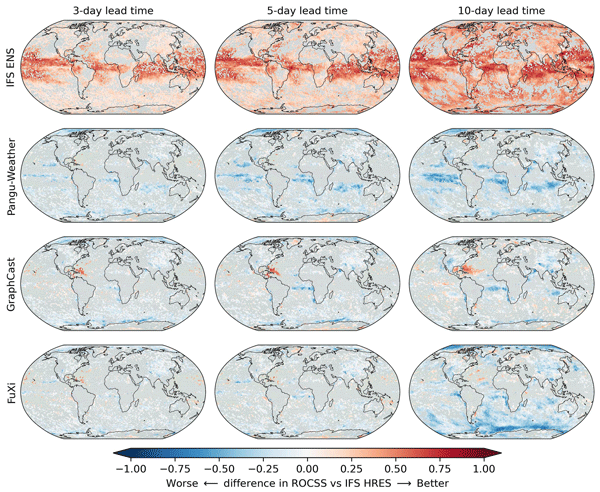
Artificial intelligence (AI) weather models are commonly trained by climate reanalysis datasets, yet the influence of reanalysis errors on forecast errors remains unclear. Focusing on precipitation, this paper proposes the use of analysis of covariance model to quantify the error propagations. The results reveal weakening responses with increasing lead time and amplified underestimation under extreme precipitation, providing useful insights for diagnosing and improving AI forecasts.
Tongtiegang Zhao, Qiang Li, Tongbi Tu, and Xiaohong Chen
Geosci. Model Dev., 18, 5781–5799, https://doi.org/10.5194/gmd-18-5781-2025, https://doi.org/10.5194/gmd-18-5781-2025, 2025
Short summary
Short summary
The recent WeatherBench 2 provides a versatile framework for the verification of deterministic and ensemble forecasts. In this paper, we present an explicit extension to binary forecasts of hydroclimatic extremes. Seventeen verification metrics for binary forecasts are employed, and scorecards are generated to showcase the predictive performance. The extension facilitates more comprehensive comparisons of hydroclimatic forecasts and provides useful information for forecast applications.
Qiang Li and Tongtiegang Zhao
EGUsphere, https://doi.org/10.5194/egusphere-2024-1449, https://doi.org/10.5194/egusphere-2024-1449, 2024
Preprint withdrawn
Short summary
Short summary
This paper focuses on the effect of the water balance constraint on the robustness of the long short-term memory (LSTM) network in learning rainfall-runoff relationships. Through large-sample tests, it is found that incorporating this constraint into the LSTM improves the robustness, while the improvement tends to decrease as the amount of training data increases. The results point to the compensation effects between training data and process knowledge on the LSTM’s performance.
Qiang Li and Tongtiegang Zhao
EGUsphere, https://doi.org/10.5194/egusphere-2023-2841, https://doi.org/10.5194/egusphere-2023-2841, 2024
Preprint archived
Short summary
Short summary
The lack of physical mechanism is a critical issue for the use of popular deep learning models. This paper presents an in-depth investigation of the fundamental mass balance constraint for deep learning-based rainfall-runoff prediction. The robustness against data sparsity, random parameters initialization and contrasting climate conditions are detailed. The results highlight that the water balance constraint evidently improves the robustness in particular when there is limited training data.
Qiang Li and Tongtiegang Zhao
EGUsphere, https://doi.org/10.5194/egusphere-2026-5557, https://doi.org/10.5194/egusphere-2026-5557, 2026
This preprint is open for discussion and under review for Geoscientific Model Development (GMD).
Short summary
Short summary
Artificial intelligence (AI) weather models are commonly trained by climate reanalysis datasets, yet the influence of reanalysis errors on forecast errors remains unclear. Focusing on precipitation, this paper proposes the use of analysis of covariance model to quantify the error propagations. The results reveal weakening responses with increasing lead time and amplified underestimation under extreme precipitation, providing useful insights for diagnosing and improving AI forecasts.
Tongtiegang Zhao, Qiang Li, Tongbi Tu, and Xiaohong Chen
Geosci. Model Dev., 18, 5781–5799, https://doi.org/10.5194/gmd-18-5781-2025, https://doi.org/10.5194/gmd-18-5781-2025, 2025
Short summary
Short summary
The recent WeatherBench 2 provides a versatile framework for the verification of deterministic and ensemble forecasts. In this paper, we present an explicit extension to binary forecasts of hydroclimatic extremes. Seventeen verification metrics for binary forecasts are employed, and scorecards are generated to showcase the predictive performance. The extension facilitates more comprehensive comparisons of hydroclimatic forecasts and provides useful information for forecast applications.

Tongtiegang Zhao, Zecong Chen, Yongyong Zhang, Bingyao Zhang, and Yu Li
Hydrol. Earth Syst. Sci., 29, 2429–2443, https://doi.org/10.5194/hess-29-2429-2025, https://doi.org/10.5194/hess-29-2429-2025, 2025
Short summary
Short summary
The classic logistic function characterizes the stationary relationship between drought loss and intensity. This paper accounts for time in the magnitude, shape and location parameters of the logistic function and derives nonstationary intensity loss functions. A case study is designed to test the functions for drought-affected populations by province in mainland China from 2006 to 2023. Overall, the nonstationary intensity loss functions are shown to be a useful tool for drought management.
Tongtiegang Zhao, Zexin Chen, Yu Tian, Bingyao Zhang, Yu Li, and Xiaohong Chen
Hydrol. Earth Syst. Sci., 28, 3597–3611, https://doi.org/10.5194/hess-28-3597-2024, https://doi.org/10.5194/hess-28-3597-2024, 2024
Short summary
Short summary
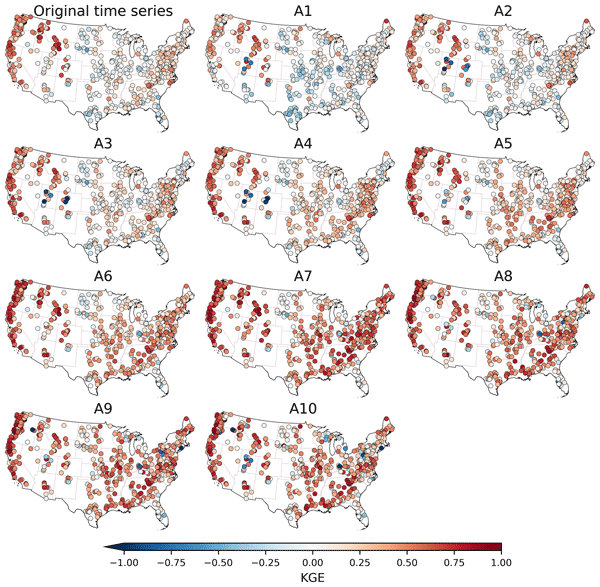
The local performance plays a critical part in practical applications of global streamflow reanalysis. This paper develops a decomposition approach to evaluating streamflow analysis at different timescales. The reanalysis is observed to be more effective in characterizing seasonal, annual and multi-annual features than daily, weekly and monthly features. Also, the local performance is shown to be primarily influenced by precipitation seasonality, longitude, mean precipitation and mean slope.
Qiang Li and Tongtiegang Zhao
EGUsphere, https://doi.org/10.5194/egusphere-2024-1449, https://doi.org/10.5194/egusphere-2024-1449, 2024
Preprint withdrawn
Short summary
Short summary
This paper focuses on the effect of the water balance constraint on the robustness of the long short-term memory (LSTM) network in learning rainfall-runoff relationships. Through large-sample tests, it is found that incorporating this constraint into the LSTM improves the robustness, while the improvement tends to decrease as the amount of training data increases. The results point to the compensation effects between training data and process knowledge on the LSTM’s performance.
Qiang Li and Tongtiegang Zhao
EGUsphere, https://doi.org/10.5194/egusphere-2023-2841, https://doi.org/10.5194/egusphere-2023-2841, 2024
Preprint archived
Short summary
Short summary
The lack of physical mechanism is a critical issue for the use of popular deep learning models. This paper presents an in-depth investigation of the fundamental mass balance constraint for deep learning-based rainfall-runoff prediction. The robustness against data sparsity, random parameters initialization and contrasting climate conditions are detailed. The results highlight that the water balance constraint evidently improves the robustness in particular when there is limited training data.

Huayang Cai, Bo Li, Junhao Gu, Tongtiegang Zhao, and Erwan Garel
Ocean Sci., 19, 603–614, https://doi.org/10.5194/os-19-603-2023, https://doi.org/10.5194/os-19-603-2023, 2023
Short summary
Short summary
For many problems concerning water resource utilization in estuaries, it is essential to be able to express observed salinity distributions based on simple theoretical models. In this study, we propose an analytical salt intrusion model inspired from a theory for predictions of flood hydrographs in watersheds. The newly developed model can be well calibrated using a minimum of three salinity measurements along the estuary and has been successfully applied in 21 estuaries worldwide.
Huayang Cai, Hao Yang, Pascal Matte, Haidong Pan, Zhan Hu, Tongtiegang Zhao, and Guangliang Liu
Ocean Sci., 18, 1691–1702, https://doi.org/10.5194/os-18-1691-2022, https://doi.org/10.5194/os-18-1691-2022, 2022
Short summary
Short summary
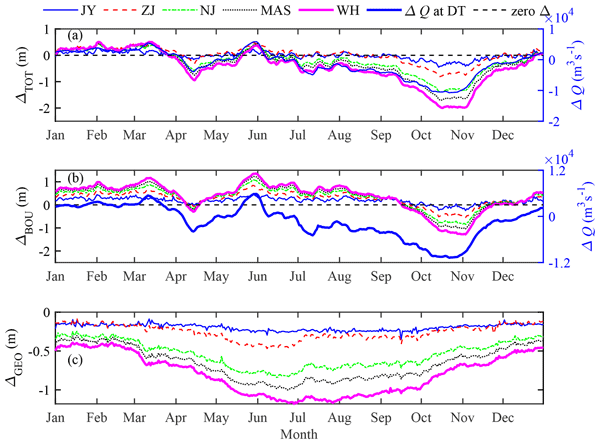
Quantifying spatial–temporal water level dynamics is essential for water resources management in estuaries. In this study, we propose a simple yet powerful regression model to examine the influence of the world’s largest dam, the Three Gorges Dam (TGD), on the spatial–temporal water level dynamics within the Yangtze River estuary. The presented method is particularly useful for determining scientific strategies for sustainable water resources management in dam-controlled estuaries worldwide.
Tongtiegang Zhao, Haoling Chen, Yu Tian, Denghua Yan, Weixin Xu, Huayang Cai, Jiabiao Wang, and Xiaohong Chen
Hydrol. Earth Syst. Sci., 26, 4233–4249, https://doi.org/10.5194/hess-26-4233-2022, https://doi.org/10.5194/hess-26-4233-2022, 2022
Short summary
Short summary
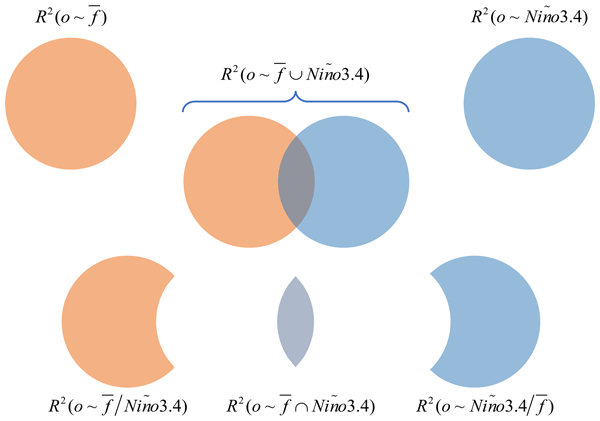
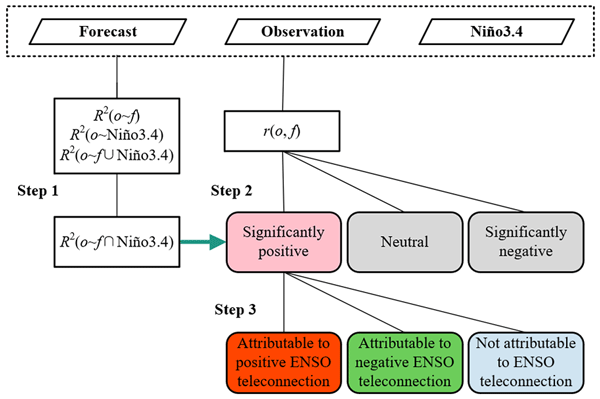
This paper develops a novel set operations of coefficients of determination (SOCD) method to explicitly quantify the overlapping and differing information for GCM forecasts and ENSO teleconnection. Specifically, the intersection operation of the coefficient of determination derives the overlapping information for GCM forecasts and the Niño3.4 index, and then the difference operation determines the differing information in GCM forecasts (Niño3.4 index) from the Niño3.4 index (GCM forecasts).
Tongtiegang Zhao, Haoling Chen, Quanxi Shao, Tongbi Tu, Yu Tian, and Xiaohong Chen
Hydrol. Earth Syst. Sci., 25, 5717–5732, https://doi.org/10.5194/hess-25-5717-2021, https://doi.org/10.5194/hess-25-5717-2021, 2021
Short summary
Short summary
This paper develops a novel approach to attributing correlation skill of dynamical GCM forecasts to statistical El Niño–Southern Oscillation (ENSO) teleconnection using the coefficient of determination. Three cases of attribution are effectively facilitated, which are significantly positive anomaly correlation attributable to positive ENSO teleconnection, attributable to negative ENSO teleconnection and not attributable to ENSO teleconnection.
Cited articles
Addor, N., Newman, A. J., Mizukami, N., and Clark, M. P.: The CAMELS data set: catchment attributes and meteorology for large-sample studies, Hydrol. Earth Syst. Sci., 21, 5293–5313, https://doi.org/10.5194/hess-21-5293-2017, 2017.
Alfieri, L., Lorini, V., Hirpa, F. A., Harrigan, S., Zsoter, E., Prudhomme, C., and Salamon, P.: A global streamflow reanalysis for 1980–2018, J. Hydrol. X, 6, 100049, https://doi.org/10.1016/j.hydroa.2019.100049, 2020.
Anderson, B. J., Slater, L. J., Dadson, S. J., Blum, A. G., and Prosdocimi, I.: Statistical Attribution of the Influence of Urban and Tree Cover Change on Streamflow: A Comparison of Large Sample Statistical Approaches, Water Resour. Res., 58, e2021WR030742, https://doi.org/10.1029/2021WR030742, 2022.
Anderson, B. J., Slater, L. J., Rapson, J., Brunner, M. I., Dadson, S. J., Yin, J., and Buechel, M.: Stationarity Assumptions in Streamflow Sensitivity to Precipitation May Bias Future Projections, Earth's Future, 13, e2025EF006188, https://doi.org/10.1029/2025EF006188, 2025.
Assouline, S., Sela, S., Dorman, M., and Svoray, T.: Runoff generation in a semiarid environment: The role of rainstorm intra-event temporal variability and antecedent soil moisture, Adv. Water Res., 188, 104715, https://doi.org/10.1016/j.advwatres.2024.104715, 2024.
Bassiouni, M., Vogel, R. M., and Archfield, S. A.: Panel regressions to estimate low‐flow response to rainfall variability in ungaged basins, Water Resour. Res., 52, 9470–9494, https://doi.org/10.1002/2016WR018718, 2016.
Berghuijs, W. R., Woods, R. A., Anderson, B. J., Hemshorn de Sánchez, A. L., and Hrachowitz, M.: Annual memory in the terrestrial water cycle, Hydrol. Earth Syst. Sci., 29, 1319–1333, https://doi.org/10.5194/hess-29-1319-2025, 2025.
Chen, Z., Zhao, T., Tu, T., Tu, X., and Chen, X.: PairwiseIHA: A python toolkit to detect flow regime alterations for headwater rivers, Environ. Modell. Softw., 154, 105427, https://doi.org/10.1016/j.envsoft.2022.105427, 2022.
Chen, Z., Zhang, B., Li, Y., and Zhao, T.: Multi-task learning of reservoir inflow and outflow for streamflow simulation, J. Hydrol., 679, 136220, https://doi.org/10.1016/j.jhydrol.2026.136220, 2026.
Cui, Z. and Tian, F.: Soil moisture thresholds for runoff generation: depth sensitivity and mechanistic controls, J. Hydrol., 677, 135827, https://doi.org/10.1016/j.jhydrol.2026.135827, 2026.
Farmani, M. A., Tavakoly, A., Behrangi, A., Qiu, Y., Gupta, A., Jawad, M., Sohi, H. Y., Zhang, X., Geheran, M., and Niu, G.-Y.: Improving Streamflow Predictions in the Arid Southwestern United States Through Understanding of Baseflow Generation Mechanisms, Water Resour. Res., 61, e2024WR039479, https://doi.org/10.1029/2024WR039479, 2025.
Ficchì, A. and Stephens, L.: Climate Variability Alters Flood Timing Across Africa, Geophys. Res. Lett., 46, 8809–8819, https://doi.org/10.1029/2019GL081988, 2019.
Frame, J. M., Kratzert, F., Gupta, H. V., Ullrich, P., and Nearing, G. S.: On strictly enforced mass conservation constraints for modelling the rainfall‐runoff process, Hydrol. Process., 37, e14847, https://doi.org/10.1002/hyp.14847, 2023.
Grimaldi, S., Salamon, P., Russo, C., Disperati, J., Zsoster, E., Carton De Wiart, C., Mazzetti, C., Choulga, M., Moschini, F., Harrigan, S., Gomes, G., Jesus, C.-R., Ramos, A., Barnard, C., Hansford, E., and Prudhomme, C.: GloFAS v4.0: towards hyper-resolution hydrological modelling at global scale, EGU General Assembly 2023, Vienna, Austria, 23–28 Apr 2023, EGU23-3410, https://doi.org/10.5194/egusphere-egu23-3410, 2023.
Hale, K. E., Jennings, K. S., Musselman, K. N., Livneh, B., and Molotch, N. P.: Recent decreases in snow water storage in western North America, Commun. Earth Environ., 4, 170, https://doi.org/10.1038/s43247-023-00751-3, 2023.
Harrigan, S., Zsoter, E., Alfieri, L., Prudhomme, C., Salamon, P., Wetterhall, F., Barnard, C., Cloke, H., and Pappenberger, F.: GloFAS-ERA5 operational global river discharge reanalysis 1979–present, Earth Syst. Sci. Data, 12, 2043–2060, https://doi.org/10.5194/essd-12-2043-2020, 2020.
Harrigan, S., Zsoter, E., Cloke, H., Salamon, P., and Prudhomme, C.: Daily ensemble river discharge reforecasts and real-time forecasts from the operational Global Flood Awareness System, Hydrol. Earth Syst. Sc., 27, 1–19, https://doi.org/10.5194/hess-27-1-2023, 2023.
Hersbach, H., Bell, B., Berrisford, P., Hirahara, S., Horányi, A., Muñoz‐Sabater, J., Nicolas, J., Peubey, C., Radu, R., Schepers, D., Simmons, A., Soci, C., Abdalla, S., Abellan, X., Balsamo, G., Bechtold, P., Biavati, G., Bidlot, J., Bonavita, M., De Chiara, G., Dahlgren, P., Dee, D., Diamantakis, M., Dragani, R., Flemming, J., Forbes, R., Fuentes, M., Geer, A., Haimberger, L., Healy, S., Hogan, R. J., Hólm, E., Janisková, M., Keeley, S., Laloyaux, P., Lopez, P., Lupu, C., Radnoti, G., de Rosnay, P., Rozum, I., Vamborg, F., Villaume, S., and Thépaut, J.: The ERA5 global reanalysis, Q. J. Roy. Meteorol. Soc., 146, 1999–2049, https://doi.org/10.1002/qj.3803, 2020.
Huang, Z. and Zhao, T.: Predictive performance of ensemble hydroclimatic forecasts: Verification metrics, diagnostic plots and forecast attributes, WIRES Water, 9, e1580, https://doi.org/10.1002/wat2.1580, 2022.
Ishida, K., Ercan, A., Nagasato, T., Kiyama, M., and Amagasaki, M.: Use of one-dimensional CNN for input data size reduction in LSTM for improved computational efficiency and accuracy in hourly rainfall-runoff modeling, J. Environ. Manage., 359, 120931, https://doi.org/10.1016/j.jenvman.2024.120931, 2024.
de Lavenne, A., Andréassian, V., Crochemore, L., Lindström, G., and Arheimer, B.: Quantifying multi-year hydrological memory with Catchment Forgetting Curves, Hydrol. Earth Syst. Sc., 26, 2715–2732, https://doi.org/10.5194/hess-26-2715-2022, 2022.
Li, Q. and Zhao, T.: Intercomparison of AI forecasts and numerical weather predictions for the July 2021 extreme precipitation event in Henan, China, Stoch. Env. Res. Risk A., 40, 141, https://doi.org/10.1007/s00477-026-03271-6, 2026a.
Li, Q. and Zhao, T.: Divergent responses of streamflow reanalysis errors to precipitation reanalysis errors modulated by catchment heterogeneity (Version 1.0), Zenodo [code], https://doi.org/10.5281/zenodo.22120405, 2026b.
Liu, L. and Lei, H.: Advanced stepwise machine learning integration of near-real-time precipitation products in China's flood-prone basins, Atmos. Res., 327, 108197, https://doi.org/10.1016/j.atmosres.2025.108197, 2026.
Liu, L., Zhou, L., Gusyev, M., and Ren, Y.: Unravelling and improving the potential of global discharge reanalysis dataset in streamflow estimation in ungauged basins, J. Cleaner Prod., 419, 138282, https://doi.org/10.1016/j.jclepro.2023.138282, 2023.
Liu, Y., Chang, Y., Haag, I., Krumm, J., Sivaprasad, V., Aigner, D., Vereecken, H., and Hendricks Franssen, H.-J.: Historical memory in remotely sensed soil moisture can enhance flash flood modeling for headwater catchments in Germany, J. Hydrol., 648, 132395, https://doi.org/10.1016/j.jhydrol.2024.132395, 2025.
Ma, X., Ma, Y., Ju, Q., Liu, C., Jin, J., Xiao, Y., Liu, H., and Wang, G.: A spatiotemporally differentiated hybrid hydrological modeling strategy with dynamically adaptive runoff generation modes, J. Hydrol., 673, 135480, https://doi.org/10.1016/j.jhydrol.2026.135480, 2026.
Mbuvha, R., Adounkpe, J. Y. P., Mongwe, W. T., Houngnibo, M., Newlands, N., and Marwala, T.: Imputation of Missing Streamflow Data at Multiple Gauging Stations in Benin Republic, https://arxiv.org/abs/2211.11576v1, last access: 17 November 2022.
Meng, H. and Zhao, T.: Evaluation of the hydrological utility of the GPM IMERG satellite precipitation products, Atmos. Res., 322, 108139, https://doi.org/10.1016/j.atmosres.2025.108139, 2025.
Miao, C., Gou, J., Hu, J., and Duan, Q.: Impacts of Different Satellite-Based Precipitation Signature Errors on Hydrological Modeling Performance Across China, Earth's Future, 12, e2024EF004954, https://doi.org/10.1029/2024EF004954, 2024.
Nan, Y., Tian, F., and Zhao, Y.: Omitting Frozen-Soil Effects in Hydrological Models Introduces Biases in Estimated Runoff Sensitivity to Climate Change in Cold Basins, Water Resour. Res., 62, e2025WR041331, https://doi.org/10.1029/2025WR041331, 2026.
Nanding, N., Wu, H., Tao, J., Maggioni, V., Beck, H. E., Zhou, N., Huang, M., and Huang, Z.: Assessment of Precipitation Error Propagation in Discharge Simulations over the Contiguous United States, J. Hydrometeorol., 22, 1987–2008, https://doi.org/10.1175/JHM-D-20-0213.1, 2021a.
Nanding, N., Rico-Ramirez, M. A., Han, D., Wu, H., Dai, Q., and Zhang, J.: Uncertainty assessment of radar-raingauge merged rainfall estimates in river discharge simulations, J. Hydrol., 603, 127093, https://doi.org/10.1016/j.jhydrol.2021.127093, 2021b.
Nearing, G., Cohen, D., Dube, V., Gauch, M., Gilon, O., Harrigan, S., Hassidim, A., Klotz, D., Kratzert, F., Metzger, A., Nevo, S., Pappenberger, F., Prudhomme, C., Shalev, G., Shenzis, S., Tekalign, T. Y., Weitzner, D., and Matias, Y.: Global prediction of extreme floods in ungauged watersheds, Nature, 627, 559–563, https://doi.org/10.1038/s41586-024-07145-1, 2024.
Newman, A. J., Clark, M. P., Sampson, K., Wood, A., Hay, L. E., Bock, A., Viger, R. J., Blodgett, D., Brekke, L., Arnold, J. R., Hopson, T., and Duan, Q.: Development of a large-sample watershed-scale hydrometeorological data set for the contiguous USA: data set characteristics and assessment of regional variability in hydrologic model performance, Hydrol. Earth Syst. Sci., 19, 209–223, https://doi.org/10.5194/hess-19-209-2015, 2015.
Nourani, V., Kheirieh, S., Kantoush, S. A., and Huang, J. J.: Bias correction of Global Flood Awareness System (GloFAS) data for multi-station river flow prediction by ensemble modelling, Eng. Appl. Comp. Fluid, 20, 2665857, https://doi.org/10.1080/19942060.2026.2665857, 2026.
Over, T., Marti, M., Ortiz, J., and Podzorski, H.: The joint effect of changes in urbanization and climate on trends in floods: A comparison of panel and single-station quantile regression approaches, J. Hydrol., 648, 132281, https://doi.org/10.1016/j.jhydrol.2024.132281, 2025.
Prudhomme, C., Zsótér, E., Matthews, G., Melet, A., Grimaldi, S., Zuo, H., Hansford, E., Harrigan, S., Mazzetti, C., de Boisseson, E., Salamon, P., and Garric, G.: Global hydrological reanalyses: The value of river discharge information for world-wide downstream applications – The example of the Global Flood Awareness System GloFAS, Meteorol. Appl., 31, e2192, https://doi.org/10.1002/met.2192, 2024.
Rahman, Md. H., Zaman, I. U., Ahmed, K., Bushra, F., Khan, N. Z., and Rahman, R. M.: Machine Learning Techniques for River Discharge Prediction Using ERA5 and GloFAS Data, in: 2022 IEEE 13th Annual Ubiquitous Computing, Electronics & Mobile Communication Conference (UEMCON), 2022 IEEE 13th Annual Ubiquitous Computing, Electronics & Mobile Communication Conference (UEMCON), 0554–0560, https://doi.org/10.1109/UEMCON54665.2022.9965629, 2022.
Ran, Q., Wang, J., Chen, X., Liu, L., Li, J., and Ye, S.: The relative importance of antecedent soil moisture and precipitation in flood generation in the middle and lower Yangtze River basin, Hydrol. Earth Syst. Sci., 26, 4919–4931, https://doi.org/10.5194/hess-26-4919-2022, 2022.
Senent-Aparicio, J., Blanco-Gómez, P., López-Ballesteros, A., Jimeno-Sáez, P., and Pérez-Sánchez, J.: Evaluating the Potential of GloFAS-ERA5 River Discharge Reanalysis Data for Calibrating the SWAT Model in the Grande San Miguel River Basin (El Salvador), Remote Sens.-Basel, 13, 3299, https://doi.org/10.3390/rs13163299, 2021.
Steinschneider, S., Yang, Y.-C. E., and Brown, C.: Panel regression techniques for identifying impacts of anthropogenic landscape change on hydrologic response, Water Resour. Res., 49, 7874–7886, https://doi.org/10.1002/2013WR013818, 2013.
Tang, G., Clark, M. P., Knoben, W. J. M., Liu, H., Gharari, S., Arnal, L., Beck, H. E., Wood, A. W., Newman, A. J., and Papalexiou, S. M.: The Impact of Meteorological Forcing Uncertainty on Hydrological Modeling: A Global Analysis of Cryosphere Basins, Water Resour. Res., 59, e2022WR033767, https://doi.org/10.1029/2022WR033767, 2023.
Thornton, M. M., Thornton, P. E., Wei, Y., Mayer, B. W., Cook, R. B., and Vose, R. S.: Daymet: monthly climate summaries on a 1-km grid for North America, Version 3. ORNL DAAC, Oak Ridge, Tennessee, USA,https://doi.org/10.3334/ORNLDAAC/1345, 2016.
Tian, F. and Xu, Z.: Streamflow diurnal fluctuation and driving mechanism of headwater stream in a semi-humid mountainous region, J. Hydrol., 641, 131803, https://doi.org/10.1016/j.jhydrol.2024.131803, 2024.
Tudaji, M., Nan, Y., and Tian, F.: Assessing the value of high-resolution rainfall and streamflow data for hydrological modeling: an analysis based on 63 catchments in southeast China, Hydrol. Earth Syst. Sc., 29, 1919–1937, https://doi.org/10.5194/hess-29-1919-2025, 2025.
Wang, J., Chen, X., Liu, J., and Hu, Q.: Changes of Precipitation-Runoff Relationship Induced by Climate Variation in a Large Glaciated Basin of the Tibetan Plateau, J. Geophys. Res.-Atmos., 126, e2020JD034367, https://doi.org/10.1029/2020JD034367, 2021.
Wang, J., Zhuo, L., Han, D., Liu, Y., and Rico-Ramirez, M. A.: Hydrological Model Adaptability to Rainfall Inputs of Varied Quality, Water Resour. Res., 59, e2022WR032484, https://doi.org/10.1029/2022WR032484, 2023.
Wang, N., Sun, F., Liu, W., Yang, S., Wang, H., Feng, Y., and Huang, Q.: Climate drives observational changes in hydrological extremes across most global regions, Innovation-Amsterdam, 7, 101171, https://doi.org/10.1016/j.xinn.2025.101171, 2026.
Wu, H., Adler, R. F., Tian, Y., Gu, G., and Huffman, G. J.: Evaluation of Quantitative Precipitation Estimations through Hydrological Modeling in IFloodS River Basins, J. Hydrometeorol., 18, 529–553, https://doi.org/10.1175/JHM-D-15-0149.1, 2017.
Yang, Y., Pan, M., Lin, P., Beck, H. E., Zeng, Z., Yamazaki, D., David, C. H., Lu, H., Yang, K., Hong, Y., and Wood, E. F.: Global Reach-Level 3-Hourly River Flood Reanalysis (1980–2019), B. Am. Meteorol. Soc., 102, E2086–E2105, https://doi.org/10.1175/BAMS-D-20-0057.1, 2021.
Ye, S., Liu, L., Li, J., Pan, H., Li, W., and Ran, Q.: From rainfall to runoff: The role of soil moisture in a mountainous catchment, J. Hydrol., 625, 130060, https://doi.org/10.1016/j.jhydrol.2023.130060, 2023.
Zhang, J., Wang, Y., Zhao, L., Sun, R., Sun, J., Wang, S., Xu, S., and Yang, Z.: Identification of key factors influencing monthly runoff simulation through the integration of deep learning and physically-based hydrological models, Environ. Modell. Softw., 199, 106927, https://doi.org/10.1016/j.envsoft.2026.106927, 2026.
Zhao, T., Chen, Z., Tu, T., Yan, D., and Chen, X.: Unravelling the potential of global streamflow reanalysis in characterizing local flow regime, Sci. Total Environ., 838, 156125, https://doi.org/10.1016/j.scitotenv.2022.156125, 2022.
Zhao, T., Chen, Z., Tian, Y., Zhang, B., Li, Y., and Chen, X.: A decomposition approach to evaluating the local performance of global streamflow reanalysis, Hydrol. Earth Syst. Sci., 28, 3597–3611, https://doi.org/10.5194/hess-28-3597-2024, 2024.
Zhao, T., Li, Q., Tu, T., and Chen, X.: An extension of WeatherBench 2 to binary hydroclimatic forecasts, Geosci. Model Dev., 18, 5781–5799, https://doi.org/10.5194/gmd-18-5781-2025, 2025.
Zhu, Y., Sang, Y.-F., Wang, B., Lutz, A., Hu, S., Chen, D., and Singh, V. P.: Heterogeneity in Spatiotemporal Variability of High Mountain Asia's Runoff and Its Underlying Mechanisms, Water Resour. Res., 59, e2022WR032721, https://doi.org/10.1029/2022WR032721, 2023.
Short summary
This paper explores how streamflow reanalysis responds to precipitation forcing errors across 671 catchments in the United States. For the Global Flood Awareness System v4.0 driven by European Centre for Medium-Range Weather Forecasts Reanalysis v5, each 1 mm increase in precipitation error causes a mean increase of 0.51 mm streamflow error. This response varies by catchments as humid regions amplify the increased errors up to 2.5 mm, but arid and snowy regions dampen or delay them by storage.
This paper explores how streamflow reanalysis responds to precipitation forcing errors across...


