
Articles | Volume 30, issue 18
https://doi.org/10.5194/hess-30-5901-2026
© Author(s) 2026. This work is distributed under
the Creative Commons Attribution 4.0 License.
the Creative Commons Attribution 4.0 License.
https://doi.org/10.5194/hess-30-5901-2026
© Author(s) 2026. This work is distributed under
the Creative Commons Attribution 4.0 License.
the Creative Commons Attribution 4.0 License.
Research article
| 
17 Sep 2026
Research article |
| 17 Sep 2026
| 17 Sep 2026
Undercatch corrected gridded precipitation data to improve hydrological modeling in high-alpine orography

Institute of Meteorology and Climatology, BOKU University, Gregor-Mendel-Straße 33, 1180 Vienna, Austria
Caroline Ehrendorfer
CORRESPONDING AUTHOR
Institute of Hydrology and Water Management, BOKU University, Muthgasse 18, 1190 Vienna, Austria
Sophie Lücking
Institute of Hydrology and Water Management, BOKU University, Muthgasse 18, 1190 Vienna, Austria
Thomas Pulka
Institute of Hydrology and Water Management, BOKU University, Muthgasse 18, 1190 Vienna, Austria
Department of Environmental Science, Policy, and Management, University of California Berkeley, 130 Mulford Hall, 94720 Berkeley, CA, USA
Fabian Lehner
Department for Climate Impact Research, GeoSphere Austria, Hohe Warte 38, 1190 Vienna, Austria
Mathew Herrnegger
Institute of Hydrology and Water Management, BOKU University, Muthgasse 18, 1190 Vienna, Austria
Herbert Formayer
Institute of Meteorology and Climatology, BOKU University, Gregor-Mendel-Straße 33, 1180 Vienna, Austria
Franziska Koch
Institute of Hydrology and Water Management, BOKU University, Muthgasse 18, 1190 Vienna, Austria
Related authors
Philipp Maier, Fabian Lehner, Tatiana Klisho, and Herbert Formayer
EGUsphere, https://doi.org/10.5194/egusphere-2024-670, https://doi.org/10.5194/egusphere-2024-670, 2024
Preprint withdrawn
Short summary
Short summary
In this article, we analyse the ability of climate models to produce south foehn in the valleys of western Austria using a machine learning technique and assess, how well they capture different aspects of annual foehn occurrence. The performance of these models is largely influenced by the underlying global climate model. After weighting the models based on their performance, we found that foehn occurrence slightly decreases with global warming, but events tend to become more widespread.
Vinzent Klaus, Johannes Laimighofer, and Fabian Lehner
Nat. Hazards Earth Syst. Sci., 25, 4807–4814, https://doi.org/10.5194/nhess-25-4807-2025, https://doi.org/10.5194/nhess-25-4807-2025, 2025
Short summary
Short summary
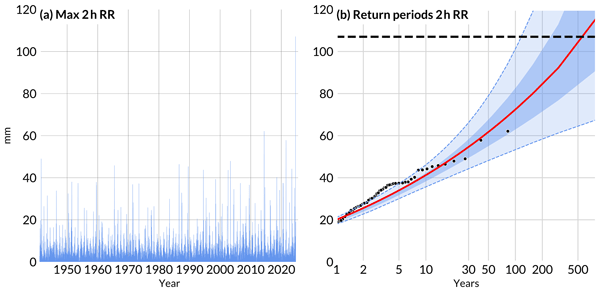
On 17 August 2024, a thunderstorm in Vienna led to a record-breaking rainfall of 107 mm in two hours. An analysis of the exceptionally long hourly rain gauge time series (since 1941) estimates this event's return period at 700 years. The extremity of the event is further confirmed by neighboring weather stations and rain-radar data. Linking the return period to atmospheric temperature shows that such events might occur more often with rising temperatures.
Philipp Maier, Fabian Lehner, Tatiana Klisho, and Herbert Formayer
EGUsphere, https://doi.org/10.5194/egusphere-2024-670, https://doi.org/10.5194/egusphere-2024-670, 2024
Preprint withdrawn
Short summary
Short summary
In this article, we analyse the ability of climate models to produce south foehn in the valleys of western Austria using a machine learning technique and assess, how well they capture different aspects of annual foehn occurrence. The performance of these models is largely influenced by the underlying global climate model. After weighting the models based on their performance, we found that foehn occurrence slightly decreases with global warming, but events tend to become more widespread.
Fabian Lehner, Imran Nadeem, and Herbert Formayer
Adv. Stat. Clim. Meteorol. Oceanogr., 9, 29–44, https://doi.org/10.5194/ascmo-9-29-2023, https://doi.org/10.5194/ascmo-9-29-2023, 2023
Short summary
Short summary
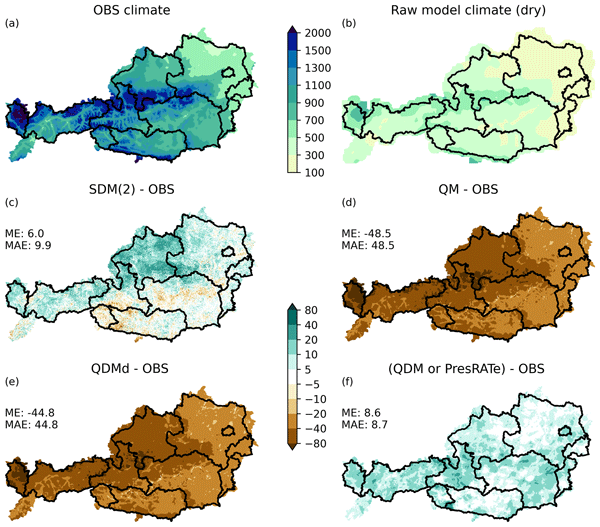
Climate model output has systematic errors which can be reduced with statistical methods. We review existing bias-adjustment methods for climate data and discuss their skills and issues. We define three demands for the method and then evaluate them using real and artificially created daily temperature and precipitation data for Austria to show how biases can also be introduced with bias-adjustment methods themselves.
Achille Capelli, Franziska Koch, Patrick Henkel, Markus Lamm, Florian Appel, Christoph Marty, and Jürg Schweizer
The Cryosphere, 16, 505–531, https://doi.org/10.5194/tc-16-505-2022, https://doi.org/10.5194/tc-16-505-2022, 2022
Short summary
Short summary
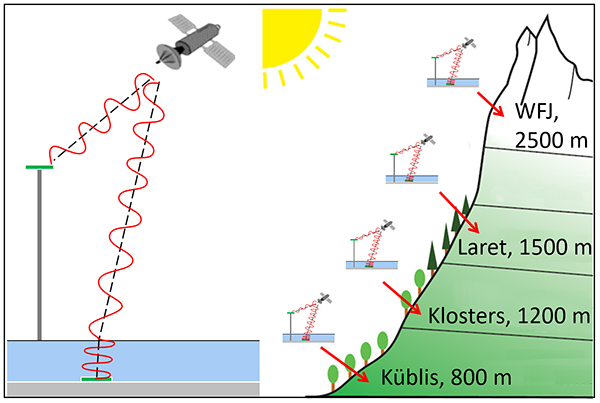
Snow occurrence, snow amount, snow density and liquid water content (LWC) can vary considerably with climatic conditions and elevation. We show that low-cost Global Navigation Satellite System (GNSS) sensors as GPS can be used for reliably measuring the amount of water stored in the snowpack or snow water equivalent (SWE), snow depth and the LWC under a broad range of climatic conditions met at different elevations in the Swiss Alps.
Fabian Lehner, Imran Nadeem, and Herbert Formayer
Hydrol. Earth Syst. Sci. Discuss., https://doi.org/10.5194/hess-2021-498, https://doi.org/10.5194/hess-2021-498, 2021
Manuscript not accepted for further review
Short summary
Short summary
Climate model output usually has systematic errors which can be reduced with statistical methods. We review existing bias adjustment methods for climate data and discuss their shortcomings. We define three demands for the method and combine two existing methods for our own approach. We then test it in comparison to two other methods using real and artificially created daily temperature and precipitation data for Austria. The results show that our method is able to meet all three demands.
Christian Voigt, Karsten Schulz, Franziska Koch, Karl-Friedrich Wetzel, Ludger Timmen, Till Rehm, Hartmut Pflug, Nico Stolarczuk, Christoph Förste, and Frank Flechtner
Hydrol. Earth Syst. Sci., 25, 5047–5064, https://doi.org/10.5194/hess-25-5047-2021, https://doi.org/10.5194/hess-25-5047-2021, 2021
Short summary
Short summary
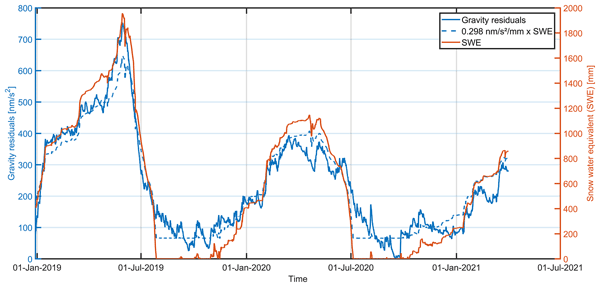
A continuously operating superconducting gravimeter at the Zugspitze summit is introduced to support hydrological studies of the Partnach spring catchment known as the Zugspitze research catchment. The observed gravity residuals reflect total water storage variations at the observation site. Hydro-gravimetric analysis show a high correlation between gravity and the snow water equivalent, with a gravimetric footprint of up to 4 km radius enabling integral insights into this high alpine catchment.
Cited articles
Adam, J. C., Clark, E. A., Lettenmaier, D. P., and Wood, E. F.: Correction of Global Precipitation Products for Orographic Effects, J. Climate, 19, 15–38, https://doi.org/10.1175/JCLI3604.1, 2006. a
Allen, R. G. (Ed.): Crop evapotranspiration: guidelines for computing crop water requirements, no. 56 in FAO irrigation and drainage paper, Food and Agriculture Organization of the United Nations, Rome, repr edn., ISBN 9789251042199, 2000. a
Alonso-González, E., Aalstad, K., Pirk, N., Mazzolini, M., Treichler, D., Leclercq, P., Westermann, S., López-Moreno, J. I., and Gascoin, S.: Spatio-temporal information propagation using sparse observations in hyper-resolution ensemble-based snow data assimilation, Hydrol. Earth Syst. Sci., 27, 4637–4659, https://doi.org/10.5194/hess-27-4637-2023, 2023. a
Aubry, C., Bélair, S., Thériault, J. M., Mekis, E., Feng, P.-N., Lespinas, F., Khedhaouiria, D., and Beaudry, F.: Impacts of Adjusting Solid Precipitation Amounts in the Canadian Precipitation Analysis System, J. Appl. Meteorol. Climatol., 64, 745–760, https://doi.org/10.1175/JAMC-D-24-0083.1, 2025. a
Avanzi, F., Ercolani, G., Gabellani, S., Cremonese, E., Pogliotti, P., Filippa, G., Morra di Cella, U., Ratto, S., Stevenin, H., Cauduro, M., and Juglair, S.: Learning about precipitation lapse rates from snow course data improves water balance modeling, Hydrol. Earth Syst. Sci., 25, 2109–2131, https://doi.org/10.5194/hess-25-2109-2021, 2021. a, b, c
Bakels, L., Tatsii, D., Tipka, A., Thompson, R., Dütsch, M., Blaschek, M., Seibert, P., Baier, K., Bucci, S., Cassiani, M., Eckhardt, S., Groot Zwaaftink, C., Henne, S., Kaufmann, P., Lechner, V., Maurer, C., Mulder, M. D., Pisso, I., Plach, A., Subramanian, R., Vojta, M., and Stohl, A.: FLEXPART version 11: improved accuracy, efficiency, and flexibility, Geosci. Model Dev., 17, 7595–7627, https://doi.org/10.5194/gmd-17-7595-2024, 2024. a
Barros, A. P. and Arulraj, M.: Remote Sensing of Orographic Precipitation, in: Satellite Precipitation Measurement, edited by Levizzani, V., Kidd, C., Kirschbaum, D. B., Kummerow, C. D., Nakamura, K., and Turk, F. J., vol. 69, 559–582, Springer International Publishing, Cham, ISBN 9783030357979 9783030357986, https://doi.org/10.1007/978-3-030-35798-6_6, 2020. a
Bergström, S.: The HBV model, in: Computer Models of Watershed Hydrology, edited by: Singh, V. P., 443–476, Water Resources Publications, Highland Ranch CO, USA, ISBN 978-0-918334-91-6, 1992. a
Bica, B., Herrnegger, M., Kann, A., and Nachtnebel, H. P.: HYDROCAST – Enhanced estimation of areal rainfall by combining a meteorological nowcasting system with a hydrological model, Final Report, Austrian Academy of Science, Vienna, https://forschung.boku.ac.at/en/publications/78344 (last access: 12 November 2025), 2011. a
BMLUK: eHYD, Federal Ministry of Agriculture and Forestry, Climate and Environmental Protection, Regions and Water Management, https://ehyd.gv.at/ (last access: 12 November 2025), 2025. a
Bohnenstengel, S. I., Schlünzen, K., and Beyrich, F.: Representativity of in situ precipitation measurements – A case study for the LITFASS area in North-Eastern Germany, J. Hydrol., 400, 387–395, https://doi.org/10.1016/j.jhydrol.2011.01.052, 2011. a
Bozzoli, M., Crespi, A., Matiu, M., Majone, B., Giovannini, L., Zardi, D., Brugnara, Y., Bozzo, A., Berro, D. C., Mercalli, L., and Bertoldi, G.: Long‐term snowfall trends and variability in the Alps, Int. J. Climatol., 44, 4571–4591, https://doi.org/10.1002/joc.8597, 2024. a, b, c
Breiman, L.: Random Forests, Mach. Learn., 45, 5–32, https://doi.org/10.1023/A:1010933404324, 2001. a
Bührle, L. J., Marty, M., Eberhard, L. A., Stoffel, A., Hafner, E. D., and Bühler, Y.: Spatially continuous snow depth mapping by aeroplane photogrammetry for annual peak of winter from 2017 to 2021 in open areas, The Cryosphere, 17, 3383–3408, https://doi.org/10.5194/tc-17-3383-2023, 2023. a
Climente-González, H., Azencott, C.-A., Kaski, S., and Yamada, M.: Block HSIC Lasso: model-free biomarker detection for ultra-high dimensional data, Bioinformatics, 35, i427–i435, https://doi.org/10.1093/bioinformatics/btz333, 2019. a
Colli, M., Rasmussen, R., Thériault, J. M., Lanza, L. G., Baker, C. B., and Kochendorfer, J.: An Improved Trajectory Model to Evaluate the Collection Performance of Snow Gauges, J. Appl. Meteorol. Climatol., 54, 1826–1836, https://doi.org/10.1175/JAMC-D-15-0035.1, 2015. a
Colli, M., Stagnaro, M., Lanza, L. G., Rasmussen, R., and Thériault, J. M.: Adjustments for Wind-Induced Undercatch in Snowfall Measurements Based on Precipitation Intensity, J. Hydrometeorol., 21, 1039–1050, https://doi.org/10.1175/JHM-D-19-0222.1, 2020. a
Cornes, R. C., Van Der Schrier, G., Van Den Besselaar, E. J. M., and Jones, P. D.: An Ensemble Version of the E‐OBS Temperature and Precipitation Data Sets, J. Geophys. Res.-Atmos., 123, 9391–9409, https://doi.org/10.1029/2017JD028200, 2018. a
Duan, Q., Sorooshian, S., and Gupta, V.: Effective and efficient global optimization for conceptual rainfall‐runoff models, Water Resour. Res., 28, 1015–1031, https://doi.org/10.1029/91WR02985, 1992. a
Duan, Q. Y., Gupta, V. K., and Sorooshian, S.: Shuffled complex evolution approach for effective and efficient global minimization, J. Optimiz. Theory App., 76, 501–521, https://doi.org/10.1007/BF00939380, 1993. a
Dura, V., Evin, G., Favre, A.-C., and Penot, D.: Spatial variability in the seasonal precipitation lapse rates in complex topographical regions – application in France, Hydrol. Earth Syst. Sci., 28, 2579–2601, https://doi.org/10.5194/hess-28-2579-2024, 2024. a
Ebert, E. E., Janowiak, J. E., and Kidd, C.: Comparison of Near-Real-Time Precipitation Estimates from Satellite Observations and Numerical Models, B. Am. Meteorol. Soc., 88, 47–64, https://doi.org/10.1175/BAMS-88-1-47, 2007. a
Feigl, M., Thober, S., Schweppe, R., Herrnegger, M., Samaniego, L., and Schulz, K.: Automatic Regionalization of Model Parameters for Hydrological Models, Water Resour. Res., 58, e2022WR031966, https://doi.org/10.1029/2022WR031966, 2022. a
Ferrarin, L., Schulz, K., Bocchiola, D., and Koch, F.: Enhancing snow depth estimation with snow cover geometrical descriptors, Front. Earth Sci., 13, https://doi.org/10.3389/feart.2025.1672558, 2025. a
Fick, S. E. and Hijmans, R. J.: WorldClim 2: new 1‐km spatial resolution climate surfaces for global land areas, Int. J. Climatol., 37, 4302–4315, https://doi.org/10.1002/joc.5086, 2017. a, b
Filippucci, P., Brocca, L., Ciabatta, L., Mosaffa, H., Avanzi, F., and Massari, C.: Development of HYPER-P: HYdroclimatic PERformance-enhanced Precipitation at 1 km/daily over the Europe-Mediterranean region from 2007 to 2022, Earth Syst. Sci. Data, 17, 5221–5258, https://doi.org/10.5194/essd-17-5221-2025, 2025. a
Ford, C. M., Kendall, A. D., and Hyndman, D. W.: Effects of shifting snowmelt regimes on the hydrology of non-alpine temperate landscapes, J. Hydrol., 590, 125517, https://doi.org/10.1016/j.jhydrol.2020.125517, 2020. a
Formayer, H., Nadeem, I., Leidinger, D., Maier, P., Schöniger, F., Suna, D., Resch, G., Totschnig, G., and Lehner, F.: SECURES-Met: A European meteorological data set suitable for electricity modelling applications, Sci. Data, 10, 590, https://doi.org/10.1038/s41597-023-02494-4, 2023. a
Förster, K., Hanzer, F., Winter, B., Marke, T., and Strasser, U.: An open-source MEteoroLOgical observation time series DISaggregation Tool (MELODIST v0.1.1), Geosci. Model Dev., 9, 2315–2333, https://doi.org/10.5194/gmd-9-2315-2016, 2016. a
Frei, C. and Schär, C.: A precipitation climatology of the Alps from high-resolution rain-gauge observations, Int. J. Climatol., 18, 873–900, https://doi.org/10.1002/(SICI)1097-0088(19980630)18:8<873::AID-JOC255>3.0.CO;2-9, 1998. a, b, c
Gampe, D. and Ludwig, R.: Evaluation of Gridded Precipitation Data Products for Hydrological Applications in Complex Topography, Hydrology, 4, 53, https://doi.org/10.3390/hydrology4040053, 2017. a
Gascoin, S., Grizonnet, M., Bouchet, M., Salgues, G., and Hagolle, O.: Theia Snow collection: high-resolution operational snow cover maps from Sentinel-2 and Landsat-8 data, Earth Syst. Sci. Data, 11, 493–514, https://doi.org/10.5194/essd-11-493-2019, 2019. a
Gentilucci, M., Bufalini, M., D’Aprile, F., Materazzi, M., and Pambianchi, G.: Comparison of Data from Rain Gauges and the IMERG Product to Analyse Precipitation in Mountain Areas of Central Italy, ISPRS Int. J. Geo-Inf., 10, 795, https://doi.org/10.3390/ijgi10120795, 2021. a
Geoland.at: Digitales Geländemodell (DGM) Österreich, https://www.data.gv.at/datasets/d88a1246-9684-480b-a480-ff63286b35b7 (last access: 16 December 2025), 2021. a
GeoSphere Austria: APOLIS, https://www.zamg.ac.at/cms/de/forschung/klima/klimatografien/apolis (last access: 21 March 2023), 2013. a
GeoSphere Austria: Messstationen Zehnminutendaten v2, https://doi.org/10.60669/8FYA-7X87, 2024. a
Girotto, M., Formetta, G., Azimi, S., Bachand, C., Cowherd, M., De Lannoy, G., Lievens, H., Modanesi, S., Raleigh, M. S., Rigon, R., and Massari, C.: Identifying snowfall elevation patterns by assimilating satellite-based snow depth retrievals, Sci. Total Environ., 906, 167312, https://doi.org/10.1016/j.scitotenv.2023.167312, 2024. a
Goodison, B. E., Louie, P. Y. T., and Yang, D.: WMO Solid Precipitation Measurement Intercomparison, Tech. Rep. 872, WMO/TD, https://globalcryospherewatch.org/bestpractices/docs/WMOtd872.pdf (last access: 7 November 2024), 1998. a
Goudenhoofdt, E. and Delobbe, L.: Evaluation of radar-gauge merging methods for quantitative precipitation estimates, Hydrol. Earth Syst. Sci., 13, 195–203, https://doi.org/10.5194/hess-13-195-2009, 2009. a
Graf, M., Scherrer, S. C., Schwierz, C., Begert, M., Martius, O., Raible, C. C., and Brönnimann, S.: Near‐surface mean wind in Switzerland: Climatology, climate model evaluation and future scenarios, Int. J. Climatol., 39, 4798–4810, https://doi.org/10.1002/joc.6108, 2019. a
Grossi, G., Lendvai, A., Peretti, G., and Ranzi, R.: Snow Precipitation Measured by Gauges: Systematic Error Estimation and Data Series Correction in the Central Italian Alps, Water, 9, 461, https://doi.org/10.3390/w9070461, 2017. a, b
Gupta, H. V., Kling, H., Yilmaz, K. K., and Martinez, G. F.: Decomposition of the mean squared error and NSE performance criteria: Implications for improving hydrological modelling, J. Hydrol., 377, 80–91, https://doi.org/10.1016/j.jhydrol.2009.08.003, 2009. a
Haeberli, W. and Beniston, M.: Climate Change and Its Impacts on Glaciers and Permafrost in the Alps, Ambio, 27, 258–265, 1998. a
Haiden, T., Kann, A., Wittmann, C., Pistotnik, G., Bica, B., and Gruber, C.: The Integrated Nowcasting through Comprehensive Analysis (INCA) System and Its Validation over the Eastern Alpine Region, Weather Forecast., 26, 166–183, https://doi.org/10.1175/2010WAF2222451.1, 2011. a, b
Haslinger, K., Breinl, K., Pavlin, L., Pistotnik, G., Bertola, M., Olefs, M., Greilinger, M., Schöner, W., and Blöschl, G.: Increasing hourly heavy rainfall in Austria reflected in flood changes, Nature, 639, 667–672, https://doi.org/10.1038/s41586-025-08647-2, 2025. a, b, c
Hedrick, A. R., Marks, D., Havens, S., Robertson, M., Johnson, M., Sandusky, M., Marshall, H., Kormos, P. R., Bormann, K. J., and Painter, T. H.: Direct Insertion of NASA Airborne Snow Observatory‐Derived Snow Depth Time Series Into the iSnobal Energy Balance Snow Model, Water Resour. Res., 54, 8045–8063, https://doi.org/10.1029/2018WR023190, 2018. a
Hedstrom, N. R. and Pomeroy, J. W.: Measurements and modelling of snow interception in the boreal forest, Hydrol. Process., 12, 1611–1625, https://doi.org/10.1002/(SICI)1099-1085(199808/09)12:10/11<1611::AID-HYP684>3.0.CO;2-4, 1998. a
Henn, B., Newman, A. J., Livneh, B., Daly, C., and Lundquist, J. D.: An assessment of differences in gridded precipitation datasets in complex terrain, J. Hydrol., 556, 1205–1219, https://doi.org/10.1016/j.jhydrol.2017.03.008, 2018. a
Herrnegger, M., Nachtnebel, H. P., and Schulz, K.: From runoff to rainfall: inverse rainfall–runoff modelling in a high temporal resolution, Hydrol. Earth Syst. Sci., 19, 4619–4639, https://doi.org/10.5194/hess-19-4619-2015, 2015a. a
Hersbach, H., Bell, B., Berrisford, P., Hirahara, S., Horányi, A., Muñoz‐Sabater, J., Nicolas, J., Peubey, C., Radu, R., Schepers, D., Simmons, A., Soci, C., Abdalla, S., Abellan, X., Balsamo, G., Bechtold, P., Biavati, G., Bidlot, J., Bonavita, M., De Chiara, G., Dahlgren, P., Dee, D., Diamantakis, M., Dragani, R., Flemming, J., Forbes, R., Fuentes, M., Geer, A., Haimberger, L., Healy, S., Hogan, R. J., Hólm, E., Janisková, M., Keeley, S., Laloyaux, P., Lopez, P., Lupu, C., Radnoti, G., De Rosnay, P., Rozum, I., Vamborg, F., Villaume, S., and Thépaut, J.: The ERA5 global reanalysis, Q. J. Roy. Meteor. Soc., 146, 1999–2049, https://doi.org/10.1002/qj.3803, 2020. a
Hiebl, J. and Frei, C.: Daily temperature grids for Austria since 1961 – concept, creation and applicability, Theor. Appl. Climatol., 124, 161–178, https://doi.org/10.1007/s00704-015-1411-4, 2016. a
Houze, R. A.: Orographic effects on precipitating clouds, Rev. Geophys., 50, 2011RG000365, https://doi.org/10.1029/2011RG000365, 2012. a, b
Hugonnet, R., McNabb, R., Berthier, E., Menounos, B., Nuth, C., Girod, L., Farinotti, D., Huss, M., Dussaillant, I., Brun, F., and Kääb, A.: Accelerated global glacier mass loss in the early twenty-first century, Nature, 592, 726–731, https://doi.org/10.1038/s41586-021-03436-z, 2021. a, b, c, d
Immerzeel, W. W., Wanders, N., Lutz, A. F., Shea, J. M., and Bierkens, M. F. P.: Reconciling high-altitude precipitation in the upper Indus basin with glacier mass balances and runoff, Hydrol. Earth Syst. Sci., 19, 4673–4687, https://doi.org/10.5194/hess-19-4673-2015, 2015. a, b
Isotta, F. A., Begert, M., and Frei, C.: Long‐Term Consistent Monthly Temperature and Precipitation Grid Data Sets for Switzerland Over the Past 150 Years, J. Geophys. Res.-Atmos., 124, 3783–3799, https://doi.org/10.1029/2018JD029910, 2019. a
Jiang, Q.: Moist dynamics and orographic precipitation, Tellus A, 55, 301, https://doi.org/10.3402/tellusa.v55i4.14577, 2003. a, b, c
Judson, A. and Doesken, N.: Density of Freshly Fallen Snow in the Central Rocky Mountains, B. Am. Meteorol. Soc., 81, 1577–1587, https://doi.org/10.1175/1520-0477(2000)081<1577:DOFFSI>2.3.CO;2, 2000. a
Kaltenboeck, R. and Steinheimer, M.: Radar-based severe storm climatology for Austrian complex orography related to vertical wind shear and atmospheric instability, Atmos. Res., 158–159, 216–230, https://doi.org/10.1016/j.atmosres.2014.08.006, 2015. a
Karger, D. N., Lange, S., Hari, C., Reyer, C. P. O., Conrad, O., Zimmermann, N. E., and Frieler, K.: CHELSA-W5E5: daily 1 km meteorological forcing data for climate impact studies, Earth Syst. Sci. Data, 15, 2445–2464, https://doi.org/10.5194/essd-15-2445-2023, 2023. a
Khanal, A. K., Delrieu, G., Cazenave, F., and Boudevillain, B.: Radar Remote Sensing of Precipitation in High Mountains: Detection and Characterization of Melting Layer in the Grenoble Valley, French Alps, Atmosphere, 10, 784, https://doi.org/10.3390/atmos10120784, 2019. a
Kirchner, J. W.: Catchments as simple dynamical systems: Catchment characterization, rainfall‐runoff modeling, and doing hydrology backward, Water Resour. Res., 45, 2008WR006912, https://doi.org/10.1029/2008WR006912, 2009. a
Kling, H., Fürst, J., and Nachtnebel, H. P.: Seasonal, spatially distributed modelling of accumulation and melting of snow for computing runoff in a long‐term, large‐basin water balance model, Hydrol. Process., 20, 2141–2156, https://doi.org/10.1002/hyp.6203, 2006. a
Klingler, C., Schulz, K., and Herrnegger, M.: LamaH-CE: LArge-SaMple DAta for Hydrology and Environmental Sciences for Central Europe, Earth Syst. Sci. Data, 13, 4529–4565, https://doi.org/10.5194/essd-13-4529-2021, 2021. a, b
Klisho, T., Laimighofer, J., Lehner, F., and Formayer, H.: High-resolution (250x250m) gridded daily mean wind speed dataset for Austria spanning from 1961 to 2023, Zenodo [data set], https://doi.org/10.5281/ZENODO.13908273, 2024. a
Koboltschnig, G. R. and Schöner, W.: The relevance of glacier melt in the water cycle of the Alps: the example of Austria, Hydrol. Earth Syst. Sci., 15, 2039–2048, https://doi.org/10.5194/hess-15-2039-2011, 2011. a
Koch, F., Prasch, M., Bach, H., Mauser, W., Appel, F., and Weber, M.: How Will Hydroelectric Power Generation Develop under Climate Change Scenarios? A Case Study in the Upper Danube Basin, Energies, 4, 1508–1541, https://doi.org/10.3390/en4101508, 2011. a
Koch, F., Gascoin, S., Achmüller, K., Schattan, P., Wetzel, K., Deschamps‐Berger, C., Lehning, M., Rehm, T., Schulz, K., and Voigt, C.: Superconducting Gravimeter Observations Show That a Satellite‐Derived Snow Depth Image Improves the Simulation of the Snow Water Equivalent Evolution in a High Alpine Site, Geophys. Res. Lett., 51, e2024GL112483, https://doi.org/10.1029/2024GL112483, 2024. a
Kochendorfer, J., Nitu, R., Wolff, M., Mekis, E., Rasmussen, R., Baker, B., Earle, M. E., Reverdin, A., Wong, K., Smith, C. D., Yang, D., Roulet, Y.-A., Buisan, S., Laine, T., Lee, G., Aceituno, J. L. C., Alastrué, J., Isaksen, K., Meyers, T., Brækkan, R., Landolt, S., Jachcik, A., and Poikonen, A.: Analysis of single-Alter-shielded and unshielded measurements of mixed and solid precipitation from WMO-SPICE, Hydrol. Earth Syst. Sci., 21, 3525–3542, https://doi.org/10.5194/hess-21-3525-2017, 2017a. a, b, c, d, e, f, g, h, i, j, k, l, m
Kochendorfer, J., Rasmussen, R., Wolff, M., Baker, B., Hall, M. E., Meyers, T., Landolt, S., Jachcik, A., Isaksen, K., Brækkan, R., and Leeper, R.: The quantification and correction of wind-induced precipitation measurement errors, Hydrol. Earth Syst. Sci., 21, 1973–1989, https://doi.org/10.5194/hess-21-1973-2017, 2017b. a, b
Kochendorfer, J., Nitu, R., Wolff, M., Mekis, E., Rasmussen, R., Baker, B., Earle, M. E., Reverdin, A., Wong, K., Smith, C. D., Yang, D., Roulet, Y.-A., Meyers, T., Buisan, S., Isaksen, K., Brækkan, R., Landolt, S., and Jachcik, A.: Testing and development of transfer functions for weighing precipitation gauges in WMO-SPICE, Hydrol. Earth Syst. Sci., 22, 1437–1452, https://doi.org/10.5194/hess-22-1437-2018, 2018. a, b, c
Kochendorfer, J., Earle, M. E., Hodyss, D., Reverdin, A., Roulet, Y.-A., Nitu, R., Rasmussen, R., Landolt, S., Buisán, S., and Laine, T.: Undercatch Adjustments for Tipping-Bucket Gauge Measurements of Solid Precipitation, J. Hydrometeorol., 21, 1193–1205, https://doi.org/10.1175/JHM-D-19-0256.1, 2020. a, b
Kovács, L.: Feature selection algorithms in generalized additive models under concurvity, Comput. Stat., 39, 461–493, https://doi.org/10.1007/s00180-022-01292-7, 2024. a
Lehner, F., Klisho, T., and Formayer, H.: BioClim Austria: Gridded climate indicators for 1961-1990 and 1991–2020 at 250 m resolution, Zenodo [data set], https://doi.org/10.5281/ZENODO.10887293, 2024. a
Lehner, F., Maier, P., Klisho, T., and Formayer, H.: FORSITE-Clim Europe: European-wide climate indicators for historical periods and climate projections at high resolution, Zenodo [data set], https://doi.org/10.5281/zenodo.14843328, 2025. a
Lehning, M., Völksch, I., Gustafsson, D., Nguyen, T. A., Stähli, M., and Zappa, M.: ALPINE3D: a detailed model of mountain surface processes and its application to snow hydrology, Hydrol. Process., 20, 2111–2128, https://doi.org/10.1002/hyp.6204, 2006. a, b, c
Livneh, B., Deems, J. S., Schneider, D., Barsugli, J. J., and Molotch, N. P.: Filling in the gaps: Inferring spatially distributed precipitation from gauge observations over complex terrain, Water Resour. Res., 50, 8589–8610, https://doi.org/10.1002/2014WR015442, 2014. a
Lu, X., Tang, G., Wang, X., Liu, Y., Jia, L., Xie, G., Li, S., and Zhang, Y.: Correcting GPM IMERG precipitation data over the Tianshan Mountains in China, J. Hydrol., 575, 1239–1252, https://doi.org/10.1016/j.jhydrol.2019.06.019, 2019. a, b
Lussana, C., Tveito, O. E., Dobler, A., and Tunheim, K.: seNorge_2018, daily precipitation, and temperature datasets over Norway, Earth Syst. Sci. Data, 11, 1531–1551, https://doi.org/10.5194/essd-11-1531-2019, 2019. a
Maier, P., Ehrendorfer, C., Lücking, S., Pulka, T., Lehner, F., Koch, F., Formayer, H., and Herrnegger, M.: GAM-generated monthly precipitation undercatch factors for Austria and surrounding catchments and their station-based training data, Zenodo [data set], https://doi.org/10.5281/zenodo.16903753, 2025. a, b, c, d
Matiu, M., Crespi, A., Bertoldi, G., Carmagnola, C. M., Marty, C., Morin, S., Schöner, W., Cat Berro, D., Chiogna, G., De Gregorio, L., Kotlarski, S., Majone, B., Resch, G., Terzago, S., Valt, M., Beozzo, W., Cianfarra, P., Gouttevin, I., Marcolini, G., Notarnicola, C., Petitta, M., Scherrer, S. C., Strasser, U., Winkler, M., Zebisch, M., Cicogna, A., Cremonini, R., Debernardi, A., Faletto, M., Gaddo, M., Giovannini, L., Mercalli, L., Soubeyroux, J.-M., Sušnik, A., Trenti, A., Urbani, S., and Weilguni, V.: Observed snow depth trends in the European Alps: 1971 to 2019, The Cryosphere, 15, 1343–1382, https://doi.org/10.5194/tc-15-1343-2021, 2021. a
Miralles, D. G., Holmes, T. R. H., De Jeu, R. A. M., Gash, J. H., Meesters, A. G. C. A., and Dolman, A. J.: Global land-surface evaporation estimated from satellite-based observations, Hydrol. Earth Syst. Sci., 15, 453–469, https://doi.org/10.5194/hess-15-453-2011, 2011. a, b
Mott, R., Vionnet, V., and Grünewald, T.: The Seasonal Snow Cover Dynamics: Review on Wind-Driven Coupling Processes, Front. Earth Sci., 6, 197, https://doi.org/10.3389/feart.2018.00197, 2018. a
Nachtnebel, H. P., Baumung, S., and Lettl, W.: Abflußprognosemodell für das Einzugsgebiet der Enns und der Steyr, Tech. rep., Institute of Water Management, Hydrology and Hydraulic Engineering, University of Natural Resources and Applied Life Sciences, Vienna, 1993. a
Nash, J. and Sutcliffe, J.: River flow forecasting through conceptual models part I – A discussion of principles, J. Hydrol., 10, 282–290, https://doi.org/10.1016/0022-1694(70)90255-6, 1970. a, b
Ohmura, A.: Enhanced temperature variability in high-altitude climate change, Theor. Appl. Climatol., 110, 499–508, https://doi.org/10.1007/s00704-012-0687-x, 2012. a
Pan, X., Yang, D., Li, Y., Barr, A., Helgason, W., Hayashi, M., Marsh, P., Pomeroy, J., and Janowicz, R. J.: Bias corrections of precipitation measurements across experimental sites in different ecoclimatic regions of western Canada, The Cryosphere, 10, 2347–2360, https://doi.org/10.5194/tc-10-2347-2016, 2016. a
Pepin, N. C., Arnone, E., Gobiet, A., Haslinger, K., Kotlarski, S., Notarnicola, C., Palazzi, E., Seibert, P., Serafin, S., Schöner, W., Terzago, S., Thornton, J. M., Vuille, M., and Adler, C.: Climate Changes and Their Elevational Patterns in the Mountains of the World, Rev. Geophys., 60, e2020RG000730, https://doi.org/10.1029/2020RG000730, 2022. a
Pflug, J. M. and Lundquist, J. D.: Inferring Distributed Snow Depth by Leveraging Snow Pattern Repeatability: Investigation Using 47 Lidar Observations in the Tuolumne Watershed, Sierra Nevada, California, Water Resour. Res., 56, e2020WR027243, https://doi.org/10.1029/2020WR027243, 2020. a
Pierre, A., Jutras, S., Smith, C., Kochendorfer, J., Fortin, V., and Anctil, F.: Evaluation of Catch Efficiency Transfer Functions for Unshielded and Single-Alter-Shielded Solid Precipitation Measurements, J. Atmos. Ocean. Tech., 36, 865–881, https://doi.org/10.1175/JTECH-D-18-0112.1, 2019. a, b
Premier, V., Marin, C., Bertoldi, G., Barella, R., Notarnicola, C., and Bruzzone, L.: Exploring the use of multi-source high-resolution satellite data for snow water equivalent reconstruction over mountainous catchments, The Cryosphere, 17, 2387–2407, https://doi.org/10.5194/tc-17-2387-2023, 2023. a
Rasmussen, R., Baker, B., Kochendorfer, J., Meyers, T., Landolt, S., Fischer, A. P., Black, J., Thériault, J. M., Kucera, P., Gochis, D., Smith, C., Nitu, R., Hall, M., Ikeda, K., and Gutmann, E.: How Well Are We Measuring Snow: The NOAA/FAA/NCAR Winter Precipitation Test Bed, B. Am. Meteorol. Soc., 93, 811–829, https://doi.org/10.1175/BAMS-D-11-00052.1, 2012. a
RGI Consortium: Randolph Glacier Inventory – A Dataset of Global Glacier Outlines (NSIDC-0770, Version 6), Boulder, Colorado USA. NASA National Snow and Ice Data Center Distributed Active Archive Center [data set], https://doi.org/10.7265/4m1f-gd79, 2017. a, b
Samaniego, L., Kumar, R., Thober, S., Rakovec, O., Zink, M., Wanders, N., Eisner, S., Müller Schmied, H., Sutanudjaja, E. H., Warrach-Sagi, K., and Attinger, S.: Toward seamless hydrologic predictions across spatial scales, Hydrol. Earth Syst. Sci., 21, 4323–4346, https://doi.org/10.5194/hess-21-4323-2017, 2017. a
Schauwecker, S., Schwarb, M., Rohrer, M., and Stoffel, M.: Heavy precipitation forecasts over Switzerland – An evaluation of bias-corrected ECMWF predictions, Weather and Climate Extremes, 34, 100372, https://doi.org/10.1016/j.wace.2021.100372, 2021. a
Sevruk, B., Hertig, J.-A., and Spiess, R.: The effect of a precipitation gauge orifice rim on the wind field deformation as investigated in a wind tunnel, Atmos. Environ. Part A, 25, 1173–1179, https://doi.org/10.1016/0960-1686(91)90228-Y, 1991. a
Shaw, T. E., Caro, A., Mendoza, P., Ayala, A., Pellicciotti, F., Gascoin, S., and McPhee, J.: The Utility of Optical Satellite Winter Snow Depths for Initializing a Glacio‐Hydrological Model of a High‐Elevation, Andean Catchment, Water Resour. Res., 56, e2020WR027188, https://doi.org/10.1029/2020WR027188, 2020. a
Sigmund, A., Melo, D. B., Dujardin, J., Nishimura, K., and Lehning, M.: Parameterizing Snow Sublimation in Conditions of Drifting and Blowing Snow, J. Adv. Model. Earth Sy., 17, e2024MS004332, https://doi.org/10.1029/2024MS004332, 2025. a
Smith, C. D., Ross, A., Kochendorfer, J., Earle, M. E., Wolff, M., Buisán, S., Roulet, Y.-A., and Laine, T.: Evaluation of the WMO Solid Precipitation Intercomparison Experiment (SPICE) transfer functions for adjusting the wind bias in solid precipitation measurements, Hydrol. Earth Syst. Sci., 24, 4025–4043, https://doi.org/10.5194/hess-24-4025-2020, 2020. a
Sodemann, H., Schwierz, C., and Wernli, H.: Interannual variability of Greenland winter precipitation sources: Lagrangian moisture diagnostic and North Atlantic Oscillation influence, J. Geophys. Res.-Atmos., 113, 2007JD008503, https://doi.org/10.1029/2007JD008503, 2008. a
Stanzel, P. and Kling, H.: From ENSEMBLES to CORDEX: Evolving climate change projections for Upper Danube River flow, J. Hydrol., 563, 987–999, https://doi.org/10.1016/j.jhydrol.2018.06.057, 2018. a
Sun, H. and Su, F.: Precipitation correction and reconstruction for streamflow simulation based on 262 rain gauges in the upper Brahmaputra of southern Tibetan Plateau, J. Hydrol., 590, 125484, https://doi.org/10.1016/j.jhydrol.2020.125484, 2020. a
Tang, G., Behrangi, A., Long, D., Li, C., and Hong, Y.: Accounting for spatiotemporal errors of gauges: A critical step to evaluate gridded precipitation products, J. Hydrol., 559, 294–306, https://doi.org/10.1016/j.jhydrol.2018.02.057, 2018. a
Thériault, J. M., Rasmussen, R., Ikeda, K., and Landolt, S.: Dependence of Snow Gauge Collection Efficiency on Snowflake Characteristics, J. Appl. Meteorol. Climatol., 51, 745–762, https://doi.org/10.1175/JAMC-D-11-0116.1, 2012. a
Thornthwaite, C. W. and Mather, J. R.: Instructions and tables for computing potential evapotranspiration and the water balance, in: Publications in Climatology, vol. 10, 185–243, Laboratory of Climatology, Centerton (New Jersey), 1957. a
Urbantschitsch, W. and Haber, A.: Statistikbroschüre 2024, Brochure, E-Control, Vienna,Austria, https://www.e-control.at/documents/1785851/1811582/Statistikbroschuere-barrierefrei2024.pdf/9fd3e833-991b-5e3d-42f4-e167c234c282?t=1731675266941 (last access: 9 October 2025), 2024. a
Vionnet, V., Martin, E., Masson, V., Guyomarc'h, G., Naaim-Bouvet, F., Prokop, A., Durand, Y., and Lac, C.: Simulation of wind-induced snow transport and sublimation in alpine terrain using a fully coupled snowpack/atmosphere model, The Cryosphere, 8, 395–415, https://doi.org/10.5194/tc-8-395-2014, 2014. a
Viviroli, D., Archer, D. R., Buytaert, W., Fowler, H. J., Greenwood, G. B., Hamlet, A. F., Huang, Y., Koboltschnig, G., Litaor, M. I., López-Moreno, J. I., Lorentz, S., Schädler, B., Schreier, H., Schwaiger, K., Vuille, M., and Woods, R.: Climate change and mountain water resources: overview and recommendations for research, management and policy, Hydrol. Earth Syst. Sci., 15, 471–504, https://doi.org/10.5194/hess-15-471-2011, 2011. a, b
Vögeli, C., Lehning, M., Wever, N., and Bavay, M.: Scaling Precipitation Input to Spatially Distributed Hydrological Models by Measured Snow Distribution, Front. Earth Sci., 4, https://doi.org/10.3389/feart.2016.00108, 2016. a, b
Wasti, A., Ray, P., Wi, S., Folch, C., Ubierna, M., and Karki, P.: Climate change and the hydropower sector: A global review, WIREs Climate Change, 13, e757, https://doi.org/10.1002/wcc.757, 2022. a
Weber, M., Braun, L., Mauser, W., and Prasch, M.: Contribution of rain, snow- and icemelt in the upper Danube discharge today and in the future, Geografia Fisica e Dinamica Quaternaria, 33, 221–230, https://www.gfdq.glaciologia.it/index.php/GFDQ/article/view/251 (last access: 21 October 2025), 2010. a
Weber, M., Feigl, M., Schulz, K., and Bernhardt, M.: On the Ability of LIDAR Snow Depth Measurements to Determine or Evaluate the HRU Discretization in a Land Surface Model, Hydrology, 7, 20, https://doi.org/10.3390/hydrology7020020, 2020. a
Weber, M., Koch, F., Bernhardt, M., and Schulz, K.: The evaluation of the potential of global data products for snow hydrological modelling in ungauged high-alpine catchments, Hydrol. Earth Syst. Sci., 25, 2869–2894, https://doi.org/10.5194/hess-25-2869-2021, 2021. a, b
Wesemann, J., Herrnegger, M., and Schulz, K.: Hydrological modelling in the anthroposphere: predicting local runoff in a heavily modified high-alpine catchment, J. Mt. Sci., 15, 921–938, https://doi.org/10.1007/s11629-017-4587-5, 2018. a, b
Wolff, M. A., Isaksen, K., Petersen-Øverleir, A., Ødemark, K., Reitan, T., and Brækkan, R.: Derivation of a new continuous adjustment function for correcting wind-induced loss of solid precipitation: results of a Norwegian field study, Hydrol. Earth Syst. Sci., 19, 951–967, https://doi.org/10.5194/hess-19-951-2015, 2015. a
Wood, S. N.: Generalized Additive Models: An Introduction with R, Chapman and Hall/CRC, 2nd edn., ISBN 9781315370279, https://doi.org/10.1201/9781315370279, 2017. a
Wortmann, M., Bolch, T., Menz, C., Tong, J., and Krysanova, V.: Comparison and Correction of High-Mountain Precipitation Data Based on Glacio-Hydrological Modeling in the Tarim River Headwaters (High Asia), J. Hydrometeorol., 19, 777–801, https://doi.org/10.1175/JHM-D-17-0106.1, 2018. a
Yamada, M., Jitkrittum, W., Sigal, L., Xing, E. P., and Sugiyama, M.: High-Dimensional Feature Selection by Feature-Wise Kernelized Lasso, Neural Comput., 26, 185–207, https://doi.org/10.1162/NECO_a_00537, 2014. a
Yang, K., Musselman, K. N., Rittger, K., Margulis, S. A., Painter, T. H., and Molotch, N. P.: Combining ground-based and remotely sensed snow data in a linear regression model for real-time estimation of snow water equivalent, Adv. Water Resour., 160, 104075, https://doi.org/10.1016/j.advwatres.2021.104075, 2022. a
Zandler, H., Haag, I., and Samimi, C.: Evaluation needs and temporal performance differences of gridded precipitation products in peripheral mountain regions, Sci. Rep., 9, 15118, https://doi.org/10.1038/s41598-019-51666-z, 2019. a
Zeitfogel, H., Herrnegger, M., and Schulz, K.: Regional-scale assessment of groundwater recharge and the water balance for Austria, J. Hydrol.: Regional Studies, 59, 102297, https://doi.org/10.1016/j.ejrh.2025.102297, 2025. a, b, c
Zekollari, H., Huss, M., and Farinotti, D.: Modelling the future evolution of glaciers in the European Alps under the EURO-CORDEX RCM ensemble, The Cryosphere, 13, 1125–1146, https://doi.org/10.5194/tc-13-1125-2019, 2019. a
Zhuang, J., Dussin, R., Bourgault, P., Huard, D., Banihirwe, A., Raynaud, S., Malevich, B., Schupfner, M., Gauthier, C., Filipe, Levang, S.,Almansi, M., Jüling, A., Scott, R., RondeauG, Rasp, S., Smith, T. J., Meyer, A. G., Mares, B., Sacks, B., Stachelek, J., Plough, M., Pierre, Bell, R., Caneill, R., and Li, X.: pangeo-data/xESMF: v0.9.2 – Third time's a charm (Version v0.9.2), Zenodo [software], https://doi.org/10.5281/zenodo.17743552, 2025. a
Short summary
Snow and rainfall measurements in mountain regions often underestimate the true amounts. We developed a method to correct Austrian precipitation data using weather stations and terrain features. The corrected data greatly improves runoff, snow and glacier modeling. This work shows that considering measurement errors is important for accurately assessing water resources, which is increasingly relevant as climate change affects alpine water systems supplying hydropower and downstream communities.
Snow and rainfall measurements in mountain regions often underestimate the true amounts. We...


