
Articles | Volume 30, issue 18
https://doi.org/10.5194/hess-30-5833-2026
© Author(s) 2026. This work is distributed under
the Creative Commons Attribution 4.0 License.
the Creative Commons Attribution 4.0 License.
https://doi.org/10.5194/hess-30-5833-2026
© Author(s) 2026. This work is distributed under
the Creative Commons Attribution 4.0 License.
the Creative Commons Attribution 4.0 License.
Research article
| 
16 Sep 2026
Research article |
| 16 Sep 2026
| 16 Sep 2026
Climatology and trends of extreme precipitation in France: evaluation of an explicit-convection regional climate model
Nicolas Decoopman
Univ. Grenoble Alpes, CNRS, INRAE, IRD, Grenoble INP, IGE, 38000 Grenoble, France
Juliette Blanchet
CORRESPONDING AUTHOR

Univ. Grenoble Alpes, CNRS, INRAE, IRD, Grenoble INP, IGE, 38000 Grenoble, France
Antoine Blanc
RTM, ONF, 38000 Grenoble, France
Cécile Caillaud
Météo-France, CNRS, Univ. Toulouse, CNRM, Toulouse, France
Related authors
No articles found.

Christophe Ogier, Mauro A. Werder, Olivier Gagliardini, Ilaria Santin, Raphael Moser, Romain Hugonnet, Antoine Blanc, and Daniel Farinotti
Nat. Hazards Earth Syst. Sci., 26, 3901–3917, https://doi.org/10.5194/nhess-26-3901-2026, https://doi.org/10.5194/nhess-26-3901-2026, 2026
Short summary
Short summary
In June 2024, a destructive flood impacted the village of La Bérarde in the French Alps. Rain, snowmelt, and the drainage of a surface lake on a glacier cannot fully explain the flood magnitude. We used glacier topography to estimate how much water could also have been stored beneath the glacier before the event. Our results show that large volumes of hidden water may have existed and could have amplified the flood, highlighting an overlooked hazard in debris-covered mountain glaciers.
Paul Fournier, Antoine Blanc, Juliette Blanchet, and Matthieu Lafaysse
EGUsphere, https://doi.org/10.5194/egusphere-2026-2497, https://doi.org/10.5194/egusphere-2026-2497, 2026
Short summary
Short summary
When rain falls on snow, the combined effect of rainfall and snowmelt can generate flooding. Using hourly weather data across the French Alps over 1958–2024, we identified and characterized such rain-on-snow events and linked them to documented natural hazard events. While these events have become less frequent overall due to shorter snow seasons, the most intense ones have shifted toward lower, more populated elevations, meaning they are increasingly likely to impact communities.
Gerhard Krinner, Aude Champouillon, Juliette Blanchet, and Frédérique Chéruy
Geosci. Model Dev., 19, 4961–4975, https://doi.org/10.5194/gmd-19-4961-2026, https://doi.org/10.5194/gmd-19-4961-2026, 2026
Short summary
Short summary
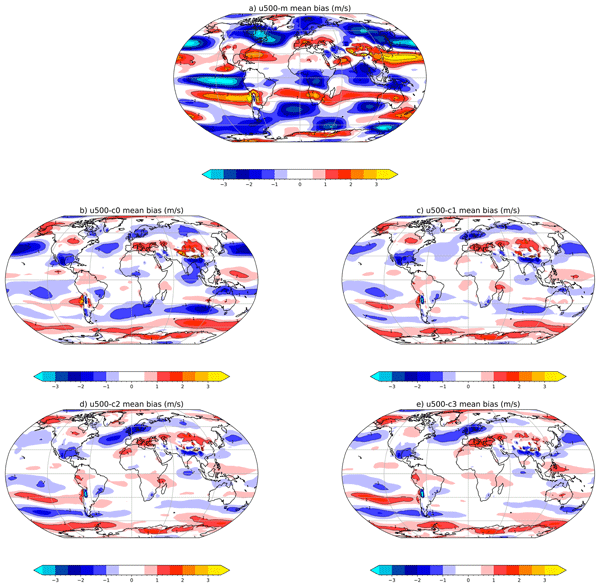
Although the scientific community has made much progress over the last decades, climate models still do not perfectly simulate the present climate. Therefore, the model outputs are usually corrected for these errors. This article presents a method to apply successive stages of repeated error correction that lead to a better simulation of the present climate than in previous studies, in which the same correction method had been applied only once.
Aude Champouillon, Gerhard Krinner, and Juliette Blanchet
EGUsphere, https://doi.org/10.5194/egusphere-2026-1380, https://doi.org/10.5194/egusphere-2026-1380, 2026
Short summary
Short summary
Climate models are essential to quantify future climate change. Despite constant progress, they still exhibit errors in long-term statistics of key variables. Impact studies require using bias correction, typically applied on model outputs. Empirical run-time bias correction (ERBC), however, consist in adding empirical corrective terms to the equations of key variables. Here, we propose an intercomparison of ERBC methods, evaluated on a broad range of criteria, from global to regional scale.
Ian Castellanos, Martin Ménégoz, Juliette Blanchet, Julien Beaumet, Hubert Gallée, Eduardo Moreno-Chamarro, Chantal Staquet, and Xavier Fettweis
Earth Syst. Dynam., 17, 581–605, https://doi.org/10.5194/esd-17-581-2026, https://doi.org/10.5194/esd-17-581-2026, 2026
Short summary
Short summary
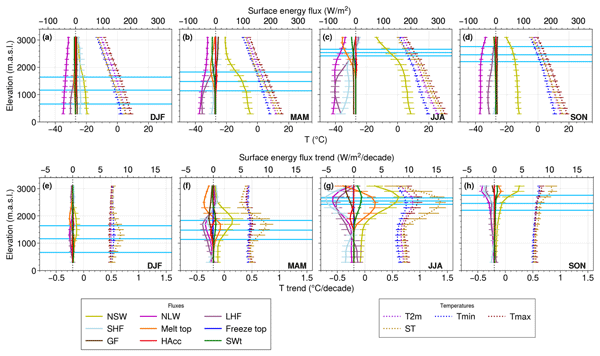
The Alps host glaciers, distinct ecosystems, socio-economic interests and water resources that are being impacted by climate change. In this study, we aim at understanding how warming occurs in the Alps in projected scenarios and what physical processes drive it. We find under these scenarios that elevations around the snowline will warm faster than elsewhere, because snow retreats to higher elevations. Indeed, snow slows down warming due to its high albedo and the energy consumed to melt it.
Gabrielle Sorini, Juliette Blanchet, Gérémy Panthou, Théo Vischel, and Yves Tramblay
EGUsphere, https://doi.org/10.5194/egusphere-2026-1176, https://doi.org/10.5194/egusphere-2026-1176, 2026
Short summary
Short summary
This study investigates regional flood trends across West Africa using time-varying extreme-value distributions. While most catchments show declining flood magnitudes up to the 1970s–1990s, recent trends diverge, ranging from decrease to intensification, revealing an original typology of regional hydrosystems. These results refine the narrative of hydrological changes in West Africa and provide clues to their attribution.

Abubakar Haruna, Juliette Blanchet, Guillaume Evin, and Emmanuel Paquet
Adv. Stat. Clim. Meteorol. Oceanogr., 12, 87–109, https://doi.org/10.5194/ascmo-12-87-2026, https://doi.org/10.5194/ascmo-12-87-2026, 2026
Short summary
Short summary
This study advances nonstationary precipitation modeling by using single, flexible distributions to analyze trends across the full daily spectrum. We demonstrate that evolving shape parameters are critical for accurately capturing observed differential changes in low, medium, and extreme quantiles. This method ensures statistical consistency, providing reliable trend assessments over the two-component framework common in climate impact analysis.
Simon Filhol, Clément Misset, Noélie Bontemps, Diego Cusicanqui, Emmanuel Paquet, Marie Dumont, Olivier Gagliardini, Pascal Lacroix, Simon Gascoin, Guillaume Thirel, Julien Brondex, Pascal Hagenmuller, Eric Larose, Philipp Schoeneich, Denis Roy, Emmanuel Thibert, Nicolas Eckert, Félix de Montety, Robin Mainieri, Alexandre Hauet, Frédéric Gottardi, Johan Berthet, Alexandre Baratier, Frédéric Liébault, Małgorzata Chmiel, Guillaume Piton, Guillaume Chambon, Guillaume James, Philippe Frey, Philip Deline, Laurent Astrade, Christian Vincent, Dominique Laigle, Alain Recking, Fatima Karbou, Adrien Mauss, Mylène Bonnefoy-Demongeot, Firmin Fontaine, Mickael Langlais, Etienne Berthier, and Antoine Blanc
EGUsphere, https://doi.org/10.5194/egusphere-2026-971, https://doi.org/10.5194/egusphere-2026-971, 2026
Short summary
Short summary
On June 21 2024, the village of La Bérarde, in the French Alps, was devastated by a flood destroying centuries old buildings. This study is an interdisciplinary work to decipher the causes and chronology of the event. The flood started with decadal rain falling on a thick snowpack. A lake observed on top of a glacier few days prior, had drained post event. With climate change, should we expect more similar compound events for alpine communities?
Camille Crapart, Sandrine Anquetin, Juliette Blanchet, and Arona Diedhiou
Hydrol. Earth Syst. Sci., 30, 163–181, https://doi.org/10.5194/hess-30-163-2026, https://doi.org/10.5194/hess-30-163-2026, 2026
Short summary
Short summary
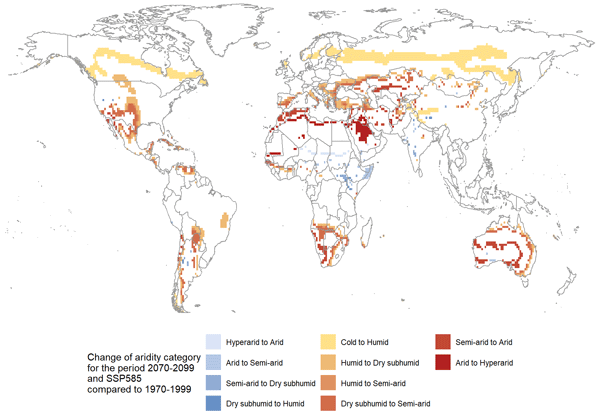
Our study investigates global dryland dynamics and aridification under future climate scenarios. By employing the Food and Agriculture Organisation Aridity Index and an ensemble of 13 models from the 6th Coupled Model Intercomparison Project, we provide projections for dryland distribution and aridity index across three shared socio-economic pathways (2-4.5, 3-7.0, and 5-8.5) for the near-term (2030–2059) and for the long-term (2070–2099) future.
Serigne Bassirou Diop, Job Ekolu, Yves Tramblay, Bastien Dieppois, Stefania Grimaldi, Ansoumana Bodian, Juliette Blanchet, Ponnambalam Rameshwaran, Peter Salamon, and Benjamin Sultan
Nat. Hazards Earth Syst. Sci., 25, 3161–3184, https://doi.org/10.5194/nhess-25-3161-2025, https://doi.org/10.5194/nhess-25-3161-2025, 2025
Short summary
Short summary
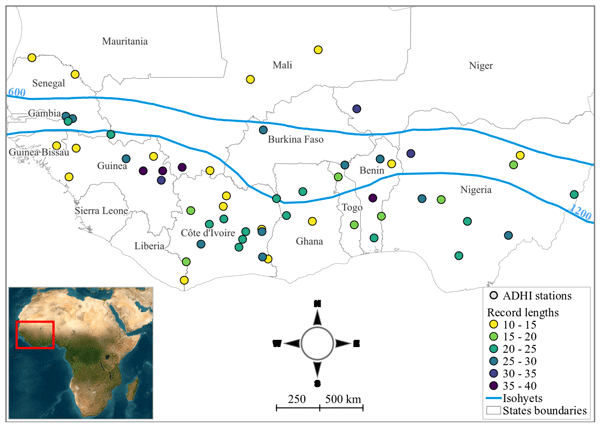
West Africa is very vulnerable to river floods. Current flood hazards are poorly understood due to limited data. This study is filling this knowledge gap using recent databases and two regional hydrological models to analyze changes in flood risk under two climate scenarios. Results show that most areas will see more frequent and severe floods, with some increasing by over 45 %. These findings stress the urgent need for climate-resilient strategies to protect communities and infrastructure.
Sebastian Berghald, Juliette Blanchet, Antoine Blanc, and David Penot
EGUsphere, https://doi.org/10.5194/egusphere-2025-3073, https://doi.org/10.5194/egusphere-2025-3073, 2025
Short summary
Short summary
Our study analyses extreme precipitation in the French Alps using extreme value theory on long-term observations. We compare daily and hourly observations and find regionally and seasonally different trends. On annual resolution, daily extremes show positive trends in the south and negative trends in the north, while trends in hourly extremes are noisier with an appearing east-west divide between increases in the high Alps and decreases in the pre-Alps.
Laura T. Massano, Giorgia Fosser, Marco Gaetani, and Cécile Caillaud
Nat. Hazards Earth Syst. Sci., 24, 4293–4315, https://doi.org/10.5194/nhess-24-4293-2024, https://doi.org/10.5194/nhess-24-4293-2024, 2024
Short summary
Short summary
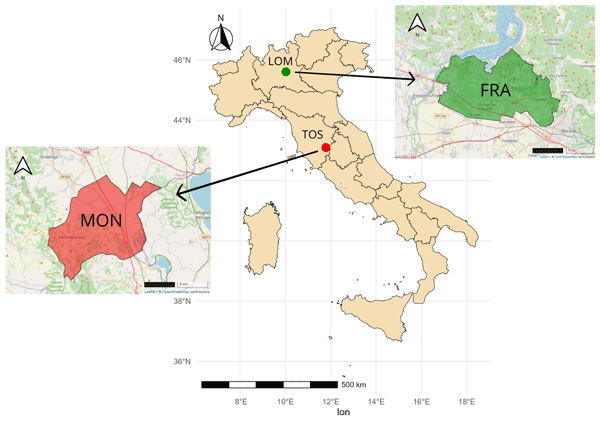
Traditional wine-growing regions are threatened by expected climate change. Climate models and observations are used to calculate bioclimatic indices based on both temperature and precipitation. These indices are correlated with grape productivity in two wine-growing regions in Italy. This analysis paves the way for using climate models to study how climate change will affect wine production in the future.
Diego Monteiro, Cécile Caillaud, Matthieu Lafaysse, Adrien Napoly, Mathieu Fructus, Antoinette Alias, and Samuel Morin
Geosci. Model Dev., 17, 7645–7677, https://doi.org/10.5194/gmd-17-7645-2024, https://doi.org/10.5194/gmd-17-7645-2024, 2024
Short summary
Short summary
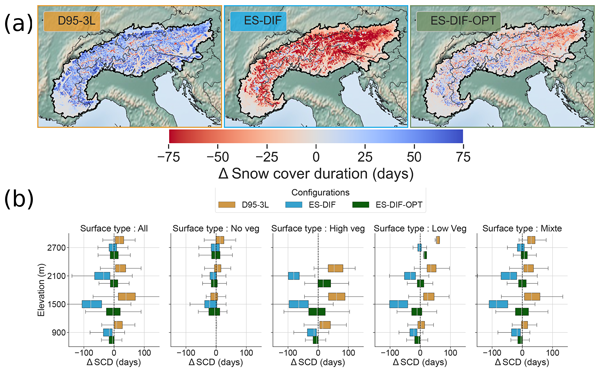
Modeling snow cover in climate and weather forecasting models is a challenge even for high-resolution models. Recent simulations with CNRM-AROME have shown difficulties when representing snow in the European Alps. Using remote sensing data and in situ observations, we evaluate modifications of the land surface configuration in order to improve it. We propose a new surface configuration, enabling a more realistic simulation of snow cover, relevant for climate and weather forecasting applications.
Erwan Le Roux, Guillaume Evin, Raphaëlle Samacoïts, Nicolas Eckert, Juliette Blanchet, and Samuel Morin
The Cryosphere, 17, 4691–4704, https://doi.org/10.5194/tc-17-4691-2023, https://doi.org/10.5194/tc-17-4691-2023, 2023
Short summary
Short summary
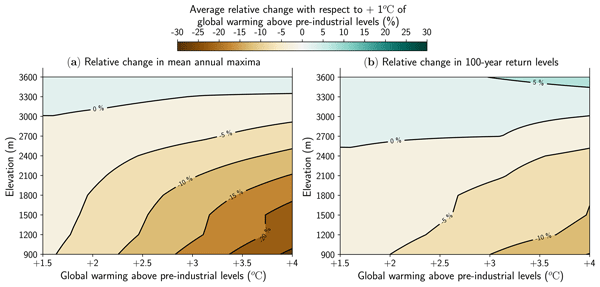
We assess projected changes in snowfall extremes in the French Alps as a function of elevation and global warming level for a high-emission scenario. On average, heavy snowfall is projected to decrease below 3000 m and increase above 3600 m, while extreme snowfall is projected to decrease below 2400 m and increase above 3300 m. At elevations in between, an increase is projected until +3 °C of global warming and then a decrease. These results have implications for the management of risks.
Juliette Blanchet, Alix Reverdy, Antoine Blanc, Jean-Dominique Creutin, Périne Kiennemann, and Guillaume Evin
Hydrol. Earth Syst. Sci. Discuss., https://doi.org/10.5194/hess-2023-197, https://doi.org/10.5194/hess-2023-197, 2023
Revised manuscript not accepted
Short summary
Short summary
The Alpine region is strongly affected by torrential floods, sometimes leading to severe negative impacts on society, economy, and the environment. Understanding such natural hazards and their drivers is essential to mitigate related risks. In this article we study the atmospheric conditions at the origin of damaging torrential events in the Northern French Alps over the long run, using a database of reported occurrence of damaging torrential flooding in the Grenoble conurbation since 1851.
Juliette Blanchet, Alix Reverdy, Antoine Blanc, Jean-Dominique Creutin, Périne Kiennemann, and Guillaume Evin
Nat. Hazards Earth Syst. Sci. Discuss., https://doi.org/10.5194/nhess-2022-276, https://doi.org/10.5194/nhess-2022-276, 2023
Manuscript not accepted for further review
Short summary
Short summary
We study the atmospheric conditions at the origin of damaging torrential events in the Northern French Alps over the long run. We consider seven atmospheric variables that describe the nature of the air masses involved and the possible triggers of precipitation and we try to isolate the most discriminating variables. The results show that humidity and particularly humidity transport plays the greatest role under westerly flows while instability potential is mostly at play under southerly flows.
Erwan Le Roux, Guillaume Evin, Nicolas Eckert, Juliette Blanchet, and Samuel Morin
Earth Syst. Dynam., 13, 1059–1075, https://doi.org/10.5194/esd-13-1059-2022, https://doi.org/10.5194/esd-13-1059-2022, 2022
Short summary
Short summary
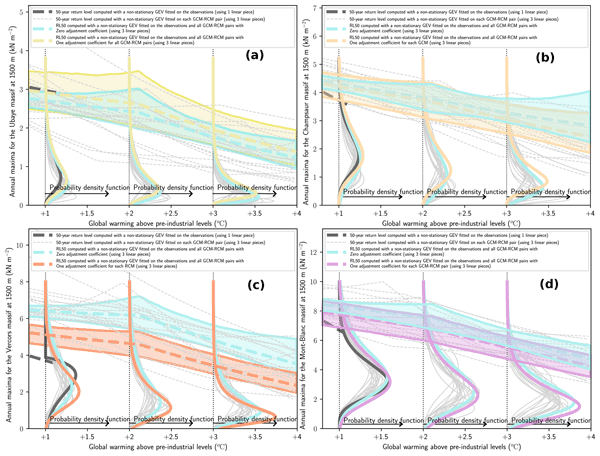
Anticipating risks related to climate extremes is critical for societal adaptation to climate change. In this study, we propose a statistical method in order to estimate future climate extremes from past observations and an ensemble of climate change simulations. We apply this approach to snow load data available in the French Alps at 1500 m elevation and find that extreme snow load is projected to decrease by −2.9 kN m−2 (−50 %) between 1986–2005 and 2080–2099 for a high-emission scenario.
Abubakar Haruna, Juliette Blanchet, and Anne-Catherine Favre
Hydrol. Earth Syst. Sci., 26, 2797–2811, https://doi.org/10.5194/hess-26-2797-2022, https://doi.org/10.5194/hess-26-2797-2022, 2022
Short summary
Short summary
Reliable prediction of floods depends on the quality of the input data such as precipitation. However, estimation of precipitation from the local measurements is known to be difficult, especially for extremes. Regionalization improves the estimates by increasing the quantity of data available for estimation. Here, we compare three regionalization methods based on their robustness and reliability. We apply the comparison to a dense network of daily stations within and outside Switzerland.
Antoine Blanc, Juliette Blanchet, and Jean-Dominique Creutin
Weather Clim. Dynam., 3, 231–250, https://doi.org/10.5194/wcd-3-231-2022, https://doi.org/10.5194/wcd-3-231-2022, 2022
Short summary
Short summary
Precipitation variability and extremes in the northern French Alps are governed by the atmospheric circulation over western Europe. In this work, we study the past evolution of western Europe large-scale circulation using atmospheric descriptors. We show some discrepancies in the trends obtained from different reanalyses before 1950. After 1950, we find trends in Mediterranean circulations that appear to be linked with trends in seasonal and extreme precipitation in the northern French Alps.
Cited articles
Ban, N., Caillaud, C., Coppola, E., Pichelli, E., Sobolowski, S., Adinolfi, M., Ahrens, B., Alias, A., Anders, I., Bastin, S., Belušić, D., Berthou, S., Brisson, E., Cardoso, R. M., Chan, S. C., Christensen, O. B., Fernández, J., Fita, L., Frisius, T., Gašparac, G., Giorgi, F., Goergen, K., Haugen, J. E., Hodnebrog, Ø., Kartsios, S., Katragkou, E., Kendon, E. J., Keuler, K., Lavin-Gullon, A., Lenderink, G., Leutwyler, D., Lorenz, T., Maraun, D., Mercogliano, P., Milovac, J., Panitz, H.-J., Raffa, M., Remedio, A. R., Schär, C., Soares, P. M. M., Srnec, L., Steensen, B. M., Stocchi, P., Tölle, M. H., Truhetz, H., Vergara-Temprado, J., de Vries, H., Warrach-Sagi, K., Wulfmeyer, V., and Zander, M. J.: The first multi-model ensemble of regional climate simulations at kilometer-scale resolution, part I: evaluation of precipitation, Clim. Dynam., 57, 275–302, https://doi.org/10.1007/s00382-021-05708-w, 2021. a, b, c, d
Berghald, S., Blanchet, J., Blanc, A., and Penot, D.: Climatology and trends of observed daily and hourly extreme precipitation in the French Alps, EGUsphere [preprint], https://doi.org/10.5194/egusphere-2025-3073, 2025a. a
Berghald, S., Blanchet, J., Blanc, A., and Penot, D.: Climatology and trends of observed daily and hourly extreme precipitation in the French Alps, EGUsphere [preprint], https://doi.org/10.5194/egusphere-2025-3073, 2025b. a
Berthou, S., Kendon, E. J., Chan, S. C., Ban, N., Leutwyler, D., Schär, C., and Fosser, G.: Pan-European climate at convection-permitting scale: a model intercomparison study, Clim. Dynam., 55, 35–59, https://doi.org/10.1007/s00382-018-4114-6, 2020. a
Blanc, A., Misset, C., Mainieri, R., and Llamas, B.: Rétro-analyse de la crue du torrent des Etançons du 21 juin 2024, Tech. rep., RTM de l'Isère et Département Risques Naturels – Pôle RTM, https://hal.science/hal-04865442v1 (last access: 11 September 2026), 2024. a
Blanchet, J. and Creutin, J.-D.: Instrumental agreement and retrospective analysis of trends in precipitation extremes in the French Mediterranean Region, Environ. Res. Lett., 17, 074011, https://doi.org/10.1088/1748-9326/ac7734, 2022. a, b, c
Blanchet, J., Molinié, G., and Touati, J.: Spatial analysis of trend in extreme daily rainfall in southern France, Clim. Dynam., 51, 799–812, https://doi.org/10.1007/s00382-016-3122-7, 2018. a, b, c
Blanchet, J., Blanc, A., and Creutin, J.-D.: Explaining recent trends in extreme precipitation in the Southwestern Alps by changes in atmospheric influences, Weather and Climate Extremes, 33, 100356, https://doi.org/10.1016/j.wace.2021.100356, 2021. a, b, c, d
Brousseau, P., Seity, Y., Ricard, D., and Léger, J.: Improvement of the forecast of convective activity from the AROME-France system, Q. J. Roy. Meteor. Soc., 142, 2231–2243, https://doi.org/10.1002/qj.2822, 2016. a, b
Caillaud, C., Somot, S., Alias, A., Bernard-Bouissières, I., Fumière, Q., Laurantin, O., Seity, Y., and Ducrocq, V.: Modelling Mediterranean heavy precipitation events at climate scale: an object-oriented evaluation of the CNRM-AROME convection-permitting regional climate model, Clim. Dynam., 56, 1717–1752, https://doi.org/10.1007/s00382-020-05558-y, 2021. a, b, c, d, e, f, g
Caillaud, C., Harader-Coustau, E., Alias, A., Casnin, A., Chevé, M., Corneille, L., Gévaudan, M., Lemonsu, A., Le, H.-H., Li, S., Monteiro, D., Machado, T., Nabat, P., Noirot, L., Quenum, G. M. L. D., Somot, S., and Bador, M.: Technical note: configuration and first evaluation of the kilometre-scale regional climate model CNRM-AROME46t1, Zenodo, https://doi.org/10.5281/zenodo.18496665, 2026. a
Coles, S.: An Introduction to Statistical Modeling of Extreme Values, Springer Series in Statistics, Springer, London, https://doi.org/10.1007/978-1-4471-3675-0, 2001. a, b
Correa-Sánchez, N., Dallan, E., Marra, F., Fosser, G., and Borga, M.: Orographic control on bias and uncertainty in extreme sub-daily precipitation simulations from a convection-permitting ensemble, J. Hydrol., 659, 133324, https://doi.org/10.1016/j.jhydrol.2025.133324, 2025. a
Cortés-Hernández, V. E., Caillaud, C., Bellon, G., Brisson, E., Alias, A., and Lucas-Picher, P.: Evaluation of the convection permitting regional climate model CNRM-AROME on the orographically complex island of Corsica, Clim. Dynam., 62, 4673–4696, https://doi.org/10.1007/s00382-024-07232-z, 2024. a, b
Da Silva, N. A. and Haerter, J. O.: Super-Clausius–Clapeyron scaling of extreme precipitation explained by shift from stratiform to convective rain type, Nat. Geosci., 18, 382–388, https://doi.org/10.1038/s41561-025-01686-4, 2025. a
Dash, S. and Maity, R.: Unfolding unique features of precipitation-temperature scaling across India, Atmos. Res., 284, 106601, https://doi.org/10.1016/j.atmosres.2022.106601, 2023. a
Decoopman, N.: ExtremePrecipit: version used for HESS submission, Zenodo [data set, code], https://doi.org/10.5281/zenodo.18788767, 2026. a, b
Dierickx, A., Dewettinck, W., Van Schaeybroeck, B., De Cruz, L., Caluwaerts, S., Termonia, P., and Van de Vyver, H.: EURO-SUPREME: sub-daily precipitation extremes in the EURO-CORDEX ensemble, Earth Syst. Sci. Data, 17, 6747–6762, https://doi.org/10.5194/essd-17-6747-2025, 2025. a
Donat, M. G., Lowry, A. L., Alexander, L. V., O'Gorman, P. A., and Maher, N.: More extreme precipitation in the world's dry and wet regions, Nat. Clim. Change, 6, 508–513, https://doi.org/10.1038/nclimate2941, 2016. a
Dura, V., Evin, G., Favre, A.-C., and Penot, D.: Spatial variability in the seasonal precipitation lapse rates in complex topographical regions – application in France, Hydrol. Earth Syst. Sci., 28, 2579–2601, https://doi.org/10.5194/hess-28-2579-2024, 2024. a
Fosser, G., Gaetani, M., Kendon, E. J., Adinolfi, M., Ban, N., Belušić, D., Caillaud, C., Careto, J. A. M., Coppola, E., Demory, M.-E., de Vries, H., Dobler, A., Feldmann, H., Goergen, K., Lenderink, G., Pichelli, E., Schär, C., Soares, P. M. M., Somot, S., and Tölle, M. H.: Convection-permitting climate models offer more certain extreme rainfall projections, npj Clim. Atmos. Sci., 7, 51, https://doi.org/10.1038/s41612-024-00600-w, 2024. a
Fumière, Q., Déqué, M., Nuissier, O., Somot, S., Alias, A., Caillaud, C., Laurantin, O., and Seity, Y.: Extreme rainfall in Mediterranean France during the fall: added value of the CNRM-AROME Convection-Permitting Regional Climate Model, Clim. Dynam., 55, 77–91, https://doi.org/10.1007/s00382-019-04898-8, 2020. a
Gibelin, A.-L., Dubuisson, B., Corre, L., Nathalie, D., Jourdain, S., Laval, L., Piquemal, J.-M., Mestre, O., Dennetière, D., Desmidt, S., and Tamburini, A.: Evolution de la température en France depuis les années 1950: Constitution d'un nouveau jeu de séries homogénéisées de référence, La Météorologie, 8, 45, https://doi.org/10.4267/2042/54336, 2014. a
Haruna, A., Blanchet, J., and Favre, A.-C.: Estimation of Intensity-Duration-Area-Frequency Relationships Based on the Full Range of Non-Zero Precipitation From Radar-Reanalysis Data, Water Resour. Res., 60, e2023WR035902, https://doi.org/10.1029/2023WR035902, 2024. a
Haruna, A., Blanchet, J., and Favre, A.-C.: Joint estimation of trend in bulk and extreme daily precipitation in Switzerland, Weather and Climate Extremes, 48, 100769, https://doi.org/10.1016/j.wace.2025.100769, 2025. a
Haruna, A., Blanchet, J., Evin, G., and Paquet, E.: Regional hotspots and contrasts in the trends of mean and extreme daily precipitation in France, J. Hydrol.-Regional Studies, 65, 103378, https://doi.org/10.1016/j.ejrh.2026.103378, 2026. a
Hersbach, H., Bell, B., Berrisford, P., Hirahara, S., Horányi, A., Muñoz-Sabater, J., Nicolas, J., Peubey, C., Radu, R., Schepers, D., Simmons, A., Soci, C., Abdalla, S., Abellan, X., Balsamo, G., Bechtold, P., Biavati, G., Bidlot, J., Bonavita, M., De Chiara, G., Dahlgren, P., Dee, D., Diamantakis, M., Dragani, R., Flemming, J., Forbes, R., Fuentes, M., Geer, A., Haimberger, L., Healy, S., Hogan, R. J., Hólm, E., Janisková, M., Keeley, S., Laloyaux, P., Lopez, P., Lupu, C., Radnoti, G., Rosnay, P., Rozum, I., Vamborg, F., Villaume, S., and Thépaut, J.-N.: The ERA5 global reanalysis, Q. J. Roy. Meteor. Soc., 146, 1999–2049, https://doi.org/10.1002/qj.3803, 2020. a, b
IPCC: Climate Change 2022: Mitigation of Climate Change. Contribution of Working Group III to the Sixth Assessment Report of the Intergovernmental Panel on Climate Change, Cambridge University Press, Cambridge, UK and New York, NY, USA, https://doi.org/10.1017/9781009157926, 2022. a
Lompi, M., Marra, F., Deidda, R., Caporali, E., Borga, M., and Dallan, E.: Non-stationary frequency analysis of long-term convection permitting simulations reveals sub-daily extreme precipitation changes in central-southern Europe, Adv. Water Resour., 205, 105071, https://doi.org/10.1016/j.advwatres.2025.105071, 2025. a
Lucas-Picher, P., Brisson, E., Caillaud, C., Alias, A., Nabat, P., Lemonsu, A., Poncet, N., Cortés Hernandez, V. E., Michau, Y., Doury, A., Monteiro, D., and Somot, S.: Evaluation of the convection-permitting regional climate model CNRM-AROME41t1 over Northwestern Europe, Clim. Dynam., 62, 4587–4615, https://doi.org/10.1007/s00382-022-06637-y, 2024a. a
Lucas-Picher, P., Argüeso, D., Brisson, E., Tramblay, Y., Berg, P., Lemonsu, A., Kotlarski, S., and Caillaud, C.: Evaluation of the convection-permitting regional climate model CNRM-AROME41t1 over Northwestern Europe, Clim. Dynam., 62, 4587–4615, https://doi.org/10.1007/s00382-022-06637-y, 2024b. a
Marra, F., Borga, M., and Morin, E.: A Unified Framework for Extreme Subdaily Precipitation Frequency Analyses Based on Ordinary Events, Geophys. Res. Lett., 47, e2020GL090209, https://doi.org/10.1029/2020GL090209, 2020. a
Masson, V.: A Physically-Based Scheme For The Urban Energy Budget In Atmospheric Models, Bound.-Lay. Meteorol., 94, 357–397, https://doi.org/10.1023/A:1002463829265, 2000. a
Météo-France: Bilan climatique de l'année 2024: France hexagonale et Corse, Rapport, Météo-France, https://meteofrance.fr/sites/meteofrance.fr/files/files/editorial/Bilan_annee_2024_France_hexagonale-et-Corse.pdf (last access: 11 September 2026), 2024a. a
Météo-France: Données d'observations météorologiques issues des stations synoptiques et climatologiques, Open Data on data.gouv.fr, https://www.data.gouv.fr/fr/datasets/donnees-dobservations-meteorologiques-issues-des-stations-synoptiques-et-climatologiques/ (last access: July 2025), 2024b. a, b, c
Météo-France: Retour sur les violents orages dans le sud du pays, https://meteofrance.com/actualites-et-dossiers/actualites/retour-sur-les-violents-orages-dans-le-sud-du-pays (last access: 11 September 2026), 2025a. a
Météo-France: Réanalyses COMEPHORE, https://www.data.gouv.fr/fr/datasets/reanalyses-comephore/ (last access: 11 September 2026), 2025b. a
Molnar, P., Fatichi, S., Gaál, L., Szolgay, J., and Burlando, P.: Storm type effects on super Clausius–Clapeyron scaling of intense rainstorm properties with air temperature, Hydrol. Earth Syst. Sci., 19, 1753–1766, https://doi.org/10.5194/hess-19-1753-2015, 2015. a
Nabat, P., Somot, S., Cassou, C., Mallet, M., Michou, M., Bouniol, D., Decharme, B., Drugé, T., Roehrig, R., and Saint-Martin, D.: Modulation of radiative aerosols effects by atmospheric circulation over the Euro-Mediterranean region, Atmos. Chem. Phys., 20, 8315–8349, https://doi.org/10.5194/acp-20-8315-2020, 2020. a
O'Gorman, P. A.: Contrasting responses of mean and extreme precipitation to climate change, Current Climate Change Reports, 1, 79–92, https://doi.org/10.1038/nature13625, 2015. a
O'Gorman, P. A. and Muller, C. J.: How closely do changes in surface and column water vapor follow Clausius-Clapeyron scaling in climate change simulations?, Environ. Res. Lett., 5, 025207, https://doi.org/10.1088/1748-9326/5/2/025207, 2010. a
Pichelli, E., Coppola, E., Sobolowski, S., Ban, N., Giorgi, F., Stocchi, P., Alias, A., Belušić, D., Berthou, S., Caillaud, C., Cardoso, R. M., Chan, S., Christensen, O. B., Dobler, A., de Vries, H., Goergen, K., Kendon, E. J., Keuler, K., Lenderink, G., Lorenz, T., Mishra, A. N., Panitz, H.-J., Schär, C., Soares, P. M. M., Truhetz, H., and Vergara-Temprado, J.: The first multi-model ensemble of regional climate simulations at kilometer-scale resolution part 2: historical and future simulations of precipitation, Clim. Dynam., 56, 3581–3602, https://doi.org/10.1007/s00382-021-05657-4, 2021. a, b, c
Poncet, N., Lucas-Picher, P., Tramblay, Y., Thirel, G., Vergara, H., Gourley, J., and Alias, A.: Does a convection-permitting regional climate model bring new perspectives on the projection of Mediterranean floods?, Nat. Hazards Earth Syst. Sci., 24, 1163–1183, https://doi.org/10.5194/nhess-24-1163-2024, 2024. a
Ribes, A., Thao, S., Vautard, R., Dubuisson, B., Somot, S., Colin, J., Planton, S., and Soubeyroux, J. M.: Observed increase in extreme daily rainfall in the French Mediterranean, Clim. Dynam., 52, 1095–1114, https://doi.org/10.1007/s00382-018-4179-2, 2019. a, b, c
Schär, C., Fuhrer, O., Arteaga, A., Ban, N., Charpilloz, C., Girolamo, S. D., Hentgen, L., Hoefler, T., Lapillonne, X., Leutwyler, D., Osterried, K., Panosetti, D., Rüdisühli, S., Schlemmer, L., Schulthess, T. C., Sprenger, M., Ubbiali, S., and Wernli, H.: Kilometer-Scale Climate Models: Prospects and Challenges, B. Am. Meteorol. Soc., 101, E567–E587, https://doi.org/10.1175/BAMS-D-18-0167.1, 2020. a
Schröer, K. and Kirchengast, G.: Sensitivity of extreme precipitation to temperature: the variability of scaling factors from a regional to local perspective, Clim. Dynam., 50, 3981–3994, https://doi.org/10.1007/s00382-017-3857-9, 2018. a
Seity, Y., Brousseau, P., Malardel, S., Hello, G., Bénard, P., Bouttier, F., Lac, C., and Masson, V.: The AROME-France Convective-Scale Operational Model, Mon. Weather Rev., 139, 976–991, https://doi.org/10.1175/2010MWR3425.1, 2011. a
Soubeyroux, J.-M., Neppel, L., Veysseire, J.-M., Tramblay, Y., Carreau, J., and Gouget, V.: Evolution des précipitations extrêmes en France en contexte de changement climatique, La Houille Blanche, 101, 27–33, https://doi.org/10.1051/lhb/2015004, 2015. a
Soubeyroux, J.-M., Bernus, S., Dubuisson, B., Drouin, A., Madec, T., Rousset, F., Samacoïts, R., Schneider, M., Tardy, M., Tocquer, F., Corre, L., Morin, S., Ribes, A., Somot, S., Chapnik, B., and Regimbeau, M.: À quel climat s'adapter en France selon la TRACC? partie 2, Tech. rep., Meteo-France, https://hal.science/hal-04991790 (last access: 11 September 2026), 2025. a
Steensen, B. M., Myhre, G., Hodnebrog, Ø., and Alterskjær, K.: How climate models reproduce the observed increase in extreme precipitation over Europe, PLOS Climate, 4, 1–14, https://doi.org/10.1371/journal.pclm.0000442, 2025. a
Trenberth, K. E., Dai, A., Rasmussen, R. M., and Parsons, D. B.: The Changing Character of Precipitation, B. Am. Meteorol. Soc., 84, 1205–1217, https://doi.org/10.1175/BAMS-84-9-1205, 2003. a
Westra, S., Alexander, L. V., and Zwiers, F. W.: Global Increasing Trends in Annual Maximum Daily Precipitation, J. Climate, 26, 3904–3918, https://doi.org/10.1175/JCLI-D-12-00502.1, 2013. a
World Meteorological Organization (WMO): State of the Global Climate 2024, https://public.wmo.int/en/our-mandate/climate/wmo-statement-state-of-global-climate (last access: 15 October 2025), 2025. a
Zeder, J. and Fischer, E. M.: Observed extreme precipitation trends and scaling in Central Europe, Weather and Climate Extremes, 29, 100266, https://doi.org/10.1016/j.wace.2020.100266, 2020. a
Zeder, J. and Fischer, E. M.: Decadal to centennial extreme precipitation disaster gaps – Long-term variability and implications for extreme value modelling, Weather and Climate Extremes, 43, 100636, https://doi.org/10.1016/j.wace.2023.100636, 2024. a
Short summary
This study evaluates the ability of the convection-permitting regional climate model AROME (Applications of Research to Operations at Mesoscale) to reproduce precipitation extremes and their trends, at daily and hourly scales in France, over 1959–2022. Overall, the results highlight the value of the explicit-convection model for extreme precipitation studies, while also highlighting its limitations for convective extremes.
This study evaluates the ability of the convection-permitting regional climate model AROME...


