
Articles | Volume 30, issue 15
https://doi.org/10.5194/hess-30-4847-2026
© Author(s) 2026. This work is distributed under
the Creative Commons Attribution 4.0 License.
the Creative Commons Attribution 4.0 License.
https://doi.org/10.5194/hess-30-4847-2026
© Author(s) 2026. This work is distributed under
the Creative Commons Attribution 4.0 License.
the Creative Commons Attribution 4.0 License.
Research article
| 
03 Aug 2026
Research article |
| 03 Aug 2026
| 03 Aug 2026
Forecast-based operation of repurposed small reservoirs for floods, farms, and (low) flows

Institute for Water and Environment – Hydrology, Karlsruhe Institute of Technology, 76133 Karlsruhe, Germany
Center for Disaster Management and Risk Reduction Technology (CEDIM), Karlsruhe Institute of Technology, 76133 Karlsruhe, Germany
Institute for Photogrammetry and Remote Sensing, Karlsruhe Institute of Technology, 76133 Karlsruhe, Germany
Robert Lang
HYDRON Ingenieurgesellschaft für Umwelt und Wasserwirtschaft GmbH, 76137 Karlsruhe, Germany
Uwe Ehret
Institute for Water and Environment – Hydrology, Karlsruhe Institute of Technology, 76133 Karlsruhe, Germany
Center for Disaster Management and Risk Reduction Technology (CEDIM), Karlsruhe Institute of Technology, 76133 Karlsruhe, Germany
Related authors
Sarah Quỳnh-Giang Ho and Uwe Ehret
Hydrol. Earth Syst. Sci., 29, 2785–2810, https://doi.org/10.5194/hess-29-2785-2025, https://doi.org/10.5194/hess-29-2785-2025, 2025
Short summary
Short summary
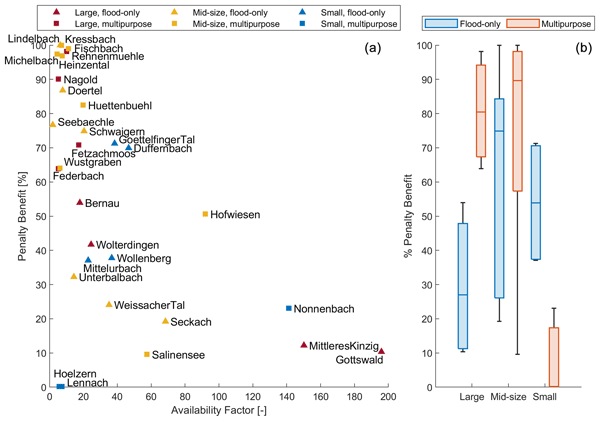
In this paper, we use models to demonstrate that even small flood reservoirs – which capture water to avoid floods downstream – can be repurposed to release water in drier conditions without affecting their ability to protect against floods. By capturing water and releasing it once levels are low, we show that reservoirs can greatly increase the water available in drought. Having more water available to the reservoir, however, is not necessarily better for drought protection.
Uwe Ehret, Jieyu Chen, Fedor Scholz, Sam Allen, and Sebastian Lerch
EGUsphere, https://doi.org/10.5194/egusphere-2026-4514, https://doi.org/10.5194/egusphere-2026-4514, 2026
This preprint is open for discussion and under review for Geoscientific Model Development (GMD).
Short summary
Short summary
Data sets in the geosciences are often very large, therefore data compression methods are required. In this study, we test four such methods: Block Averaging, Principal Component Analysis, Autoencoder, and Ramer-Douglas-Peucker algorithm. "Lossy" means that the original data cannot fully be restored from the compressed data. We tested the methods on rainfall and air temperature data. All methods worked very well, and for the air temperature and rainfall, different methods were best.
Eduardo Jose Acuna Espinoza, Manuel Álvarez Chaves, Frederik Kratzert, Daniel Klotz, Martin Gauch, Robert Lang, Dominik Elfgang, Alexander Dolich, Ralf Loritz, and Uwe Ehret
EGUsphere, https://doi.org/10.5194/egusphere-2026-4885, https://doi.org/10.5194/egusphere-2026-4885, 2026
This preprint is open for discussion and under review for Hydrology and Earth System Sciences (HESS).
Short summary
Short summary
We present the Multi-Frequency Masked-Forecasting LSTM (MF2LSTM), a pipeline unifying multi-frequency modeling, missing-data handling, and real-time data assimilation for hourly streamflow forecasting. Forced with ICON-D2 weather data, MF2LSTM yields higher performance than LARSIM, the operational model used in Baden-Württemberg, Germany. Using a single-cell baseline, this work proves that simple deep learning models can deliver high-level operational performance without extra complexity.
Alexander Dolich, Eduardo Acuña Espinoza, Uwe Ehret, Michael Kraft, Jan Bondy, Johannes Meuer, and Ralf Loritz
Earth Syst. Sci. Data Discuss., https://doi.org/10.5194/essd-2026-289, https://doi.org/10.5194/essd-2026-289, 2026
Preprint under review for ESSD
Short summary
Short summary
CAMELS-DE-1h provides a unified collection of hourly river flow and weather time series for 1,611 German catchments from 2001 to 2024, alongside operational weather forecasts. Benchmark simulation results serve as a baseline for future model development. This dataset allows researchers to investigate small and medium-sized catchments that react quickly to heavy rainfall and to test models under operational conditions, improving future flood forecasting and early warning systems.
Tianlong Jia, Guoding Chen, Yao Li, Xinyu Chang, and Uwe Ehret
EGUsphere, https://doi.org/10.5194/egusphere-2026-1637, https://doi.org/10.5194/egusphere-2026-1637, 2026
Short summary
Short summary
Supervised learning-based streamflow prediction models typically rely on large volumes of meteorological forcing data paired with streamflow observations, but the data scarcity of streamflow observations limits their applicability. To address this, we propose a novel method to improve prediction performance in data-scarce regions, that first pre-trains on abundant meteorological forcing data, and then fine-tunes using limited meteorological forcing data paired with streamflow observations.
Manuel Álvarez Chaves, Eduardo Acuña Espinoza, Uwe Ehret, and Anneli Guthke
Hydrol. Earth Syst. Sci., 30, 629–658, https://doi.org/10.5194/hess-30-629-2026, https://doi.org/10.5194/hess-30-629-2026, 2026
Short summary
Short summary
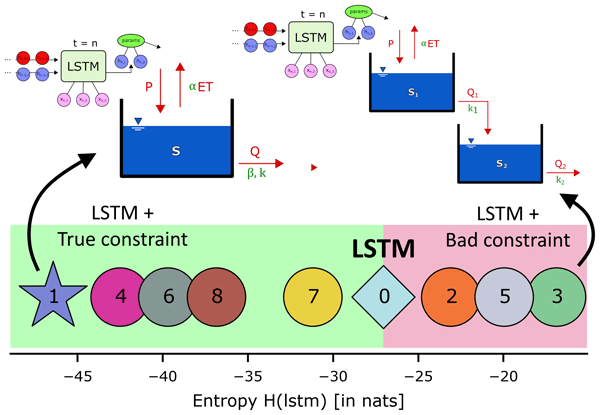
This study evaluates hybrid hydrological models combining physics-based and data-driven components, using Information Theory to measure their relative contributions. When testing conceptual models with Long Short-Term Memory (LSTM) networks that adjust parameters over time, we found performance primarily comes from the data-driven component, with physics constraints adding minimal value. We propose a quantitative tool to analyse this behaviour and suggest a workflow for diagnosing hybrid models.
Maria Staudinger, Anna Herzog, Ralf Loritz, Tobias Houska, Sandra Pool, Diana Spieler, Paul D. Wagner, Juliane Mai, Jens Kiesel, Stephan Thober, Björn Guse, and Uwe Ehret
Hydrol. Earth Syst. Sci., 29, 5005–5029, https://doi.org/10.5194/hess-29-5005-2025, https://doi.org/10.5194/hess-29-5005-2025, 2025
Short summary
Short summary
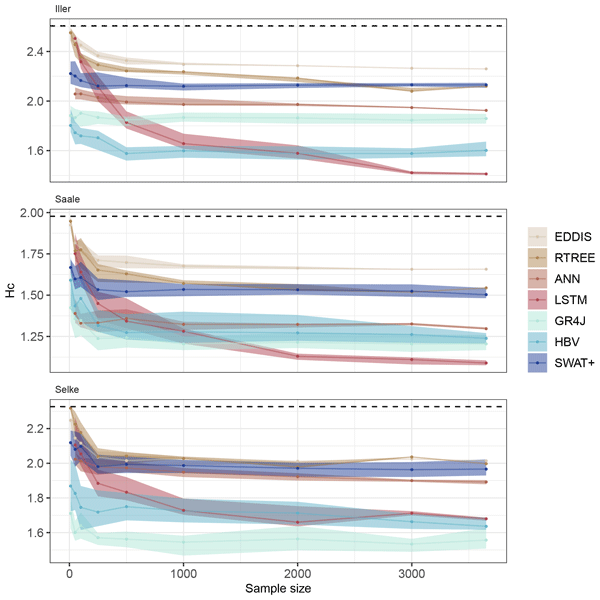
Three process-based and four data-driven hydrological models are compared using different training data. We found that process-based models perform better with small datasets but stop learning soon, while data-driven models learn longer. The study highlights the importance of memory in data and the impact of different data sampling methods on model performance. The direct comparison of these models is novel and provides a clear understanding of their performance under various data conditions.
Andrea L. Campoverde, Uwe Ehret, Patrick Ludwig, and Joaquim G. Pinto
EGUsphere, https://doi.org/10.5194/egusphere-2025-3988, https://doi.org/10.5194/egusphere-2025-3988, 2025
Short summary
Short summary
Droughts are becoming more common in Europe. Our study used vast climate data to uncover extreme unseen low-water events. These simulations show the potential droughts becoming more severe and lasting longer than the damaging 2018 event, which impacted shipping and industry. This research highlights the urgent need for adaptation measures to prevent costly economic and ecological consequences for the Rhine's waterway.
Sarah Quỳnh-Giang Ho and Uwe Ehret
Hydrol. Earth Syst. Sci., 29, 2785–2810, https://doi.org/10.5194/hess-29-2785-2025, https://doi.org/10.5194/hess-29-2785-2025, 2025
Short summary
Short summary
In this paper, we use models to demonstrate that even small flood reservoirs – which capture water to avoid floods downstream – can be repurposed to release water in drier conditions without affecting their ability to protect against floods. By capturing water and releasing it once levels are low, we show that reservoirs can greatly increase the water available in drought. Having more water available to the reservoir, however, is not necessarily better for drought protection.
Eduardo Acuña Espinoza, Frederik Kratzert, Daniel Klotz, Martin Gauch, Manuel Álvarez Chaves, Ralf Loritz, and Uwe Ehret
Hydrol. Earth Syst. Sci., 29, 1749–1758, https://doi.org/10.5194/hess-29-1749-2025, https://doi.org/10.5194/hess-29-1749-2025, 2025
Short summary
Short summary
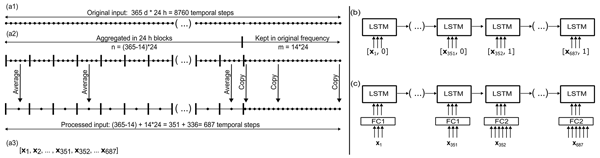
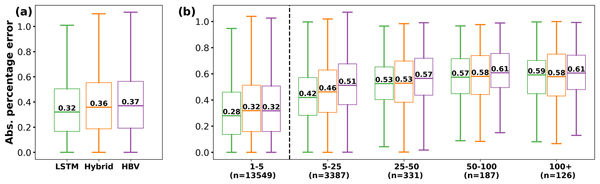
Long short-term memory (LSTM) networks have demonstrated state-of-the-art performance for rainfall-runoff hydrological modelling. However, most studies focus on predictions at a daily scale, limiting the benefits of sub-daily (e.g. hourly) predictions in applications like flood forecasting. In this study, we introduce a new architecture, multi-frequency LSTM (MF-LSTM), designed to use inputs of various temporal frequencies to produce sub-daily (e.g. hourly) predictions at a moderate computational cost.
Eduardo Acuña Espinoza, Ralf Loritz, Frederik Kratzert, Daniel Klotz, Martin Gauch, Manuel Álvarez Chaves, and Uwe Ehret
Hydrol. Earth Syst. Sci., 29, 1277–1294, https://doi.org/10.5194/hess-29-1277-2025, https://doi.org/10.5194/hess-29-1277-2025, 2025
Short summary
Short summary
Data-driven techniques have shown the potential to outperform process-based models in rainfall–runoff simulations. Hybrid models, combining both approaches, aim to enhance accuracy and maintain interpretability. Expanding the set of test cases to evaluate hybrid models under different conditions, we test their generalization capabilities for extreme hydrological events.
Andrea L. Campoverde, Uwe Ehret, Patrick Ludwig, and Joaquim G. Pinto
Geosci. Model Dev. Discuss., https://doi.org/10.5194/gmd-2024-134, https://doi.org/10.5194/gmd-2024-134, 2024
Revised manuscript not accepted
Short summary
Short summary
We looked at how well the model WRF-Hydro performed during the 2018 drought event in the River Rhine basin, even though it is typically used for floods. We used the meteorological ERA5 reanalysis dataset to simulate River Rhine’s streamflow and adjusted the model using parameters and actual discharge measurements. We focused on Lake Constance, a key part of the basin, but found issues with the model’s lake outflow simulation. By removing the lake module, we obtained more accurate results.
Eduardo Acuña Espinoza, Ralf Loritz, Manuel Álvarez Chaves, Nicole Bäuerle, and Uwe Ehret
Hydrol. Earth Syst. Sci., 28, 2705–2719, https://doi.org/10.5194/hess-28-2705-2024, https://doi.org/10.5194/hess-28-2705-2024, 2024
Short summary
Short summary
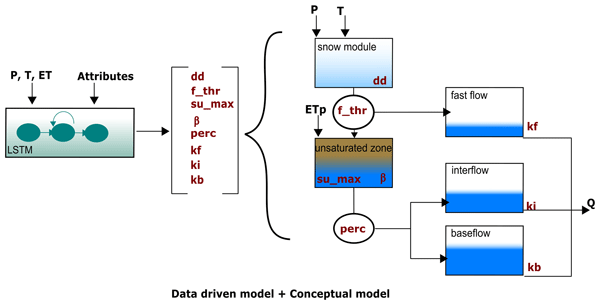
Hydrological hybrid models promise to merge the performance of deep learning methods with the interpretability of process-based models. One hybrid approach is the dynamic parameterization of conceptual models using long short-term memory (LSTM) networks. We explored this method to evaluate the effect of the flexibility given by LSTMs on the process-based part.
Uwe Ehret and Pankaj Dey
Hydrol. Earth Syst. Sci., 27, 2591–2605, https://doi.org/10.5194/hess-27-2591-2023, https://doi.org/10.5194/hess-27-2591-2023, 2023
Short summary
Short summary
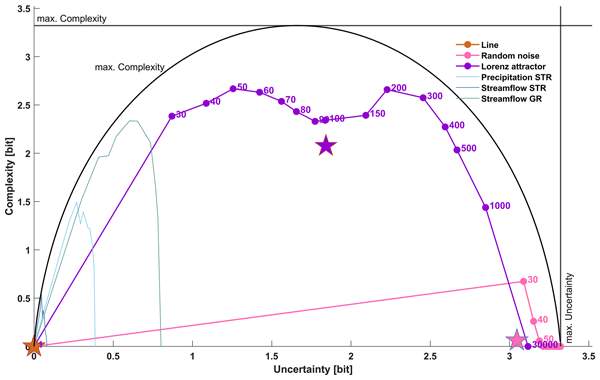
We propose the
c-u-curvemethod to characterize dynamical (time-variable) systems of all kinds.
Uis for uncertainty and expresses how well a system can be predicted in a given period of time.
Cis for complexity and expresses how predictability differs between different periods, i.e. how well predictability itself can be predicted. The method helps to better classify and compare dynamical systems across a wide range of disciplines, thus facilitating scientific collaboration.

Patrick Ludwig, Florian Ehmele, Mário J. Franca, Susanna Mohr, Alberto Caldas-Alvarez, James E. Daniell, Uwe Ehret, Hendrik Feldmann, Marie Hundhausen, Peter Knippertz, Katharina Küpfer, Michael Kunz, Bernhard Mühr, Joaquim G. Pinto, Julian Quinting, Andreas M. Schäfer, Frank Seidel, and Christina Wisotzky
Nat. Hazards Earth Syst. Sci., 23, 1287–1311, https://doi.org/10.5194/nhess-23-1287-2023, https://doi.org/10.5194/nhess-23-1287-2023, 2023
Short summary
Short summary
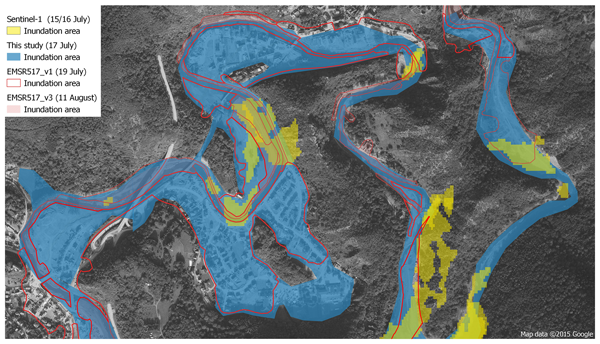
Heavy precipitation in July 2021 led to widespread floods in western Germany and neighboring countries. The event was among the five heaviest precipitation events of the past 70 years in Germany, and the river discharges exceeded by far the statistical 100-year return values. Simulations of the event under future climate conditions revealed a strong and non-linear effect on flood peaks: for +2 K global warming, an 18 % increase in rainfall led to a 39 % increase of the flood peak in the Ahr river.
Susanna Mohr, Uwe Ehret, Michael Kunz, Patrick Ludwig, Alberto Caldas-Alvarez, James E. Daniell, Florian Ehmele, Hendrik Feldmann, Mário J. Franca, Christian Gattke, Marie Hundhausen, Peter Knippertz, Katharina Küpfer, Bernhard Mühr, Joaquim G. Pinto, Julian Quinting, Andreas M. Schäfer, Marc Scheibel, Frank Seidel, and Christina Wisotzky
Nat. Hazards Earth Syst. Sci., 23, 525–551, https://doi.org/10.5194/nhess-23-525-2023, https://doi.org/10.5194/nhess-23-525-2023, 2023
Short summary
Short summary
The flood event in July 2021 was one of the most severe disasters in Europe in the last half century. The objective of this two-part study is a multi-disciplinary assessment that examines the complex process interactions in different compartments, from meteorology to hydrological conditions to hydro-morphological processes to impacts on assets and environment. In addition, we address the question of what measures are possible to generate added value to early response management.
Cited articles
Ad-Hoc-Arbeitsgruppe: Bodenkundliche Kartieranleitung, Schweizerbart Science Publishers, Stuttgart, Germany, 438 pp., ISBN 978-3-510-95920-4, 2005.
Allen, R. G., Pereira, L. S., Raes, D., and Smith, M.: FAO Irrigation and drainage paper No. 56, Food and agriculture organization of the United Nations, Rome, e156, https://www.fao.org/4/x0490e/x0490e00.htm (last access: 24 July 2026), 1998.
Aminzadeh, M., Friedrich, N., Narayanaswamy, S., Madani, K., and Shokri, N.: Evaporation Loss From Small Agricultural Reservoirs in a Warming Climate: An Overlooked Component of Water Accounting, Earth's Future, 12, 10.1029/2023ef004050, 2024.
Baldauf, M., Gebhardt, C., Theis, S., Ritter, B., and Schraff, C.: Beschreibung des operationellen Kürzestfristvorhersagemodells COSMO-D2 und COSMO-D2-EPS und seiner Ausgabe in die Datenbanken des DWD, Deutsche Wetterdienst, Offenbach, https://www.dwd.de/SharedDocs/downloads/DE/modelldokumentationen/nwv/cosmo_d2/cosmo_d2_dbbeschr_version_1_0_201805.pdf?__blob=publicationFile&v=3 (last access: 28 July 2026), 2018.
Baldauf, M., Förstner, J., Klink, S., Reinhardt, T., Schraff, C., Seifert, A., and Stephan, K.: Kurze Beschreibung des Lokal-Modells Kürzestfrist COSMO-DE (LMK) und seiner Datenbanken auf dem Datenserver des DWD, Deutsche Wetterdienst, Offenbach, https://www.dwd.de/SharedDocs/downloads/DE/ (last access: 24 July 2026), 2016.
Balley, P.: An integrated real-time optimal flood and drought control operation model of a multi-purpose two-reservoir system: the Waiau River System, Dissertation, Department of Natural Resources Engineering, Lincoln University, https://hdl.handle.net/10182/2317 (last access: 28 July 2026), 1997.
Bartholomeus, R. P., van der Wiel, K., van Loon, A. F., van Huijgevoort, M. H. J., van Vliet, M. T. H., Mens, M., Muurling-van Geffen, S., Wanders, N., and Pot, W.: Managing water across the flood-drought spectrum – experiences from and challenges for the Netherlands, Cambridge Prisms, Water, 1–22, https://doi.org/10.1017/wat.2023.4, 2023.
Beck, H. E., McVicar, T. R., Vergopolan, N., Berg, A., Lutsko, N. J., Dufour, A., Zeng, Z., Jiang, X., van Dijk, A., and Miralles, D. G.: High-resolution (1 km) Koppen-Geiger maps for 1901–2099 based on constrained CMIP6 projections, Sci. Data, 10, 724, https://doi.org/10.1038/s41597-023-02549-6, 2023.
Blickensdörfer, L., Schwieder, M., Pflugmacher, D., Nendel, C., Erasmi, S., and Hostert, P.: Mapping of crop types and crop sequences with combined time series of Sentinel-1, Sentinel-2 and Landsat 8 data for Germany, Remote Sens. Environ., 269, https://doi.org/10.1016/j.rse.2021.112831, 2022.
Bremicker, M.: Das Wasserhaushaltsmodell LARSIM: Modellgrundlagen und Anwendungsbeispiele, Freiburger Schriften zur Hydrologie, Institut für Hydrologie der Universität Freiburg, Freiburg, Germany, https://www.hydrology.uni-freiburg.de/publika/FSH-Bd11-Bremicker.pdf (last access: 28 July 2026), 2000.
Bremicker, M., Brahmer, G., Demuth, N., Holle, F.-K., and Haag, I.: Räumlich hoch aufgelöste LARSIM Wasserhaushaltsmodelle für die Hochwasservorhersage und weitere Anwendungen, KW Korrespondenz Wasserwirtschaft, 6, 509–519, 2013.
Cammalleri, C., Vogt, J., and Salamon, P.: Development of an operational low-flow index for hydrological drought monitoring over Europe, Hydrol. Sci. J., 1–13, https://doi.org/10.1080/02626667.2016.1240869, 2016.
Caretta, M. A., Mukherji, A., Arfanuzzaman, M., Betts, R. A., Gelfan, A., Hirabayashi, Y., Lissner, T. K., Liu, J., Lopez Gunn, E., Morgan, R., Mwanga, S., and Supratid, S.: Water, in: Climate Change 2022 – Impacts, Adaptation and Vulnerability, Cambridge University Press, Cambridge, UK and New York, NY, USA, 551–712, https://doi.org/10.1017/9781009325844.006, 2022.
Casadei, S., Di Francesco, S., Giannone, F., and Pierleoni, A.: Small reservoirs for a sustainable water resources management, Adv. Geosci., 49, 165–174, https://doi.org/10.5194/adgeo-49-165-2019, 2019.
Chang, T. J., Kleopa, X. A., and Teoh, C. B.: Use of Flood-Control Reservoirs for Drought Management, J. Irrig. Drain. E., 121, https://doi.org/10.1061/(ASCE)0733-9437(1995)121:1(34), 1995.
Chen, L., Singh, V. P., Lu, W., Zhang, J., Zhou, J., and Guo, S.: Streamflow forecast uncertainty evolution and its effect on real-time reservoir operation, J. Hydrol., 540, 712–726, https://doi.org/10.1016/j.jhydrol.2016.06.015, 2016.
Christodoulou, A., Christidis, P., and Bisselink, B.: Forecasting the impacts of climate change on inland waterways, Trans. Res. Pt. D, 82, https://doi.org/10.1016/j.trd.2019.10.012, 2020.
Delaney, C. J., Hartman, R. K., Mendoza, J., Dettinger, M., Delle Monache, L., Jasperse, J., Ralph, F. M., Talbot, C., Brown, J., Reynolds, D., and Evett, S.: Forecast Informed Reservoir Operations Using Ensemble Streamflow Predictions for a Multipurpose Reservoir in Northern California, Water Resour. Res., 56, https://doi.org/10.1029/2019wr026604, 2020.
Di Baldassarre, G., Wanders, N., AghaKouchak, A., Kuil, L., Rangecroft, S., Veldkamp, T. I. E., Garcia, M., van Oel, P. R., Breinl, K., and Van Loon, A. F.: Water shortages worsened by reservoir effects, Nat. Sustain., 1, 617–622, https://doi.org/10.1038/s41893-018-0159-0, 2018.
Doering, K., Quinn, J., Reed, P. M., and Steinschneider, S.: Diagnosing the Time-Varying Value of Forecasts in Multiobjective Reservoir Control, J. Water Res. Plan. Manag., 147, https://doi.org/10.1061/(asce)wr.1943-5452.0001386, 2021.
Draper, A. and Lund, J.: Optimal hedging and carryover storage value, J. Water Res. Plan. Manag., 130, 83–87, https://doi.org/10.1061/(ASCE)0733-9496(2004)130:1(83), 2004.
Drastig, K., Kreidenweis, U., Meyer-Aurich, A., Ammon, C., and Prochnow, A.: Case Study of Effects of Mineral N Fertilization Amounts on Water Productivity in Rainfed Winter Rapeseed Cultivation on a Sandy Soil in Brandenburg (Germany) over Three Years, Water, 13, https://doi.org/10.3390/w13141958, 2021.
Düwel, O., Siebner, C. S., and Utermann, J.: Bodenarten in Oberböden Deutschlands 1:1000000 [dataset], https://www.bgr.bund.de/DE/Themen/Boden/ (last access: 24 July 2026), 2007.
Haag, I. and Luce, A.: The integrated water balance and water temperature model LARSIM‐WT, Hydrological Processes: An International Journal, 22, 1046–1056, 2008.
Haag, I., Krumm, J., Aigner, D., Steinbrich, A., and Weiler, M.: Simulation von Hochwasserereignissen in Folge lokaler Starkregen mit dem Wasserhaushaltsmodell LARSIM, Hydrol. Wasserbewirts., 66, 6–27, 2022.
Heinzel, C., Fink, M., and Höllermann, B.: The potential of unused small-scale water reservoirs for climate change adaptation: A model- and scenario based analysis of a local water reservoir system in Thuringia, Germany, Front. Water, 4, https://doi.org/10.3389/frwa.2022.892834, 2022.
Ho, S.: Forecast-based operation of re-purposed small reservoirs for floods, farms, and (low) flows (Version 1.0.1), Zenodo [code] and [data set], https://doi.org/10.5281/zenodo.17183389, 2025.
Ho, S. Q.-G. and Ehret, U.: Is drought protection possible without compromising flood protection? Estimating the potential dual-use benefit of small flood reservoirs in southern Germany, Hydrol. Earth Syst. Sci., 29, 2785–2810, https://doi.org/10.5194/hess-29-2785-2025, 2025.
Ho, S. Q.-G., Bernhardt, J., Stahl, K., and Ehret, U.: Fielding Floods for Flourishing Farms: A Framework for Assessing the Reuse of Small Flood Reservoirs as Irrigation Reservoirs, Earth's Future, 14, https://doi.org/10.1029/2025ef006841, 2026.
Ho, S. Q.-G., Bernhardt, J., Stahl, K., and Ehret, U.: Fielding Floods for Flourishing Farms: A Framework for Assessing the Reuse of Small Flood Reservoirs as Irrigation Reservoirs, Earth's Future, 14, https://doi.org/10.1029/2025ef006841, 2026.
Hui, R., Lund, J., Zhao, J., and Zhao, T.: Optimal Pre-storm Flood Hedging Releases for a Single Reservoir, Water Res. Manag., 30, 5113–5129, https://doi.org/10.1007/s11269-016-1472-x, 2016.
Jonkeren, O., Rietveld, P., and van Ommeren, J.: Climate Change and Inland Waterway Transport: Welfare Effects of Low Water Levels on the river Rhine, J. Trans. Econ. Pol., 41, https://doi.org/10.3828/jtep.2007.41.3.387, 2007.
Jurík, L., Zeleňáková, M., Kaletová, T., and Arifjanov, A.: Small Water Reservoirs: Sources of Water for Irrigation, in: Water Resources in Slovakia: Part I, The Handbook of Environmental Chemistry, 115–131, https://doi.org/10.1007/698_2018_301, 2018.
Lesk, C., Rowhani, P., and Ramankutty, N.: Influence of extreme weather disasters on global crop production, Nature, 529, 84–87, https://doi.org/10.1038/nature16467, 2016.
Liebe, J., Andreini, M., van de Giesen, N., and Steenhuis, T.: The small reservoirs project: Research to improve water availability and economic development in rural semi-arid areas, in: The hydropolitics of Africa: A contemporary challenge, edited by: Bardouille, R., Nagel, M., and Ndulo, M., Cambridge Scholars Publishing, Necastle, UK, 325–332, ISBN 9781443802277, 2007.
LUBW: Arbeitshilfe zur DIN 19700 für Hochwasserrückhaltebecken in Baden-Württemberg, https://pd.lubw.de/93810 (last access: 24 July 2026), 2007.
Luce, A., Haag, I., and Bremicker, M.: Einsatz von Wasserhaushaltsmodellen zur kontinuierlichen Abflussvorhersage in Baden-Württemberg, Hydrol. Wasserbewirts., 50, 58–66, 2006.
Ludwig, P., Ehmele, F., Franca, M. J., Mohr, S., Caldas-Alvarez, A., Daniell, J. E., Ehret, U., Feldmann, H., Hundhausen, M., Knippertz, P., Küpfer, K., Kunz, M., Mühr, B., Pinto, J. G., Quinting, J., Schäfer, A. M., Seidel, F., and Wisotzky, C.: A multi-disciplinary analysis of the exceptional flood event of July 2021 in central Europe – Part 2: Historical context and relation to climate change, Nat. Hazards Earth Syst. Sci., 23, 1287–1311, https://doi.org/10.5194/nhess-23-1287-2023, 2023.
Mady, B., Lehmann, P., Gorelick, S. M., and Or, D.: Distribution of small seasonal reservoirs in semi-arid regions and associated evaporative losses, Environ. Res. Commun., 2, https://doi.org/10.1088/2515-7620/ab92af, 2020.
Matiu, M., Ankerst, D. P., and Menzel, A.: Interactions between temperature and drought in global and regional crop yield variability during 1961–2014, PLoS One, 12, e0178339, https://doi.org/10.1371/journal.pone.0178339, 2017.
Mohr, S., Ehret, U., Kunz, M., Ludwig, P., Caldas-Alvarez, A., Daniell, J. E., Ehmele, F., Feldmann, H., Franca, M. J., Gattke, C., Hundhausen, M., Knippertz, P., Küpfer, K., Mühr, B., Pinto, J. G., Quinting, J., Schäfer, A. M., Scheibel, M., Seidel, F., and Wisotzky, C.: A multi-disciplinary analysis of the exceptional flood event of July 2021 in central Europe – Part 1: Event description and analysis, Nat. Hazards Earth Syst. Sci., 23, 525–551, https://doi.org/10.5194/nhess-23-525-2023, 2023.
Mostaghimzadeh, E., Adib, A., Ashrafi, S. M., and Kisi, O.: Investigation of a composite two-phase hedging rule policy for a multi reservoir system using streamflow forecast, Agr. Water Manag., 265, https://doi.org/10.1016/j.agwat.2022.107542, 2022.
Naumann, G., Cammalleri, C., Mentaschi, L., and Feyen, L.: Increased economic drought impacts in Europe with anthropogenic warming, Nat. Clim. Change, 11, 485–491, https://doi.org/10.1038/s41558-021-01044-3, 2021.
Owusu, S., Cofie, O., Mul, M., and Barron, J.: The Significance of Small Reservoirs in Sustaining Agricultural Landscapes in Dry Areas of West Africa: A Review, Water, 14, https://doi.org/10.3390/w14091440, 2022.
Pereira, L. S., Paredes, P., Hunsaker, D. J., López-Urrea, R., and Mohammadi Shad, Z.: Standard single and basal crop coefficients for field crops. Updates and advances to the FAO56 crop water requirements method, Agr. Water Manag., 243, https://doi.org/10.1016/j.agwat.2020.106466, 2021a.
Pereira, L. S., Paredes, P., López-Urrea, R., Hunsaker, D. J., Mota, M., and Mohammadi Shad, Z.: Standard single and basal crop coefficients for vegetable crops, an update of FAO56 crop water requirements approach, Agr. Water Manag., 243, https://doi.org/10.1016/j.agwat.2020.106196, 2021b.
Poff, N. L., Tharme, R. E., and Arthington, A. H.: Evolution of Environmental Flows Assessment Science, Principles, and Methodologies, in: Water for the Environment, 203–236, https://doi.org/10.1016/b978-0-12-803907-6.00011-5, 2017.
Qadir, M., Sharma, B. R., Bruggeman, A., Choukr-Allah, R., and Karajeh, F.: Non-conventional water resources and opportunities for water augmentation to achieve food security in water scarce countries, Agr. Water Manag., 87, 2–22, https://doi.org/10.1016/j.agwat.2006.03.018, 2007.
Rallo, G., Paço, T. A., Paredes, P., Puig-Sirera, À., Massai, R., Provenzano, G., and Pereira, L. S.: Updated single and dual crop coefficients for tree and vine fruit crops, Agr. Water Manag., 250, https://doi.org/10.1016/j.agwat.2020.106645, 2021.
Reinert, D., Prill, F., Frank, H., Denhard, M., Baldauf, M., Schraff, C., Gebhardt, C., Marsigli, C., Förstner, J., Zängl, G., Schlemmer, L., Blahak, U., and Welzbacher, C.: DWD Database Reference for the Global and Regional ICON and ICON-EPS Forecasting System, Deutsche Wetterdienst, Offenbach, https://www.dwd.de/DE/leistungen/nwv_icon (last access: 24 July 2026), 2025.
Schwanenberg, D., Fan, F. M., Naumann, S., Kuwajima, J. I., Montero, R. A., and Assis dos Reis, A.: Short-Term Reservoir Optimization for Flood Mitigation under Meteorological and Hydrological Forecast Uncertainty, Water Res. Manag., 29, 1635–1651, https://doi.org/10.1007/s11269-014-0899-1, 2015.
Schwieder, M., Tetteh, G. O., Blickensdörfer, L., Gocht, A., and Erasmi, S.: Agricultural land use (raster): National-scale crop type maps for Germany from combined time series of Sentinel-1, Sentinel-2 and Landsat data (2017 to 2021) (v202), Zenodo [data set], https://doi.org/10.5281/zenodo.10617622, 2024.
Şen, Z.: Reservoirs for Water Supply Under Climate Change Impact – A Review, Water Res. Manag., 35, 3827–3843, https://doi.org/10.1007/s11269-021-02925-0, 2021.
Spinoni, J., Naumann, G., and Vogt, J. V.: Pan-European seasonal trends and recent changes of drought frequency and severity, Glob. Planet. Change, 148, 113–130, https://doi.org/10.1016/j.gloplacha.2016.11.013, 2017.
Timberlake, T. W., Ramirez-Avila, J., Grigg, N. S., and Curtis, D. C.: Forecast-Informed Prerelease Reservoir Operations for Flood Risk Management, J. Water Res. Plan. Manag., 151, https://doi.org/10.1061/jwrmd5.Wreng-6683, 2025.
Turner, S. W. D., Bennett, J. C., Robertson, D. E., and Galelli, S.: Complex relationship between seasonal streamflow forecast skill and value in reservoir operations, Hydrol. Earth Syst. Sci., 21, 4841–4859, https://doi.org/10.5194/hess-21-4841-2017, 2017.
Venot, J.-P. and Krishnan, J.: Discursive framing: Debates over small reservoirs in the rural South, Water Altern., 4, 316–324, 2011.
Vigiak, O., Lutz, S., Mentzafou, A., Chiogna, G., Tuo, Y., Majone, B., Beck, H., de Roo, A., Malago, A., Bouraoui, F., Kumar, R., Samaniego, L., Merz, R., Gamvroudis, C., Skoulikidis, N., Nikolaidis, N. P., Bellin, A., Acuna, V., Mori, N., Ludwig, R., and Pistocchi, A.: Uncertainty of modelled flow regime for flow-ecological assessment in Southern Europe, Sci. Total Environ., 615, 1028–1047, https://doi.org/10.1016/j.scitotenv.2017.09.295, 2018.
Wisser, D., Frolking, S., Douglas, E. M., Fekete, B. M., Schumann, A. H., and Vörösmarty, C. J.: The significance of local water resources captured in small reservoirs for crop production – A global-scale analysis, J. Hydrol., 384, 264–275, https://doi.org/10.1016/j.jhydrol.2009.07.032, 2010.
Yarnell, S. M., Stein, E. D., Webb, J. A., Grantham, T., Lusardi, R. A., Zimmerman, J., Peek, R. A., Lane, B. A., Howard, J., and Sandoval‐Solis, S.: A functional flows approach to selecting ecologically relevant flow metrics for environmental flow applications, River Res. Appl., 36, 318–324, https://doi.org/10.1002/rra.3575, 2020.
Zhao, Q., Cai, X., and Li, Y.: Determining Inflow Forecast Horizon for Reservoir Operation, Water Resour. Res., 55, 4066–4081, https://doi.org/10.1029/2019wr025226, 2019.
Zhao, T., Cai, X., and Yang, D.: Effect of streamflow forecast uncertainty on real-time reservoir operation, Adv. Water Res., 34, 495–504, https://doi.org/10.1016/j.advwatres.2011.01.004, 2011.
Zhao, T., Yang, D., Cai, X., Zhao, J., and Wang, H.: Identifying effective forecast horizon for real-time reservoir operation under a limited inflow forecast, Water Resour. Res., 48, https://doi.org/10.1029/2011wr010623, 2012.
Zhao, T., Zhao, J., Lund, J. R., and Yang, D.: Optimal Hedging Rules for Reservoir Flood Operation from Forecast Uncertainties, J. Water Res. Plan. Manag., 140, 040140411, https://doi.org/10.1061/(asce)wr.1943-5452.0000432, 2014.
Short summary
Small flood reservoirs are modelled to determine whether they can still provide water for farms and low-flows under uncertain forecasts. Though forecasts did affect how much water was available, reservoirs were still able to provide water for raising river levels and for crops. At the same time, they were able to ensure that flooding conditions were maintained. This shows that such flood reservoirs could be converted into water supply reservoirs to expand water resources in a warming world.
Small flood reservoirs are modelled to determine whether they can still provide water for farms...


