Articles | Volume 30, issue 14
https://doi.org/10.5194/hess-30-4741-2026
© Author(s) 2026. This work is distributed under
the Creative Commons Attribution 4.0 License.
https://doi.org/10.5194/hess-30-4741-2026
© Author(s) 2026. This work is distributed under
the Creative Commons Attribution 4.0 License.
A Universal Multifractals perspective into the link between rainfall variability and temperature

HM&Co, École nationale des ponts et chaussées, Institut Polytechnique de Paris, Champs-sur-Marne, France
CEREA, École nationale des ponts et chaussées, Institut Polytechnique de Paris, EDF R&D, Île-de-France, France
Yann Torres
HM&Co, École nationale des ponts et chaussées, Institut Polytechnique de Paris, Champs-sur-Marne, France
Military Institute of Engineering (IME), Rio de Janeiro, Brazil
Related authors
Bing-Zhang Wang, Li-Pen Wang, and Auguste Gires
EGUsphere, https://doi.org/10.5194/egusphere-2026-2406, https://doi.org/10.5194/egusphere-2026-2406, 2026
This preprint is open for discussion and under review for Hydrology and Earth System Sciences (HESS).
Short summary
Short summary
This study presents a new way to create detailed rainfall maps using only a small number of rain gauges. By learning rainfall patterns from radar data, the method can reconstruct realistic rainfall across an area even when measurements are sparse. This approach can improve flood forecasting and water management, especially in regions where weather radar is not available or data coverage is limited.
Ching-Chun Chou, Auguste Gires, Ioulia Tchiguirinskaia, Daniel Schertzer, and Li-Pen Wang
EGUsphere, https://doi.org/10.5194/egusphere-2026-3860, https://doi.org/10.5194/egusphere-2026-3860, 2026
This preprint is open for discussion and under review for Nonlinear Processes in Geophysics (NPG).
Short summary
Short summary
Heavy rainfall from typhoons can trigger sudden floods, yet the most intense bursts are brief and easily missed. We measured rain every ten seconds during three 2022 typhoons in Taiwan and examined how the patterns behaved across time scales. One storm produced exceptionally concentrated, rare rainfall, while the others were limited by record length. The results show that fast measurements matter because slower instruments smooth out these peaks and can lead us to underestimate flood risk.
Jerry Jose, Auguste Gires, Yelva Roustan, Ernani Schnorenberger, Ioulia Tchiguirinskaia, and Daniel Schertzer
Nonlin. Processes Geophys., 31, 587–602, https://doi.org/10.5194/npg-31-587-2024, https://doi.org/10.5194/npg-31-587-2024, 2024
Short summary
Short summary
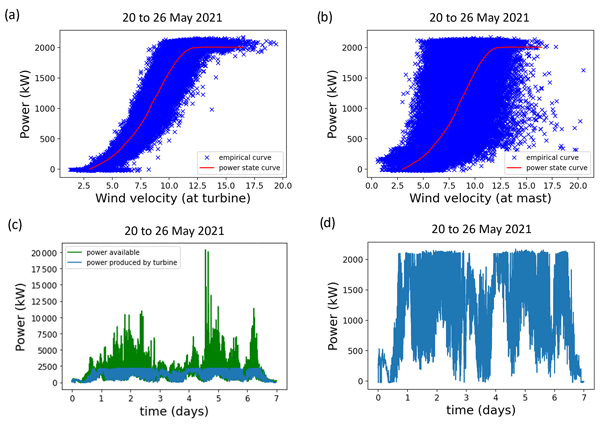
Wind energy exhibits extreme variability in space and time. However, it also shows scaling properties (properties that remain similar across different times and spaces of measurement). This can be quantified using appropriate statistical tools. In this way, the scaling properties of power from a wind farm are analysed here. Since every turbine is manufactured by design for a rated power, this acts as an upper limit on the data. This bias is identified here using data and numerical simulations.
Jerry Jose, Auguste Gires, Ernani Schnorenberger, Yelva Roustan, Daniel Schertzer, and Ioulia Tchiguirinskaia
Nonlin. Processes Geophys., 31, 603–624, https://doi.org/10.5194/npg-31-603-2024, https://doi.org/10.5194/npg-31-603-2024, 2024
Short summary
Short summary
To understand the influence of rainfall on wind power production, turbine power and rainfall were measured simultaneously on an operational wind farm and analysed. The correlation between wind, wind power, air density, and other fields was obtained on various temporal scales under rainy and dry conditions. An increase in the correlation was observed with an increase in the rain; rain also influenced the correspondence between actual and expected values of power at various velocities.
Auguste Gires, Ioulia Tchiguirinskaia, and Daniel Schertzer
Atmos. Meas. Tech., 15, 5861–5875, https://doi.org/10.5194/amt-15-5861-2022, https://doi.org/10.5194/amt-15-5861-2022, 2022
Short summary
Short summary
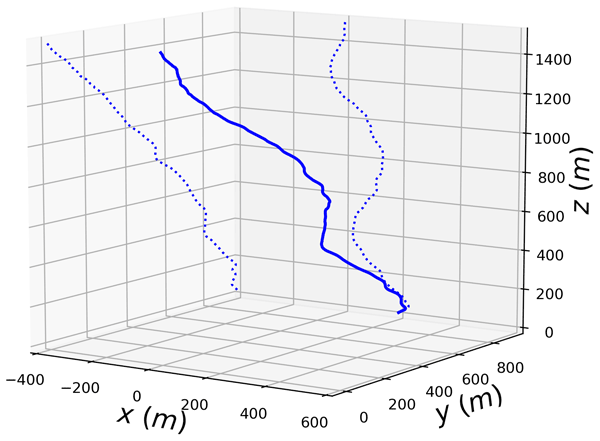
Weather radars measure rainfall in altitude whereas hydro-meteorologists are mainly interested in rainfall at ground level. During their fall, drops are advected by the wind which affects the location of the measured field. Governing equation linking acceleration, gravity, buoyancy, and drag force is updated to account for oblateness of drops. Then multifractal wind is used as input to explore velocities and trajectories of drops. Finally consequence on radar rainfall estimation is discussed.
Auguste Gires, Jerry Jose, Ioulia Tchiguirinskaia, and Daniel Schertzer
Earth Syst. Sci. Data, 14, 3807–3819, https://doi.org/10.5194/essd-14-3807-2022, https://doi.org/10.5194/essd-14-3807-2022, 2022
Short summary
Short summary
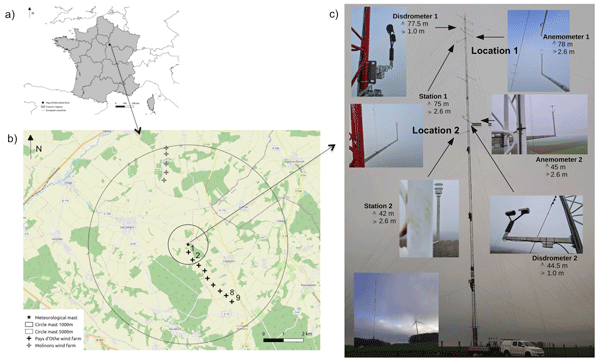
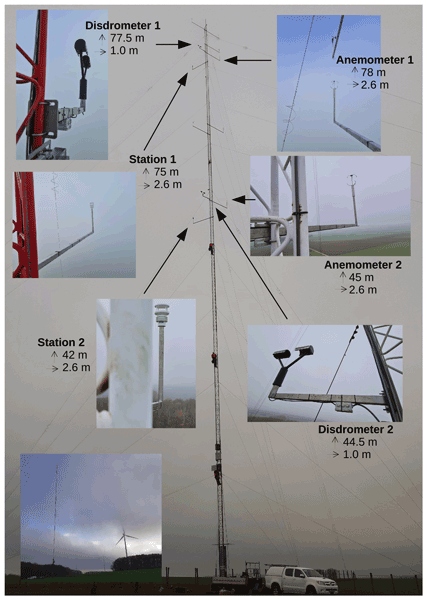
The Hydrology Meteorology and Complexity laboratory of École des Ponts ParisTech (https://hmco.enpc.fr) has made a data set of high-resolution atmospheric measurements (rainfall, wind, temperature, pressure, and humidity) available. It comes from a campaign carried out on a meteorological mast located on a wind farm in the framework of the Rainfall Wind Turbine or Turbulence project (RW-Turb; supported by the French National Research Agency – ANR-19-CE05-0022).
Bing-Zhang Wang, Li-Pen Wang, and Auguste Gires
EGUsphere, https://doi.org/10.5194/egusphere-2026-2406, https://doi.org/10.5194/egusphere-2026-2406, 2026
This preprint is open for discussion and under review for Hydrology and Earth System Sciences (HESS).
Short summary
Short summary
This study presents a new way to create detailed rainfall maps using only a small number of rain gauges. By learning rainfall patterns from radar data, the method can reconstruct realistic rainfall across an area even when measurements are sparse. This approach can improve flood forecasting and water management, especially in regions where weather radar is not available or data coverage is limited.
Ching-Chun Chou, Auguste Gires, Ioulia Tchiguirinskaia, Daniel Schertzer, and Li-Pen Wang
EGUsphere, https://doi.org/10.5194/egusphere-2026-3860, https://doi.org/10.5194/egusphere-2026-3860, 2026
This preprint is open for discussion and under review for Nonlinear Processes in Geophysics (NPG).
Short summary
Short summary
Heavy rainfall from typhoons can trigger sudden floods, yet the most intense bursts are brief and easily missed. We measured rain every ten seconds during three 2022 typhoons in Taiwan and examined how the patterns behaved across time scales. One storm produced exceptionally concentrated, rare rainfall, while the others were limited by record length. The results show that fast measurements matter because slower instruments smooth out these peaks and can lead us to underestimate flood risk.
Jerry Jose, Auguste Gires, Yelva Roustan, Ernani Schnorenberger, Ioulia Tchiguirinskaia, and Daniel Schertzer
Nonlin. Processes Geophys., 31, 587–602, https://doi.org/10.5194/npg-31-587-2024, https://doi.org/10.5194/npg-31-587-2024, 2024
Short summary
Short summary
Wind energy exhibits extreme variability in space and time. However, it also shows scaling properties (properties that remain similar across different times and spaces of measurement). This can be quantified using appropriate statistical tools. In this way, the scaling properties of power from a wind farm are analysed here. Since every turbine is manufactured by design for a rated power, this acts as an upper limit on the data. This bias is identified here using data and numerical simulations.
Jerry Jose, Auguste Gires, Ernani Schnorenberger, Yelva Roustan, Daniel Schertzer, and Ioulia Tchiguirinskaia
Nonlin. Processes Geophys., 31, 603–624, https://doi.org/10.5194/npg-31-603-2024, https://doi.org/10.5194/npg-31-603-2024, 2024
Short summary
Short summary
To understand the influence of rainfall on wind power production, turbine power and rainfall were measured simultaneously on an operational wind farm and analysed. The correlation between wind, wind power, air density, and other fields was obtained on various temporal scales under rainy and dry conditions. An increase in the correlation was observed with an increase in the rain; rain also influenced the correspondence between actual and expected values of power at various velocities.
Auguste Gires, Ioulia Tchiguirinskaia, and Daniel Schertzer
Atmos. Meas. Tech., 15, 5861–5875, https://doi.org/10.5194/amt-15-5861-2022, https://doi.org/10.5194/amt-15-5861-2022, 2022
Short summary
Short summary
Weather radars measure rainfall in altitude whereas hydro-meteorologists are mainly interested in rainfall at ground level. During their fall, drops are advected by the wind which affects the location of the measured field. Governing equation linking acceleration, gravity, buoyancy, and drag force is updated to account for oblateness of drops. Then multifractal wind is used as input to explore velocities and trajectories of drops. Finally consequence on radar rainfall estimation is discussed.
Auguste Gires, Jerry Jose, Ioulia Tchiguirinskaia, and Daniel Schertzer
Earth Syst. Sci. Data, 14, 3807–3819, https://doi.org/10.5194/essd-14-3807-2022, https://doi.org/10.5194/essd-14-3807-2022, 2022
Short summary
Short summary
The Hydrology Meteorology and Complexity laboratory of École des Ponts ParisTech (https://hmco.enpc.fr) has made a data set of high-resolution atmospheric measurements (rainfall, wind, temperature, pressure, and humidity) available. It comes from a campaign carried out on a meteorological mast located on a wind farm in the framework of the Rainfall Wind Turbine or Turbulence project (RW-Turb; supported by the French National Research Agency – ANR-19-CE05-0022).
Cited articles
Borga, M., Stoffel, M., Marchi, L., Marra, F., and Jakob, M.: Hydrogeomorphic response to extreme rainfall in headwater systems: Flash floods and debris flows, J. Hydrol., 518, 194–205, https://doi.org/10.1016/j.jhydrol.2014.05.022, 2014. a
Capozzi, V., Annella, C., Montopoli, M., Adirosi, E., Fusco, G., and Budillon, G.: Influence of Wind-Induced Effects on Laser Disdrometer Measurements: Analysis and Compensation Strategies, Remote Sens., 13, https://doi.org/10.3390/rs13153028, 2021. a
Chagnaud, G., Blanchet, J., Evin, G., Hingray, B., Lebel, T., Panthou, G., and Vischel, T.: How fast is the frequency of precipitation extremes doubling in global land regions?, Environ. Res. Commun., 6, 121010, https://doi.org/10.1088/2515-7620/ad9f12, 2024. a, b
Chen, Y., Li, W., Jiang, X., Zhai, P., and Luo, Y.: Detectable Intensification of Hourly and Daily Scale Precipitation Extremes across Eastern China, J. Clim., 34, 1185–1201, https://doi.org/10.1175/JCLI-D-20-0462.1, 2021. a
Chinchella, E., Cauteruccio, A., and Lanza, L. G.: Quantifying the Wind-Induced Bias of Rainfall Measurements for the Thies CLIMA Optical Disdrometer, Water Resour. Res., 60, https://doi.org/10.1029/2024WR037366, 2024. a
Chinchella, E., Cauteruccio, A., and Lanza, L. G.: Impact of Wind on Rainfall Measurements Obtained from the OTT Parsivel2 Disdrometer, Sensors, 25, https://doi.org/10.3390/s25206440, 2025. a
Dallan, E., Borga, M., Fosser, G., Canale, A., Roghani, B., Marani, M., and Marra, F.: A Method to Assess and Explain Changes in Sub-Daily Precipitation Return Levels From Convection-Permitting Simulations, Water Resour. Res., 60, https://doi.org/10.1029/2023WR035969, 2024. a
de Lima, M. and Grasman, J.: Multifractal analysis of 15-min and daily rainfall from a semi-arid region in Portugal, J. Hydrol., 220, 1–11, https://doi.org/10.1016/S0022-1694(99)00053-0, 1999. a
de Montera, L., Barthès, L., Mallet, C., and Golé, P.: The Effect of Rain – No Rain Intermittency on the Estimation of the Universal Multifractals Model Parameters, J. Hydrometeorol., 10, 493–506, https://doi.org/10.1175/2008JHM1040.1, 2009. a
Douglas, E. M. and Barros, A. P.: Probable Maximum Precipitation Estimation Using Multifractals: Application in the Eastern United States, J. Hydrometeorol., 4, 1012–1024, https://doi.org/10.1175/1525-7541(2003)004<1012:PMPEUM>2.0.CO;2, 2003. a
Drobinski, P., Alonzo, B., Bastin, S., Silva, N. D., and Muller, C.: Scaling of precipitation extremes with temperature in the French Mediterranean region: What explains the hook shape?, J. Geophys. Res.-Atmos., 121, 3100–3119, https://doi.org/10.1002/2015JD023497, 2016. a
Emmanouil, S., Langousis, A., Nikolopoulos, E. I., and Anagnostou, E. N.: Quantitative assessment of annual maxima, peaks-over-threshold and multifractal parametric approaches in estimating intensity-duration-frequency curves from short rainfall records, J.Hydrol., 589, 125151, https://doi.org/10.1016/j.jhydrol.2020.125151, 2020. a
Emmanouil, S., Langousis, A., Nikolopoulos, E. I., and Anagnostou, E. N.: The Spatiotemporal Evolution of Rainfall Extremes in a Changing Climate: A CONUS-Wide Assessment Based on Multifractal Scaling Arguments, Earth's Future, 10, e2021EF002539, https://doi.org/10.1029/2021EF002539, 2022. a, b
Emmanouil, S., Langousis, A., Nikolopoulos, E. I., and Anagnostou, E. N.: Exploring the Future of Rainfall Extremes Over CONUS: The Effects of High Emission Climate Change Trajectories on the Intensity and Frequency of Rare Precipitation Events, Earth's Future, 11, e2022EF003039, https://doi.org/10.1029/2022EF003039, 2023. a
Fowler, H. J., Lenderink, G., Prein, A. F., Westra, S., Allan, R. P., Ban, N., Barbero, R., Berg, P., Blenkinsop, S., Do, H. X., Guerreiro, S., Haerter, J. O., Kendon, E. J., Lewis, E., Schaer, C., Sharma, A., Villarini, G., Wasko, C., and Zhang, X.: Anthropogenic intensification of short-duration rainfall extremes, Nat. Rev. Earth Environ., 2, 107–122, https://doi.org/10.1038/s43017-020-00128-6, 2021. a, b, c
Gires, A.: Data for “A Universal Multifractals perspective into the link between rainfall extremes and temperature”, Zenodo, https://doi.org/10.5281/zenodo.16406221, 2025. a, b
Gires, A., Tchiguirinskaia, I., Schertzer, D., and Lovejoy, S.: Influence of the zero-rainfall on the assessment of the multifractal parameters, Adv. Water Res., 45, 13–25, http://www.sciencedirect.com/science/article/pii/S0309170812000814 (last access: 24 July 2026), 2012. a
Gires, A., Tchiguirinskaia, I., and Schertzer, D.: Multifractal comparison of the outputs of two optical disdrometers, Hydrol. Sci. J., 61, 1641–1651, https://doi.org/10.1080/02626667.2015.1055270, 2016. a
Gires, A., Tchiguirinskaia, I., and Schertzer, D.: Two months of disdrometer data in the Paris area, Earth Syst. Sci. Data, 10, 941–950, https://doi.org/10.5194/essd-10-941-2018, 2018. a
Gires, A., Jose, J., Tchiguirinskaia, I., and Schertzer, D.: Combined high-resolution rainfall and wind data collected for 3 months on a wind farm 110 km southeast of Paris (France), Earth Syst. Sci. Data, 14, 3807–3819, https://doi.org/10.5194/essd-14-3807-2022, 2022. a
Haerter, J. O. and Berg, P.: Unexpected rise in extreme precipitation caused by a shift in rain type?, Nat. Geosci., 2, 372–373, https://doi.org/10.1038/ngeo523, 2009. a
Haerter, J. O., Berg, P., and Hagemann, S.: Heavy rain intensity distributions on varying time scales and at different temperatures, J. Geophys. Res.-Atmos., 115, https://doi.org/10.1029/2009JD013384, 2010. a, b
Jose, J., Gires, A., Roustan, Y., Schnorenberger, E., Tchiguirinskaia, I., and Schertzer, D.: Multifractal analysis of wind turbine power and rainfall from an operational wind farm – Part 1: Wind turbine power and the associated biases, Nonl. Proc. Geophys., 31, 587–602, https://doi.org/10.5194/npg-31-587-2024, 2024a. a
Jose, J., Gires, A., Schnorenberger, E., Roustan, Y., Schertzer, D., and Tchiguirinskaia, I.: Multifractal analysis of wind turbine power and rainfall from an operational wind farm – Part 2: Joint analysis of available wind power and rain intensity, Nonl. Proc. Geophys., 31, 603–624, https://doi.org/10.5194/npg-31-603-2024, 2024b. a, b
Ladoy, P., Schmitt, F., Schertzer, D., and Lovejoy, S.: The multifractal temporal variability of nimes rainfall data, Comptes Rendus de l'Academie Des Sciences Serie Ii, 317, 775–782, 1993. a
Langousis, A. and Veneziano, D.: Intensity-duration-frequency curves from scaling representations of rainfall, Water Resour. Res., 43, https://doi.org/10.1029/2006WR005245, 2007. a
Langousis, A., Veneziano, D., Furcolo, P., and Lepore, C.: Multifractal rainfall extremes: Theoretical analysis and practical estimation, Chaos, Solitons and Fractals, 39, 1182–1194, https://doi.org/10.1016/j.chaos.2007.06.004, 2009. a
Lanza, L. G., Merlone, A., Cauteruccio, A., Chinchella, E., Stagnaro, M., Dobre, M., Garcia Izquierdo, M. C., Nielsen, J., Kjeldsen, H., Roulet, Y. A., Coppa, G., Musacchio, C., Bordianu, C., and Parrondo, M.: Calibration of non-catching precipitation measurement instruments: A review, Meteorol. Appl., 28, e2002, https://doi.org/10.1002/met.2002, 2021. a
Lenderink, G. and van Meijgaard, E.: Increase in hourly precipitation extremes beyond expectations from temperature changes, Nat. Geosci., 1, 511–514, https://doi.org/10.1038/ngeo262, 2008. a, b, c
Lenderink, G., Barbero, R., Loriaux, J. M., and Fowler, H. J.: Super-Clausius–Clapeyron Scaling of Extreme Hourly Convective Precipitation and Its Relation to Large-Scale Atmospheric Conditions, J. Clim., 30, 6037–6052, https://doi.org/10.1175/JCLI-D-16-0808.1, 2017. a, b
Li, C., Zwiers, F., Zhang, X., Chen, G., Lu, J., Li, G., Norris, J., Tan, Y., Sun, Y., and Liu, M.: Larger Increases in More Extreme Local Precipitation Events as Climate Warms, Geophys. Res. Lett., 46, 6885–6891, https://doi.org/10.1029/2019GL082908, 2019. a
Lovejoy, S. and Schertzer, D.: Comment on “Are rain rate processes self-similar?” by B. Kedem and L. S. Chiu, Water Resour. Res., 25, 577–579, https://doi.org/10.1029/WR025i003p00577, 1989. a
Lovejoy, S. and Schertzer, D.: Multifractals and rain, in: New Uncertainty Concepts in Hydrology and Hydrological modelling, edited by: Kundzewicz, A. W., 62–103, Cambridge Press, https://doi.org/10.1017/CBO9780511564482.009, 1995. a
Lovejoy, S. and Schertzer, D.: Scaling and multifractal fields in the solid earth and topography, Nonl. Proc. Geophys., 14, 465–502, https://doi.org/10.5194/npg-14-465-2007, 2007. a
Mandapaka, P. V., Lewandowski, P., Eichinger, W. E., and Krajewski, W. F.: Multiscaling analysis of high resolution space-time lidar-rainfall, Nonl. Proc. Geophys., 16, 579–586, https://doi.org/10.5194/npg-16-579-2009, 2009. a
Marra, F., Koukoula, M., Canale, A., and Peleg, N.: Predicting extreme sub-hourly precipitation intensification based on temperature shifts, Hydrol. Earth Syst. Sci., 28, 375–389, https://doi.org/10.5194/hess-28-375-2024, 2024. a
Masson-Delmotte, V., Zhai, P., Pirani, A., Connors, S., Péan, C., Caud, S. B. N., Chen, Y., Goldfarb, L., Gomis, M., Huang, M., Leitzell, K., Lonnoy, E., Matthews, J., Maycock, T., Waterfield, T., Yelekçi, O., Yu, R., and Zhou, B.: IPCC, 2021: Climate Change 2021: The Physical Science Basis. Contribution of Working Group I to the Sixth Assessment Report of the Intergovernmental Panel on Climate Change, https://doi.org/10.1017/9781009157896, 2021. a
Moustakis, Y., Onof, C. J., and Paschalis, A.: Atmospheric convection, dynamics and topography shape the scaling pattern of hourly rainfall extremes with temperature globally, Commun. Earth Environ., 1, 11, https://doi.org/10.1038/s43247-020-0003-0, 2020. a
Moustakis, Y., Papalexiou, S. M., Onof, C. J., and Paschalis, A.: Seasonality, Intensity, and Duration of Rainfall Extremes Change in a Warmer Climate, Earth's Future, 9, e2020EF001824, https://doi.org/10.1029/2020EF001824, 2021. a, b
O’Gorman, P. A.: Precipitation Extremes Under Climate Change, Curr. Clim. Change Rep., 1, 49–59, https://doi.org/10.1007/s40641-015-0009-3, 2015. a
Panthou, G., Mailhot, A., Laurence, E., and Talbot, G.: Relationship between Surface Temperature and Extreme Rainfalls: A Multi-Time-Scale and Event-Based Analysis, J. Hydrometeorol., 15, 1999–2011, https://doi.org/10.1175/JHM-D-14-0020.1, 2014. a, b, c
Parisi, G. and Frisch, U.: A multifractal model of intermittency, in: Turbulence and predictability in geophysical fluid dynamics, edited by Ghill, M., Benzi, R., and Parisi, G., 111–114, Elsevier North Holland, New-York, ISBN-10: 0444869360, 1985. a
Peleg, N., Marra, F., Fatichi, S., Molnar, P., Morin, E., Sharma, A., and Burlando, P.: Intensification of Convective Rain Cells at Warmer Temperatures Observed from High-Resolution Weather Radar Data, J. Hydrometeorol., 19, 715–726, https://doi.org/10.1175/JHM-D-17-0158.1, 2018. a
Qiu, Y., Schertzer, D., Tisserand, B., and Tchiguirinskaia, I.: Spatio-temporal rainfall variability and its impacts on the hydrological response of nature-based solutions, Urban Water J., 21, 1147–1163, https://doi.org/10.1080/1573062X.2023.2180395, 2024. a
Royer, J.-F., Biaou, A., Chauvin, F., Schertzer, D., and Lovejoy, S.: Multifractal analysis of the evolution of simulated precipitation over France in a climate scenario, C. R. Geosci., 340, 431–440, 2008. a
Schertzer, D. and Lovejoy, S.: Physical modeling and analysis of rain and clouds by anisotropic scaling multiplicative processes, J. Geophys. Res.-Atmos., 92, 9693–9714, https://doi.org/10.1029/JD092iD08p09693, 1987. a, b
Schertzer, D. and Lovejoy, S.: Universal Multifractals Do Exist!: Comments on “A Statistical Analysis of Mesoscale Rainfall as a Random Cascade”, J. Appl. Meteorol., 36, 1296–1303, https://doi.org/10.1175/1520-0450(1997)036<1296:UMDECO>2.0.CO;2, 1997. a
Schertzer, D. and Tchiguirinskaia, I.: A Century of Turbulent Cascades and the Emergence of Multifractal Operators, Earth Space Sci., 7, e2019EA000608, https://doi.org/10.1029/2019EA000608, 2020. a, b, c
Schleiss, M.: How intermittency affects the rate at which rainfall extremes respond to changes in temperature, Earth Syst. Dynam., 9, 955–968, https://doi.org/10.5194/esd-9-955-2018, 2018. a
Sharma, S. and Mujumdar, P.: On the relationship of daily rainfall extremes and local mean temperature, J. Hydrol., 572, 179–191, https://doi.org/10.1016/j.jhydrol.2019.02.048, 2019. a
Tessier, Y., Lovejoy, S., and Schertzer, D.: Universal Multifractals: Theory and Observations for Rain and Clouds, J. Appl. Meteorol. Climatol., 32, 223–250, https://doi.org/10.1175/1520-0450(1993)032<0223:UMTAOF>2.0.CO;2, 1993. a
Veneziano, D. and Furcolo, P.: Multifractality of rainfall and scaling of intensity-duration-frequency curves, Water Resour. Res., 38, https://doi.org/10.1029/2001WR000372, 2002. a
Verrier, S., de Montera, L., Barthès, L., and Mallet, C.: Multifractal analysis of African monsoon rain fields, taking into account the zero rain-rate problem, J. Hydrol., 389, 111–120, https://doi.org/10.1016/j.jhydrol.2010.05.035, 2010. a
Short summary
The link between rainfall extremes and temperature has been widely studied and a scale dependence of the rate of increase with temperature is commonly reported. Here we investigate, with high resolution data, how rainfall variability across scales, and the associated extremes, change with temperature. We confirm scaling behaviour and find that the scale invariant maximum observable singularity increases on average with greater temperature. Connection with previous results are discussed.
The link between rainfall extremes and temperature has been widely studied and a scale...