
Articles | Volume 30, issue 2
https://doi.org/10.5194/hess-30-317-2026
© Author(s) 2026. This work is distributed under
the Creative Commons Attribution 4.0 License.
the Creative Commons Attribution 4.0 License.
https://doi.org/10.5194/hess-30-317-2026
© Author(s) 2026. This work is distributed under
the Creative Commons Attribution 4.0 License.
the Creative Commons Attribution 4.0 License.
Research article
| 
23 Jan 2026
Research article |
| 23 Jan 2026
| 23 Jan 2026
Insights into evapotranspiration partitioning based on hydrological observations using the generalized proportionality hypothesis
Amin Hassan
Department of Civil and Environmental Engineering, University of Pittsburgh, Pittsburgh, Pennsylvania, 15213, USA
Iain Colin Prentice
Georgina Mace Centre for the Living Planet, Department of Life Sciences, Imperial College London, Silwood Park Campus, Ascot, UK
Department of Earth System Science, Ministry of Education Key Laboratory for Earth System Modeling, Institute for Global Change Studies, Tsinghua University, Beijing, China
Xu Liang
CORRESPONDING AUTHOR

Department of Civil and Environmental Engineering, University of Pittsburgh, Pittsburgh, Pennsylvania, 15213, USA
Related authors
No articles found.
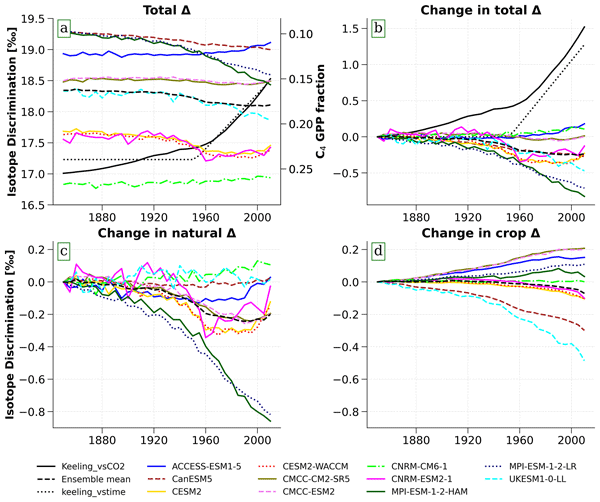
Joseph Ovwemuvwose, Ian Colin Prentice, and Heather Graven
Biogeosciences, 23, 5593–5605, https://doi.org/10.5194/bg-23-5593-2026, https://doi.org/10.5194/bg-23-5593-2026, 2026
Short summary
Short summary
This work examines the roles of cropland representation and the treatment of photosynthetic pathways in the uncertainties of carbon flux simulations in Earth System Models (ESMs). Our results show that reducing these uncertainties will require improvements in the representation of C3 and C4 crops and natural vegetation area coverage, as well as the theories underpinning the simulation of their carbon uptake processes, specifically the implementation of photosynthetic pathways.
Wenyao Gan, Martin Best, Pier Luigi Vidale, I. Colin Prentice, and Sandy P. Harrison
EGUsphere, https://doi.org/10.5194/egusphere-2026-2804, https://doi.org/10.5194/egusphere-2026-2804, 2026
Short summary
Short summary
Plants dynamically adjust their photosynthetic capacity as environmental conditions change, but most land models represent this with fixed parameters set separately for each plant type. We added a simple optimality-based photosynthesis scheme to the Joint UK Land Environment Simulator, allowing photosynthetic capacity to acclimate, and tested it against flux-tower observations together with the standard setups. The new scheme improves simulated carbon uptake without worsening energy fluxes.
Matthew Forrest, Mateus Dantas de Paula, Filipe Gomes de Almeida, Sandy P. Harrison, I. Colin Prentice, and Thomas Hickler
EGUsphere, https://doi.org/10.5194/egusphere-2026-3273, https://doi.org/10.5194/egusphere-2026-3273, 2026
Short summary
Short summary
Global photosynthesis on land is a large flow of carbon in the Earth system which underpins food production and ecosystems. It is particularly important to know how it responds to climate change, but current vegetation models do not agree on this. We implemented a new photosynthesis model based on recent theoretical advances into a vegetation model. We found that it improved the representation of photosynthesis when compared both to global data from satellites and detailed site measurements.
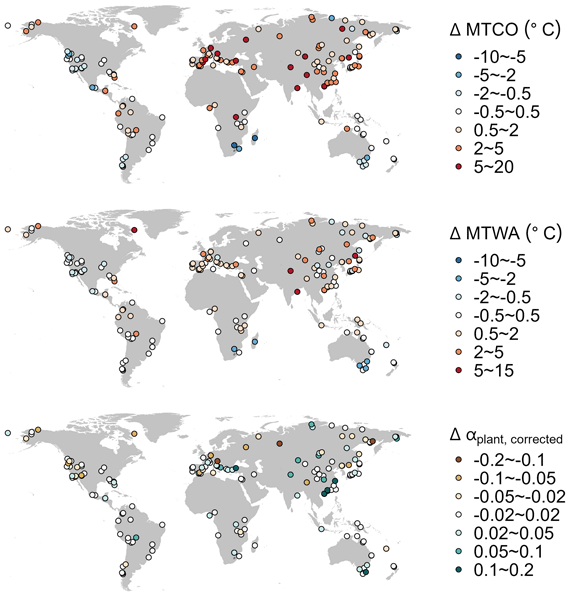
Mengmeng Liu, Iain Colin Prentice, and Sandy P. Harrison
Clim. Past, 22, 205–226, https://doi.org/10.5194/cp-22-205-2026, https://doi.org/10.5194/cp-22-205-2026, 2026
Short summary
Short summary
Dansgaard-Oeschger events were large and rapid climate transitions that occurred multiple times during the last glacial period. We reconstructed the global pattern during these events using fossil pollen records, and found a north-south antiphasing of temperature change, and reduced seasonality in the northern extratropics.
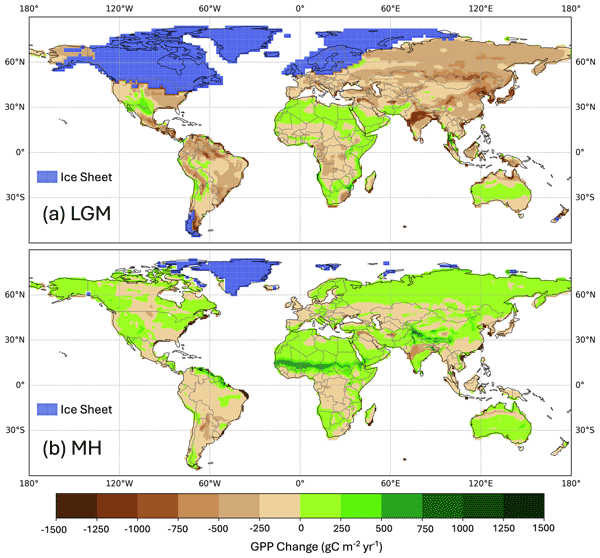
Jierong Zhao, Boya Zhou, Sandy P. Harrison, and Colin Prentice
Earth Syst. Dynam., 16, 1655–1669, https://doi.org/10.5194/esd-16-1655-2025, https://doi.org/10.5194/esd-16-1655-2025, 2025
Short summary
Short summary
We used eco-evolutionary optimality modelling to examine how climate and CO2 impacted vegetation at the Last Glacial Maximum (LGM; 21 000 years ago) and the mid-Holocene (MH; 6000 years ago). Low CO2 at the LGM was as important as climate in reducing tree cover and productivity and in increasing C4 plant abundance. Climate had positive effects on MH vegetation, but the low CO2 was a constraint on plant growth. These results show it is important to consider changing CO2 to model ecosystem changes.
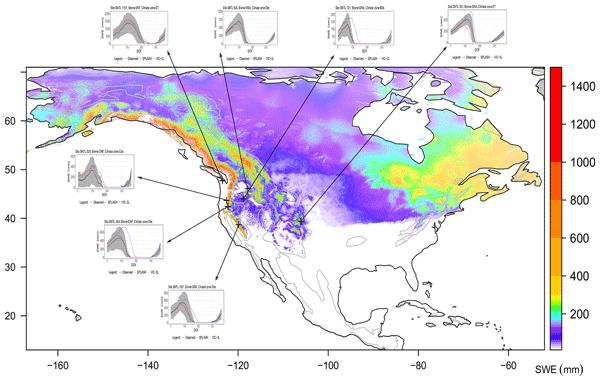
David Sandoval, Iain Colin Prentice, and Rodolfo L. B. Nóbrega
Geosci. Model Dev., 17, 4229–4309, https://doi.org/10.5194/gmd-17-4229-2024, https://doi.org/10.5194/gmd-17-4229-2024, 2024
Short summary
Short summary
Numerous estimates of water and energy balances depend on empirical equations requiring site-specific calibration, posing risks of "the right answers for the wrong reasons". We introduce novel first-principles formulations to calculate key quantities without requiring local calibration, matching predictions from complex land surface models.
Katie R. Blackford, Matthew Kasoar, Chantelle Burton, Eleanor Burke, Iain Colin Prentice, and Apostolos Voulgarakis
Geosci. Model Dev., 17, 3063–3079, https://doi.org/10.5194/gmd-17-3063-2024, https://doi.org/10.5194/gmd-17-3063-2024, 2024
Short summary
Short summary
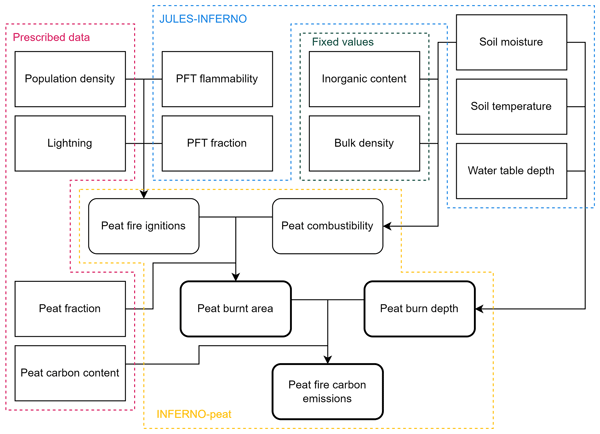
Peatlands are globally important stores of carbon which are being increasingly threatened by wildfires with knock-on effects on the climate system. Here we introduce a novel peat fire parameterization in the northern high latitudes to the INFERNO global fire model. Representing peat fires increases annual burnt area across the high latitudes, alongside improvements in how we capture year-to-year variation in burning and emissions.
Huiying Xu, Han Wang, Iain Colin Prentice, and Sandy P. Harrison
Biogeosciences, 20, 4511–4525, https://doi.org/10.5194/bg-20-4511-2023, https://doi.org/10.5194/bg-20-4511-2023, 2023
Short summary
Short summary
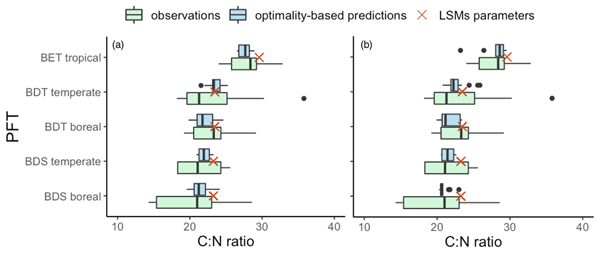
Leaf carbon (C) and nitrogen (N) are crucial elements in leaf construction and physiological processes. This study reconciled the roles of phylogeny, species identity, and climate in stoichiometric traits at individual and community levels. The variations in community-level leaf N and C : N ratio were captured by optimality-based models using climate data. Our results provide an approach to improve the representation of leaf stoichiometry in vegetation models to better couple N with C cycling.
Esmeralda Cruz-Silva, Sandy P. Harrison, I. Colin Prentice, Elena Marinova, Patrick J. Bartlein, Hans Renssen, and Yurui Zhang
Clim. Past, 19, 2093–2108, https://doi.org/10.5194/cp-19-2093-2023, https://doi.org/10.5194/cp-19-2093-2023, 2023
Short summary
Short summary
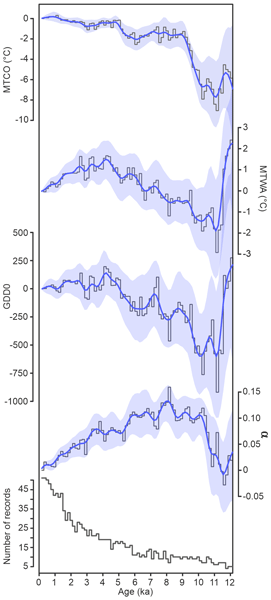
We examined 71 pollen records (12.3 ka to present) in the eastern Mediterranean, reconstructing climate changes. Over 9000 years, winters gradually warmed due to orbital factors. Summer temperatures peaked at 4.5–5 ka, likely declining because of ice sheets. Moisture increased post-11 kyr, remaining high from 10–6 kyr before a slow decrease. Climate models face challenges in replicating moisture transport.
Olivia Haas, Iain Colin Prentice, and Sandy P. Harrison
Biogeosciences, 20, 3981–3995, https://doi.org/10.5194/bg-20-3981-2023, https://doi.org/10.5194/bg-20-3981-2023, 2023
Short summary
Short summary
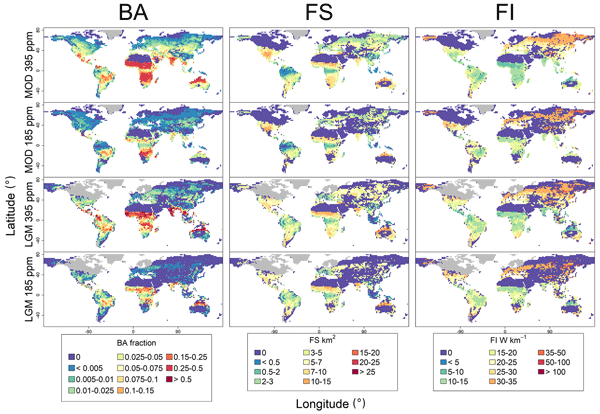
We quantify the impact of CO2 and climate on global patterns of burnt area, fire size, and intensity under Last Glacial Maximum (LGM) conditions using three climate scenarios. Climate change alone did not produce the observed LGM reduction in burnt area, but low CO2 did through reducing vegetation productivity. Fire intensity was sensitive to CO2 but strongly affected by changes in atmospheric dryness. Low CO2 caused smaller fires; climate had the opposite effect except in the driest scenario.
Giulia Mengoli, Sandy P. Harrison, and I. Colin Prentice
EGUsphere, https://doi.org/10.5194/egusphere-2023-1261, https://doi.org/10.5194/egusphere-2023-1261, 2023
Preprint archived
Short summary
Short summary
Soil water availability affects plant carbon uptake by reducing leaf area and/or by closing stomata, which reduces its efficiency. We present a new formulation of how climatic dryness reduces both maximum carbon uptake and the soil-moisture threshold below which it declines further. This formulation illustrates how plants adapt their water conservation strategy to thrive in dry climates, and is step towards a better representation of soil-moisture effects in climate models.
Mengmeng Liu, Yicheng Shen, Penelope González-Sampériz, Graciela Gil-Romera, Cajo J. F. ter Braak, Iain Colin Prentice, and Sandy P. Harrison
Clim. Past, 19, 803–834, https://doi.org/10.5194/cp-19-803-2023, https://doi.org/10.5194/cp-19-803-2023, 2023
Short summary
Short summary
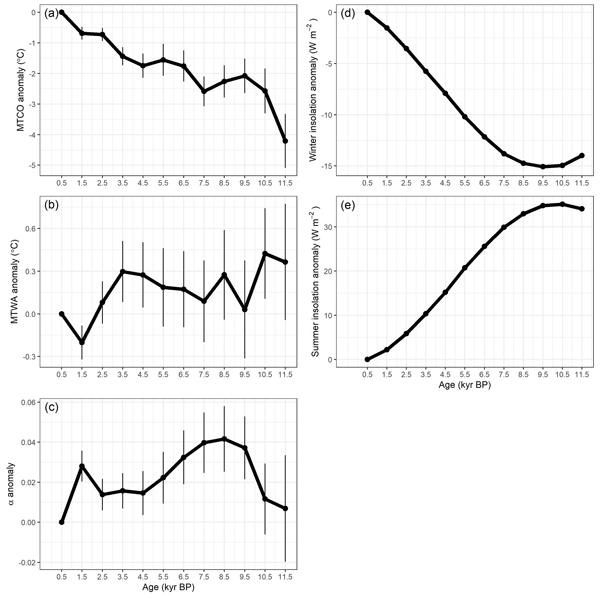
We reconstructed the Holocene climates in the Iberian Peninsula using a large pollen data set and found that the west–east moisture gradient was much flatter than today. We also found that the winter was much colder, which can be expected from the low winter insolation during the Holocene. However, summer temperature did not follow the trend of summer insolation, instead, it was strongly correlated with moisture.
Jing M. Chen, Rong Wang, Yihong Liu, Liming He, Holly Croft, Xiangzhong Luo, Han Wang, Nicholas G. Smith, Trevor F. Keenan, I. Colin Prentice, Yongguang Zhang, Weimin Ju, and Ning Dong
Earth Syst. Sci. Data, 14, 4077–4093, https://doi.org/10.5194/essd-14-4077-2022, https://doi.org/10.5194/essd-14-4077-2022, 2022
Short summary
Short summary
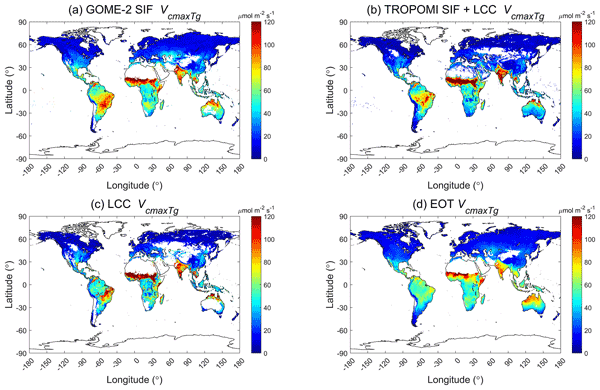
Green leaves contain chlorophyll pigments that harvest light for photosynthesis and also emit chlorophyll fluorescence as a byproduct. Both chlorophyll pigments and fluorescence can be measured by Earth-orbiting satellite sensors. Here we demonstrate that leaf photosynthetic capacity can be reliably derived globally using these measurements. This new satellite-based information overcomes a bottleneck in global ecological research where such spatially explicit information is currently lacking.
Yicheng Shen, Luke Sweeney, Mengmeng Liu, Jose Antonio Lopez Saez, Sebastián Pérez-Díaz, Reyes Luelmo-Lautenschlaeger, Graciela Gil-Romera, Dana Hoefer, Gonzalo Jiménez-Moreno, Heike Schneider, I. Colin Prentice, and Sandy P. Harrison
Clim. Past, 18, 1189–1201, https://doi.org/10.5194/cp-18-1189-2022, https://doi.org/10.5194/cp-18-1189-2022, 2022
Short summary
Short summary
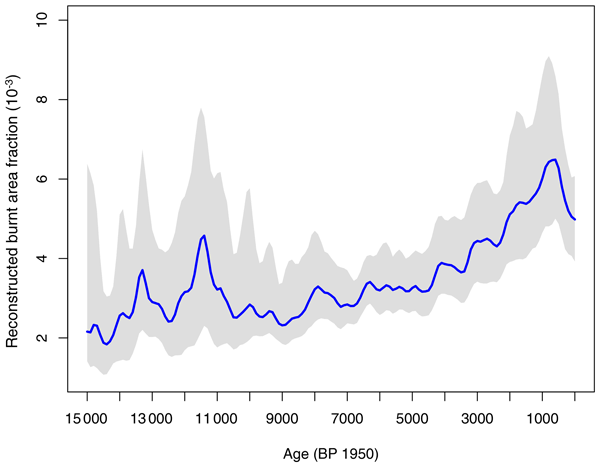
We present a method to reconstruct burnt area using a relationship between pollen and charcoal abundances and the calibration of charcoal abundance using modern observations of burnt area. We use this method to reconstruct changes in burnt area over the past 12 000 years from sites in Iberia. We show that regional changes in burnt area reflect known changes in climate, with a high burnt area during warming intervals and low burnt area when the climate was cooler and/or wetter than today.
Cited articles
Abeshu, G. W. and Li, H. Y.: Horton Index: Conceptual Framework for Exploring Multi-Scale Links Between Catchment Water Balance and Vegetation Dynamics, Water Resources Research, 57, https://doi.org/10.1029/2020WR029343, 2021.
Abolafia-Rosenzweig, R., Badger, A. M., Small, E. E., and Livneh, B.: A continental-scale soil evaporation dataset derived from Soil Moisture Active Passive satellite drying rates, Scientific Data, 7, 1–10, https://doi.org/10.1038/s41597-020-00748-z, 2020.
Alemohammad, S. H., Fang, B., Konings, A. G., Aires, F., Green, J. K., Kolassa, J., Miralles, D., Prigent, C., and Gentine, P.: Water, Energy, and Carbon with Artificial Neural Networks (WECANN): a statistically based estimate of global surface turbulent fluxes and gross primary productivity using solar-induced fluorescence, Biogeosciences, 14, 4101–4124, https://doi.org/10.5194/bg-14-4101-2017, 2017.
Arsenault, R., Brissette, F., Martel, J. L., Troin, M., Lévesque, G., Davidson-Chaput, J., Gonzalez, M. C., Ameli, A., and Poulin, A.: A comprehensive, multisource database for hydrometeorological modeling of 14,425 North American watersheds, Scientific Data, 7, https://doi.org/10.1038/s41597-020-00583-2, 2020.
Arsenault, R., Brissette, F., Martel, J., et al.: HYSETS – A 14425 watershed Hydrometeorological Sandbox over North America, OSF [data set], https://doi.org/10.17605/OSF.IO/RPC3W, 2024.
Baver, L. D., Gardner, W. H., and Gardner, W. R.: Soil Physics, John Wiley & Sons, New York, ISBN 0471059749, 1972.
Berkelhammer, M., Noone, D. C., Wong, T. E., Burns, S. P., Knowles, J. F., Kaushik, A., Blanken, P. D., and Williams, M. W.: Convergent approaches to determine an ecosystem's transpiration fraction, Global Biogeochemical Cycles, 30, 933–951, https://doi.org/10.1002/2016GB005392, 2016.
Cai, W., Zhu, Z., Harrison, S. P., Ryu, Y., Wang, H., Zhou, B., and Prentice, I. C.: A unifying principle for global greenness patterns and trends, Commun. Earth Environ., 6, 19, https://doi.org/10.1038/s43247-025-01992-0, 2025.
Cao, R., Huang, H., Wu, G., Han, D., Jiang, Z., Di, K., and Hu, Z.: Spatiotemporal variations in the ratio of transpiration to evapotranspiration and its controlling factors across terrestrial biomes, Agricultural and Forest Meteorology, 321, https://doi.org/10.1016/j.agrformet.2022.108984, 2022.
Cavanaugh, M. L., Kurc, S. A., and Scott, R. L.: Evapotranspiration partitioning in semiarid shrubland ecosystems: a two-site evaluation of soil moisture control on transpiration, Ecohydrology, 4, 671–681, https://doi.org/10.1002/ECO.157, 2011.
Čermák, J., Deml, M., and Penka, M.: A new method of sap flow rate determination in trees, Biologia Plantarum, 15, 171–178, https://doi.org/10.1007/BF02922390, 1973.
Čermák, J., Kučera, J., and Nadezhdina, N.: Sap flow measurements with some thermodynamic methods, flow integration within trees and scaling up from sample trees to entire forest stands, Trees, 18, 529–546, https://doi.org/10.1007/S00468-004-0339-6, 2004.
Chaves, M. M., Maroco, J. P., and Pereira, J. S.: Understanding plant responses to drought – from genes to the whole plant, Functional Plant Biology, 30, 239, https://doi.org/10.1071/FP02076, 2003.
Chen, X. and Wang, D.: Modeling seasonal surface runoff and base flow based on the generalized proportionality hypothesis, Journal of Hydrology, 527, 367–379, https://doi.org/10.1016/j.jhydrol.2015.04.059, 2015.
Cohen, Y., Fuchs, M., and Green, G. C.: Improvement of the heat pulse method for determining sap flow in trees, Plant, Cell & Environment, 4, 391–397, https://doi.org/10.1111/J.1365-3040.1981.TB02117.X, 1981.
Damm, A., Roethlin, S., and Fritsche, L.: Towards advanced retrievals of plant transpiration using suninduced chlorophyll fluorescence: First considerations, International Geoscience and Remote Sensing Symposium (IGARSS), July 2018, 5983–5986, https://doi.org/10.1109/IGARSS.2018.8518974, 2018.
Dixon, M. and Grace, J.: Effect of Wind on the Transpiration of Young Trees, Annals of Botany, 53, 811–819, https://doi.org/10.1093/oxfordjournals.aob.a086751, 1984.
Eckhardt, K.: How to construct recursive digital filters for baseflow separation, Hydrological Processes, 19, 507–515, https://doi.org/10.1002/hyp.5675, 2005.
Eckhardt, K.: A comparison of baseflow indices, which were calculated with seven different baseflow separation methods, Journal of Hydrology, 352, 168–173, https://doi.org/10.1016/J.JHYDROL.2008.01.005, 2008.
Fan, J., McConkey, B., Wang, H., and Janzen, H.: Root distribution by depth for temperate agricultural crops, Field Crops Research, 189, 68–74, https://doi.org/10.1016/j.fcr.2016.02.013, 2016.
Gardner, W. R.: Soil Properties and Efficient Water Use: An Overview, in: Limitations to Efficient Water Use in Crop Production, 45–64, https://doi.org/10.2134/1983.limitationstoefficientwateruse.c3, 1983.
Gerrits, A. M. J., Savenije, H. H. G., Veling, E. J. M., and Pfister, L.: Analytical derivation of the Budyko curve based on rainfall characteristics and a simple evaporation model, Water Resources Research, 45, https://doi.org/10.1029/2008WR007308, 2009.
Good, S. P., Moore, G. W., and Miralles, D. G.: A mesic maximum in biological water use demarcates biome sensitivity to aridity shifts, Nature Ecology and Evolution, 1, 1883–1888, https://doi.org/10.1038/s41559-017-0371-8, 2017.
Granier, A.: Une nouvelle méthode pour la mesure du flux de sève brute dans le tronc des arbres, Annales des Sciences Forestières, 42, 193–200, https://doi.org/10.1051/forest:19850204, 1985.
Green, J. K., Zhang, Y., Luo, X., and Keenan, T. F.: Systematic Underestimation of Canopy Conductance Sensitivity to Drought by Earth System Models, AGU Advances, 5, https://doi.org/10.1029/2023AV001026, 2024.
Green, S., Clothier, B., and Jardine, B.: Theory and Practical Application of Heat Pulse to Measure Sap Flow, Agronomy Journal, 95, 1371–1379, https://doi.org/10.2134/agronj2003.1371, 2003.
Griffis, T. J.: Tracing the flow of carbon dioxide and water vapor between the biosphere and atmosphere: A review of optical isotope techniques and their application, Agricultural and Forest Meteorology, 174–175, 85–109, https://doi.org/10.1016/J.AGRFORMET.2013.02.009, 2013.
Gupta, H. V., Kling, H., Yilmaz, K. K., and Martinez, G. F.: Decomposition of the mean squared error and NSE performance criteria: Implications for improving hydrological modelling, Journal of Hydrology, 377, 80–91, https://doi.org/10.1016/j.jhydrol.2009.08.003, 2009.
Hall, A., Cox, P., Huntingford, C., and Klein, S.: Progressing emergent constraints on future climate change, Nature Climate Change, 9, 269–278, https://doi.org/10.1038/s41558-019-0436-6, 2019.
Hassan, A., Prentice, I. C., and Liang, X.: Understanding the Variability in Potential Evapotranspiration (PET) Products for U.S. Watersheds, in: AGU24, 9–13 December 2024, https://agu.confex.com/agu/agu24/meetingapp.cgi/Paper/1599970, last access: 13 December 2024.
Huang, C.-W., Chu, C.-R., Hsieh, C.-I., Palmroth, S., and Katul, G. G.: Wind-induced leaf transpiration, Advances in Water Resources, 86, 240–255, https://doi.org/10.1016/j.advwatres.2015.10.009, 2015.
Hurkmans, R. T. W. L., De Moel, H., Aerts, J. C. J. H., and Troch, P. A.: Water balance versus land surface model in the simulation of Rhine river discharges, Water Resources Research, 44, https://doi.org/10.1029/2007WR006168, 2008.
Jackson, R. B., Canadell, J., Ehleringer, J. R., Mooney, H. A., Sala, O. E., and Schulze, E. D.: A global analysis of root distributions for terrestrial biomes, Oecologia, 108, 389–411, https://doi.org/10.1007/BF00333714, 1996.
Kool, D., Agam, N., Lazarovitch, N., Heitman, J. L., Sauer, T. J., and Ben-Gal, A.: A review of approaches for evapotranspiration partitioning, Agricultural and Forest Meteorology, 184, 56–70, https://doi.org/10.1016/j.agrformet.2013.09.003, 2014.
L'Vovich, M. I.: World water resources and their future, American Geophysical Union, 415 pp., https://doi.org/10.1029/SP013, 1979.
Li, B., Ryu, Y., Jiang, C., Dechant, B., Liu, J., Yan, Y., and Li, X.: BESSv2.0: A satellite-based and coupled-process model for quantifying long-term global land–atmosphere fluxes, Remote Sensing of Environment, 295, https://doi.org/10.1016/j.rse.2023.113696, 2023.
Li, M., Wu, P., Ma, Z., Pan, Z., Lv, M., Yang, Q., and Duan, Y.: The Increasing Role of Vegetation Transpiration in Soil Moisture Loss across China under Global Warming, Journal of Hydrometeorology, 23, 253–274, https://doi.org/10.1175/JHM-D-21-0132.1, 2022.
Li, X., Gentine, P., Lin, C., Zhou, S., Sun, Z., Zheng, Y., Liu, J., and Zheng, C.: A simple and objective method to partition evapotranspiration into transpiration and evaporation at eddy-covariance sites, Agricultural and Forest Meteorology, 265, 171–182, https://doi.org/10.1016/J.AGRFORMET.2018.11.017, 2019.
Lim, K. J., Engel, B. A., Tang, Z., Choi, J., Kim, K. S., Muthukrishnan, S., and Tripathy, D.: Automated Web GIS Based Hydrograph Analysis Tool, WHAT, JAWRA Journal of the American Water Resources Association, 41, 1407–1416, https://doi.org/10.1111/J.1752-1688.2005.TB03808.X, 2005.
Lim, K. J., Park, Y. S., Kim, J., Shin, Y. C., Kim, N. W., Kim, S. J., Jeon, J. H., and Engel, B. A.: Development of genetic algorithm-based optimization module in WHAT system for hydrograph analysis and model application, Computers & Geosciences, 36, 936–944, https://doi.org/10.1016/J.CAGEO.2010.01.004, 2010.
Lin, C., Gentine, P., Huang, Y., Guan, K., Kimm, H., and Zhou, S.: Diel ecosystem conductance response to vapor pressure deficit is suboptimal and independent of soil moisture, Agricultural and Forest Meteorology, 250–251, 24–34, https://doi.org/10.1016/J.AGRFORMET.2017.12.078, 2018.
Liu, Y., Zhang, Y., Shan, N., Zhang, Z., and Wei, Z.: Global assessment of partitioning transpiration from evapotranspiration based on satellite solar-induced chlorophyll fluorescence data, Journal of Hydrology, 612, 128044, https://doi.org/10.1016/J.JHYDROL.2022.128044, 2022.
Lozanova, L., Zhiyanski, M., Vanguelova, E., Doncheva, S., Marinov, M. P., and Lazarova, S.: Dynamics and Vertical Distribution of Roots in European Beech Forests and Douglas Fir Plantations in Bulgaria, Forests 2019, 10, 1123, https://doi.org/10.3390/F10121123, 2019.
Lu, X., Liu, Z., An, S., Miralles, D. G., Maes, W., Liu, Y., and Tang, J.: Potential of solar-induced chlorophyll fluorescence to estimate transpiration in a temperate forest, Agricultural and Forest Meteorology, 252, 75–87, https://doi.org/10.1016/J.AGRFORMET.2018.01.017, 2018.
Lyne, V. and Hollick, M.: Stochastic time-variable rainfall-runoff modelling, in: Institute of engineers Australia national conference, 89–93, https://www.researchgate.net/profile/Vincent-Lyne/publication/272491803_Stochastic_Time-Variable_Rainfall-Runoff_Modeling/links/54f45fb40cf299c8d9e6e6c1/Stochastic-Time-Variable-Rainfall-Runoff-Modeling.pdf (last access: 8 May 2025), 1979.
Magliano, P. N., Giménez, R., Houspanossian, J., Páez, R. A., Nosetto, M. D., Fernández, R. J., and Jobbágy, E. G.: Litter is more effective than forest canopy reducing soil evaporation in Dry Chaco rangelands, Ecohydrology, 10, https://doi.org/10.1002/eco.1879, 2017.
Mao, J. and Yan, B.: Global Monthly Mean Leaf Area Index Climatology, 1981–2015, ORNL Distributed Active Archive Center [data set], https://doi.org/10.3334/ORNLDAAC/1653, 2019.
Martens, B., Miralles, D. G., Lievens, H., van der Schalie, R., de Jeu, R. A. M., Fernández-Prieto, D., Beck, H. E., Dorigo, W. A., and Verhoest, N. E. C.: GLEAM v3: satellite-based land evaporation and root-zone soil moisture, Geosci. Model Dev., 10, 1903–1925, https://doi.org/10.5194/gmd-10-1903-2017, 2017.
Medlyn, B. E., Duursma, R. A., Eamus, D., Ellsworth, D. S., Prentice, I. C., Barton, C. V. M., Crous, K. Y., De Angelis, P., Freeman, M., and Wingate, L.: Reconciling the optimal and empirical approaches to modelling stomatal conductance, Global Change Biology, 17, 2134–2144, https://doi.org/10.1111/J.1365-2486.2010.02375.X, 2011.
Mesinger, F., DiMego, G., Kalnay, E., Mitchell, K., Shafran, P. C., Ebisuzaki, W., Jović, D., Woollen, J., Rogers, E., Berbery, E. H., Ek, M. B., Fan, Y., Grumbine, R., Higgins, W., Li, H., Lin, Y., Manikin, G., Parrish, D., and Shi, W.: North American Regional Reanalysis, Bulletin of the American Meteorological Society, 87, 343–360, https://doi.org/10.1175/BAMS-87-3-343, 2006.
Mianabadi, A., Coenders-Gerrits, M., Shirazi, P., Ghahraman, B., and Alizadeh, A.: A global Budyko model to partition evaporation into interception and transpiration, Hydrol. Earth Syst. Sci., 23, 4983–5000, https://doi.org/10.5194/hess-23-4983-2019, 2019.
Moran, M. S., Scott, R. L., Keefer, T. O., Emmerich, W. E., Hernandez, M., Nearing, G. S., Paige, G. B., Cosh, M. H., and O'Neill, P. E.: Partitioning evapotranspiration in semiarid grassland and shrubland ecosystems using time series of soil surface temperature, Agricultural and Forest Meteorology, 149, 59–72, https://doi.org/10.1016/J.AGRFORMET.2008.07.004, 2009.
Niu, Z., He, H., Zhu, G., Ren, X., Zhang, L., Zhang, K., Yu, G., Ge, R., Li, P., Zeng, N., and Zhu, X.: An increasing trend in the ratio of transpiration to total terrestrial evapotranspiration in China from 1982 to 2015 caused by greening and warming, Agricultural and Forest Meteorology, 279, https://doi.org/10.1016/j.agrformet.2019.107701, 2019.
Pagán, B. R., Maes, W. H., Gentine, P., Martens, B., and Miralles, D. G.: Exploring the Potential of Satellite Solar-Induced Fluorescence to Constrain Global Transpiration Estimates, Remote Sensing, 11, 413, https://doi.org/10.3390/RS11040413, 2019.
Peng, L., Zeng, Z., Wei, Z., Chen, A., Wood, E. F., and Sheffield, J.: Determinants of the ratio of actual to potential evapotranspiration, Global Change Biology, 25, 1326–1343, https://doi.org/10.1111/gcb.14577, 2019.
Ponce, V. M. and Shetty, A. V.: A conceptual model of catchment water balance: 1. Formulation and calibration, Journal of Hydrology, 173, 27–40, https://doi.org/10.1016/0022-1694(95)02739-C, 1995a.
Ponce, V. M. and Shetty, A. V.: A conceptual model of catchment water balance: 2. Application to runoff and baseflow modeling, Journal of Hydrology, 173, 41–50, https://doi.org/10.1016/0022-1694(95)02745-B, 1995b.
Pool, S., Vis, M., and Seibert, J.: Evaluating model performance: towards a non-parametric variant of the Kling-Gupta efficiency, Hydrological Sciences Journal, 63, 1941–1953, https://doi.org/10.1080/02626667.2018.1552002, 2018.
Running, S., Mu, Q., Zhao, M., and Moreno, A.: MODIS/Terra Net Evapotranspiration Gap-Filled Yearly L4 Global 500m SIN Grid V061, NASA Land Processes Distributed Active Archive Center [data set], https://doi.org/10.5067/MODIS/MOD16A3GF.061, 2022.
Sakuratani, T.: A Heat Balance Method for Measuring Water Flux in the Stem of Intact Plants, Journal of Agricultural Meteorology, 37, 9–17, https://doi.org/10.2480/AGRMET.37.9, 1981.
Sakuratani, T.: Studies on Evapotranspiration from Crops (2) Separate Estimation of Transpiration and Evaporation from a Soybean Field without Water Shortage, Journal of Agricultural Meteorology, 42, 309–317, https://doi.org/10.2480/AGRMET.42.309, 1987.
Sandoval, D.: dsval/rsplash: Simple process-led algorithms for simulating habitats (SPLASH v.2.0): calibration-free calculations of water and energy fluxes (GMD), Zenodo [code and data set], https://doi.org/10.5281/zenodo.10047627, 2023.
Sandoval, D., Prentice, I. C., and Nóbrega, R. L. B.: Simple process-led algorithms for simulating habitats (SPLASH v.2.0): robust calculations of water and energy fluxes, Geosci. Model Dev., 17, 4229–4309, https://doi.org/10.5194/gmd-17-4229-2024, 2024.
Savenije, H. H. G.: The importance of interception and why we should delete the term evapotranspiration from our vocabulary, Hydrological Processes, 18, 1507–1511, https://doi.org/10.1002/hyp.5563, 2004.
Scanlon, T. M. and Kustas, W. P.: Partitioning carbon dioxide and water vapor fluxes using correlation analysis, Agricultural and Forest Meteorology, 150, 89–99, https://doi.org/10.1016/J.AGRFORMET.2009.09.005, 2010.
Scanlon, T. M. and Kustas, W. P.: Partitioning Evapotranspiration Using an Eddy Covariance-Based Technique: Improved Assessment of Soil Moisture and Land–Atmosphere Exchange Dynamics, Vadose Zone Journal, 11, https://doi.org/10.2136/vzj2012.0025, 2012.
Scanlon, T. M. and Sahu, P.: On the correlation structure of water vapor and carbon dioxide in the atmospheric surface layer: A basis for flux partitioning, Water Resources Research, 44, 10418, https://doi.org/10.1029/2008WR006932, 2008.
Schenk, H. J. and Jackson, R. B.: The Global Biogeography of Roots, Ecological Monographs, 72, 311–328, https://doi.org/10.1890/0012-9615(2002)072[0311:TGBOR]2.0.CO;2, 2002.
Schlesinger, W. H. and Jasechko, S.: Transpiration in the global water cycle, Agricultural and Forest Meteorology, 189–190, 115–117, https://doi.org/10.1016/j.agrformet.2014.01.011, 2014.
Schymanski, S. J. and Or, D.: Wind increases leaf water use efficiency, Plant, Cell & Environment, 39, 1448–1459, https://doi.org/10.1111/pce.12700, 2016.
Scott, R. L. and Biederman, J. A.: Partitioning evapotranspiration using long-term carbon dioxide and water vapor fluxes, Geophysical Research Letters, 44, 6833–6840, https://doi.org/10.1002/2017GL074324, 2017.
Shan, N., Ju, W., Migliavacca, M., Martini, D., Guanter, L., Chen, J., Goulas, Y., and Zhang, Y.: Modeling canopy conductance and transpiration from solar-induced chlorophyll fluorescence, Agricultural and Forest Meteorology, 268, 189–201, https://doi.org/10.1016/J.AGRFORMET.2019.01.031, 2019.
Sivapalan, M., Yaeger, M. A., Harman, C. J., Xu, X., and Troch, P. A.: Functional model of water balance variability at the catchment scale: 1. Evidence of hydrologic similarity and space-time symmetry, Water Resources Research, 47, https://doi.org/10.1029/2010WR009568, 2011.
Skaggs, T. H., Anderson, R. G., Alfieri, J. G., Scanlon, T. M., and Kustas, W. P.: Fluxpart: Open source software for partitioning carbon dioxide and water vapor fluxes, Agricultural and Forest Meteorology, 253–254, 218–224, https://doi.org/10.1016/J.AGRFORMET.2018.02.019, 2018.
Stocker, B. D., Wang, H., Smith, N. G., Harrison, S. P., Keenan, T. F., Sandoval, D., Davis, T., and Prentice, I. C.: P-model v1.0: an optimality-based light use efficiency model for simulating ecosystem gross primary production, Geosci. Model Dev., 13, 1545–1581, https://doi.org/10.5194/gmd-13-1545-2020, 2020.
Stoy, P. C., El-Madany, T. S., Fisher, J. B., Gentine, P., Gerken, T., Good, S. P., Klosterhalfen, A., Liu, S., Miralles, D. G., Perez-Priego, O., Rigden, A. J., Skaggs, T. H., Wohlfahrt, G., Anderson, R. G., Coenders-Gerrits, A. M. J., Jung, M., Maes, W. H., Mammarella, I., Mauder, M., Migliavacca, M., Nelson, J. A., Poyatos, R., Reichstein, M., Scott, R. L., and Wolf, S.: Reviews and syntheses: Turning the challenges of partitioning ecosystem evaporation and transpiration into opportunities, Biogeosciences, 16, 3747–3775, https://doi.org/10.5194/bg-16-3747-2019, 2019.
Swanson, R. H. and Whitfield, D. W. A.: A Numerical Analysis of Heat Pulse Velocity Theory and Practice, Journal of Experimental Botany, 32, 221–239, https://doi.org/10.1093/JXB/32.1.221, 1981.
Tan, S., Wang, H., Prentice, I. C., and Yang, K.: Land-surface evapotranspiration derived from a first-principles primary production model, Environmental Research Letters, 16, 104047, https://doi.org/10.1088/1748-9326/ac29eb, 2021.
Tang, Y. and Wang, D.: Evaluating the role of watershed properties in long-term water balance through a Budyko equation based on two-stage partitioning of precipitation, Water Resources Research, 53, 4142–4157, https://doi.org/10.1002/2016WR019920, 2017.
Thornton, M. M., Shrestha, R., Wei, Y., Thornton, P. E., Kao, S.-C., and Wilson, B. E.: Daymet: Daily Surface Weather Data on a 1-km Grid for North America, Version 4 R1, ORNL Distributed Active Archive Center [data set], https://doi.org/10.3334/ORNLDAAC/2129, 2022.
USDA SCS: National engineering handbook, Section 4, Hydrology, U.S. Dept. of Agriculture, Soil Conservation Service, Washington, D.C., https://ia601205.us.archive.org/27/items/CAT71334647003/CAT71334647003.pdf (last access: 7 September 2022), 1985.
Wallace, A., Romney, E. M., and Cha, J. W.: Depth Distribution of Roots of Some Perennial Plants in the Nevada Test Site Area of the Northern Mojave Desert, Great Basin Naturalist Memoirs, 201–207, https://www.jstor.org/stable/23376679 (last access: 12 October 2022), 1980.
Wang, D. and Tang, Y.: A one-parameter Budyko model for water balance captures emergent behavior in darwinian hydrologic models, Geophysical Research Letters, 41, 4569–4577, https://doi.org/10.1002/2014GL060509, 2014.
Wang, D., Zhao, J., Tang, Y., and Sivapalan, M.: A thermodynamic interpretation of Budyko and L'Vovich formulations of annual water balance: Proportionality Hypothesis and maximum entropy production, Water Resources Research, 51, 3007–3016, https://doi.org/10.1002/2014WR016857, 2015.
Wang, H., Prentice, I. C., Keenan, T. F., Davis, T. W., Wright, I. J., Cornwell, W. K., Evans, B. J., and Peng, C.: Towards a universal model for carbon dioxide uptake by plants, Nature Plants, 3, 734–741, https://doi.org/10.1038/s41477-017-0006-8, 2017.
Wang, L., Good, S. P., and Caylor, K. K.: Global synthesis of vegetation control on evapotranspiration partitioning, Geophysical Research Letters, 41, 6753–6757, https://doi.org/10.1002/2014GL061439, 2014.
Wang, Y., Zhang, Y., Yu, X., Jia, G., Liu, Z., Sun, L., Zheng, P., and Zhu, X.: Grassland soil moisture fluctuation and its relationship with evapotranspiration, Ecological Indicators, 131, https://doi.org/10.1016/j.ecolind.2021.108196, 2021.
Wei, Z., Yoshimura, K., Wang, L., Miralles, D. G., Jasechko, S., and Lee, X.: Revisiting the contribution of transpiration to global terrestrial evapotranspiration, Geophysical Research Letters, 44, 2792–2801, https://doi.org/10.1002/2016GL072235, 2017.
Williams, D. G., Cable, W., Hultine, K., Hoedjes, J. C. B., Yepez, E. A., Simonneaux, V., Er-Raki, S., Boulet, G., De Bruin, H. A. R., Chehbouni, A., Hartogensis, O. K., and Timouk, F.: Evapotranspiration components determined by stable isotope, sap flow and eddy covariance techniques, Agricultural and Forest Meteorology, 125, 241–258, https://doi.org/10.1016/J.AGRFORMET.2004.04.008, 2004.
Williamson, M. S., Thackeray, C. W., Cox, P. M., Hall, A., Huntingford, C., and Nijsse, F. J. M. M.: Emergent constraints on climate sensitivities, Reviews of Modern Physics, 93, https://doi.org/10.1103/RevModPhys.93.025004, 2021.
Xie, J., Liu, X., Wang, K., Yang, T., Liang, K., and Liu, C.: Evaluation of typical methods for baseflow separation in the contiguous United States, Journal of Hydrology, 583, 124628, https://doi.org/10.1016/J.JHYDROL.2020.124628, 2020.
Yu, L., Zhou, S., Zhao, X., Gao, X., Jiang, K., Zhang, B., Cheng, L., Song, X., and Siddique, K. H. M.: Evapotranspiration Partitioning Based on Leaf and Ecosystem Water Use Efficiency, Water Resources Research, 58, https://doi.org/10.1029/2021WR030629, 2022.
Zeng, X.: Global Vegetation Root Distribution for Land Modeling, Journal of Hydrometeorology, 2, 525–530, https://doi.org/10.1175/1525-7541(2001)002<0525:GVRDFL>2.0.CO;2, 2001.
Zhang, J., Duan, L., Liu, T., Chen, Z., Wang, Y., Li, M., and Zhou, Y.: Experimental analysis of soil moisture response to rainfall in a typical grassland hillslope under different vegetation treatments, Environmental Research, 213, https://doi.org/10.1016/j.envres.2022.113608, 2022.
Zhang, K., Kimball, J. S., Nemani, R. R., and Running, S. W.: A continuous satellite-derived global record of land surface evapotranspiration from 1983 to 2006, Water Resources Research, 46, 9522, https://doi.org/10.1029/2009WR008800, 2010.
Zhang, Y., Shen, Y., Sun, H., and Gates, J. B.: Evapotranspiration and its partitioning in an irrigated winter wheat field: A combined isotopic and micrometeorologic approach, Journal of Hydrology, 408, 203–211, https://doi.org/10.1016/J.JHYDROL.2011.07.036, 2011.
Zhou, B., Cai, W., Zhu, Z., Wang, H., Harrison, S. P., and Prentice, I. C.: A General Model for the Seasonal to Decadal Dynamics of Leaf Area, Global Change Biology, 31, https://doi.org/10.1111/gcb.70125, 2025.
Zhou, S., Yu, B., Zhang, Y., Huang, Y., and Wang, G.: Partitioning evapotranspiration based on the concept of underlying water use efficiency, Water Resources Research, 52, 1160–1175, https://doi.org/10.1002/2015WR017766, 2016.
Short summary
Evapotranspiration is evaporation that occurs from plants, soil, and water bodies, but determining these components is difficult. We developed a new method that uses measurements such as streamflow and rainfall to determine the portion of plant evaporation. We found differences among vegetation types and climate conditions, and showed that plant water use peaks in moderately dry regions. The results improve understanding of plant-water interactions and can help improve water and climate models.
Evapotranspiration is evaporation that occurs from plants, soil, and water bodies, but...


