
Articles | Volume 30, issue 6
https://doi.org/10.5194/hess-30-1719-2026
© Author(s) 2026. This work is distributed under
the Creative Commons Attribution 4.0 License.
the Creative Commons Attribution 4.0 License.
https://doi.org/10.5194/hess-30-1719-2026
© Author(s) 2026. This work is distributed under
the Creative Commons Attribution 4.0 License.
the Creative Commons Attribution 4.0 License.
Research article
| 
31 Mar 2026
Research article |
| 31 Mar 2026
| 31 Mar 2026
Leveraging normalized data to improve point-scale estimates of precipitation–temperature scaling rates
Matthew Switanek
CORRESPONDING AUTHOR

Department of Geography and Regional Science, University of Graz, Graz, Austria
Jakob Abermann
Department of Geography and Regional Science, University of Graz, Graz, Austria
Wolfgang Schöner
Department of Geography and Regional Science, University of Graz, Graz, Austria
Michael L. Anderson
California Department of Water Resources, Sacramento, California, United States
Related authors
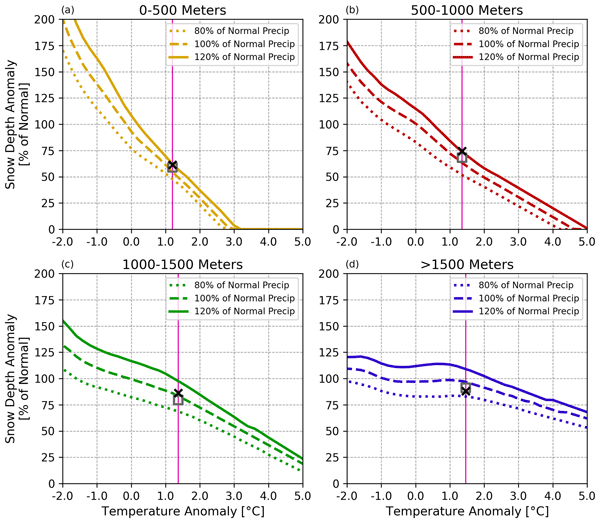
Matthew Switanek, Gernot Resch, Andreas Gobiet, Daniel Günther, Christoph Marty, and Wolfgang Schöner
The Cryosphere, 18, 6005–6026, https://doi.org/10.5194/tc-18-6005-2024, https://doi.org/10.5194/tc-18-6005-2024, 2024
Short summary
Short summary
Snow depth plays an important role in water resources, mountain tourism, and hazard management across the European Alps. Our study uses station-based historical observations to quantify how changes in temperature and precipitation affect average seasonal snow depth. We find that the relationship between these variables has been surprisingly robust over the last 120 years. This allows us to more accurately estimate how future climate will affect seasonal snow depth in different elevation zones.
Marie Schroeder, Ivana Stiperski, Michael Winkler, Georg Kaser, Jakob Steiner, Jakob Abermann, Georg Wohlfahrt, and Rainer Prinz
EGUsphere, https://doi.org/10.5194/egusphere-2026-5112, https://doi.org/10.5194/egusphere-2026-5112, 2026
This preprint is open for discussion and under review for The Cryosphere (TC).
Short summary
Short summary
Steep ice cliffs can lose ice much faster than flat glacier surfaces, yet little is known about how they interact with the air around them. Measurements at a 25-metre-high ice cliff on Kilimanjaro revealed distinct day–night air flows and major differences in how heat is transported. Higher up, heat is transported in an organised way, while near the cliff base this exchange was more complex. The cliff shape and its surroundings can strongly influence how heat reaches the ice and how it is lost.
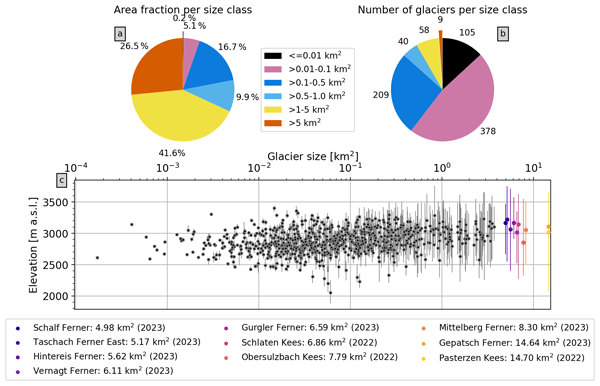
Lea Hartl, Jakob Abermann, Ayla Akgün, Giulia Bertolotti, Tobias Bolch, Svenja Conzelmann, Codrut-Andrei Diaconu, Iris Hansche, Anne Hartig, Anna Haut, Kay Helfricht, Bernhard Hynek, Marie Sophie Kaucher, Andreas Kellerer-Pirklbauer, Ann Christin Kogel, Julie Krippes, Marcela Violeta Lauria, Christoph Mayer, Jan-Christoph Otto, Rainer Prinz, Sina Prölß, Lorenzo Rieg, Lea Schönleber, Gabriele Schwaizer, Bernd Seiser, Martin Stocker-Waldhuber, Markus Strudl, Martin Verhounik, and Harald Zandler
The Cryosphere, 20, 5157–5180, https://doi.org/10.5194/tc-20-5157-2026, https://doi.org/10.5194/tc-20-5157-2026, 2026
Short summary
Short summary
We mapped glacier outlines in Austria using recent, high resolution imagery. The resulting glacier inventory provides an update on glacier area in Austria in 2021-2023. More than 30% of glacier area was lost and 95 glaciers have disappeared since the mid-2000s. Glacier recession is accelerating and regular updates to glacier inventories are needed to understand downstream changes to the hydrological system, quantify glacier mass loss, and support planning and adaptation measures.
Tiago Silva, Kristine Flacké Haualand, Jacob Clement Yde, Johan Hassing Scheller, Jakob Abermann, Andreas Trügler, and Wolfgang Schöner
EGUsphere, https://doi.org/10.5194/egusphere-2026-3687, https://doi.org/10.5194/egusphere-2026-3687, 2026
Short summary
Short summary
Severe downslope windstorms (locally known as piteraq) impact southeast Greenland communities and global ocean currents. Using high-resolution weather reanalysis, we show how piteraq events are driven by massive cold weather systems colliding with Greenland. As the dense air plunges down the steep coastal slopes, it accelerates into concentrated low-level jets. Recognizing the associated large-scale preconditioning will improve early warning systems and future climate predictions.
Kristine Flacké Haualand, Tiago Silva, Kerstin Rasmussen, Caroline Drost Jensen, Johan Hassing Scheller, Jakob Abermann, Simon de Villiers, Andreas Trügler, Wolfgang Schöner, and Jacob Clement Yde
EGUsphere, https://doi.org/10.5194/egusphere-2026-3684, https://doi.org/10.5194/egusphere-2026-3684, 2026
Short summary
Short summary
Southeast Greenland is often affected by damaging windstorms from the Greenland ice sheet. Using weather observations, we find that these windstorms have footprints covering several 100 km in the horizontal and several km in the vertical. The largest seasonal differences are warming instead of cooling and larger reductions in humidity in summer compared to winter. Our findings improve our understanding of spatial and temporal characteristics of these windstorms in the present and future climate.
Christoph Gaisberger, Stefan Muckenhuber, Birgit Schlager, Thomas Goelles, Simon Genser, Markus Schratter, and Wolfgang Schöner
EGUsphere, https://doi.org/10.5194/egusphere-2026-2492, https://doi.org/10.5194/egusphere-2026-2492, 2026
Short summary
Short summary
To utilize newly emerging perception sensors to track rapid environmental changes, like melting glaciers or rock falls, we developed MOSEP (Multi-Sensor Environment Perception), an affordable, portable monitoring system. We tested it by mapping icebergs in Greenland and in heavy rain, proving it works in harsh conditions. By sharing our open-source design, we hope to make advanced environmental monitoring more accessible, helping more scientists to better understand our changing planet.
Jasper F. D. Lammers, Thomas Wagner, Martin Masten, Simon Seelig, Wolfgang Schöner, and Gerfried Winkler
EGUsphere, https://doi.org/10.5194/egusphere-2026-2190, https://doi.org/10.5194/egusphere-2026-2190, 2026
This preprint is open for discussion and under review for The Cryosphere (TC).
Short summary
Short summary
Snow stores water that is released during melt, but its chemical composition changes after it falls. We studied how snowfall chemistry and snow layers evolve in a cirque in Austria. We found that cloud conditions and moisture source humidity set the initial snow chemistry. After snowfall, snowpack chemistry is reshaped by temperature gradients and diffusive mixing. This improves understanding of snow records and their changes, and improves their use in water and climate studies.
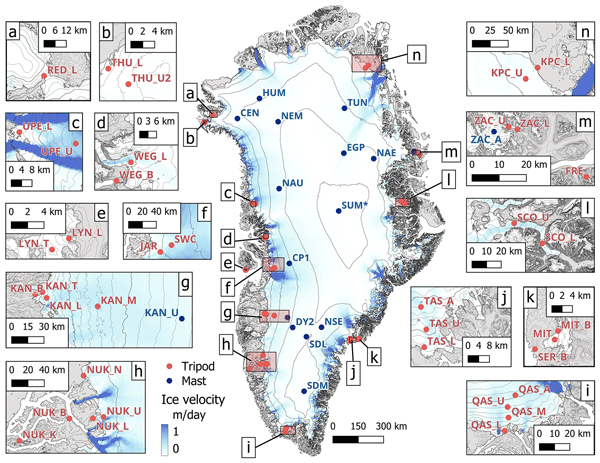
Robert S. Fausto, Penelope How, Baptiste Vandecrux, Mads C. Lund, Jason E. Box, Kenneth D. Mankoff, Signe B. Andersen, Dirk van As, Rasmus Bahbah, Michele Citterio, William Colgan, Henrik T. Jakobsgaard, Nanna B. Karlsson, Kristian K. Kjeldsen, Signe H. Larsen, Charlotte Olsen, Falk M. Oraschewski, Anja Rutishauser, Christopher L. Shields, Anne M. Solgaard, Ian T. Stevens, Synne H. Svendsen, Kirsty Langley, Alexandra Messerli, Anders A. Bjørk, Jonas K. Andersen, Jakob Abermann, Jakob Steiner, Rainer Prinz, Berhard Hynek, James M. Lea, Stephen Brough, and Andreas P. Ahlstrøm
Earth Syst. Sci. Data, 18, 2829–2873, https://doi.org/10.5194/essd-18-2829-2026, https://doi.org/10.5194/essd-18-2829-2026, 2026
Short summary
Short summary
In summary, the PROMICE (Programme for Monitoring of the Greenland Ice Sheet ) | GC-NET AWS (Greenland Climate Network automatic weather station) data product update represents a significant advancement in Arctic climate monitoring. Through enhanced station designs, state-of-the-art instrumentation, and a transparent, automated data processing workflow, the dataset offers an essential resource for studying the Greenland Ice Sheet and its periphery, validating climate models, and supporting global assessments of cryospheric change.
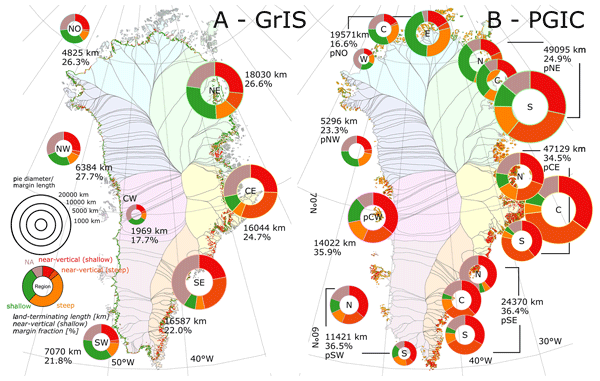
Jakob Steiner, Jakob Abermann, and Rainer Prinz
The Cryosphere, 20, 1797–1814, https://doi.org/10.5194/tc-20-1797-2026, https://doi.org/10.5194/tc-20-1797-2026, 2026
Short summary
Short summary
Nearly 95% of the Greenland ice margin ends on land, where meltwater leaves the ice to supply surrounding ecosystems. Here we show that nearly 30% of this land-terminating margin ends in extremely steep, often vertical sections, previously only described in individual locations. Less than 20% are shallow ramps. Knowledge of these margin shapes and their locations allows us to further investigate what they can potentially tell us about the current ice sheet health and its future evolution.
Jonathan Fipper, Jakob Abermann, Ingo Sasgen, Henrik Skov, Lise Lotte Sørensen, and Wolfgang Schöner
The Cryosphere, 20, 683–698, https://doi.org/10.5194/tc-20-683-2026, https://doi.org/10.5194/tc-20-683-2026, 2026
Short summary
Short summary
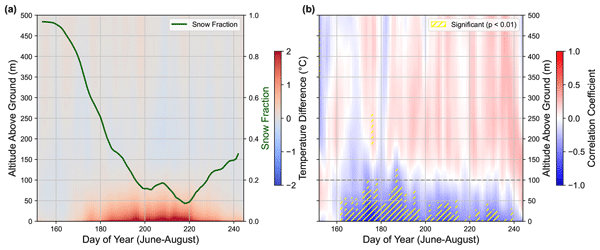
We use measurements conducted with uncrewed aerial vehicles (UAVs) and reanalysis data to study the drivers of vertical air temperature structures and their link to the surface mass balance of Flade Isblink, a large ice cap in Northeast Greenland. Surface properties control temperature structures up to 100 m above ground, while large-scale circulation dominates above. Mass loss has increased since 2015, with record loss in 2023 associated with frequent synoptic conditions favouring melt.
Florina Roana Schalamon, Sebastian Scher, Andreas Trügler, Lea Hartl, Wolfgang Schöner, and Jakob Abermann
Weather Clim. Dynam., 6, 1075–1088, https://doi.org/10.5194/wcd-6-1075-2025, https://doi.org/10.5194/wcd-6-1075-2025, 2025
Short summary
Short summary
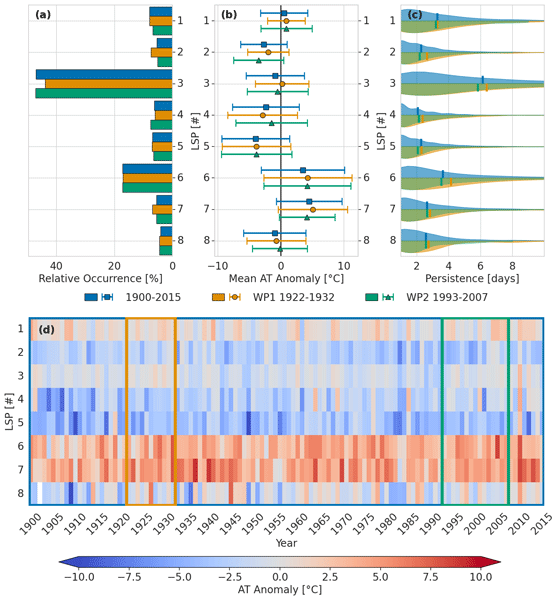
Atmospheric patterns influence the air temperature in Greenland. We investigate two warming periods, from 1922–1932 and 1993–2007, both showing similar temperature increases. Using a neural network-based clustering method, we defined predominant atmospheric patterns for further analysis. Our findings reveal that while the connection between these patterns and local air temperature remains stable, the distribution of patterns changes between the warming periods and the full period (1900–2015).
Tiago Silva, Brandon Samuel Whitley, Elisabeth Machteld Biersma, Jakob Abermann, Katrine Raundrup, Natasha de Vere, Toke Thomas Høye, Verena Haring, and Wolfgang Schöner
Biogeosciences, 22, 4601–4626, https://doi.org/10.5194/bg-22-4601-2025, https://doi.org/10.5194/bg-22-4601-2025, 2025
Short summary
Short summary
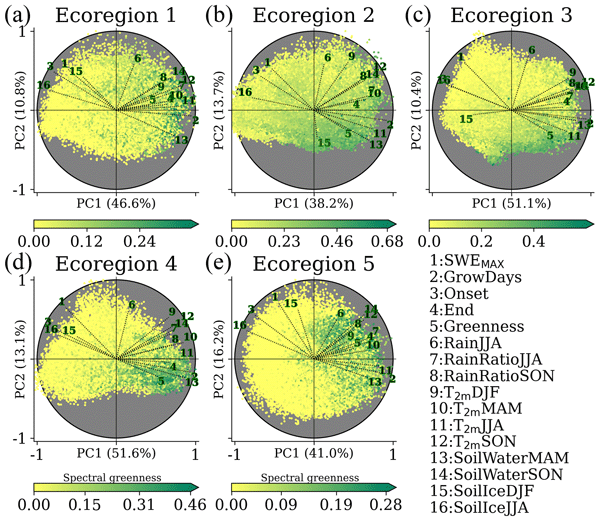
Ecosystems in Greenland have experienced significant changes over recent decades. We show the consistency of a high-resolution polar-adapted reanalysis product to represent bio-climatic factors influencing ecological processes. Our results describe the relevance/interaction between snowmelt and soil water content before the growing season onset, infer how the thermal growing season relates to changes in spectral greenness, and describe regions of ongoing changes in vegetation distribution.
Lea Hartl, Patrick Schmitt, Lilian Schuster, Kay Helfricht, Jakob Abermann, and Fabien Maussion
The Cryosphere, 19, 1431–1452, https://doi.org/10.5194/tc-19-1431-2025, https://doi.org/10.5194/tc-19-1431-2025, 2025
Short summary
Short summary
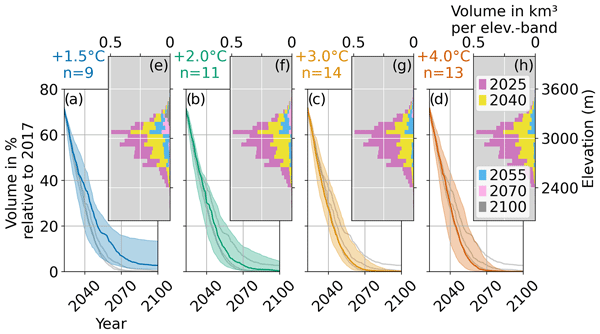
We use regional observations of glacier area and volume change to inform glacier evolution modeling in the Ötztal and Stubai range (Austrian Alps) until 2100 in different climate scenarios. Glaciers in the region lost 23 % of their volume between 2006 and 2017. Under current warming trajectories, glacier loss in the region is expected to be near-total by 2075. We show that integrating regional calibration and validation data in glacier models is important to improve confidence in projections.
Matthew Switanek, Gernot Resch, Andreas Gobiet, Daniel Günther, Christoph Marty, and Wolfgang Schöner
The Cryosphere, 18, 6005–6026, https://doi.org/10.5194/tc-18-6005-2024, https://doi.org/10.5194/tc-18-6005-2024, 2024
Short summary
Short summary
Snow depth plays an important role in water resources, mountain tourism, and hazard management across the European Alps. Our study uses station-based historical observations to quantify how changes in temperature and precipitation affect average seasonal snow depth. We find that the relationship between these variables has been surprisingly robust over the last 120 years. This allows us to more accurately estimate how future climate will affect seasonal snow depth in different elevation zones.
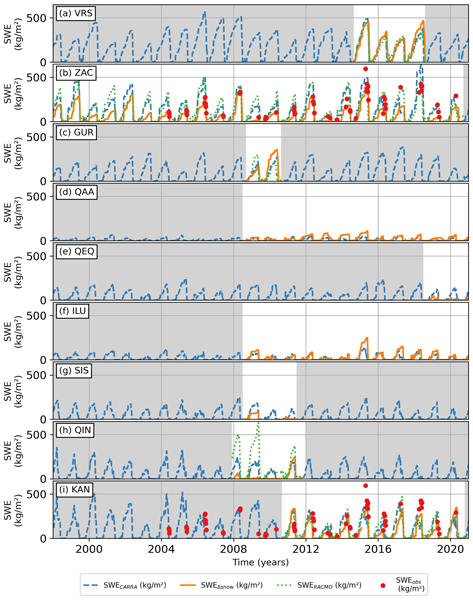
Jorrit van der Schot, Jakob Abermann, Tiago Silva, Kerstin Rasmussen, Michael Winkler, Kirsty Langley, and Wolfgang Schöner
The Cryosphere, 18, 5803–5823, https://doi.org/10.5194/tc-18-5803-2024, https://doi.org/10.5194/tc-18-5803-2024, 2024
Short summary
Short summary
We present snow data from nine locations in coastal Greenland. We show that a reanalysis product (CARRA) simulates seasonal snow characteristics better than a regional climate model (RACMO). CARRA output matches particularly well with our reference dataset when we look at the maximum snow water equivalent and the snow cover end date. We show that seasonal snow in coastal Greenland has large spatial and temporal variability and find little evidence of trends in snow cover characteristics.
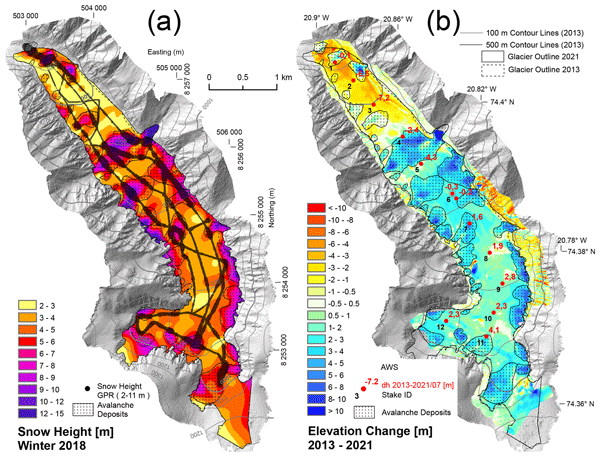
Bernhard Hynek, Daniel Binder, Michele Citterio, Signe Hillerup Larsen, Jakob Abermann, Geert Verhoeven, Elke Ludewig, and Wolfgang Schöner
The Cryosphere, 18, 5481–5494, https://doi.org/10.5194/tc-18-5481-2024, https://doi.org/10.5194/tc-18-5481-2024, 2024
Short summary
Short summary
An avalanche event in February 2018 caused thick snow deposits on Freya Glacier, a peripheral mountain glacier in northeastern Greenland. The avalanche deposits contributed significantly to the mass balance, leaving a strong imprint in the elevation changes in 2013–2021. The 8-year geodetic mass balance (2013–2021) of the glacier is positive, whereas previous estimates by direct measurements were negative and now turned out to have a negative bias.
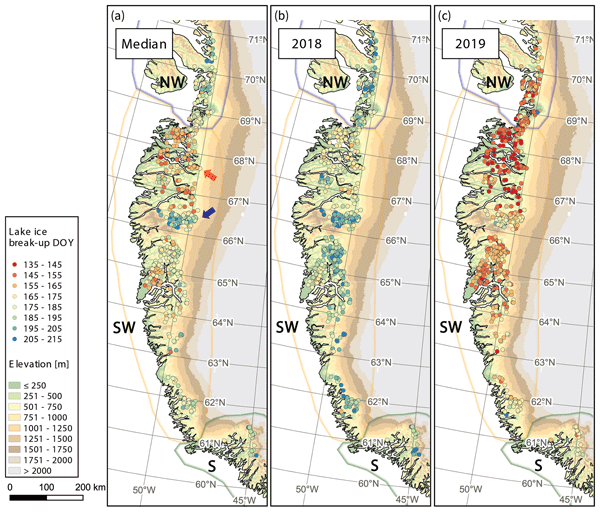
Christoph Posch, Jakob Abermann, and Tiago Silva
The Cryosphere, 18, 2035–2059, https://doi.org/10.5194/tc-18-2035-2024, https://doi.org/10.5194/tc-18-2035-2024, 2024
Short summary
Short summary
Radar beams from satellites exhibit reflection differences between water and ice. This condition, as well as the comprehensive coverage and high temporal resolution of the Sentinel-1 satellites, allows automatically detecting the timing of when ice cover of lakes in Greenland disappear. We found that lake ice breaks up 3 d later per 100 m elevation gain and that the average break-up timing varies by ±8 d in 2017–2021, which has major implications for the energy budget of the lakes.
Florian Lippl, Alexander Maringer, Margit Kurka, Jakob Abermann, Wolfgang Schöner, and Manuela Hirschmugl
Earth Syst. Sci. Data Discuss., https://doi.org/10.5194/essd-2024-12, https://doi.org/10.5194/essd-2024-12, 2024
Preprint withdrawn
Short summary
Short summary
The aim of our work was to give an overview of data currently available for the National Park Gesäuse and Johnsbachtal relevant to the European long-term ecosystem monitoring. This data, further was made available on respective data repositories, where all data is downloadable free of charge. Data presented in our paper is from all compartments, the atmosphere, social & economic sphere, biosphere and geosphere. We consider our approach as an opportunity to function as a showcase for other sites.
Maral Habibi, Iman Babaeian, and Wolfgang Schöner
Hydrol. Earth Syst. Sci. Discuss., https://doi.org/10.5194/hess-2024-48, https://doi.org/10.5194/hess-2024-48, 2024
Publication in HESS not foreseen
Short summary
Short summary
Our study investigates how snow melting affects droughts in Iran's Urmia Lake Basin, revealing that future droughts will likely become more severe due to reduced snowmelt and increased evaporation. This is crucial for understanding water availability in the region, affecting millions. We used advanced climate models and drought indices to predict changes, aiming to inform water management strategies.
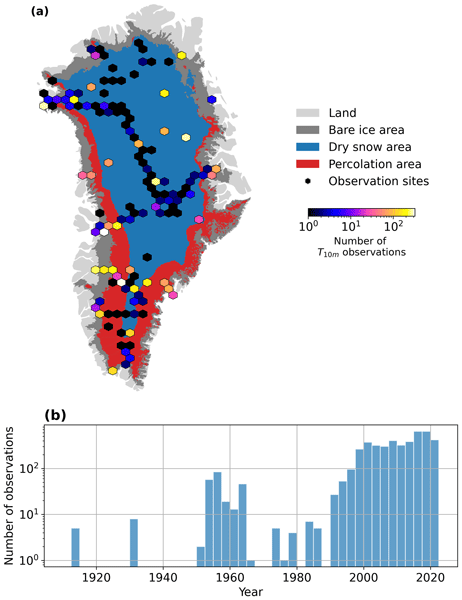
Baptiste Vandecrux, Robert S. Fausto, Jason E. Box, Federico Covi, Regine Hock, Åsa K. Rennermalm, Achim Heilig, Jakob Abermann, Dirk van As, Elisa Bjerre, Xavier Fettweis, Paul C. J. P. Smeets, Peter Kuipers Munneke, Michiel R. van den Broeke, Max Brils, Peter L. Langen, Ruth Mottram, and Andreas P. Ahlstrøm
The Cryosphere, 18, 609–631, https://doi.org/10.5194/tc-18-609-2024, https://doi.org/10.5194/tc-18-609-2024, 2024
Short summary
Short summary
How fast is the Greenland ice sheet warming? In this study, we compiled 4500+ temperature measurements at 10 m below the ice sheet surface (T10m) from 1912 to 2022. We trained a machine learning model on these data and reconstructed T10m for the ice sheet during 1950–2022. After a slight cooling during 1950–1985, the ice sheet warmed at a rate of 0.7 °C per decade until 2022. Climate models showed mixed results compared to our observations and underestimated the warming in key regions.
Sonika Shahi, Jakob Abermann, Tiago Silva, Kirsty Langley, Signe Hillerup Larsen, Mikhail Mastepanov, and Wolfgang Schöner
Weather Clim. Dynam., 4, 747–771, https://doi.org/10.5194/wcd-4-747-2023, https://doi.org/10.5194/wcd-4-747-2023, 2023
Short summary
Short summary
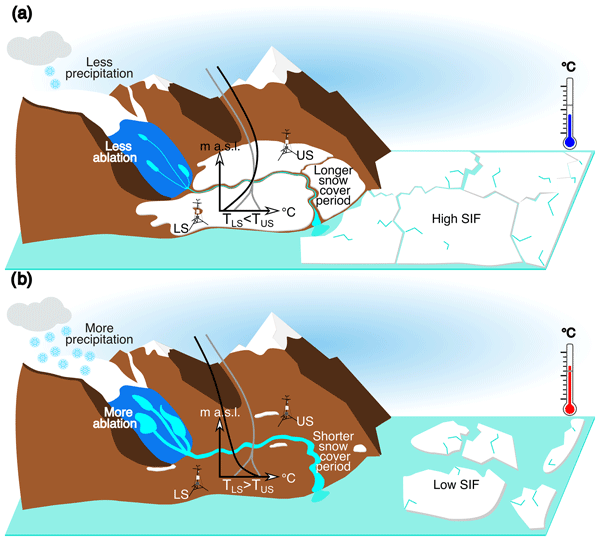
This study highlights how the sea ice variability in the Greenland Sea affects the terrestrial climate and the surface mass changes of peripheral glaciers of the Zackenberg region (ZR), Northeast Greenland, combining model output and observations. Our results show that the temporal evolution of sea ice influences the climate anomaly magnitude in the ZR. We also found that the changing temperature and precipitation patterns due to sea ice variability can affect the surface mass of the ice cap.
Klaus Haslinger, Wolfgang Schöner, Jakob Abermann, Gregor Laaha, Konrad Andre, Marc Olefs, and Roland Koch
Nat. Hazards Earth Syst. Sci., 23, 2749–2768, https://doi.org/10.5194/nhess-23-2749-2023, https://doi.org/10.5194/nhess-23-2749-2023, 2023
Short summary
Short summary
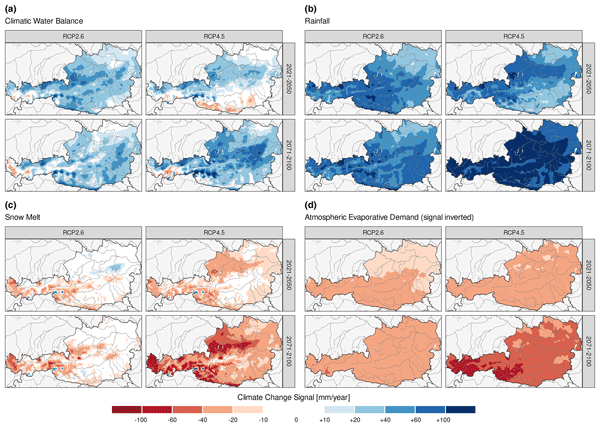
Future changes of surface water availability in Austria are investigated. Alterations of the climatic water balance and its components are analysed along different levels of elevation. Results indicate in general wetter conditions with particular shifts in timing of the snow melt season. On the contrary, an increasing risk for summer droughts is apparent due to increasing year-to-year variability and decreasing snow melt under future climate conditions.
Moritz Buchmann, Gernot Resch, Michael Begert, Stefan Brönnimann, Barbara Chimani, Wolfgang Schöner, and Christoph Marty
The Cryosphere, 17, 653–671, https://doi.org/10.5194/tc-17-653-2023, https://doi.org/10.5194/tc-17-653-2023, 2023
Short summary
Short summary
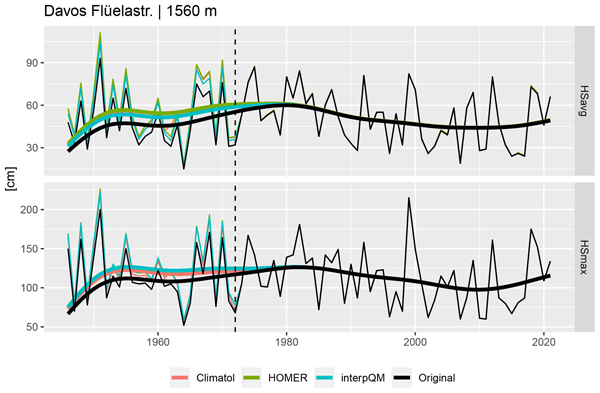
Our current knowledge of spatial and temporal snow depth trends is based almost exclusively on time series of non-homogenised observational data. However, like other long-term series from observations, they are susceptible to inhomogeneities that can affect the trends and even change the sign. To assess the relevance of homogenisation for daily snow depths, we investigated its impact on trends and changes in extreme values of snow indices between 1961 and 2021 in the Swiss observation network.

Tiago Silva, Jakob Abermann, Brice Noël, Sonika Shahi, Willem Jan van de Berg, and Wolfgang Schöner
The Cryosphere, 16, 3375–3391, https://doi.org/10.5194/tc-16-3375-2022, https://doi.org/10.5194/tc-16-3375-2022, 2022
Short summary
Short summary
To overcome internal climate variability, this study uses k-means clustering to combine NAO, GBI and IWV over the Greenland Ice Sheet (GrIS) and names the approach as the North Atlantic influence on Greenland (NAG). With the support of a polar-adapted RCM, spatio-temporal changes on SEB components within NAG phases are investigated. We report atmospheric warming and moistening across all NAG phases as well as large-scale and regional-scale contributions to GrIS mass loss and their interactions.
Jonathan P. Conway, Jakob Abermann, Liss M. Andreassen, Mohd Farooq Azam, Nicolas J. Cullen, Noel Fitzpatrick, Rianne H. Giesen, Kirsty Langley, Shelley MacDonell, Thomas Mölg, Valentina Radić, Carleen H. Reijmer, and Jean-Emmanuel Sicart
The Cryosphere, 16, 3331–3356, https://doi.org/10.5194/tc-16-3331-2022, https://doi.org/10.5194/tc-16-3331-2022, 2022
Short summary
Short summary
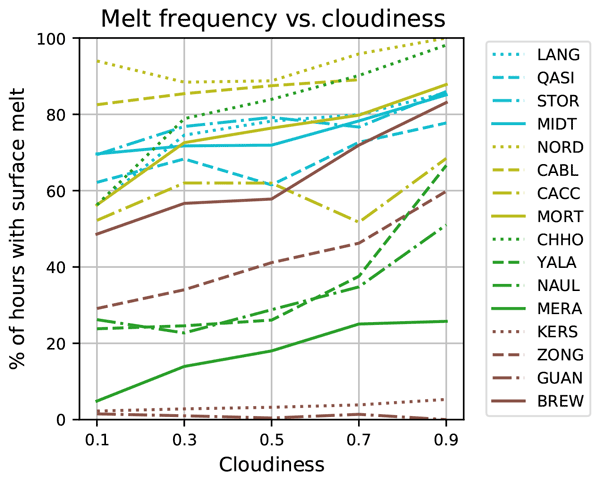
We used data from automatic weather stations on 16 glaciers to show how clouds influence glacier melt in different climates around the world. We found surface melt was always more frequent when it was cloudy but was not universally faster or slower than under clear-sky conditions. Also, air temperature was related to clouds in opposite ways in different climates – warmer with clouds in cold climates and vice versa. These results will help us improve how we model past and future glacier melt.

Thomas Goelles, Tobias Hammer, Stefan Muckenhuber, Birgit Schlager, Jakob Abermann, Christian Bauer, Víctor J. Expósito Jiménez, Wolfgang Schöner, Markus Schratter, Benjamin Schrei, and Kim Senger
Geosci. Instrum. Method. Data Syst., 11, 247–261, https://doi.org/10.5194/gi-11-247-2022, https://doi.org/10.5194/gi-11-247-2022, 2022
Short summary
Short summary
We propose a newly developed modular MObile LIdar SENsor System (MOLISENS) to enable new applications for small industrial light detection and ranging (lidar) sensors. MOLISENS supports both monitoring of dynamic processes and mobile mapping applications. The mobile mapping application of MOLISENS has been tested under various conditions, and results are shown from two surveys in the Lurgrotte cave system in Austria and a glacier cave in Longyearbreen on Svalbard.
Moritz Buchmann, John Coll, Johannes Aschauer, Michael Begert, Stefan Brönnimann, Barbara Chimani, Gernot Resch, Wolfgang Schöner, and Christoph Marty
The Cryosphere, 16, 2147–2161, https://doi.org/10.5194/tc-16-2147-2022, https://doi.org/10.5194/tc-16-2147-2022, 2022
Short summary
Short summary
Knowledge about inhomogeneities in a data set is important for any subsequent climatological analysis. We ran three well-established homogenization methods and compared the identified break points. By only treating breaks as valid when detected by at least two out of three methods, we enhanced the robustness of our results. We found 45 breaks within 42 of 184 investigated series; of these 70 % could be explained by events recorded in the station history.
Cited articles
Abatzoglou, J. T., Marshall, A. M., Lute, A. C., and Safeeq, M.: Precipitation dependence of temperature trends across the contiguous US, Geophys. Res. Lett., 49, e2021GL095414, https://doi.org/10.1029/2021GL095414, 2022. a
Alduchov, O. A. and Eskridge, R. E.: Improved Magnus Form Approximation of Saturation Vapor Pressure, J. Appl. Meteorol., 35, 601–609, 1996. a
Ali, H. and Mishra, V.: Contrasting response of rainfall extremes to increase in surface air and dewpoint temperatures at urban locations in India, Sci. Rep., 7, 1228, https://doi.org/10.1038/s41598-017-01306-1, 2017. a
Ali, H., Fowler, H. J., Lenderink, G., Lewis, E., and Pritchard, D.: Consistent large-scale response of hourly extreme precipitation to temperature variation over land, Geophys. Res. Lett., 48, e2020GL090317, https://doi.org/10.1029/2020GL090317, 2021. a, b, c, d
Ali, H., Fowler, H. J., Pritchard, D., Lenderink, G., Blenkinsop, S., and Lewis, E.: Towards quantifying the uncertainty in estimating observed scaling rates, Geophys. Res. Lett., 49, e2022GL099138, https://doi.org/10.1029/2022GL099138, 2022. a, b, c
Allen, M. R. and Ingram, W. J.: Constraints on future changes in climate and the hydrologic cycle, Nature, 419, 224–232, https://doi.org/10.1038/nature01092, 2002. a
Ban, N., Schmidli, J., and Schär, C.: Heavy precipitation in a changing climate: Does short-term summer precipitation increase faster?, Geophys. Res. Lett., 42, 1165–1172, https://doi.org/10.1002/2014GL062588, 2015. a, b, c
Barbero, R., Westra, S., Lenderink, G., and Fowler, H. J.: Temperature-extreme precipitation scaling: a two-way causality?, Int. J. Climatol., 38, e1274–e1279, https://doi.org/10.1002/joc.5370, 2018. a
Berg, P. and Haerter, J. O.: Unexpected increase in precipitation intensity with temperature – A result of mixing of precipitation types?, Atmos. Res., 119, 56–61, https://doi.org/10.1016/j.atmosres.2011.05.012, 2013. a
Berg, P., Haerter, J. O., Thejll, P., Piani, C., Hagemann, S., and Christensen, J. H.: Seasonal characteristics of the relationship between daily precipitation intensity and surface temperature, J. Geophys. Res.-Atmos., 114, D18102, https://doi.org/10.1029/2009JD012008, 2009. a
Chiappa, J., Parsons, D. B., Furtado, J. C., and Shapiro, A.: Short‐duration extreme rainfall events in the central and eastern United States during the summer: 2003–2023 trends and variability, Geophys. Res. Lett., 51, e2024GL110424, https://doi.org/10.1029/2024GL110424, 2024. a, b
Dollan, I. J., Maggioni, V., Johnston, J., de A. Coelho, G., and Kinter III, J. L.: Seasonal variability of future extreme precipitation and associated trends across the Contiguous U.S., Front. Clim., 4, 954892, https://doi.org/10.3389/fclim.2022.954892, 2022. a
Donat, M. G., Delgado-Torres, C., Luca, P. D., Mahmood, R., Ortega, P., and Doblas-Reyes, F. J.: How credibly do CMIP6 simulations capture historical mean and extreme precipitation changes?, Geophys. Res. Lett., 50, e2022GL102466, https://doi.org/10.1029/2022GL102466, 2023. a, b
Drobinski, P., Silva, N. D., Panthou, G., Bastin, S., Muller, C., Ahrens, B., Borga, M., Conte, D., Fosser, G., Giorgi, F., Güttler, I., Kotroni, V., Li, L., Morin, E., Önol, B., Quintana‐Segui, P., Romera, R., and Torma, C. Z.: Scaling precipitation extremes with temperature in the Mediterranean: past climate assessment and projection in anthropogenic scenarios, Clim. Dynam., 51, 1237–1257, https://doi.org/10.1007/s00382-016-3083-x, 2018. a, b, c, d
Estermann, R., Rajczak, J., Velasquez, P., Lorenz, R., and Schär, C.: Projections of heavy precipitation characteristics over the Greater Alpine Region using a kilometer–scale climate model ensemble, J. Geophys. Res.-Atmos., 130, e2024JD040901, https://doi.org/10.1029/2024JD040901, 2025. a
Fowler, H. J., Lenderink, G., Prein, A. F., Westra, S., Allan, R. P., Ban, N., Barbero, R., Berg, P., Blenkinsop, S., Do, H. X., Guerreiro, S., Haerter, J. O., Kendon, E., Lewis, E., Schaer, C., Sharma, A., Villarini, G., Wasko, C., and Zhang, X.: Anthropogenic intensification of short-duration rainfall extremes, Nature Reviews Earth and Environment, 2, 107–122, https://doi.org/10.1038/s43017-020-00128-6, 2021. a, b, c
Gründemann, G. J., van de Giesen, N., Brunner, L., and van der Ent, R.: Rarest rainfall events will see the greatest relative increase in magnitude under future climate change, Commun. Earth Environ., 3, 235, https://doi.org/10.1038/s43247-022-00558-8, 2022. a
Gu, L., Yin, J., Gentine, P., Wang, H.-M., Slater, L. J., Sullivan, S. C., Chen, J., Zscheischler, J., and Guo, S.: Large anomalies in future extreme precipitation sensitivity driven by atmospheric dynamics, Nat. Commun., 14, 3197, https://doi.org/10.1038/s41467-023-39039-7, 2023. a, b, c
Harp, R. D. and Horton, D. E.: Observed changes in daily precipitation intensity in the United States, Geophys. Res. Lett., 49, e2022GL099955, https://doi.org/10.1029/2022GL099955, 2022. a
Haslinger, K., Breinl, K., Pavlin, L., Pistotnik, G., Bertola, M., Olefs, M., Greilinger, M., Schöner, W., and Blöschl, G.: Increasing hourly heavy rainfall in Austria reflected in flood changes, Nature, 639, 667–672, https://doi.org/10.1038/s41586-025-08647-2, 2025. a, b
Hersbach, H., Bell, B., Berrisford, P., Biavati, G., Horányi, A., Muñoz Sabater, J., Nicolas, J., Peubey, C., Radu, R., Rozum, I., Schepers, D., Simmons, A., Soci, C., Dee, D., and Thépaut, J.-N.: ERA5 hourly data on single levels from 1940 to present, Copernicus Climate Change Service (C3S) Climate Data Store (CDS) [data set], https://doi.org/10.24381/cds.adbb2d47, 2023. a
Higgins, T. B., Subramanian, A. C., Watson, P. A. G., and Sparrow, S.: Changes to Atmospheric River Related Extremes Over the United States West Coast Under Anthropogenic Warming, Geophys. Res. Lett., 52, e2024GL112237, https://doi.org/10.1029/2024GL112237, 2025. a
Huang, X. and Swain, D. L.: Climate change is increasing the risk of a California megaflood, Sci. Adv., 8, eabq0995, https://doi.org/10.1126/sciadv.abq0995, 2022. a
Jones, R. H., Westra, S., and Sharma, A.: Observed relationships between extreme sub‐daily precipitation, surface temperature, and relative humidity, Geophys. Res. Lett., 37, L22805, https://doi.org/10.1029/2010GL045081, 2010. a, b, c
Jong, B. T., Delworth, T. L., Cooke, W. F., Tseng, K. C., and Murakami, H.: Increases in extreme precipitation over the Northeast United States using high-resolution climate model simulations, npj Clim. Atmos. Sci., 6, 18, https://doi.org/10.1038/s41612-023-00347-w, 2023. a
Lenderink, G. and van Meijgaard, E.: Increase in hourly precipitation extremes beyond expectations from temperature changes, Nat. Geosci., 1, 511–514, https://doi.org/10.1038/ngeo262, 2008. a, b
Lenderink, G. and van Meijgaard, E.: Linking increases in hourly precipitation extremes to atmospheric temperature and moisture changes, Environ. Res. Lett., 5, 025208, https://doi.org/10.1088/1748-9326/5/2/025208, 2010. a, b, c, d
Li, X., Wang, T., Zhou, Z., Su, J., and Yang, D.: Seasonal characteristics and spatio-temporal variations of the extreme precipitation-air temperature relationship across China, Environ. Res. Lett., 18, 054022, https://doi.org/10.1088/1748-9326/acd01a, 2023. a
Martinez‐Villalobos, C. and Neelin, J. D.: Regionally high risk increase for precipitation extreme events under global warming, Sci. Rep., 13, 5579, https://doi.org/10.1038/s41598-023-32372-3, 2023. a, b
Menne, M. J., Durre, I., Vose, R. S., Gleason, B. E., and Houston, T. G.: An Overview of the Global Historical Climatology Network-Daily Database, J. Atmos. Ocean. Tech., 29, 897–910, https://doi.org/10.1175/JTECH-D-11-00103.1, 2012. a
Meresa, H., Tischbein, B., and Mekonnen, T.: Climate change impact on extreme precipitation and peak flood magnitude and frequency: observations from CMIP6 and hydrological models, Nat. Hazards, 111, 2649–2679, https://doi.org/10.1007/s11069-021-05152-3, 2022. a
Myhre, G., Alterskjær, K., Stjern, C. W., Hodnebrog, Marelle, L., Samset, B. H., Sillmann, J., Schaller, N., Fischer, E., Schulz, M., and Stohl, A.: Frequency of extreme precipitation increases extensively with event rareness under global warming, Sci. Rep., 9, 16063, https://doi.org/10.1038/s41598-019-52277-4, 2019. a
Najibi, N. and Steinschneider, S.: Extreme precipitation-temperature scaling in California: The role of atmospheric rivers, Geophys. Res. Lett., 50, e2023GL104606, https://doi.org/10.1029/2023GL104606, 2023. a, b
Najibi, N., Mukhopadhyay, S., and Steinschneider, S.: Precipitation scaling with temperature in the Northeast US: Variations by weather regime, season, and precipitation intensity, Geophys. Res. Lett., 49, e2021GL097100, https://doi.org/10.1029/2021GL097100, 2022. a
Panthou, G., Mailhot, A., Laurence, E., and Talbot, G.: Relationship between Surface Temperature and Extreme Rainfalls: A Multi-Time-Scale and Event-Based Analysis, J. Hydrometeorol., 15, 1999–2011, https://doi.org/10.1175/JHM-D-14-0020.1, 2014. a, b
Prein, A. F., Rasmussen, M., Ikeda, K., Liu, C., Clark, M. P., and Holland, G. J.: The future intensification of hourly precipitation extremes, Nat. Clim. Change, 7, 48–52, https://doi.org/10.1038/NCLIMATE3168, 2017. a, b, c, d
Rahat, S. H., Saki, S., Khaira, U., Biswas, N. K., Dollan, I. J., Wasti, A., Miura, Y., Bhuiyan, M. A. E., and Ray, P.: Bracing for impact: how shifting precipitation extremes may influence physical climate risks in an uncertain future, Sci. Rep., 14, 17398, https://doi.org/10.1038/s41598-024-65618-9, 2024. a
Smith, A., Lott, N., and Vose, R.: The integrated surface database: Recent developments and partnerships, B. Am. Meteorol. Soc., 92, 704–708, https://doi.org/10.1175/2011BAMS3015.1, 2011. a
Switanek, M.., Abermann, J., Schöner, W., and Anderson, M. L.: Data for the paper, “Precipitation-temperature scaling: current challenges and proposed methodological strategies”, figshare [data set], https://doi.org/10.6084/m9.figshare.29858954, 2025. a
Tabari, H.: Climate change impact on flood and extreme precipitation increases with water availability, Sci. Rep., 10, 13768, https://doi.org/10.1038/s41598-020-70816-2, 2020. a, b
Tian, B., Chen, H., Yin, J., Liao, Z., Li, N., and He, S.: Global scaling of precipitation extremes using near-surface air temperature and dew point temperature, Environ. Res. Lett., 18, 034016, https://doi.org/10.1088/1748-9326/acb836, 2023. a, b
Trenberth, K. E., Dai, A., Rasmussen, R. M., and Parsons, D. B.: The changing character of precipitation, B. Am. Meteorol. Soc., 84, 1205–1218, https://doi.org/10.1175/BAMS-84-9-1205, 2003. a
Utsumi, N., Seto, S., Kanae, S., Maeda, E. E., and Oki, T.: Does higher surface temperature intensify extreme precipitation?, Geophys. Res. Lett., 38, L16708, https://doi.org/10.1029/2011GL048426, 2011. a, b, c, d
Visser, J. B., Wasko, C., Sharma, A., and Nathan, R.: Eliminating the “Hook” in Precipitation–Temperature Scaling, J. Climate, 34, 9535–9549, https://doi.org/10.1175/JCLI-D-21-0292.1, 2021. a, b, c, d
Wasko, C. and Sharma, A.: Quantile regression for investigating scaling of extreme precipitation with temperature, Water Resour. Res., 50, 3608–3614, https://doi.org/10.1002/2013WR015194, 2014. a, b, c, d
Wasko, C., Sharma, A., and Johnson, F.: Does storm duration modulate the extreme precipitation-temperature scaling relationship?, Geophys. Res. Lett., 42, 8783–8790, https://doi.org/10.1002/2015GL066274, 2015. a, b
Wasko, C., Lu, W. T., and Mehrotra, R.: Relationship of extreme precipitation, dry-bulb temperature, and dew point temperature across Australia, Environ. Res. Lett., 13, 074031, https://doi.org/10.1088/1748-9326/aad135, 2018. a, b, c
Westra, S., Fowler, H. J., Evans, J. P., Alexander, L. V., Berg, P., Johnson, F., Kendon, E. J., Lenderink, G., and Roberts, N. M.: Future changes to the intensity and frequency of short-duration extreme rainfall, Rev. Geophys., 52, 522–555, https://doi.org/10.1002/2014RG000464, 2014. a
Yin, J., Guo, S., Gentine, P., He, S., Chen, J., and Liu, P.: Does the hook structure constrain future flood intensification under anthropogenic climate warming?, Water Resour. Res., 57, e2020WR028491, https://doi.org/10.1029/2020WR028491, 2021. a
Short summary
Extreme precipitation is expected to increase in a warming climate. Station-based measurements of precipitation and dew point temperature are often used to estimate observed precipitation-temperature scaling rates. In this study, we use three different approaches which rely on either raw or normalized data to estimate scaling rates and produce predictions of extreme precipitation. We find that normalizing the data first can improve our estimates of precipitation-temperature scaling rates.
Extreme precipitation is expected to increase in a warming climate. Station-based measurements...


