Articles | Volume 30, issue 6
https://doi.org/10.5194/hess-30-1543-2026
© Author(s) 2026. This work is distributed under
the Creative Commons Attribution 4.0 License.
https://doi.org/10.5194/hess-30-1543-2026
© Author(s) 2026. This work is distributed under
the Creative Commons Attribution 4.0 License.
DAR-type model based on “long memory-threshold” structure: a competitor for daily streamflow prediction under changing environment
Huimin Wang
College of Hydraulic Science and Engineering, Yangzhou University, Yangzhou 225009, China
Songbai Song
College of Water Resources and Architectural Engineering, Northwest A & F University, Yangling 712100, China
Key Laboratory for Agricultural Soil and Water Engineering in Arid Area of Ministry of Education, Northwest A & F University, Yangling 712100, China
Gengxi Zhang
CORRESPONDING AUTHOR
College of Hydraulic Science and Engineering, Yangzhou University, Yangzhou 225009, China
Thian Yew Gan
Department of Civil and Environmental Engineering, University of Alberta, Edmonton T6G2R3, Canada
Zhuoyue Peng
College of Hydraulic Science and Engineering, Yangzhou University, Yangzhou 225009, China
Related authors
No articles found.
Tianliang Jiang, Xiaoling Su, Gengxi Zhang, Te Zhang, and Haijiang Wu
Hydrol. Earth Syst. Sci., 27, 559–576, https://doi.org/10.5194/hess-27-559-2023, https://doi.org/10.5194/hess-27-559-2023, 2023
Short summary
Short summary
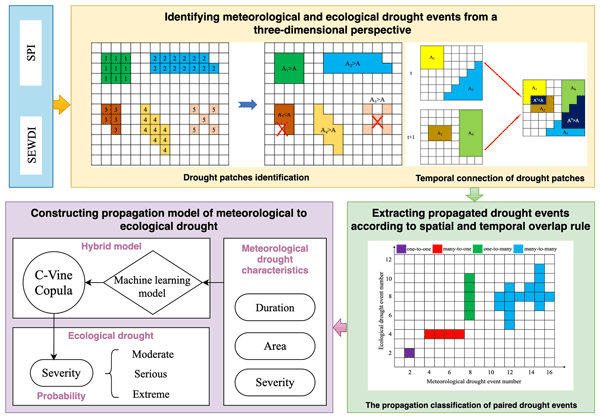
A hybrid method is developed for calculating the propagation probability of meteorological to ecological drought at different levels. Drought events are identified from a three-dimensional perspective. A spatial and temporal overlap rule is developed for extracting propagated drought events.
Huimin Wang, Gengxi Zhang, Shuyu Zhang, Xiaoling Su, Songbai Song, Lijie Shi, Kai Feng, and Xiaolei Fu
Hydrol. Earth Syst. Sci. Discuss., https://doi.org/10.5194/hess-2022-217, https://doi.org/10.5194/hess-2022-217, 2022
Manuscript not accepted for further review
Short summary
Short summary
A significant increasing trend of compound dry and hot events has been reported in many regions under global warming. However, most of the proposed indices are based on monthly meteorological data and cannot monitor short-term events timely. This study proposes a novel daily-scale compound dry and hot index by jointing daily drought index and heat index. This index can detect spatial evolutions of dry and hot conditions and reflects vegetation losses, indicating its applicability.
Cited articles
Adnan, R. M., Meshram, S. G., Mostafa, R. R., Towfiqul IsIam, A. R. M., Abba, S. I., Andorful, F., and Chen, Z. H.: Application of soft computing models in streamflow forecasting, P. I. Civil Eng.-Wat. M., 172, 123–134, https://doi.org/10.1680/jwama.16.00075, 2019.
Beven, K.: Deep learning, hydrological processes and the uniqueness of place, Hydrol. Process., 34, 3608–3613, https://doi.org/10.1002/hyp.13805, 2020.
Bollerslev, T.: Generalized autoregressive conditional heteroskedasticity, J. Econometrics, 31, 307–327, https://doi.org/10.1016/0304-4076(86)90063-1, 1986.
Broock, W. A., Scheinkman, J. A., Dechert, W. D., and LeBaron, B.: A test for independence based on the correlation dimension, Economet. Rev., 15, 197–235, https://doi.org/10.1080/07474939608800353, 1996.
Can, İ., Tosunoğlu, F., and Kahya, E.: Daily streamflow modelling using autoregressive moving average and artificial neural networks models: case study of Çoruh basin, Turkey, Hydrol. Process., 26, 567–576, https://doi.org/10.1111/j.1747-6593.2012.00337.x, 2012.
Chen, S., Xu, J. J., Li, Q. Q., Wang, Y. Q., Yuan, Z., and Wang, D.: Nonstationary stochastic simulation method for the risk assessment of water allocation, Environ. Sci.-Wat. Res., 7, 212–221, https://doi.org/10.1039/d0ew00695e, 2021.
Cline, D. B. H. and Pu, H. H.: Stability and the Lyapounov exponent of threshold AR-ARCH models, An. Appl. Probab., 14, 1920–1949, https://doi.org/10.1214/105051604000000431, 2004.
Dawson, C. W., Abrahart, R. J., and See, L. M.: HydroTest: A web-based toolbox of evaluation metrics for the standardised assessment of hydrological forecasts, Environ. Modell. Softw., 22, 1034–1052, https://doi.org/10.1016/j.envsoft.2006.06.008, 2007.
Delforge, D., de Viron, O., Vanclooster, M., Van Camp, M., and Watlet, A.: Detecting hydrological connectivity using causal inference from time series: synthetic and real karstic case studies, Hydrol. Earth Syst. Sci., 26, 2181–2199, https://doi.org/10.5194/hess-26-2181-2022, 2022.
Dickey, D. A. and Fuller, W. A.: Likelihood ratio statistics for autoregressive time series with a unit root, Econometrica, 49, 1057–1072, https://doi.org/10.2307/1912517, 1981.
Dimitriadis, P. and Koutsoyiannis, D.: Climacogram versus autocovariance and power spectrum in stochastic modelling for Markovian and Hurst–Kolmogorov processes, Stoch. Env. Res. Risk A., 29, 1649–1669, https://doi.org/10.1007/s00477-015-1023-7, 2015.
Dimitriadis, P. and Koutsoyiannis, D.: Stochastic synthesis approximating any process dependence and distribution, Stoch. Env. Res. Risk A., 32, 1493–1515, https://doi.org/10.1007/s00477-018-1540-2, 2018.
Dimitriadis, P., Koutsoyiannis, D., Iliopoulou, T., and Papanicolaou, P.: A Global-scale investigation of stochastic similarities in marginal distribution and dependence structure of key hydrological-cycle processes, Hydrology, 8, 59, https://doi.org/10.3390/hydrology8020059, 2021.
Engle, R. F.: Autoregressive conditional heteroscedasticity with estimates of the variance of United Kingdom inflation, Econometrica, 50, 987–1007, https://doi.org/10.2307/1912773, 1982.
Engle, R. F.: Stock volatility and the crash of '87: Discussion, Rev. Financ. Stud., 3, 103–106, https://www.jstor.org/stable/2961959, 1990.
Engle, R. F. and Ng, V. K.: Measuring and testing the impact of news on volatility, J. Financ., 48, 1749–1778, https://doi.org/10.1111/j.1540-6261.1993.tb05127.x, 1993.
Engle, R. F., Lilien, D. M., and Robins, R. P.: Estimating time varying risk premia in the term structure: The Arch-M model, Econometrica, 55, 391–407, https://doi.org/10.2307/1913242, 1987.
Fathian, F. and Vaheddoost, B.: Modeling the volatility changes in Lake Urmia water level time series, Theor. Appl. Climatol., 143, 61–72, https://doi.org/10.1007/s00704-020-03417-8, 2021.
Fathian, F., Fakheri-Fard, A., Modarres, R., and van Gelder, P. H. A. J. M.: Regional scale rainfall–runoff modeling using VARX–MGARCH approach, Stoch. Env. Res. Risk A., 32, 999–1016, https://doi.org/10.1007/s00477-017-1428-6, 2018.
Fathian, F., Mehdizadeh, S., Kozekalani Sales, A., and Safari, M. J. S.: Hybrid models to improve the monthly river flow prediction: Integrating artificial intelligence and non-linear time series models, J. Hydrol., 575, 1200–1213, https://doi.org/10.1016/j.jhydrol.2019.06.025, 2019.
Feng, Z. K., Niu, W. J., Wan, X. Y., Xu, B., Zhu, F. L., and Chen, J.: Hydrological time series forecasting via signal decomposition and twin support vector machine using cooperation search algorithm for parameter identification, J. Hydrol., 612, 128213, https://doi.org/10.1016/j.jhydrol.2022.128213, 2022.
Gharehbaghi, V. R., Kalbkhani, H., Farsangi, E. N., Yang, T. Y., and Mirjalili, S.: A data-driven approach for linear and nonlinear damage detection using variational mode decomposition and GARCH model, Eng. Comput., 39, 2017–2034, https://doi.org/10.1007/s00366-021-01568-4, 2022.
Granger, C. W. J.: New classes of time series models, J. Roy. Stat. Soc. D-Sta., 27, 237–253, https://doi.org/10.2307/2988186, 1978.
Graves, T., Gramacy, R., Watkins, N., and Franzke, C.: A brief history of long memory: Hurst, Mandelbrot and the road to ARFIMA, 1951–1980, Entropy, 19, https://doi.org/10.3390/e19090437, 2017.
Grimaldi, S.: Linear parametric models applied to daily hydrological series, J. Hydrol. Eng., 9, 383–391, https://doi.org/10.1061/(ASCE)1084-0699(2004)9:5(383), 2004.
Guo, S., Xiong, L., Zha, X., Zeng, L., and Cheng, L.: Impacts of the Three Gorges Dam on the streamflow fluctuations in the downstream region, J. Hydrol., 598, 126480, https://doi.org/10.1016/j.jhydrol.2021.126480, 2021a.
Guo, T. L., Song, S. B., and Ma, W. J.: Point and interval forecasting of groundwater depth using nonlinear models, Water Resour. Res., 57, e2021WR030209, https://doi.org/10.1029/2021WR030209, 2021b.
Hansen, A. L.: Modeling persistent interest rates with double-autoregressive processes, J. Bank. Financ., 133, 106302, https://doi.org/10.1016/j.jbankfin.2021.106302, 2021.
Hochreiter, S. and Schmidhuber, J.: Long short-term memory, Neural Comput., 9, 1735–1780, https://doi.org/10.1162/neco.1997.9.8.1735, 1997.
Hosking, J. R. M.: Fractional differencing, Biometrika, 68, 165–176, https://doi.org/10.2307/2335817, 1981.
Hosseini, F., Prieto, C., and Álvarez, C.: An explainable AI approach for interpreting regionally optimized deep neural networks in hydrological prediction, J. Hydrol., 661, 133689, https://doi.org/10.1016/j.jhydrol.2025.133689, 2025.
Huang, Y. M., Dai, X. Y., Wang, Q. W., and Zhou, D. Q.: A hybrid model for carbon price forecasting using GARCH and long short-term memory network, Appl. Energ., 285, 116485, https://doi.org/10.1016/j.apenergy.2021.116485, 2021.
Hurst, H. E.: Long-term storage capacity of reservoirs, T. Am. Soc. Civ. Eng., 116, 770–799, https://doi.org/10.1061/TACEAT.0006518, 1951.
Jiang, F. Y., Li, D., and Zhu, K.: Non-standard inference for augmented double autoregressive models with null volatility coefficients, J. Econometrics, 215, 165–183, https://doi.org/10.1016/j.jeconom.2019.08.009, 2020.
Kolte, A., Roy, J. K., and Vasa, L.: The impact of unpredictable resource prices and equity volatility in advanced and emerging economies: An econometric and machine learning approach, Resour. Policy, 80, 103216, https://doi.org/10.1016/j.resourpol.2022.103216, 2023.
Koutsoyiannis, D. and Montanari, A.: Negligent killing of scientific concepts: the stationarity case, Hydrolog. Sci. J., 60, 1174–1183, https://doi.org/10.1080/02626667.2014.959959, 2015.
Kratzert, F., Klotz, D., Brenner, C., Schulz, K., and Herrnegger, M.: Rainfall–runoff modelling using Long Short-Term Memory (LSTM) networks, Hydrol. Earth Syst. Sci., 22, 6005–6022, https://doi.org/10.5194/hess-22-6005-2018, 2018.
Kwiatkowski, D., Phillips, P. C. B., Schmidt, P., and Shin, Y.: Testing the null hypothesis of stationarity against the alternative of a unit root: How sure are we that economic time series have a unit root?, J. Econometrics, 54, 159–178, https://doi.org/10.1016/0304-4076(92)90104-Y, 1992.
Li, D., Ling, S., and Zhang, R.: On a threshold double autoregressive model, J. Bus. Econ. Stat., 34, 68–80, https://doi.org/10.1080/07350015.2014.1001028, 2016.
Li, D., Guo, S., and Zhu, K.: Double AR model without intercept: An alternative to modeling nonstationarity and heteroscedasticity, Econ. Rev., 38, 319–331, https://doi.org/10.1080/07474938.2017.1310080, 2019.
Ling, S.: A double AR(p) model: structure and estimation, Stat. Sinica, 17, 161–175, 2007.
Liu, C., Cui, N., Gong, D., Hu, X., and Feng, Y.: Evaluation of seasonal evapotranspiration of winter wheat in humid region of East China using large-weighted lysimeter and three models, J. Hydrol., 590, 125388, https://doi.org/10.1016/j.jhydrol.2020.125388, 2020.
Liu, F., Li, D., and Kang, X.: Sample path properties of an explosive double autoregressive model, Econ. Rev., 37, 484–490, https://doi.org/10.1080/07474938.2015.1092841, 2018.
Ljung, G. M. and Box, G. E. P.: On a measure of lack of fit in time series models, Biometrika, 65, 297–303, https://doi.org/10.2307/2335207, 1978.
Lo, A. W.: Long-term memory in stock market prices, Econometrica, 59, 1279–1313, https://doi.org/10.2307/2938368, 1991.
Lyu, Y., Chen, H., Cheng, Z., He, Y., and Zheng, X.: Identifying the impacts of land use landscape pattern and climate changes on streamflow from past to future, J. Environ. Manage., 345, 118910, https://doi.org/10.1016/j.jenvman.2023.118910, 2023.
Ma, X., Li, Z., Ren, Z., Shen, Z., Xu, G., and Xie, M.: Predicting future impacts of climate and land use change on streamflow in the middle reaches of China's Yellow River, J. Environ. Manage., 370, 123000, https://doi.org/10.1016/j.jenvman.2024.123000, 2024.
Mandelbrot, B. B. and Wallis, J. R.: Computer experiments with fractional Gaussian noises: Part 1, averages and variances, Water Resour. Res., 5, 228–241, https://doi.org/10.1029/WR005i001p00228, 1969.
Matic, P., Bego, O., and Males, M.: Complex hydrological system inflow prediction using artificial neural network, Teh. Vjesn., 29, 172–177, https://doi.org/10.17559/TV-20200721133924, 2022.
Mehdizadeh, S., Fathian, F., and Adamowski, J. F.: Hybrid artificial intelligence-time series models for monthly streamflow modelling, Appl. Soft Comput., 80, 873–887, https://doi.org/10.1016/j.asoc.2019.03.046, 2019.
Miller, R. L.: Nonstationary streamflow effects on backwater flood management of the Atchafalaya Basin, USA, J. Environ. Manage., 309, 114726, https://doi.org/10.1016/j.jenvman.2022.114726, 2022.
Modarres, R.: Streamflow drought time series forecasting, Stoch. Env. Res. Risk A., 21, 223–233, https://doi.org/10.1007/s00477-006-0058-1, 2007.
Modarres, R. and Ouarda, T. B. M. J.: Modelling heteroscedasticty of streamflow times series, Hydrolog. Sci. J., 58, 54–64, https://doi.org/10.1080/02626667.2012.743662, 2013.
Montanari, A., Rosso, R., and Taqqu, M. S.: Some long-run properties of rainfall records in Italy, J. Geophys. Res.-Atmos., 101, 29431–29438, https://doi.org/10.1029/96JD02512, 1996.
Montanari, A., Rosso, R., and Taqqu, M. S.: Fractionally differenced ARIMA models applied to hydrologic time series: Identification, estimation, and simulation, Water Resour. Res., 33, 1035–1044, https://doi.org/10.1029/97WR00043, 1997.
Moriasi, D., Arnold, J., Van Liew, M. W., Bingner, R., Harmel, R. D., and Veith, T. L.: Model evaluation guidelines for systematic quantification of accuracy in watershed simulations, T. ASABE, 50, 885–900, https://doi.org/10.13031/2013.23153, 2007.
Myronidis, D., Ioannou, K., Fotakis, D., and Dörflinger, G.: Streamflow and hydrological drought trend analysis and forecasting in Cyprus, Water Resour. Manag., 32, 1759–1776, https://doi.org/10.1007/s11269-018-1902-z, 2018.
Nazeri-Tahroudi, M., Ramezani, Y., De Michele, C., and Mirabbasi, R.: Bivariate simulation of potential evapotranspiration using copula-GARCH model, Water Resour. Manag., 36, 1007–1024, https://doi.org/10.1007/s11269-022-03065-9, 2022.
O'Connell, P. E., Koutsoyiannis, D., Lins, H. F., Markonis, Y., Montanari, A., and Cohn, T.: The scientific legacy of Harold Edwin Hurst (1880–1978), Hydrolog. Sci. J., 61, 1571–1590, https://doi.org/10.1080/02626667.2015.1125998, 2016.
Pandey, P. K., Tripura, H., and Pandey, V.: Improving prediction accuracy of rainfall time series by hybrid SARIMA–GARCH modeling, Natural Resources Research, 28, 1125–1138, https://doi.org/10.1007/s11053-018-9442-z, 2019.
Peter, C. B. P. and Perron, P.: Testing for a unit root in time series regression, Biometrika, 75, 335–346, https://doi.org/10.2307/2336182, 1988.
Serinaldi, F. and Kilsby, C. G.: Irreversibility and complex network behavior of stream flow fluctuations, Physica A, 450, 585–600, https://doi.org/10.1016/j.physa.2016.01.043, 2016.
Sivakumar, B.: Nonlinear dynamics and chaos in hydrologic systems: latest developments and a look forward, Stoch. Env. Res. Risk A., 23, 1027–1036, https://doi.org/10.1007/s00477-008-0265-z, 2009.
Song, Z., Xia, J., Wang, G., She, D., Hu, C., and Hong, S.: Regionalization of hydrological model parameters using gradient boosting machine, Hydrol. Earth Syst. Sci., 26, 505–524, https://doi.org/10.5194/hess-26-505-2022, 2022.
Tiwari, A. D., Mukhopadhyay, P., and Mishra, V.: Influence of bias correction of meteorological and streamflow forecast on hydrological prediction in India, J. Hydrometeorol., 23, 1171–1192, https://doi.org/10.1175/JHM-D-20-0235.1, 2022.
Tong, H.: Threshold models in non-linear time series analysis, Springer, New York, USA, 323 pp., ISBN 978-1-4684-7888-4, 1983.
van Cranenburgh, S., Wang, S., Vij, A., Pereira, F., and Walker, J.: Choice modelling in the age of machine learning-Discussion paper, J. Choice Model., 42, 100340, https://doi.org/10.1016/j.jocm.2021.100340, 2022.
Vavoulogiannis, S., Iliopoulou, T., Dimitriadis, P., and Koutsoyiannis, D.: Multiscale temporal irreversibility of streamflow and its stochastic modelling, Hydrology, 8, 63, https://doi.org/10.3390/hydrology8020063, 2021.
Wang, H.: Streamflow Data, figshare [data set], https://doi.org/10.6084/m9.figshare.26795140.v1, 2024.
Wang, H., Song, S., Zhang, G., Ayantobo, O. O., and Guo, T.: Stochastic volatility modeling of daily streamflow time series, Water Resour. Res., 59, e2021WR031662, https://doi.org/10.1029/2021WR031662, 2023a.
Wang, H., Song, S., Zhang, G., and Ayantoboc, O.O.: Predicting daily streamflow with a novel multi-regime switching ARIMA-MS-GARCH model, Journal of Hydrology: Regional Studies, 47, 101374, https://doi.org/10.1016/j.ejrh.2023.101374, 2023b.
Wang, H., Song, S., and Zhang, G.: Daily runoff simulation based on seasonal long-term memory DAR model, J. Hydraul. Eng., 54, 686–695, https://doi.org/10.13243/j.cnki.slxb.20220982, 2023c (in Chinese with English Abstract).
Wang, L., Li, X., Ma, C., and Bai, Y.: Improving the prediction accuracy of monthly streamflow using a data-driven model based on a double-processing strategy, J. Hydrol., 573, 733–745, https://doi.org/10.1016/j.jhydrol.2019.03.101, 2019.
Wu, Z., Liu, D., Mei, Y., Guo, S., Xiong, L., Liu, P., Chen, J., Yin, J., and Zeng, Y.: A nonlinear model for evaluating dynamic resilience of water supply hydropower generation-environment conservation nexus system, Water Resour. Res., 59, e2023WR034922, https://doi.org/10.1029/2023WR034922, 2023.
Xia, J., O'Connor, K. M., Kachroo, R. K., and Liang, G. C.: A non-linear perturbation model considering catchment wetness and its application in river flow forecasting, J. Hydrol., 200, 164–178, https://doi.org/10.1016/S0022-1694(97)00013-9, 1997.
Yan, B., Mu, R., Guo, J., Liu, Y., Tang, J., and Wang, H.: Flood risk analysis of reservoirs based on full-series ARIMA model under climate change, J. Hydrol., 610, 127979, https://doi.org/10.1016/j.jhydrol.2022.127979, 2022.
Yang, G. and Bowling, L. C.: Detection of changes in hydrologic system memory associated with urbanization in the Great Lakes region, Water Resour. Res., 50, 3750–3763, https://doi.org/10.1002/2014WR015339, 2014.
Yang, L., Zhong, P., Zhu, F., Ma, Y., Wang, H., Li, J., and Xu, C.: A comparison of the reproducibility of regional precipitation properties simulated respectively by weather generators and stochastic simulation methods, Stoch. Env. Res. Risk A., 36, 495–509, https://doi.org/10.1007/s00477-021-02053-6, 2022.
Yuan, R., Cai, S., Liao, W., Lei, X., Zhang, Y., Yin, Z., Ding, G., Wang, J., and Xu, Y.: Daily runoff forecasting using ensemble empirical mode decomposition and long short-term memory, Front. Earth Sci., 9, 621780, https://doi.org/10.3389/feart.2021.621780, 2021.
Zha, X., Xiong, L., Guo, S., Kim, J. S., and Liu, D.: AR-GARCH with exogenous variables as a postprocessing model for improving streamflow forecasts, J. Hydrol. Eng., 25, 04020036, https://doi.org/10.1061/(ASCE)HE.1943-5584.0001955, 2020.
Zhong, M., Zhang, H., Jiang, T., Guo, J., Zhu, J., Wang, D., and Chen, X.: A hybrid model combining the Cama-flood model and deep learning methods for streamflow prediction, Water Resour. Manag., 37, 4841–4859, https://doi.org/10.1007/s11269-023-03583-0, 2023.
Short summary
This study introduces a novel dual-threshold double autoregressive (DTDAR) model for daily streamflow prediction. The DTDAR model outperforms other commonly used models, especially when using a Student's t distribution for residuals, showing improved accuracy in capturing non-linearity and long-term memory in streamflow data.
This study introduces a novel dual-threshold double autoregressive (DTDAR) model for daily...