
Articles | Volume 30, issue 4
https://doi.org/10.5194/hess-30-1097-2026
© Author(s) 2026. This work is distributed under
the Creative Commons Attribution 4.0 License.
the Creative Commons Attribution 4.0 License.
https://doi.org/10.5194/hess-30-1097-2026
© Author(s) 2026. This work is distributed under
the Creative Commons Attribution 4.0 License.
the Creative Commons Attribution 4.0 License.
Research article
| 
24 Feb 2026
Research article |
| 24 Feb 2026
| 24 Feb 2026
Skills in sub-seasonal to seasonal terrestrial water storage forecasting: insights from the FEWS NET land data assimilation system

ESSIC University of Maryland, College Park, MD 20740, USA
Abheera Hazra
ESSIC University of Maryland, College Park, MD 20740, USA
Amy McNally
NASA Goddard Space Flight Center, Greenbelt, MD 20771, USA
Kimberly Slinski
ESSIC University of Maryland, College Park, MD 20740, USA
Shraddhanand Shukla
University of California at Santa Barbara, Santa Barbara, CA 93106, USA
Weston Anderson
Department of Geography, University of Maryland, College Park, MD 20740, USA
Related authors
Eunsaem Cho, Eunsang Cho, Carrie Vuyovich, Bailing Li, and Jennifer M. Jacobs
Hydrol. Earth Syst. Sci., 30, 6359–6380, https://doi.org/10.5194/hess-30-6359-2026, https://doi.org/10.5194/hess-30-6359-2026, 2026
Short summary
Short summary
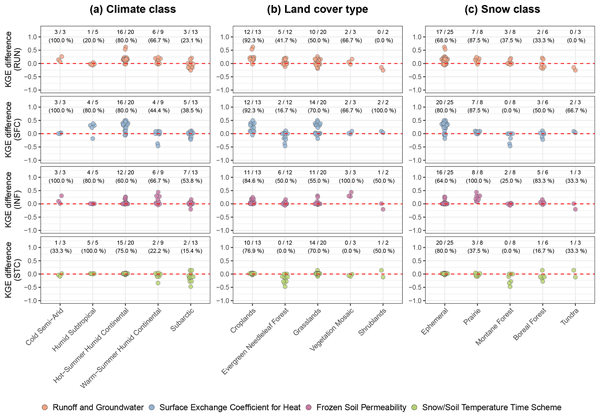
This study evaluated how alternative parameterization schemes in the Noah-Multiparameterization model affect snow and runoff in the Missouri River Basin. Simulations were compared with U.S. Geological Survey streamflow, University of Arizona snow water equivalent, and Global Land Evaporation Amsterdam Model evapotranspiration across 50 Hydro-Climate Data Network subbasins. As a result, we confirmed alternative schemes could improve groundwater, evapotranspiration, and runoff representation.
Farhaan Cooverji, Eunsang Cho, Bailing Li, Carrie Vuyovich, Jennifer M. Jacobs, Eunsaem Cho, Eric A. Sproles, and Samuel E. Tuttle
EGUsphere, https://doi.org/10.5194/egusphere-2026-4186, https://doi.org/10.5194/egusphere-2026-4186, 2026
Short summary
Short summary
Quantifying how much snowmelt feeds mountain rivers is hard. In a Missouri Headwater watershed, we estimated the region's water cycle, focusing on snowmelt generation. Well-validated hydrological data were more accurate individually, but the land surface model better balanced the annual water budget. It also underestimates evaporation and sublimation, inflating runoff estimates. This approach shows snowmelt supplies only about 32 % of runoff, well below earlier estimates near 65 %.
Eunsaem Cho, Eunsang Cho, Carrie Vuyovich, Bailing Li, and Jennifer M. Jacobs
Hydrol. Earth Syst. Sci., 30, 6359–6380, https://doi.org/10.5194/hess-30-6359-2026, https://doi.org/10.5194/hess-30-6359-2026, 2026
Short summary
Short summary
This study evaluated how alternative parameterization schemes in the Noah-Multiparameterization model affect snow and runoff in the Missouri River Basin. Simulations were compared with U.S. Geological Survey streamflow, University of Arizona snow water equivalent, and Global Land Evaporation Amsterdam Model evapotranspiration across 50 Hydro-Climate Data Network subbasins. As a result, we confirmed alternative schemes could improve groundwater, evapotranspiration, and runoff representation.
Farhaan Cooverji, Eunsang Cho, Bailing Li, Carrie Vuyovich, Jennifer M. Jacobs, Eunsaem Cho, Eric A. Sproles, and Samuel E. Tuttle
EGUsphere, https://doi.org/10.5194/egusphere-2026-4186, https://doi.org/10.5194/egusphere-2026-4186, 2026
Short summary
Short summary
Quantifying how much snowmelt feeds mountain rivers is hard. In a Missouri Headwater watershed, we estimated the region's water cycle, focusing on snowmelt generation. Well-validated hydrological data were more accurate individually, but the land surface model better balanced the annual water budget. It also underestimates evaporation and sublimation, inflating runoff estimates. This approach shows snowmelt supplies only about 32 % of runoff, well below earlier estimates near 65 %.
Michiel Kallenberg, Dilli Paudel, Stella Ofori-Ampofo, Hilmy Baja, Ron van Bree, Aike Potze, Pratishtha Poudel, Abdelrahman Saleh, Weston Anderson, Malte von Bloh, Andres Castellano, Oumnia Ennaji, Raed Hamed, Rahel Laudien, Donghoon Lee, Inti Luna, Dainius Masiliūnas, Michele Meroni, Janet Mumo Mutuku, Siyabusa Mkuhlani, Jonathan Richetti, Alex C. Ruane, Ritvik Sahajpal, Guanyuan Shuai, Vasileios Sitokonstantinou, Rogério de S. Nóia-Júnior, Amit Kumar Srivastava, Robert Strong, Lily-belle Sweet, Petar Vojnović, Allard de Wit, Maximilian Zachow, and Ioannis N. Athanasiadis
Earth Syst. Sci. Data, 18, 3997–4018, https://doi.org/10.5194/essd-18-3997-2026, https://doi.org/10.5194/essd-18-3997-2026, 2026
Short summary
Short summary
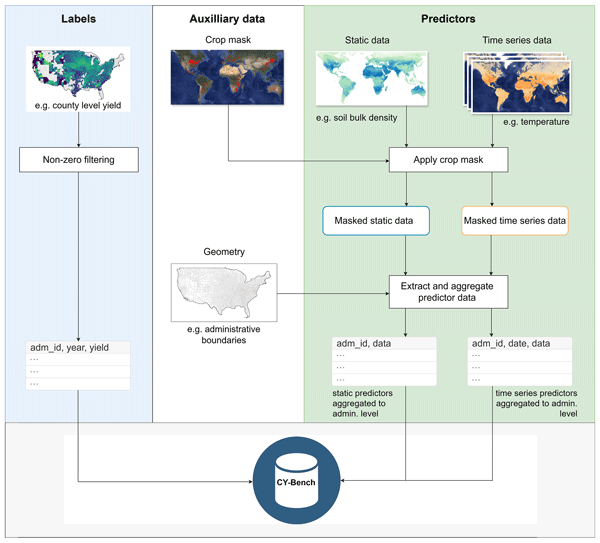
Improving crop yield predictions is crucial for food security. Prior research relied on case studies, making it hard to compare methods and track progress. We introduce CY-Bench (Crop Yield Benchmark), a global dataset for forecasting maize and wheat yields across diverse farming systems in over 25 countries. It includes standardized weather, soil, and satellite data, curated by a diverse set of experts. CY-Bench supports the development of tools to help decision-makers plan for food security.
Melissa Leah Breeden, Andrew Hoell, John Robert Albers, and Kimberly Slinski
Weather Clim. Dynam., 4, 963–980, https://doi.org/10.5194/wcd-4-963-2023, https://doi.org/10.5194/wcd-4-963-2023, 2023
Short summary
Short summary
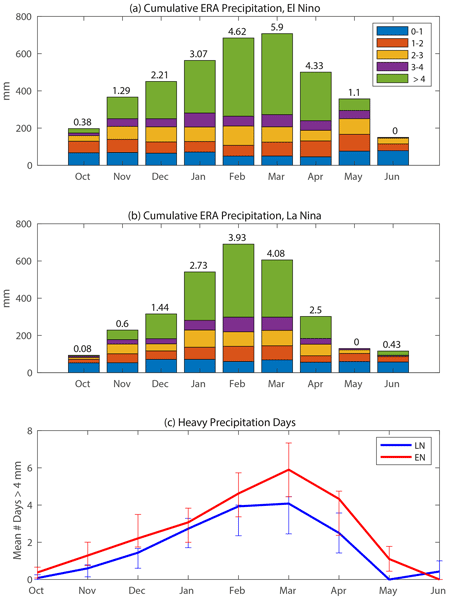
We compare the month-to-month evolution of daily precipitation over central southwest Asia (CSWA), a data-sparse, food-insecure area prone to drought and flooding. The seasonality of CSWA precipitation aligns with the seasonality of warm conveyor belts (WCBs), the warm, rapidly ascending airstreams associated with extratropical storms, most common from February–April. El Niño conditions are related to more WCBs and precipitation and La Niña conditions the opposite, except in January.
Amy McNally, Jossy Jacob, Kristi Arsenault, Kimberly Slinski, Daniel P. Sarmiento, Andrew Hoell, Shahriar Pervez, James Rowland, Mike Budde, Sujay Kumar, Christa Peters-Lidard, and James P. Verdin
Earth Syst. Sci. Data, 14, 3115–3135, https://doi.org/10.5194/essd-14-3115-2022, https://doi.org/10.5194/essd-14-3115-2022, 2022
Short summary
Short summary
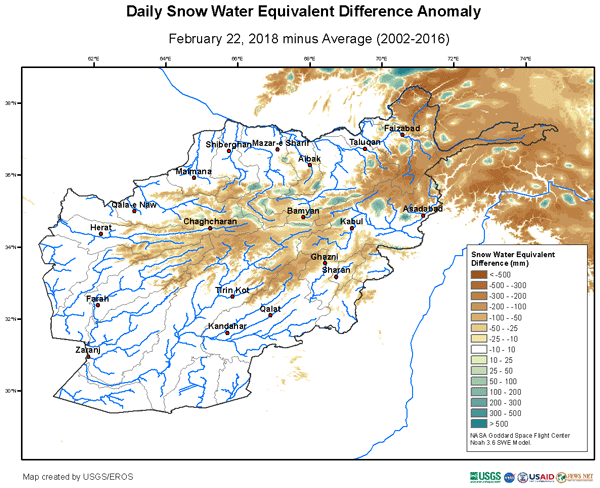
The Famine Early Warning Systems Network (FEWS NET) Land Data Assimilation System (FLDAS) global and Central Asia data streams described here generate routine estimates of snow, soil moisture, runoff, and other variables useful for tracking water availability. These data are hosted by NASA and USGS data portals for public use.
Wanshu Nie, Sujay V. Kumar, Kristi R. Arsenault, Christa D. Peters-Lidard, Iliana E. Mladenova, Karim Bergaoui, Abheera Hazra, Benjamin F. Zaitchik, Sarith P. Mahanama, Rachael McDonnell, David M. Mocko, and Mahdi Navari
Hydrol. Earth Syst. Sci., 26, 2365–2386, https://doi.org/10.5194/hess-26-2365-2022, https://doi.org/10.5194/hess-26-2365-2022, 2022
Short summary
Short summary
The MENA (Middle East and North Africa) region faces significant food and water insecurity and hydrological hazards. Here we investigate the value of assimilating remote sensing data sets into an Earth system model to help build an effective drought monitoring system and support risk mitigation and management by countries in the region. We highlight incorporating satellite-informed vegetation conditions into the model as being one of the key processes for a successful application for the region.
Cited articles
Ainembabazi, J. H., Rusike, J., and Keizire, B: The 2015-16 El Niño-induced drought crisis in Southern Africa: Lessons from Historical Data and Policy Implications, https://agra.org/wp-content/uploads/2020/08/AGRA-drought-crisis-in-Southern-Africa_v2-.pdf (last access: 25 August 2025), 2018.
Arsenault, K.R., Shukla,S., Hazra, A., Getirana, A., McNally, A., Kumar, S., Koster, R. D., Peters-Lidard, C. D., Zaitchik, B. F., Badr, H., Jung, H. C., Narapusetty, B., Navari, M., Wang, S., Mocko, D. M., Funk, C., Harrison, L., Husak, G. J., Adoum, A., Galu, G., Magadzire, T., Roningen, J., Shaw, M., Eylander, J., Bergaoui, K., McDonnell, R. A., and Verdin, J. P.: The NASA hydrological forecast system for food and water security applications, Bull. Am. Meteorol. Soc., https://doi.org/10.1175/BAMS-D-18-0264.1, 2020.
Ascott, M. J., Macdonald, D. M. J., Black, E., Verhoef, A., Nakohoun, P., Tirogo, J., Sandwidi, W. J. P., Bliefernicht, J., Sorensen, J. P. R., and Bossa, A.: In situ observations and lumped parameter model reconstructions reveal intra-annual to multidecadal variability in groundwater levels in sub-Saharan Africa, Water Resources Research, 56, e2020WR028056, https://doi.org/10.1029/2020WR028056, 2020.
Becker, E., H. v. den Dool, and Q. Zhang: Predictability and Forecast Skill in NMME, J. Climate, 27, 5891–5906, https://doi.org/10.1175/JCLI-D-13-00597.1, 2014.
Bierkens, M. F. and Wada, Y.: Non-renewable groundwater use and groundwater depletion: a review, Environ. Res. Lett., 14, 063002, https://doi.org/10.1088/1748-9326/ab1a5f, 2019.
Bishumba, N.: El Nino-induced floods ravage East Africa, https://www.dw.com/en/el-nino-induced-floods-ravage-east-africa/a-19245333 (last access: 17 February 2026), 2016.
Boergens, E., Güntner, A., Sips, M., Schwatke, C., and Dobslaw, H.: Interannual variations of terrestrial water storage in the East African Rift region, Hydrol. Earth Syst. Sci., 28, 4733–4754, https://doi.org/10.5194/hess-28-4733-2024, 2024.
Borovikov, A., Cullather, R., Kovach, R., Marshak, J., Vernieres, G., Vikhliaev, Y., Zhao, B., and Li, Z.: GEOS-5 seasonal forecast system, Clim. Dyn., 53, 7335–7361, https://doi.org/10.1007/s00382-017-3835-2, 2019.
Bonsor, H. C., Shamsudduha, M., Marchant, B. P., MacDonald, A. M., and Taylor, R. G.: Seasonal and Decadal Groundwater Changes in African Sedimentary Aquifers Estimated Using GRACE Products and LSMs, Remote Sens., 10, 904, https://doi.org/10.3390/rs10060904, 2018.
Cook, B. I, Slinski, K., Peters-Lidard, C., McNally, A., Arsenault, K., and Hazra, A.: The efficacy of seasonal terrestrial water storage forecasts for predicting vegetation activity over Africa, J. Hydrometeorol., 22, 3121–3137, https://doi.org/10.1175/JHM-D-21-0046.1, 2021.
Correia, C. D. N., Fonseca, A., Amraoui, M., Pereira, C. A., and Santos, J. A.: Long-Term Climate Trends in Southern Angola and Possible Implications in Agriculture, Climate, 13, 173, https://doi.org/10.3390/cli13090173, 2025.
Deggim, S., Eicker, A., Schawohl, L., Gerdener, H., Schulze, K., Engels, O., Kusche, J., Saraswati, A. T., van Dam, T., Ellenbeck, L., Dettmering, D., Schwatke, C., Mayr, S., Klein, I., and Longuevergne, L.: RECOG RL01: correcting GRACE total water storage estimates for global lakes/reservoirs and earthquakes, Earth Syst. Sci. Data, 13, 2227–2244, https://doi.org/10.5194/essd-13-2227-2021, 2021.
Döll, P., Schmied, H. M., Schuh, C., Portmann, F. T., and Eicker, A.: Global-scale assessment of groundwater depletion and related groundwater abstractions: Combining hydrological modeling with information from well observations and GRACE satellites, Water Resour. Res., 50, 5698–5720, https://doi.org/10.1002/2014WR015595, 2014.
Eltahir, E. A. B. and Yeh P. J.-F.: On the asymmetric response of aquifer water level to floods and droughts in Illinois, Water Resour. Res., 35, 1199–1217, https://doi.org/10.1029/1998WR900071, 1999.
Favreau, G., Cappelaere, B., Massuel, S., Leblanc, M., Boucher,M., Boulain, N., and Leduc, C.: Land clearing, climate variability, and water resources increase in semiarid southwest Niger: A review, Water Resour. Res., 45, W00A16, https://doi.org/10.1029/2007WR006785, 2009.
FloodList: West Africa – Deadly Floods in Mali and Burkina Faso, https://floodlist.com/africa/west-africa-floods-nigeria-mali-burkina-faso-august-2016, (last access: 11 August 2025), 2016.
FEWS NET: Southern Africa: Special Report Illustrating the extent and severity of the 2015-16 drought, https://reliefweb.int/report/south-africa/southern-africa-special-report-illustrating-extent-and-severity-2015-16-drought (last access: 19 August 2025), 2016.
Frappart, F.: Groundwater Storage Changes in the Major North African Transboundary Aquifer Systems during the GRACE Era (2003–2016), Water, 2669, https://doi.org/10.3390/w12102669, 2020.
Funk, C., Peterson, P., Landsfeld, M., Shukla, S., Husak, G., Harrison, L., and Michaelsen, J.: The climate hazards infrared precipitation with stations – a new environmental record for monitoring extremes, Sci. Data, 2, 150066, https://doi.org/10.1038/sdata.2015.66, 2015.
Gelaro, R., McCarty, W., Suárez, M. J., Todling, R., Molod, A., Takacs, L., Randles, C. A., Darmenov, A., Bosilovich, M. G., Reichle, R., Wargan, K., Coy, L., Cullather, R., Draper, C., Akella, S., Buchard, V., Conaty, A., da Silva, A. M., Gu, W., Kim, G.-K., Koster, R., Lucchesi, R., Merkova, D., Nielsen, J. E., Partyka, G., Pawson, S., Putman, W., Rienecker, M., Schubert, S. D., Sienkiewicz, M., and Zhao, B.: The Modern-Era Retrospective Analysis for Research and Applications, Version 2 (MERRA-2), J. Climate, 30, 5419–5454, https://doi.org/10.1175/JCLI-D-16-0758.1, 2017.
Gossel, W., Ebraheem, A. M., and Wycisk, P.: A very large scale GIS-based groundwater flow model for the Nubian sandstone aquifer in Eastern Sahara (Egypt, northern Sudan and eastern Libya), Hydrogeology Journal, 12, 698–713, https://doi.org/10.1007/s10040-004-0379-4, 2004.
Getirana, A., Kumar, S. V., Girotto, M., and Rodell, M.: Rivers and floodplains as key components of global terrestrial water storage variability, Geophysical Research Letters, 44, 10359–10368, https://doi.org/10.1002/2017GL074684, 2017.
Hazra, A., McNally, A., Slinski, K., Arsenault, K. R., Shukla, S., Getirana, A., Jacob, J. P., Sarmiento, D. P., Peters-Lidard, C., Kumar, S. V., and Koster, R. D.: NASA's NMME-based S2S hydrologic forecast system for food insecurity early warning in southern Africa, J. Hydrology, 617, 129005, https://doi.org/10.1016/j.jhydrol.2022.129005, 2023.
Humphrey, V., Gudmundsson, L., and Seneviratne, S. I.: Assessing Global Water Storage Variability from GRACE: Trends, Seasonal Cycle, Subseasonal Anomalies and Extremes, Surv. Geophys., 37, 357–395, https://doi.org/10.1007/s10712-016-9367-1, 2016.
Jasechko, S., Seybold, H., Perrone, D., Fan, Y., Shamsudduha, M., Taylor, R. G., Fallatah, O., and Kirchner, J. W.: Rapid groundwater decline and some cases of recovery in aquifers globally, Nature, 625, 715–721, https://doi.org/10.1038/s41586-023-06879-8, 2024.
Jensen, L., Eicker, A., Dobslaw, H., Stacke, T., and Humphrey, V.: Long-term wetting and drying trends in land water storage derived from GRACE and CMIP5 models, J. Geophys. Res. Atmos., 124, 9808–9823, https://doi.org/10.1029/2018JD029989, 2019.
Kirtman, B. P., Min, D., Infanti, J. M., Kinter III, J. L., Paolino, D. A., Zhang, Q., van den Dool, H., Saha, S., Pena Mendez, M., Becker, E., Peng, P., Tripp, P., Huang, J., DeWitt, D. G., Tippett, M. K., Barnston, A. G., Li, S., Rosati, A., Schubert, S. D., Rienecker, M., Suarez, M., Li, Z. E., Marshak, J., Lim, Y.-K., Tribbia, J., Pegion, K., Merryfield, W. J., Denis, B., and Wood, E. F.: The North American Multimodel Ensemble: Phase-1 Seasonal-to-Interannual Prediction; Phase-2 toward Developing Intraseasonal Prediction, Bull. Amer. Meteor. Soc., 95, 585–601, https://doi.org/10.1175/BAMS-D-12-00050.1, 2014.
Koster, R. and Suarez, M.: Energy and water balance calculations in the Mosaic LSM, NASA Tech. Memo, NASA, TM-104606, vol. 9, 60 pp., https://gmao.gsfc.nasa.gov/pubs/docs/Koster130.pdf (last access: 17 February 2026), 1996.
Koster, R. D., Suarez, M. J., Ducharne, A., Stieglitz, M., and Kumar, P.: A catchment-based approach to modeling land surface processes in a general circulation model: 1. Model structure, J. Geophys. Res., 105, 24809–24822, https://doi.org/10.1029/2000JD900328, 2000.
Kumar, S., Peters-Lidard, C. D., Tian, Y., Houser, P. R., Geiger, J., Olden, S., Lighty, L., Eastman, J. L., Doty, B., Dirmeyer, P., Adams, J., Mitchell, K., Wood, E. F., and Sheffield, J.: Land information system: An interoperable framework for high resolution land surface modeling, Environmental Modelling & Software, 21, https://doi.org/10.1016/j.envsoft.2005.07.004, 2006.
Landerer, F. W. and Swenson, S. C.: Accuracy of scaled GRACE terrestrial water storage estimates, Water Resour. Res., 48, W04531, https://doi.org/10.1029/2011WR011453, 2012.
Landerer, F. W., Flechtner, F. M., Save, H., Webb, F. H., Bandikova, T., Bertiger, W. I., Bettadpur, S. V., Byun, S. H., Dahle, C., Dobslaw, H., Fahnestock, E., Harvey, N., Kang, Z., Kruizinga, G. L. H., Loomis, B. D., McCullough, C., Murböck, M., Nagel, P., Paik, M., Pie, N., Poole, S., Strekalov, D., Tamisiea, M. E., Wang, F., Watkins, M. M., Wen, H.-Y., Wiese, D. N., and Yuan, D.-N.: Extending the global mass change data record: GRACE Follow-On instrument and science data performance, Geophysical Research Letters, 47, e2020GL088306, https://doi.org/10.1029/2020GL088306, 2020.
Levey, J. R. and Sankarasubramanian, A.: Spatial and Temporal Variation of Subseasonal-to-Seasonal (S2S) Precipitation Reforecast Skill across the CONUS, J. Hydrometeor., 25, 755–770, https://doi.org/10.1175/JHM-D-23-0159.1, 2024.
Li, B. and Rodell, M.: How have hydrological extremes changed over the past 20 years?, Journal of Climate, https://doi.org/10.1175/jcli-d-23-0199.1, 2023.
Li, B., Rodell, M., and Famiglietti, J.: Groundwater variability across temporal and spatial scales in the central and northeastern U.S., Journal of Hydrology, 525, 769–780, https://doi.org/10.1016/j.jhydrol.2015.04.033, 2015.
Li, B., Rodell, M., Sheffield, J. Wood, E., and Sutanudjaja, E.: Long-term, non-anthropogenic groundwater storage changes simulated by three global-scale hydrological models, Scientific Reports, 9, 10746, https://doi.org/10.1038/s41598-019-47219-z, 2019a.
Li, B., Rodell, M., Kumar, S., Beaudoing, H. K., Getirana, A., Zaitchik, B. F., de Goncalves, L. G., Cossetin, C., Bhanja, S., Mukherjee, A., Tian, S., Tangdamrongsub, N., Long, D., Nanteza, J., Lee, J., Policelli, F., Goni, I. B., Daira, D., Bila, M., de Lannoy, G., Mocko, D., Steele-Dunne, S. C., Save, H., and Bettadpur, S.: Global GRACE data assimilation for groundwater and drought monitoring: Advances and challenges, Water Resour. Res., 55, 7564–7586, https://doi.org/10.1029/2018wr024618, 2019b.
Li, B., Rodell, M., Peters-Lidard, C., Erlingis, J., Kumar, S., and Mocko, D.: Groundwater recharge estimated by land surface models: an evaluation in the conterminous U.S, J. Hydrometeor., 22, 499–522, https://doi.org/10.1175/JHM-D-20-0130.1, 2021.
Li B., Rodell, M., and Save, H.: Terrestrial water storage in 2024, Nature Reviews Earth & Environment, 6, 261–263, https://doi.org/10.1038/s43017-025-00659-w, 2025.
Li, F., Kusche, J., Sneeuw, N., Siebert, S., Gerdener, H., Wang, Z., Chao, N., Chen, G., and Tian, K.: Forecasting next year's global land water storage using GRACE data, Geophysical Research Letters, 51, e2024GL109101, https://doi.org/10.1029/2024GL109101, 2024.
Li, F., Springer, A., Kusche, J., Gutknecht, B., and Ewerdwalbesloh, Y.: Reanalysis and Forecasting of Total Water Storage and Hydrological States by Combining Machine Learning With CLM Model Simulations and GRACE Data Assimilation, Water Resources Research, e2024WR037926, https://doi.org/10.1029/2024WR037926, 2025.
Mason, S. J. and Goddard, L.: Probabilistic precipitation anomalies associated with ENSO, Bull. Am. Meteorol. Soc., 82, 619–638, https://doi.org/10.1175/1520-0477(2001)082<0619:PPAAWE>2.3.CO;2, 2001.
Met Office: Relative operating characteristic (ROC), https://www.metoffice.gov.uk/research/climate/seasonal-to-decadal/gpc-outlooks/user-guide/interpret-roc, last access: 5 August 2025.
Ngcamu, B. S. and Chari, F.: Drought Influences on Food Insecurity in Africa: A Systematic Literature Review, Int. J. Environ. Res. Public Health, 17, 5897, https://doi.org/10.3390/ijerph17165897, 2020.
Niu, G.-Y., Yang, Z., Mitchell, K., Chen, F., Ek., M, Barlage, M., Kumar, A., Manning, K., Niyogi, D., Rosero, E., Tewari, M., and Xia, Y.: The community Noah land surface model with multiparameterization options (Noah-MP): 1. Model description and evaluation with local-scale measurements, J. Geophys. Res., 116, D12109, https://doi.org/10.1029/2010JD015139, 2011.
Phakula, S., Landman, W. A., and Engelbrecht, C. J.: Literature survey of subseasonal-to-seasonal predictions in the southern hemisphere, Meteorological Applications, 31, e2170, https://doi.org/10.1002/met.2170, 2024.
Rodell, M. and Famiglietti, J. S.: An analysis of terrestrial water storage variations in Illinois with implications for the Gravity Recovery and Climate Experiment (GRACE), Water Resources Research, 37, 1327–1340, https://doi.org/10.1029/2000WR900306, 2001.
Rodell, M. and Li, B.: Changing intensity of hydroclimatic extreme events revealed by GRACE and GRACE-FO, Nature Water, 1, https://doi.org/10.1038/s44221-023-00040-5, 2023.
Rodell, M., Famiglietti, J. S., Wiese, D. N., Reager, J. T., Beaudoing, H. K., Landerer, F. W., and Lo, M.-H.: Emerging trends in global freshwater availability, Nature, 557, 651–659, https://doi.org/10.1038/s41586-018-0123-1, 2018.
Save, H., Bettadpur, S. and Tapley, B. D.: High resolution CSR GRACE RL05 mascons, J. Geophys. Res. Solid Earth, 121, 7547–7569, https://doi.org/10.1002/2016JB013007, 2016.
Scanlon, B. G., Zhang, Z., Save, H., Sun, A., Schmied, H. M., van Beek, L. P. H., Wiese, D. N., Wada, Y., Long, D., Reedy, R. C., Longuevergne, L., Döll, P., and Bierkens, M. F. P.: Global models underestimate large decadal declining and rising water storage trends relative to GRACE satellite data, Proc. Natl. Acad. Sci. USA, 115, E1080–E1089, https://doi.org/10.1073/pnas.1704665115, 2018.
Scanlon, B., Rateb, A., Anyamba, A., Kebede, S., MacDonald, A. M., Shamsudduha, M., Small, J., Sun, A., Taylor, R. G., and Xie, H.: Linkages between GRACE water storage, hydrologic extremes, and climate teleconnections in major African aquifers, Environ. Res. Lett., 17, 014046, https://doi.org/10.1088/1748-9326/ac3bfc, 2022.
Sharifi, E., Haas, J., Boergens, E., Dobslaw, H., and Güntner, A.: Technical note: GRACE-compatible filtering of water storage data sets via spatial autocorrelation analysis, Hydrol. Earth Syst. Sci., 29, 6985–6998, https://doi.org/10.5194/hess-29-6985-2025, 2025.
Shukla, S., Roberts, J., Hoell, A., Funk, C. C., Robertson, F., and Kirtman, B.: Assessing North American multimodel ensemble (NMME) seasonal forecast skill to assist in the early warning of anomalous hydrometeorological events over East Africa, Clim. Dyn., 53, 7411–7427, 2019.
Slater, L. J., Villarini, G., and Bradley, A. A.: Evaluation of the skill of North-American Multi-Model Ensemble (NMME) Global Climate Models in predicting average and extreme precipitation and temperature over the continental USA, Clim. Dyn., 53, 7381–7396, 2019.
Tapley, B. D., Bettadpur, S., Watkins, M., and Reigber, C.: The gravity recovery and climate experiment: Mission overview and early results, Geophys. Res. Lett., 31, L09607, https://doi.org/10.1029/2004GL019920, 2004.
Trisos, C. H., Adelekan, I. O., Totin, E., Ayanlade, A., Efitre, J., Gemeda, A., Kalaba, K., Lennard, C., Masao, C., Mgaya, Y., Ngaruiya, G., Olago, D., Simpson, N. P., and Zakieldeen, S.: Africa, in: Climate Change 2022: Impacts, Adaptation and Vulnerability. Contribution of Working Group II to the Sixth Assessment Report of the Intergovernmental Panel on Climate Change, edited by: Pörtner, H.-O., Roberts, D. C., Tignor, M., Poloczanska, E. S., Mintenbeck, K., Alegría, A., Craig, M., Langsdorf, S., Löschke, S., Möller, V., Okem, A., and Rama, B., Cambridge University Press, Cambridge, UK and New York, NY, USA, 1285–1455, https://doi.org/10.1017/9781009325844.011, 2022.
WMO: State of the Climate in Africa 2024, https://library.wmo.int/idurl/4/69495 (last access: 17 February 2026), 2025.
Wood, A. W., Maurer, E. P., Kumar, A., and Lettenmaier, D.: Long-range experimental hydrologic forecasting for the eastern United States, J. Geophys. Res., 107, 4429, https://doi.org/10.1029/2001JD000659, 2002.
Xia, Y., Mocko, D., Huang, M., Li, B., Rodell, M., Mitchell, K. E., Cai, X., and Ek, M. B.: Comparison and assessment of three advanced land surface models in simulating terrestrial water storage components over the United States, J. Hydrometeor., 18, 625–649, https://doi.org/10.1175/jhm-d-16-0112.1, 2017.
Xu, T., Guo, Z., Xia, Y., Ferreira, V. G., Liu, S., Wang, K., Yao, Y., Zhang, X., and Zhao, C.: Evaluation of twelve evapotranspiration products from machine learning, remote sensing and land surface models over conterminous United States, J. Hydrology, 578, https://doi.org/10.1016/j.jhydrol.2019.124105, 2019.
Yuan, X. and Zhu, E.: A first look at decadal hydrological predictability by land surface ensemble simulations, Geophysical Research Letters, 45, 2362–2369, https://doi.org/10.1002/2018GL077211, 2018.
Yue, S., Pilon, P., and Cavadias, G.: Power of the Mann–Kendall and Spearman's rho tests for detecting monotonic trends in hydrological series, Journal of Hydrology, 259, https://doi.org/10.1016/S0022-1694(01)00594-7, 2002.
Zhang, L., Kim, T., Yang, T., Hong, Y., and Zhu, Q.: Evaluation of Subseasonal-to-Seasonal (S2S) precipitation forecast from the North American Multi-Model ensemble phase II (NMME-2) over the contiguous U.S., J. Hydrology, 603, https://doi.org/10.1016/j.jhydrol.2021.127058, 2021.
Zhao, M., Geruo A, Velicogna, I., and Kimball, J. S.: A global gridded dataset of GRACE drought severity index for 2002-14: Comparison with PDSI and SPEI and a case study of the Australia Millennium Drought, J. Hydrometeorol., 18, 2117–2129, https://doi.org/10.1175/JHM-D-16-0182.1, 2017.
Zhu, E., Yuan, X., and Wood, A. W.: Benchmark decadal forecast skill for terrestrial water storage estimated by an elasticity framework, Nat. Commun., 10, 1237, https://doi.org/10.1038/s41467-019-09245-3, 2019.
Short summary
Accurate prediction of terrestrial water storage (TWS) changes is essential for disaster response. This study evaluates TWS forecast skill over Africa using observations from the Gravity Recovery and Climate Experiment (GRACE). Results show that the NASA Catchment Land Surface Model (CLSM) outperforms Noah with Multi-Parameterization (Noah-MP) across 1-6 months lead times, owing to more accurate reanalysis-based initial conditions and stronger representation of TWS interannual variability.
Accurate prediction of terrestrial water storage (TWS) changes is essential for disaster...


