
Articles | Volume 29, issue 23
https://doi.org/10.5194/hess-29-7073-2025
© Author(s) 2025. This work is distributed under
the Creative Commons Attribution 4.0 License.
the Creative Commons Attribution 4.0 License.
https://doi.org/10.5194/hess-29-7073-2025
© Author(s) 2025. This work is distributed under
the Creative Commons Attribution 4.0 License.
the Creative Commons Attribution 4.0 License.
Research article
| 
08 Dec 2025
Research article |
| 08 Dec 2025
| 08 Dec 2025
Streamflow generation in a nested system of intermittent and perennial tropical streams under changing land use
Giovanny M. Mosquera
CORRESPONDING AUTHOR

Laboratorio de Ecología Acuática, Global Research and Solutions Center, Universidad San Francisco de Quito USFQ, Quito, Ecuador
Daniela Rosero-López
Laboratorio de Ecología Acuática, Global Research and Solutions Center, Universidad San Francisco de Quito USFQ, Quito, Ecuador
José Daza
Laboratorio de Ecología Acuática, Global Research and Solutions Center, Universidad San Francisco de Quito USFQ, Quito, Ecuador
Daniel Escobar-Camacho
Laboratorio de Ecología Acuática, Global Research and Solutions Center, Universidad San Francisco de Quito USFQ, Quito, Ecuador
Annika Künne
Geographic Information Science Group, Institute of Geography, Friedrich Schiller University Jena, Jena, Germany
Patricio Crespo
Departamento de Recursos Hídricos y Ciencias Ambientales & Facultad de Ingeniería, Universidad de Cuenca, Cuenca, Ecuador
Sven Kralisch
Geographic Information Science Group, Institute of Geography, Friedrich Schiller University Jena, Jena, Germany
Jordan Karubian
Department of Ecology and Evolutionary Biology, Tulane University, New Orleans, LA, USA
Fundación para la Conservación de Los Andes Tropicales, Quito, Ecuador
Andrea C. Encalada
CORRESPONDING AUTHOR
Laboratorio de Ecología Acuática, Global Research and Solutions Center, Universidad San Francisco de Quito USFQ, Quito, Ecuador
Related authors
No articles found.
Anthony C. Ross, Ben C. Howard, Braulio Lahuatte, Paola Fuentes, Bert De Bièvre, Mateo Jerves-Ramirez, Patricio Crespo, Nilton Montoya, Jasper Oshun, Athanasios Paschalis, and Wouter Buytaert
EGUsphere, https://doi.org/10.5194/egusphere-2026-4439, https://doi.org/10.5194/egusphere-2026-4439, 2026
Short summary
Short summary
High-mountain wetlands can secure year-round water for communities, but their connection to streams remains unclear. Using dye tracing across five tropical mountain sites, we tracked water movement over several months. Results show that wetland-to-stream travel times vary from under one week to over three months, depending on season, topography and geology, among other factors. Understanding this complex connectivity is vital for improving streamflow predictions and water supply management.
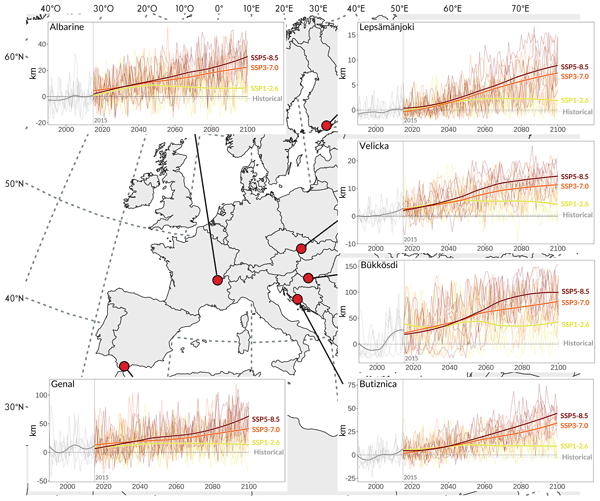
Louise Mimeau, Annika Künne, Alexandre Devers, Flora Branger, Sven Kralisch, Claire Lauvernet, Jean-Philippe Vidal, Núria Bonada, Zoltán Csabai, Heikki Mykrä, Petr Pařil, Luka Polović, and Thibault Datry
Hydrol. Earth Syst. Sci., 29, 1615–1636, https://doi.org/10.5194/hess-29-1615-2025, https://doi.org/10.5194/hess-29-1615-2025, 2025
Short summary
Short summary
Our study projects how climate change will affect the drying of river segments and stream networks in Europe, using advanced modelling techniques to assess changes in six river networks across diverse ecoregions. We found that drying events will become more frequent and intense and will start earlier or last longer, potentially turning some river sections from perennial to intermittent. The results are valuable for river ecologists for evaluating the ecological health of river ecosystem.
Louise Mimeau, Annika Künne, Flora Branger, Sven Kralisch, Alexandre Devers, and Jean-Philippe Vidal
Hydrol. Earth Syst. Sci., 28, 851–871, https://doi.org/10.5194/hess-28-851-2024, https://doi.org/10.5194/hess-28-851-2024, 2024
Short summary
Short summary
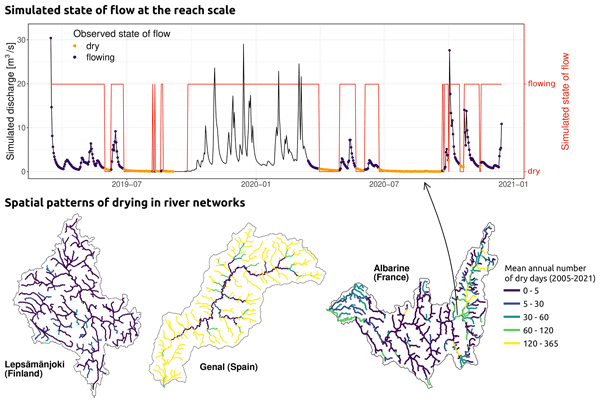
Modelling flow intermittence is essential for predicting the future evolution of drying in river networks and better understanding the ecological and socio-economic impacts. However, modelling flow intermittence is challenging, and observed data on temporary rivers are scarce. This study presents a new modelling approach for predicting flow intermittence in river networks and shows that combining different sources of observed data reduces the model uncertainty.
Cited articles
Akoglu, H.: User's guide to correlation coefficients, Turk. J. Emerg. Med., 18, 91–93, https://doi.org/10.1016/J.TJEM.2018.08.001, 2018.
APHA: Standard methods for the examination of water and wastewater, 22nd edn., edited by: Rice, E. W., Baird, R. B., Eaton, A. D., and Clesceri, L. S., American Public Health Association (APHA), American Water Works Association (AWWA) and Water Environment Federation (WEF), Washington, D.C., USA, ISBN 978-0875530130, 2012.
APHA: Standard methods for the examination of water and wastewater, 24th edn., edited by: Lipps, W. C., Braun-Howland, E. B., and Baxter, T. E., American Public Health Association (APHA), American Water Works Association (AWWA) and Water Environment Federation (WEF), ISBN 978-0-87553-299-8, 2023.
Asano, Y., Uchida, T., and Ohte, N.: Residence times and flow paths of water in steep unchannelled catchments, Tanakami, Japan, J. Hydrol., 261, 173–192, https://doi.org/10.1016/S0022-1694(02)00005-7, 2002.
Banda, V. D., Mengistu, H., and Kanyerere, T.: Assessment of catchment scale groundwater-surface water interaction in a non-perennial river system, Heuningnes catchment, South Africa, Sci. Afr., 20, e01614, https://doi.org/10.1016/J.SCIAF.2023.E01614, 2023.
Barthold, F., Wu, J., Vaché, K., Schneider, K., Frede, H.-G., and Breuer, L.: Identification of geographic runoff sources in a data sparse region: hydrological processes and the limitations of tracer-based approaches, Hydrol. Process., 24, 2313–2327, https://doi.org/10.1002/hyp.7678, 2010.
Bourke, S. A., Degens, B., Searle, J., de Castro Tayer, T., and Rothery, J.: Geological permeability controls streamflow generation in a remote, ungauged, semi-arid drainage system, J. Hydrol. Reg. Stud., 38, 100956, https://doi.org/10.1016/J.EJRH.2021.100956, 2021.
Correa, A., Windhorst, D., Crespo, P., Célleri, R., Feyen, J., and Breuer, L.: Continuous versus event-based sampling: how many samples are required for deriving general hydrological understanding on Ecuador's páramo region?, Hydrol. Process., 30, 4059–4073, https://doi.org/10.1002/hyp.10975, 2016.
Correa, A., Windhorst, D., Tetzlaff, D., Crespo, P., Célleri, R., Feyen, J., and Breuer, L.: Temporal dynamics in dominant runoff sources and flow paths in the Andean Páramo, Water Resour. Res., 53, 5998–6017, https://doi.org/10.1002/2016WR020187, 2017.
Costigan, K. H., Jaeger, K. L., Goss, C. W., Fritz, K. M., and Goebel, P. C.: Understanding controls on flow permanence in intermittent rivers to aid ecological research: integrating meteorology, geology and land cover, Ecohydrology, 9, 1141–1153, https://doi.org/10.1002/ECO.1712, 2016.
Costigan, K. H., Kennard, M. J., Leigh, C., Sauquet, E., Datry, T., and Boulton, A. J.: Flow Regimes in Intermittent Rivers and Ephemeral Streams, Intermittent Rivers and Ephemeral Streams: Ecology and Management, 51–78, https://doi.org/10.1016/B978-0-12-803835-2.00003-6, 2017.
Craig, H.: Isotopic Variations in Meteoric Waters, Science, 133, 1702–1703, https://doi.org/10.1126/science.133.3465.1702, 1961.
Cuesta, F., Peralvo, M., Merino-Viteri, A., Bustamante, M., Baquero, F., Freile, J. F., Muriel, P., and Torres-Carvajal, O.: Priority areas for biodiversity conservation in mainland Ecuador, Neotrop. Biodivers., 3, 93–106, https://doi.org/10.1080/23766808.2017.1295705, 2017.
Datry, T., Allen, D., Argelich, R., Barquin, J., Bonada, N., Boulton, A., Branger, F., Cai, Y., Cañedo-Argüelles, M., Cid, N., Csabai, Z., Dallimer, M., Araújo, J. C. de, Declerck, S., Dekker, T., Döll, P., Encalada, A., Forcellini, M., Foulquier, A., Heino, J., Jabot, F., Keszler, P., Kopperoinen, L., Kralisch, S., Künne, A., Lamouroux, N., Lauvernet, C., Lehtoranta, V., Loskotová, B., Marcé, R., Ortega, J. M., Matauschek, C., Miliša, M., Mogyorósi, S., Moya, N., Schmied, H. M., Munné, A., Munoz, F., Mykrä, H., Pal, I., Paloniemi, R., Pařil, P., Pengal, P., Pernecker, B., Polášek, M., Rezende, C., Sabater, S., Sarremejane, R., Schmidt, G., Domis, L. S., Singer, G., Suárez, E., Talluto, M., Teurlincx, S., Trautmann, T., Truchy, A., Tyllianakis, E., Väisänen, S., Varumo, L., Vidal, J.-P., Vilmi, A., and Vinyoles, D.: Securing Biodiversity, Functional Integrity, and Ecosystem Services in Drying River Networks (DRYvER), Research Ideas and Outcomes, 7, e77750, https://doi.org/10.3897/RIO.7.E77750, 2021.
Dansgaard, W.: Stable isotopes in precipitation, Tellus A, 16, 436–468, https://doi.org/10.3402/tellusa.v16i4.8993, 1964.
DIIEA: Geology and Geomorphology [geographic layers], Dirección de Información, Investigación y Educación Ambiental (DIIEA), 2010.
Dinerstein, E., Olson, D., Joshi, A., Vynne, C., Burgess, N. D., Wikramanayake, E., Hahn, N., Palminteri, S., Hedao, P., Noss, R., Hansen, M., Locke, H., Ellis, E. C., Jones, B., Barber, C. V., Hayes, R., Kormos, C., Martin, V., Crist, E., Sechrest, W., Price, L., Baillie, J. E. M., Weeden, D., Suckling, K., Davis, C., Sizer, N., Moore, R., Thau, D., Birch, T., Potapov, P., Turubanova, S., Tyukavina, A., De Souza, N., Pintea, L., Brito, J. C., Llewellyn, O. A., Miller, A. G., Patzelt, A., Ghazanfar, S. A., Timberlake, J., Klöser, H., Shennan-Farpón, Y., Kindt, R., Lillesø, J. P. B., Van Breugel, P., Graudal, L., Voge, M., Al-Shammari, K. F., and Saleem, M.: An Ecoregion-Based Approach to Protecting Half the Terrestrial Realm, Bioscience, 67, 534–545, https://doi.org/10.1093/biosci/bix014, 2017.
Dingman, S. L.: Physical hydrology, 3rd edn., Waveland Press, Inc., Long Grove, IL, 643 pp., ISBN 978-1478611189, 2015.
Dohman, J. M., Godsey, S. E., and Hale, R. L.: Three-Dimensional Subsurface Flow Path Controls on Flow Permanence, Water Resour. Res., 57, e2020WR028270, https://doi.org/10.1029/2020WR028270, 2021.
EURACHEM/CITAC: Quantifying Uncertainty in Analytical Measurement, 3rd edn., edited by: Ellison, S. L. R. and Williams, A., EURACHEM, 133 pp., ISBN 978-0-948926-30-3, 2012.
Fagua, J. C. and Ramsey, R. D.: Geospatial modeling of land cover change in the Chocó-Darien global ecoregion of South America; One of most biodiverse and rainy areas in the world, PLoS One, 14, e0211324, https://doi.org/10.1371/JOURNAL.PONE.0211324, 2019.
Farrick, K. K. and Branfireun, B. A.: Flowpaths, source water contributions and water residence times in a Mexican tropical dry forest catchment, J. Hydrol., 529, 854–865, https://doi.org/10.1016/j.jhydrol.2015.08.059, 2015.
Godsey, S. E. and Kirchner, J. W.: Dynamic, discontinuous stream networks: hydrologically driven variations in active drainage density, flowing channels and stream order, Hydrol. Process., 28, 5791–5803, https://doi.org/10.1002/HYP.10310, 2014.
Gutiérrez-Jurado, K. Y., Partington, D., Batelaan, O., Cook, P., and Shanafield, M.: What Triggers Streamflow for Intermittent Rivers and Ephemeral Streams in Low-Gradient Catchments in Mediterranean Climates, Water Resour. Res., 55, 9926–9946, https://doi.org/10.1029/2019WR025041, 2019.
Gutierrez-Jurado, K. Y., Partington, D., and Shanafield, M.: Taking theory to the field: streamflow generation mechanisms in an intermittent Mediterranean catchment, Hydrol. Earth Syst. Sci., 25, 4299–4317, https://doi.org/10.5194/hess-25-4299-2021, 2021.
Hatley, C. M., Armijo, B., Andrews, K., Anhold, C., Nippert, J. B., and Kirk, M. F.: Intermittent streamflow generation in a merokarst headwater catchment, Environmental Science: Advances, 2, 115–131, https://doi.org/10.1039/D2VA00191H, 2023.
Inamdar, S., Dhillon, G., Singh, S., Dutta, S., Levia, D., Scott, D., Mitchell, M., Van Stan, J., and McHale, P.: Temporal variation in end-member chemistry and its influence on runoff mixing patterns in a forested, Piedmont catchment, Water Resour. Res., 49, 1828–1844, https://doi.org/10.1002/wrcr.20158, 2013.
Jachens, E. R., Roques, C., Rupp, D. E., and Selker, J. S.: Streamflow Recession Analysis Using Water Height, Water Resour. Res., 56, e2020WR027091, https://doi.org/10.1029/2020WR027091, 2020.
Jacobs, S. R., Timbe, E., Weeser, B., Rufino, M. C., Butterbach-Bahl, K., and Breuer, L.: Assessment of hydrological pathways in East African montane catchments under different land use, Hydrol. Earth Syst. Sci., 22, 4981–5000, https://doi.org/10.5194/hess-22-4981-2018, 2018.
Kirchner, J. W., Godsey, S. E., Solomon, M., Osterhuber, R., McConnell, J. R., and Penna, D.: The pulse of a montane ecosystem: coupling between daily cycles in solar flux, snowmelt, transpiration, groundwater, and streamflow at Sagehen Creek and Independence Creek, Sierra Nevada, USA, Hydrol. Earth Syst. Sci., 24, 5095–5123, https://doi.org/10.5194/hess-24-5095-2020, 2020.
Lahuatte, B., Mosquera, G. M., Páez-Bimos, S., Calispa, M., Vanacker, V., Zapata-Ríos, X., Muñoz, T., and Crespo, P.: Delineation of water flow paths in a tropical Andean headwater catchment with deep soils and permeable bedrock, Hydrol. Process., 36, e14725, https://doi.org/10.1002/HYP.14725, 2022.
Laudon, H., Seibert, J., Köhler, S., and Bishop, K.: Hydrological flow paths during snowmelt: Congruence between hydrometric measurements and oxygen 18 in meltwater, soil water, and runoff, Water Resour. Res, 40, https://doi.org/10.1029/2003WR002455, 2004.
Lazo, P. X., Mosquera, G. M., McDonnell, J. J., and Crespo, P.: The role of vegetation, soils, and precipitation on water storage and hydrological services in Andean Páramo catchments, J. Hydrol., 572, 805–819, https://doi.org/10.1016/j.jhydrol.2019.03.050, 2019.
Leibundgut, C., Maloszewski, P., and Külls, C.: Tracers in hydrology, Wiley InterScience (Online service), Wiley-Blackwell, 415 pp., ISBN 978-0-470-51885-4, 2009.
Leigh, C., Boulton, A. J., Courtwright, J. L., Fritz, K., May, C. L., Walker, R. H., and Datry, T.: Ecological research and management of intermittent rivers: an historical review and future directions, Freshw Biol, 61, 1181–1199, https://doi.org/10.1111/FWB.12646, 2016.
Liu, F., Williams, M., and Caine, N.: Source waters and flow paths in an alpine catchment, Colorado Front Range, United States, Water Resour. Res., 40, 1–16, https://doi.org/10.1029/2004WR003076, 2004.
MAATE: Land Cover and Use Map of Ecuador [geographic layer], Geovisor of the Ecuadorian Ministry of the Environment, Water, and Ecological Transition (MAATE), http://ide.ambiente.gob.ec/mapainteractivo/ (last access: 11 November 2023), 2022.
MAG: Geopedological Unit [geographic layer], Geovisor of the Ecuadorian Ministry of Agriculture and Livestock (MAG), http://geoportal.agricultura.gob.ec/ (last access: 11 November 2023), 2019.
McDonnell, J. J.: Where does water go when it rains? Moving beyond the variable source area concept of rainfall-runoff response, Hydrol. Process., 17, 1869–1875, https://doi.org/10.1002/HYP.5132, 2003.
McDonnell, J. J. and Kendall, C.: Isotope tracers in hydrology, Eos Transactions American Geophysical Union, 73, 260–260, https://doi.org/10.1029/91EO00214, 1992.
McGuire, K. J., McDonnell, J. J., Weiler, M., Kendall, C., McGlynn, B. L., Welker, J. M., and Seibert, J.: The role of topography on catchment-scale water residence time, Water Resour Res, 41, W05002, https://doi.org/10.1029/2004WR003657, 2005.
Messager, M. L., Lehner, B., Cockburn, C., Lamouroux, N., Pella, H., Snelder, T., Tockner, K., Trautmann, T., Watt, C., and Datry, T.: Global prevalence of non-perennial rivers and streams, Nature, 594, 391–397, https://doi.org/10.1038/s41586-021-03565-5, 2021.
Meyer, J. L., Wallace, J. B., and Eggert, S. L.: Leaf litter as a source of dissolved organic carbon in streams, Ecosystems, 1, 240–249, https://doi.org/10.1007/s100219900019, 1998.
Mimeau, L., Künne, A., Branger, F., Kralisch, S., Devers, A., and Vidal, J.-P.: Flow intermittence prediction using a hybrid hydrological modelling approach: influence of observed intermittence data on the training of a random forest model, Hydrol. Earth Syst. Sci., 28, 851–871, https://doi.org/10.5194/hess-28-851-2024, 2024.
Moeller, A., Kaiser, K., and Guggenberger, G.: Dissolved organic carbon and nitrogen in precipitation, throughfall, soil solution, and stream water of the tropical highlands in northern Thailand, J. Plant Nutr. Soil Sc., 168, 649–659, https://doi.org/10.1002/jpln.200521804, 2005.
Molinero, J., Barrado, M., Guijarro, M., Ortiz, M., Carnicer, O., and Zuazagoitia, D.: The Teaone river: A snapshot of a tropical river from the coastal region of Ecuador, Limnetica, 38, 587–605, https://doi.org/10.23818/LIMN.38.34, 2019.
Mosquera, G. M., Lazo, P. X., Célleri, R., Wilcox, B. P., and Crespo, P.: Runoff from tropical alpine grasslands increases with areal extent of wetlands, Catena, 125, 120–128, https://doi.org/10.1016/j.catena.2014.10.010, 2015.
Mosquera, G. M., Célleri, R., Lazo, P. X., Vaché, K. B., Perakis, S. S., and Crespo, P.: Combined Use of Isotopic and Hydrometric Data to Conceptualize Ecohydrological Processes in a High-Elevation Tropical Ecosystem, Hydrol. Process., 30, 2930–2947, https://doi.org/10.1002/hyp.10927, 2016a.
Mosquera, G. M., Segura, C., Vaché, K. B., Windhorst, D., Breuer, L., and Crespo, P.: Insights into the water mean transit time in a high-elevation tropical ecosystem, Hydrol. Earth Syst. Sci., 20, 2987–3004, https://doi.org/10.5194/hess-20-2987-2016, 2016b.
Mosquera, G. M., Crespo, P., Breuer, L., Feyen, J., and Windhorst, D.: Water transport and tracer mixing in volcanic ash soils at a tropical hillslope: A wet layered sloping sponge, Hydrol. Process., 34, 2032–2047, https://doi.org/10.1002/hyp.13733, 2020.
Mosquera, G. M., Marín, F., Carabajo-Hidalgo, A., Asbjornsen, H., Célleri, R., and Crespo, P.: Ecohydrological assessment of the water balance of the world's highest elevation tropical forest (Polylepis), Sci. Total Environ., 941, 173671, https://doi.org/10.1016/j.scitotenv.2024.173671, 2024.
Muñoz-Villers, L. E. and McDonnell, J. J.: Runoff generation in a steep, tropical montane cloud forest catchment on permeable volcanic substrate, Water Resour. Res., 48, W09528, https://doi.org/10.1029/2011WR011316, 2012.
Muñoz-Villers, L. E., Geissert, D. R., Holwerda, F., and McDonnell, J. J.: Factors influencing stream baseflow transit times in tropical montane watersheds, Hydrol. Earth Syst. Sci., 20, 1621–1635, https://doi.org/10.5194/hess-20-1621-2016, 2016.
Myers, N., Mittermeier, R. A., Mittermeier, C. G., da Fonseca, G. A. B., and Kent, J.: Biodiversity hotspots for conservation priorities, Nature, 403, 853–858, https://doi.org/10.1038/35002501, 2000.
Newbold, T., Oppenheimer, P., Etard, A., and Williams, J. J.: Tropical and Mediterranean biodiversity is disproportionately sensitive to land-use and climate change, Nature Ecology & Evolution, 4, 1630–1638, https://doi.org/10.1038/s41559-020-01303-0, 2020.
Ochoa-Sánchez, A. E., Crespo, P., Carrillo-Rojas, G., Marín, F., and Célleri, R.: Unravelling evapotranspiration controls and components in tropical Andean tussock grasslands, Hydrol. Process., 34, 2117–2127, https://doi.org/10.1002/hyp.13716, 2020.
Pastor, A. V., Tzoraki, O., Bruno, D., Kaletová, T., Mendoza-Lera, C., Alamanos, A., Brummer, M., Datry, T., De Girolamo, A. M., Jakubínský, J., Logar, I., Loures, L., Ilhéu, M., Koundouri, P., Nunes, J. P., Quintas-Soriano, C., Sykes, T., Truchy, A., Tsani, S., and Jorda-Capdevila, D.: Rethinking ecosystem service indicators for their application to intermittent rivers, Ecol. Indic., 137, 108693, https://doi.org/10.1016/J.ECOLIND.2022.108693, 2022.
Peña, P., Pesántez, J., Birkel, C., Mosquera, G., Arízaga-Idrovo, V., Mora, E., and Crespo, P.: How do storm characteristics influence concentration-discharge hysteresis in a high-elevation tropical ecosystem?, J. Hydrol., 619, 129345, https://doi.org/10.1016/J.JHYDROL.2023.129345, 2023.
Penna, D., Stenni, B., Šanda, M., Wrede, S., Bogaard, T. A., Michelini, M., Fischer, B. M. C., Gobbi, A., Mantese, N., Zuecco, G., Borga, M., Bonazza, M., Sobotková, M., Čejková, B., and Wassenaar, L. I.: Technical Note: Evaluation of between-sample memory effects in the analysis of δ2H and δ18O of water samples measured by laser spectroscopes, Hydrol. Earth Syst. Sci., 16, 3925–3933, https://doi.org/10.5194/hess-16-3925-2012, 2012.
Penna, D., Engel, M., Mao, L., Dell'Agnese, A., Bertoldi, G., and Comiti, F.: Tracer-based analysis of spatial and temporal variations of water sources in a glacierized catchment, Hydrol. Earth Syst. Sci., 18, 5271–5288, https://doi.org/10.5194/hess-18-5271-2014, 2014.
Pesántez, J., Mosquera, G. M., Crespo, P., Breuer, L., and Windhorst, D.: Effect of land cover and hydro-meteorological controls on soil water DOC concentrations in a high-elevation tropical environment, Hydrol. Process., 32, 2624–2635, https://doi.org/10.1002/hyp.13224, 2018.
Ramón, J., Correa, A., Timbe, E., Mosquera, G. M., Mora, E., and Crespo, P.: Do mixing models with different input requirement yield similar streamflow source contributions? Case study: A tropical montane catchment, Hydrol. Process., 35, e14209, https://doi.org/10.1002/HYP.14209, 2021.
Serrano-Muela, M. P., Lana-Renault, N., Nadal-Romero, E., Regüés, D., Latron, J., Martí-Bono, C., and García-Ruíz, J.: Forests and Their Hydrological Effects in Mediterranean Mountains, Mt. Res. Dev., 28, 279–285, https://doi.org/10.1659/MRD.0876, 2008.
Shanafield, M., Bourke, S. A., Zimmer, M. A., and Costigan, K. H.: An overview of the hydrology of non-perennial rivers and streams, WIREs Water, 8, e1504, https://doi.org/10.1002/WAT2.1504, 2021.
Sidle, R. C., Tsuboyama, Y., Noguchi, S., Hosoda, I., Fujieda, M., and Shimizu, T.: Stormflow generation in steep forested headwaters: a linked hydrogeomorphic paradigm, Hydrol. Process., 14, 369–385, https://doi.org/10.1002/(SICI)1099-1085(20000228)14:3<369::AID-HYP943>3.0.CO;2-P, 2000.
Soil Survey Staff: Keys to Soil Taxonomy, 13th edn., USDA Natural Resources Conservation Service, Washington, DC, 1–401, ISBN 978-1998295005, 2022.
Staudinger, M., Stoelzle, M., Seeger, S., Seibert, J., Weiler, M., and Stahl, K.: Catchment water storage variation with elevation, Hydrol. Process., 31, 2000–2015, https://doi.org/10.1002/hyp.11158, 2017.
Tetzlaff, D., Buttle, J., Carey, S. K., McGuire, K., Laudon, H., and Soulsby, C.: Tracer-based assessment of flow paths, storage and runoff generation in northern catchments: a review, Hydrol. Process., 29, 3475–3490, https://doi.org/10.1002/hyp.10412, 2015.
Timbe, E., Windhorst, D., Crespo, P., Frede, H.-G., Feyen, J., and Breuer, L.: Understanding uncertainties when inferring mean transit times of water trough tracer-based lumped-parameter models in Andean tropical montane cloud forest catchments, Hydrol. Earth Syst. Sci., 18, 1503–1523, https://doi.org/10.5194/hess-18-1503-2014, 2014.
Timbe, E., Feyen, J., Timbe, L., Crespo, P., Célleri, R., Windhorst, D., Frede, H.-G., and Breuer, L.: Multicriteria assessment of water dynamics reveals subcatchment variability in a seemingly homogeneous tropical cloud forest catchment, Hydrol. Process., 31, 1456–1468, https://doi.org/10.1002/hyp.11146, 2017.
USGS: Sentinel-8 Satellite Imagery [satellite imagery], EarthExplorer, U.S. Geological Survey (USGS), https://earthexplorer.usgs.gov/ (last access: 11 November 2023), 2023.
van Meerveld, H. J. I., Kirchner, J. W., Vis, M. J. P., Assendelft, R. S., and Seibert, J.: Expansion and contraction of the flowing stream network alter hillslope flowpath lengths and the shape of the travel time distribution, Hydrol. Earth Syst. Sci., 23, 4825–4834, https://doi.org/10.5194/hess-23-4825-2019, 2019.
van Meerveld, H. J. I., Sauquet, E., Gallart, F., Sefton, C., Seibert, J., and Bishop, K.: Aqua temporaria incognita, Hydrol. Process., 34, 5704–5711, https://doi.org/10.1002/hyp.13979, 2020.
Vander Vorste, R., Sarremejane, R., and Datry, T.: Intermittent Rivers and Ephemeral Streams: A Unique Biome With Important Contributions to Biodiversity and Ecosystem Services, in: Encyclopedia of the World's Biomes, edited by: Goldstein, M. I. and DellaSala, D. A., Elsevier Inc., 419–429, https://doi.org/10.1016/b978-0-12-409548-9.12054-8, 2020.
WHO Water, Sanitation, Hygiene and Health Team: Guidelines for drinking-water quality, Recommendations, 3rd edn., edited by: World Health Organization (WHO), 1–515 pp., ISBN 978 92 4 154761 1, 2008.
Wilcke, W., Yasin, S., Valarezo, C., and Zech, W.: Change in water quality during the passage through a tropical montane rain forest in Ecuador, Biogeochemistry, 55, 45–72, https://doi.org/10.1023/A:1010631407270, 2001.
Wilcoxon, F.: Individual Comparisons by Ranking Methods, Biometrics Bull., 1, 80–83, https://doi.org/10.2307/3001968, 1945.
Willems, P.: Parsimonious rainfall–runoff model construction supported by time series processing and validation of hydrological extremes – Part 1: Step-wise model-structure identification and calibration approach, J. Hydrol., 510, 578–590, https://doi.org/10.1016/j.jhydrol.2014.01.017, 2014.
Wright, C., Kagawa-Viviani, A., Gerlein-Safdi, C., Mosquera, G. M., Poca, M., Tseng, H., and Chun, K. P.: Advancing ecohydrology in the changing tropics: Perspectives from early career scientists, Ecohydrology, 11, e1918, https://doi.org/10.1002/eco.1918, 2017.
Zhou, Z. and Cartwright, I.: Using geochemistry to identify and quantify the sources, distribution, and fluxes of baseflow to an intermittent river impacted by climate change: The upper Wimmera River, southeast Australia, Sci. Total Environ., 801, 149725, https://doi.org/10.1016/j.scitotenv.2021.149725, 2021.
Zimmer, M. A. and McGlynn, B. L.: Ephemeral and intermittent runoff generation processes in a low relief, highly weathered catchment, Water Resour. Res., 53, 7055–7077, https://doi.org/10.1002/2016WR019742, 2017.
Short summary
Tropical forests supply the water needs of millions of people around the world. Hydrological intermittency, defined as the cessation of river and stream flow, reduces the ability of these forests to provide continuous flow throughout the year. However, there is a lack of knowledge about the factors that cause hydrological intermittency in tropical forests. The results reveal that geology is a key factor causing hydrological intermittency in the Ecuadorian forest of the Chocó-Darién ecoregion.
Tropical forests supply the water needs of millions of people around the world. Hydrological...


