
Articles | Volume 27, issue 15
https://doi.org/10.5194/hess-27-2865-2023
© Author(s) 2023. This work is distributed under
the Creative Commons Attribution 4.0 License.
the Creative Commons Attribution 4.0 License.
https://doi.org/10.5194/hess-27-2865-2023
© Author(s) 2023. This work is distributed under
the Creative Commons Attribution 4.0 License.
the Creative Commons Attribution 4.0 License.
Research article
| 
01 Aug 2023
Research article |
| 01 Aug 2023
| 01 Aug 2023
Routing stemflow water through the soil via preferential flow: a dual-labelling approach with artificial tracers
Surface Hydrology and Erosion Group, Institute of Environmental
Assessment and Water Research, IDAEA-CSIC, Barcelona, Spain
Department of Crop and Soil Sciences, Washington State University, Puyallup, WA 98371, USA
Markus Flury
Department of Crop and Soil Sciences, Washington State University, Puyallup, WA 98371, USA
Department of Crop and Soil Sciences, Washington State University, Pullman, WA 99164, USA
Jérôme Latron
Surface Hydrology and Erosion Group, Institute of Environmental
Assessment and Water Research, IDAEA-CSIC, Barcelona, Spain
Pilar Llorens
Surface Hydrology and Erosion Group, Institute of Environmental
Assessment and Water Research, IDAEA-CSIC, Barcelona, Spain
Related authors
Jinxia An, Guangyao Gao, Chuan Yuan, Juan Pinos, and Bojie Fu
Hydrol. Earth Syst. Sci., 26, 3885–3900, https://doi.org/10.5194/hess-26-3885-2022, https://doi.org/10.5194/hess-26-3885-2022, 2022
Short summary
Short summary
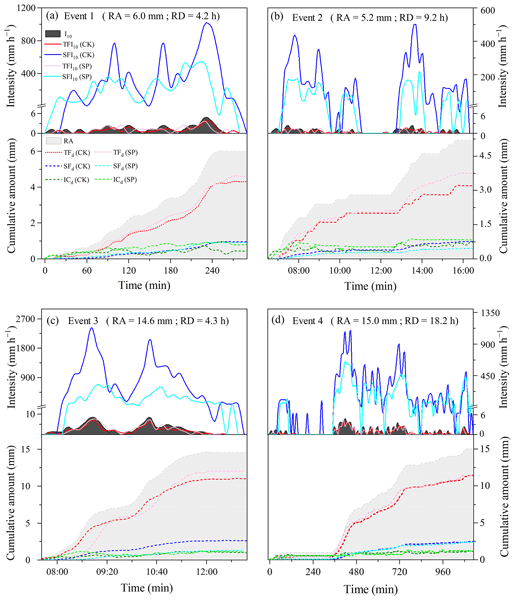
An in-depth investigation was conducted of all rainfall-partitioning components at inter- and intra-event scales for two xerophytic shrubs. Inter-event rainfall partitioning amount and percentage depended more on rainfall amount, and rainfall intensity and duration controlled intra-event rainfall-partitioning variables. One shrub has larger branch angle, small branch and smaller canopy area to produce stemflow more efficiently, and the other has larger biomass to intercept more rainfall.
Francesc Gallart, Sebastián González-Fuentes, and Pilar Llorens
Hydrol. Earth Syst. Sci., 28, 229–239, https://doi.org/10.5194/hess-28-229-2024, https://doi.org/10.5194/hess-28-229-2024, 2024
Short summary
Short summary
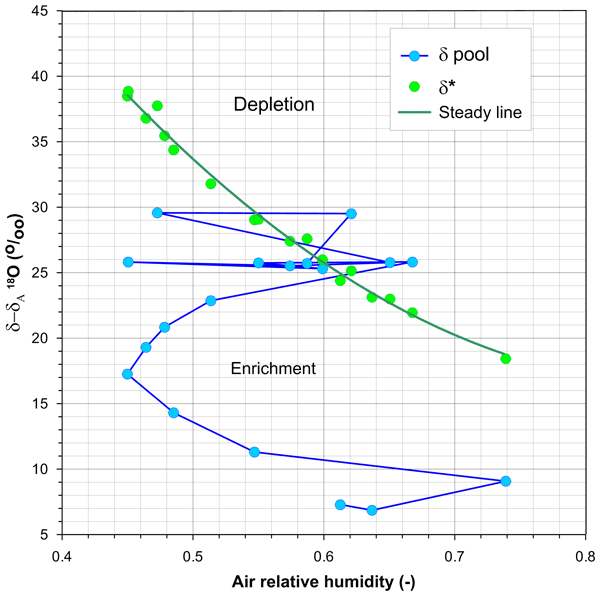
Normally, lighter oxygen and hydrogen isotopes are preferably evaporated from a water body, which becomes enriched in heavy isotopes. However, we observed that, in a water body subject to prolonged evaporation, some periods of heavy isotope depletion instead of enrichment happened. Furthermore, the usual models that describe the isotopy of evaporating waters may be in error if the atmospheric conditions of temperature and relative humidity are time-averaged instead of evaporation flux-weighted.
Matthias Sprenger, Pilar Llorens, Francesc Gallart, Paolo Benettin, Scott T. Allen, and Jérôme Latron
Hydrol. Earth Syst. Sci., 26, 4093–4107, https://doi.org/10.5194/hess-26-4093-2022, https://doi.org/10.5194/hess-26-4093-2022, 2022
Short summary
Short summary
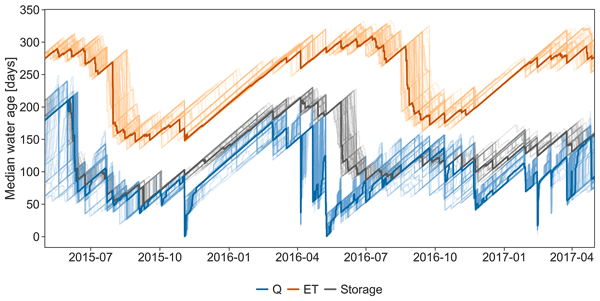
Our catchment-scale transit time modeling study shows that including stable isotope data on evapotranspiration in addition to the commonly used stream water isotopes helps constrain the model parametrization and reveals that the water taken up by plants has resided longer in the catchment storage than the water leaving the catchment as stream discharge. This finding is important for our understanding of how water is stored and released, which impacts the water availability for plants and humans.
Jinxia An, Guangyao Gao, Chuan Yuan, Juan Pinos, and Bojie Fu
Hydrol. Earth Syst. Sci., 26, 3885–3900, https://doi.org/10.5194/hess-26-3885-2022, https://doi.org/10.5194/hess-26-3885-2022, 2022
Short summary
Short summary
An in-depth investigation was conducted of all rainfall-partitioning components at inter- and intra-event scales for two xerophytic shrubs. Inter-event rainfall partitioning amount and percentage depended more on rainfall amount, and rainfall intensity and duration controlled intra-event rainfall-partitioning variables. One shrub has larger branch angle, small branch and smaller canopy area to produce stemflow more efficiently, and the other has larger biomass to intercept more rainfall.
Rafael Poyatos, Víctor Granda, Víctor Flo, Mark A. Adams, Balázs Adorján, David Aguadé, Marcos P. M. Aidar, Scott Allen, M. Susana Alvarado-Barrientos, Kristina J. Anderson-Teixeira, Luiza Maria Aparecido, M. Altaf Arain, Ismael Aranda, Heidi Asbjornsen, Robert Baxter, Eric Beamesderfer, Z. Carter Berry, Daniel Berveiller, Bethany Blakely, Johnny Boggs, Gil Bohrer, Paul V. Bolstad, Damien Bonal, Rosvel Bracho, Patricia Brito, Jason Brodeur, Fernando Casanoves, Jérôme Chave, Hui Chen, Cesar Cisneros, Kenneth Clark, Edoardo Cremonese, Hongzhong Dang, Jorge S. David, Teresa S. David, Nicolas Delpierre, Ankur R. Desai, Frederic C. Do, Michal Dohnal, Jean-Christophe Domec, Sebinasi Dzikiti, Colin Edgar, Rebekka Eichstaedt, Tarek S. El-Madany, Jan Elbers, Cleiton B. Eller, Eugénie S. Euskirchen, Brent Ewers, Patrick Fonti, Alicia Forner, David I. Forrester, Helber C. Freitas, Marta Galvagno, Omar Garcia-Tejera, Chandra Prasad Ghimire, Teresa E. Gimeno, John Grace, André Granier, Anne Griebel, Yan Guangyu, Mark B. Gush, Paul J. Hanson, Niles J. Hasselquist, Ingo Heinrich, Virginia Hernandez-Santana, Valentine Herrmann, Teemu Hölttä, Friso Holwerda, James Irvine, Supat Isarangkool Na Ayutthaya, Paul G. Jarvis, Hubert Jochheim, Carlos A. Joly, Julia Kaplick, Hyun Seok Kim, Leif Klemedtsson, Heather Kropp, Fredrik Lagergren, Patrick Lane, Petra Lang, Andrei Lapenas, Víctor Lechuga, Minsu Lee, Christoph Leuschner, Jean-Marc Limousin, Juan Carlos Linares, Maj-Lena Linderson, Anders Lindroth, Pilar Llorens, Álvaro López-Bernal, Michael M. Loranty, Dietmar Lüttschwager, Cate Macinnis-Ng, Isabelle Maréchaux, Timothy A. Martin, Ashley Matheny, Nate McDowell, Sean McMahon, Patrick Meir, Ilona Mészáros, Mirco Migliavacca, Patrick Mitchell, Meelis Mölder, Leonardo Montagnani, Georgianne W. Moore, Ryogo Nakada, Furong Niu, Rachael H. Nolan, Richard Norby, Kimberly Novick, Walter Oberhuber, Nikolaus Obojes, A. Christopher Oishi, Rafael S. Oliveira, Ram Oren, Jean-Marc Ourcival, Teemu Paljakka, Oscar Perez-Priego, Pablo L. Peri, Richard L. Peters, Sebastian Pfautsch, William T. Pockman, Yakir Preisler, Katherine Rascher, George Robinson, Humberto Rocha, Alain Rocheteau, Alexander Röll, Bruno H. P. Rosado, Lucy Rowland, Alexey V. Rubtsov, Santiago Sabaté, Yann Salmon, Roberto L. Salomón, Elisenda Sánchez-Costa, Karina V. R. Schäfer, Bernhard Schuldt, Alexandr Shashkin, Clément Stahl, Marko Stojanović, Juan Carlos Suárez, Ge Sun, Justyna Szatniewska, Fyodor Tatarinov, Miroslav Tesař, Frank M. Thomas, Pantana Tor-ngern, Josef Urban, Fernando Valladares, Christiaan van der Tol, Ilja van Meerveld, Andrej Varlagin, Holm Voigt, Jeffrey Warren, Christiane Werner, Willy Werner, Gerhard Wieser, Lisa Wingate, Stan Wullschleger, Koong Yi, Roman Zweifel, Kathy Steppe, Maurizio Mencuccini, and Jordi Martínez-Vilalta
Earth Syst. Sci. Data, 13, 2607–2649, https://doi.org/10.5194/essd-13-2607-2021, https://doi.org/10.5194/essd-13-2607-2021, 2021
Short summary
Short summary
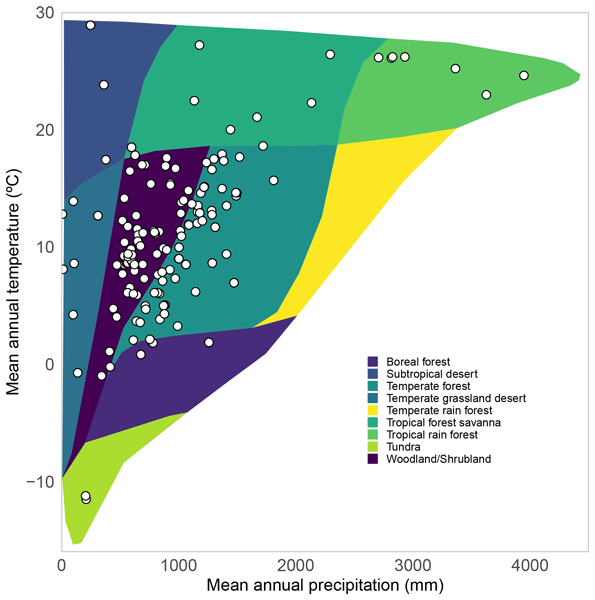
Transpiration is a key component of global water balance, but it is poorly constrained from available observations. We present SAPFLUXNET, the first global database of tree-level transpiration from sap flow measurements, containing 202 datasets and covering a wide range of ecological conditions. SAPFLUXNET and its accompanying R software package
sapfluxnetrwill facilitate new data syntheses on the ecological factors driving water use and drought responses of trees and forests.
Cited articles
Bargués Tobella, A., Reese, H., Almaw, A., Bayala, J., Malmer, A.,
Laudon, H., and Ilstedt, U.: The effect of trees on preferential flow and
soil infiltrability in an agroforestry parkland in semiarid Burkina Faso,
Water Resour. Res., 50, 3342–3354, https://doi.org/10.1002/2013WR015197, 2014.
Beven, K. and Germann, P.: Macropores and water flow in soils revisited,
Water Resour. Res., 49, 3071–3092, https://doi.org/10.1002/wrcr.20156, 2013.
Carlyle-Moses, D. E., Iida, S., Germer, S., Llorens, P., Michalzik, B.,
Nanko, K., Tischer, A., and Levia, D. F.: Expressing stemflow commensurate
with its ecohydrological importance, Adv. Water Resour., 121, 472–479, https://doi.org/10.1016/j.advwatres.2018.08.015, 2018.
Carlyle-Moses, D. E., Iida, S., Germer, S., Llorens, P., Michalzik, B.,
Nanko, K., Tanaka, T., Tischer, A., and Levia, D. F.: Commentary: What we
know about stemflow's infiltration area, Front. Forests Global Change, 3, 577247, https://doi.org/10.3389/ffgc.2020.577247, 2020.
Cayuela, C., Llorens, P., Sánchez-Costa, E., Levia, D. F., and Latron,
J.: Effect of biotic and abiotic factors on inter-and intra-event
variability in stemflow rates in oak and pine stands in a Mediterranean
mountain area, J. Hydrol., 560, 396–406, https://doi.org/10.1016/j.jhydrol.2018.03.050, 2018.
Di Prima, S., Giannini, V., Roder, L. R., Giadrossich, F., Lassabatere, L.,
Stewart, R. D., Abou Najm, M. R., Longo, V., Campus, S., Winiarski, T.,
Angulo-Jaramillo, R., del Campo, A., Capello, G., Biddoccu, M., Roggero P.
P., and Pirastru, M.: Coupling time-lapse ground penetrating radar surveys
and infiltration experiments to characterize two types of non-uniform flow,
Sci. Total Environ., 806, 150410, https://doi.org/10.1016/j.scitotenv.2021.150410, 2022.
Faé, G. S., Montes, F., Bazilevskaya, E., Añó, R. M., and
Kemanian, A. R.: Making soil particle size analysis by laser diffraction
compatible with standard soil texture determination methods, Soil Sci.
Soc. Am. J., 83, 1244–1252, https://doi.org/10.2136/sssaj2018.10.0385, 2019.
Fan, B., Liu, X., Zhu, Q., Qin, G., Li, J., Lin, H., and Guo, L.: Exploring
the interplay between infiltration dynamics and Critical Zone structures
with multiscale geophysical imaging: A review, Geoderma, 374, 114431,
https://doi.org/10.1016/j.geoderma.2020.114431, 2020.
Flury, M. and Flühler, H.: Brilliant Blue FCF as a dye tracer for solute
transport studies - a toxicological overview, J. Environ. Qual., 23, 1108–1112, https://doi.org/10.2134/jeq1994.00472425002300050037x, 1994.
Flury, M. and Flühler, H.: Tracer characteristics of Brilliant Blue FCF,
Soil Sci. Soc. Am. J., 59, 22–27, https://doi.org/10.2136/sssaj1995.03615995005900010003x, 1995.
Flury, M. and Wai, N. N.: Dyes as tracers for vadose zone hydrology, Rev.
Geophys., 41, 1002, https://doi.org/10.1029/2001RG000109, 2003.
Flury, M., Flühler, H., Jury, W. A., and Leuenberger, J.: Susceptibility
of soils to preferential flow of water: A field study, Water Resour. Res., 30, 1945–1954, https://doi.org/10.1029/94WR00871, 1994.
Forrer, I., Papritz, A., Kasteel, R., Flühler, H., and Luca, D.:
Quantifying dye tracers in soil profiles by image processing, Eur. J. Soil Sci., 51, 313-322, https://doi.org/10.1046/j.1365-2389.2000.00315.x, 2000.
Gerke, H. H.: Bypass flow in soil, in: Encyclopedia of Agrophysics, edited
by: Gliński, J., Horabik, J., and Lipiec, J., Springer, Dordrecht, the
Netherlands, 100–105, https://doi.org/10.1007/978-90-481-3585-1_23, 2011.
German-Heins, J. and Flury, M.: Sorption of Brilliant Blue FCF in soils as
affected by pH and ionic strength, Geoderma, 97, 87–101,
https://doi.org/10.1016/S0016-7061(00)00027-6, 2000.
Ghodrati, M. and Jury, W. A.: A field study using dyes to characterize
preferential flow of water, Soil Sci. Soc. Am. J., 54, 1558–1563, https://doi.org/10.2136/sssaj1990.03615995005400060008x, 1990.
Gonzalez-Ollauri, A., Stokes, A., and Mickovski, S. B.: A novel framework to
study the effect of tree architectural traits on stemflow yield and its
consequences for soil-water dynamics, J. Hydrol., 582, 124448,
https://doi.org/10.1016/j.jhydrol.2019.124448, 2020.
Guo, L., Mount, G. J., Hudson, S., Lin, H., and Levia, D.: Pairing geophysical techniques improves understanding of the near-surface Critical
Zone: Visualization of preferential routing of stemflow along coarse roots,
Geoderma, 357, 113953, https://doi.org/10.1016/j.geoderma.2019.113953, 2020.
Hao, X., Ball, B. C., Culley, J. L. B., Carter, M. R., and Parkin, G. W.:
Soil density and porosity, in: Soil Sampling and Methods of Analysis, Earth
Sciences, Environment & Agriculture, edited by: Carter, M. R. and Gregorich, E. G., CRC Press, Boca Raton, FL, USA, 743–759, https://doi.org/10.1201/9781420005271, 2007.
Hatano, R. and Booltink, H. W. G.: Using fractal dimensions of stained flow
patterns in a clay soil to predict bypass flow, J. Hydrol., 135, 121–131, https://doi.org/10.1016/0022-1694(92)90084-9, 1992.
Hatano, R., Kawamura, N., Ikeda, J., and Sakuma, T.: Evaluation of the effect of morphological features of flow paths on solute transport by using fractal dimensions of methylene blue staining pattern, Geoderma, 53, 31–44,
https://doi.org/10.1016/0016-7061(92)90019-4, 1992.
Hildebrandt, A.: Root-Water Relations and Interactions in Mixed Forest
Settings, in: Forest-Water Interactions, Ecological Studies (Analysis and
Synthesis), edited by: Levia, D. F., Carlyle-Moses, D. E., Iida, S.,
Michalzik, B., Nanko, K., and Tischer, A., Springer, Cham, Zug, Switzerland,
319–348, https://doi.org/10.1007/978-3-030-26086-6_14, 2020.
Iovino, M., Pekárová, P., Hallett, P. D., Pekár, J., Lichner,
L., Mataix-Solera, J., Alagna, V., Walsh, R., Raffan, A., Schacht, K., and
Rodný, M.: Extent and persistence of soil water repellency induced by
pines in different geographic regions, J. Hydrol. Hydromech., 66, 360–368, https://doi.org/10.2478/johh-2018-0024, 2018.
Johnson, M. S. and Lehmann, J.: Double-funneling of trees: stemflow and
root-induced preferential flow, Écoscience, 13, 324–333,
https://doi.org/10.2980/i1195-6860-13-3-324.1, 2006.
Kendall, C. and McDonnell, J. J. (Eds.): Isotope Tracers in Catchment
Hydrology, Elsevier, Amsterdam, the Netherlands, paperback ISBN 9780444501554, eBook ISBN 9780080929156, 1998.
Ketelsen, H. and Meyer-Windel, S.: Adsorption of brilliant blue FCF by
soils, Geoderma, 90, 131–145, https://doi.org/10.1016/S0016-7061(98)00119-0, 1999.
Kobayashi, M. and Shimizu, T.: Soil water repellency in a Japanese cypress
plantation restricts increases in soil water storage during rainfall events,
Hydrol. Process., 21, 2356–2364, https://doi.org/10.1002/hyp.6754, 2007.
Levia, D. F. and Frost, E. E.: A review and evaluation of stemflow literature in the hydrologic and biogeochemical cycles of forested and agricultural ecosystems, J. Hydrol., 274, 1–29, https://doi.org/10.1016/S0022-1694(02)00399-2, 2003.
Levia, D. F. and Germer, S.: A review of stemflow generation dynamics and
stemflow-environment interactions in forests and shrublands, Rev. Geophys., 53, 673–714, https://doi.org/10.1002/2015RG000479, 2015.
Levia, D. F., Carlyle-Moses, D., and Tanaka, T. (Eds.): Forest Hydrology and
Biogeochemistry: Synthesis of Past Research and Future Directions, Springer,
Dordrecht, the Netherlands, https://doi.org/10.1007/978-94-007-1363-5, 2011.
Liang, W. L., Kosugi, K. I., and Mizuyama, T.: Soil water dynamics around a
tree on a hillslope with or without rainwater supplied by stemflow, Water
Resour. Res., 47, W02541, https://doi.org/10.1029/2010WR009856, 2011.
Llorens, P. and Domingo, F.: Rainfall partitioning by vegetation under
Mediterranean conditions. A review of studies in Europe, J. Hydrol., 335, 37–54, https://doi.org/10.1016/j.jhydrol.2006.10.032, 2007.
Llorens, P., Gallart, F., Cayuela, C., Roig-Planasdemunt, M., Casellas, E.,
Molina, A. J., Moreno-de las Heras, M., Bertran, G., Sánchez-Costa, E.,
and Latron, J.: What have we learnt about Mediterranean catchment hydrology?
30 years observing hydrological processes in the Vallcebre research
catchments, Geogr. Res. Lett., 44, 475–501, https://doi.org/10.18172/cig.3432, 2018.
Llorens, P., Latron, J., Carlyle-Moses, D. E., Näthe, K., Chang, J. L.,
Nanko, K., Iida, S., and Levia, D. F.: Stemflow infiltration areas into forest soils around American beech (Fagus grandifolia Ehrh.) trees, Ecohydrology, 15, e2369, https://doi.org/10.1002/eco.2369, 2022.
Luo, Z., Niu, J., Zhang, L., Chen, X., Zhang, W., Xie, B., Du, J., Zhu, Z.,
Wu, S., and Li, X.: Roots-enhanced preferential flows in deciduous and
coniferous forest soils revealed by dual-tracer experiments, J. Environ. Qual., 48, 136–146, https://doi.org/10.2134/jeq2018.03.0091, 2019.
Luo, Z., Niu, J., He, S., Zhang, L., Chen, X., Tan, B., Wang, D., and Berndtsson, R.: Linking roots, preferential flow, and soil moisture
redistribution in deciduous and coniferous forest soils, J. Soils Sediments, 23, 1524–1538, https://doi.org/10.1007/s11368-022-03375-w, 2023.
Magyar, D., Van Stan, J. T., and Sridhar, K. R.: Hypothesis and theory:
fungal spores in stemflow and potential bark sources, Front. Forests Global Change, 4, 623758, https://doi.org/10.3389/ffgc.2021.623758, 2021.
Metzger, J. C., Wutzler, T., Dalla Valle, N., Filipzik, J., Grauer, C.,
Lehmann, R., Roggenbuck, M., Schelhorn, D., Weckmüller, J., Küsel, K., Totsche, K. U., Trumbore, S., and Hildebrandt, A.: Vegetation impacts
soil water content patterns by shaping canopy water fluxes and soil
properties, Hydrol. Process., 31, 3783–3795, https://doi.org/10.1002/hyp.11274, 2017.
Metzger, J. C., Filipzik, J., Michalzik, B., and Hildebrandt, A.: Stemflow
infiltration hotspots create soil microsites near tree stems in an unmanaged
mixed beech forest, Front. Forests Global Change, 4, 701293,
https://doi.org/10.3389/ffgc.2021.701293, 2021.
Molina, A. J., Llorens, P., Garcia-Estringana, P., de Las Heras, M. M., Cayuela, C., Gallart, F., and Latron, J.: Contributions of throughfall,
forest and soil characteristics to near-surface soil water-content
variability at the plot scale in a mountainous Mediterranean area, Sci. Total Environ., 647, 1421–1432, https://doi.org/10.1016/j.scitotenv.2018.08.020, 2019.
Noguchi, S., Nik, A. R., Kasran, B., Tani, M., Sammori, T., and Morisada, K.: Soil physical properties and preferential flow pathways in tropical rain
forest, Bukit Tarek, Peninsular Malaysia, J. Forest Res., 2, 115–120, https://doi.org/10.1007/BF02348479, 1997.
Phillips, T. H., Baker, M. E., Lautar, K., Yesilonis, I., and Pavao-Zuckerman, M. A.: The capacity of urban forest patches to infiltrate
stormwater is influenced by soil physical properties and soil moisture, J. Environ. Manage., 246, 11–18, https://doi.org/10.1016/j.jenvman.2019.05.127, 2019.
Pinos, J., Latron, J., Levia, D. F., and Llorens, P.: Drivers of the
circumferential variation of stemflow inputs on the boles of Pinus
sylvestris L. (Scots pine), Ecohydrology, 14, e2348, https://doi.org/10.1002/eco.2348, 2021.
Poyatos, R., Latron, J., and Llorens, P.: Land use and land cover change
after agricultural abandonment, Mt. Res. Dev., 23, 362–368, https://doi.org/10.1659/0276-4741(2003)023[0362:LUALCC]2.0.CO;2, 2003.
Rubio, C. M., Llorens, P., and Gallart, F.: Uncertainty and efficiency of
pedotransfer functions for estimating water retention characteristics of soils, Eur. J. Soil Sci., 59, 339–347, https://doi.org/10.1111/j.1365-2389.2007.01002.x, 2008.
Schwärzel, K., Ebermann, S., and Schalling, N.: Evidence of double-funneling effect of beech trees by visualization of flow pathways
using dye tracer, J. Hydrol., 470, 184–192, https://doi.org/10.1016/j.jhydrol.2012.08.048, 2012.
Spencer, S. A. and van Meerveld, H. V.: Double funnelling in a mature coastal British Columbia forest: spatial patterns of stemflow after infiltration, Hydrol. Process., 30, 4185–4201, https://doi.org/10.1002/hyp.10936, 2016.
Sprenger, M., Llorens, P., Cayuela, C., Gallart, F., and Latron, J.: Mechanisms of consistently disjunct soil water pools over (pore) space and
time, Hydrol. Earth Syst. Sci., 23, 2751–2762, https://doi.org/10.5194/hess-23-2751-2019, 2019.
Tischer, A., Michalzik, B., and Lotze, R.: Nonuniform but highly preferential stemflow routing along bark surfaces and actual smaller infiltration areas than previously assumed: A case study on European beech (Fagus sylvatica L.) and sycamore maple (Acer pseudoplatanus L.), Ecohydrology, 13, e2230, https://doi.org/10.1002/eco.2230, 2020.
Tonello, K. C., Campos, S. D., de Menezes, A. J., Bramorski, J., Mathias, S.
L., and Lima, M. T.: How is bark absorbability and wettability related to
stemflow yield? Observations from isolated trees in the Brazilian Cerrado,
Front. Forests Global Change, 4, 650665, https://doi.org/10.3389/ffgc.2021.650665, 2021.
Tucker, A., Levia, D. F., Katul, G. G., Nanko, K., and Rossi, L. F.: A network model for stemflow solute transport, Appl. Math. Model., 88, 266–282, https://doi.org/10.1016/j.apm.2020.06.047, 2020.
USDA, Soil survey manual, in: Soil Survey Division Staff, Soil Conservation
Service Volume Handbook 18, in: Chapter 3, US Department of Agriculture, https://www.nrcs.usda.gov/sites/default/files/2022-09/SSM-ch3.pdf (last
access: 26 July 2023), 2017.
Van Schaik, N. L. M. B.: Spatial variability of infiltration patterns related to site characteristics in a semi-arid watershed, Catena, 78, 36–47,
https://doi.org/10.1016/j.catena.2009.02.017, 2009.
Van Stan, J. T., Gutmann, E., and Friesen, J. (Eds.): Precipitation
Partitioning by Vegetation: A Global Synthesis, Springer, Cham, Switzerland,
https://doi.org/10.1007/978-3-030-29702-2, 2020.
Van Stan, J. T., Ponette-González, A. G., Swanson, T., and Weathers, K.
C.: Throughfall and stemflow are major hydrologic highways for particulate
traffic through tree canopies, Front. Ecol. Environ., 19, 404–410, https://doi.org/10.1002/fee.2360, 2021.
Van Stiphout, T. P. J., Van Lanen, H. A. J., Boersma, O. H., and Bouma, J.:
The effect of bypass flow and internal catchment of rain on the water regime
in a clay loam grassland soil, J. Hydrol., 95, 1–11, https://doi.org/10.1016/0022-1694(87)90111-9, 1987.
Wang, X., Wang, J., and Zhang, J.: Comparisons of three methods for organic
and inorganic carbon in calcareous soils of northwestern China, PLOS ONE, 7,
e44334, https://doi.org/10.1371/journal.pone.0044334, 2012.
Weiler, M. and Flühler, H.: Inferring flow types from dye patterns in
macroporous soils, Geoderma, 120, 137–153, https://doi.org/10.1016/j.geoderma.2003.08.014, 2004.
Yue, K., De Frenne, P., Fornara, D. A., Van Meerbeek, K., Li, W., Peng, X.,
Ni, X., Peng, Y., Wu, F., Yang, Y., and Peñuelas, J.: Global patterns
and drivers of rainfall partitioning by trees and shrubs, Global Change Biol., 27, 3350–3357, https://doi.org/10.1111/gcb.15644, 2021.
Zhang, Y. and Schaap, M. G.: Weighted recalibration of the Rosetta
pedotransfer model with improved estimates of hydraulic parameter distributions and summary statistics (Rosetta3), J. Hydrol., 547, 39–53, https://doi.org/10.1016/j.jhydrol.2017.01.004, 2017.
Zhang, Y., Wang, X., Pan, Y., Hu, R., and Chen, N.: Global quantitative
synthesis of effects of biotic and abiotic factors on stemflow production in
woody ecosystems, Global Ecol. Biogeogr., 30, 1713–1723, https://doi.org/10.1111/geb.13322, 2021.
Zisa, R. P., Halverson, H. G., and Stout, B. B.: Establishment and early
growth of conifers on compact soils in urban areas, Res. Pap. NE-451, US Department of Agriculture, Forest Service, Northeastern Forest Experiment Station, Broomall, PA, USA, 8 pp., https://www.fs.usda.gov/research/treesearch/14985 (last access:
26 July 2023), 1980.
Short summary
We investigated how stemflow (intercepted rainwater by the tree crown that travels down the stem) infiltrates within the soil. We simulated stemflow, applying coloured water along a tree trunk. Coloured patterns, observed when we excavated the soil after the experiment, were used to view and quantify preferential flow in the soil. We found that stemflow was mainly funnelled belowground along tree roots and macropores. Soil moisture near the trunk was affected both vertically and horizontally.
We investigated how stemflow (intercepted rainwater by the tree crown that travels down the...


