
Articles | Volume 30, issue 22
https://doi.org/10.5194/hess-30-7257-2026
© Author(s) 2026. This work is distributed under
the Creative Commons Attribution 4.0 License.
https://doi.org/10.5194/hess-30-7257-2026
© Author(s) 2026. This work is distributed under
the Creative Commons Attribution 4.0 License.
LESSONS Report
| 
24 Nov 2026
LESSONS Report |
| 24 Nov 2026
LESSONS report: Fine-scale representation of consecutive dry days
Benjamin Poschlod
CORRESPONDING AUTHOR

Institute for Global Water Security, Hamburg University of Technology, Hamburg, 21079, Germany
Research Unit Sustainability and Climate Risks, Earth and Society Research Hub (ESRAH), Universität Hamburg, Hamburg, 20144, Germany
Lukas Brunner
Research Unit Sustainability and Climate Risks, Earth and Society Research Hub (ESRAH), Universität Hamburg, Hamburg, 20144, Germany
Jana Sillmann
Research Unit Sustainability and Climate Risks, Earth and Society Research Hub (ESRAH), Universität Hamburg, Hamburg, 20144, Germany
Related authors
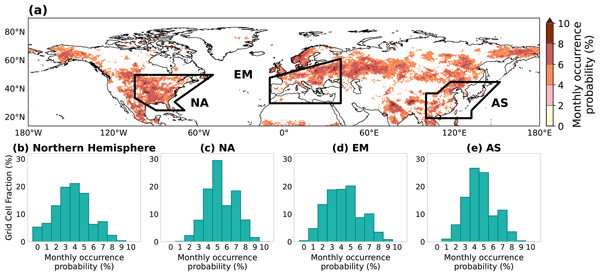
Natalia Castillo Bautista, Marco Gaetani, Leonard F. Borchert, Benjamin Poschlod, Lukas Brunner, Jana Sillmann, and Mario L. V. Martina
Weather Clim. Dynam., 7, 2107–2132, https://doi.org/10.5194/wcd-7-2107-2026, https://doi.org/10.5194/wcd-7-2107-2026, 2026
Short summary
Short summary
When hot temperatures and drought occur together (compound events), they can cause harmful impacts on crops and society. Using six decades of climate data, we show that such compound events repeatedly occurred in three breadbaskets of the Northern Hemisphere. These events are linked to atmospheric circulation patterns that favor heat and dryness, which in turn interact to amplify the impact. Our study contributes to understand the drivers of these events to support climate impact assessment.
Henrique M. D. Goulart, Lily-belle Sweet, Axel Deijns, Seth Bryant, and Benjamin Poschlod
EGUsphere, https://doi.org/10.5194/egusphere-2026-5735, https://doi.org/10.5194/egusphere-2026-5735, 2026
This preprint is open for discussion and under review for Hydrology and Earth System Sciences (HESS).
Short summary
Short summary
Floods are changing as the climate warms, but different types of floods may respond differently. We used a data-driven method to identify flood types and study how they change in four Bavarian catchments. Rainfall-driven floods become more frequent and severe, while floods linked to snowmelt decline. These changes shift flood risk from spring towards rainfall-driven flooding throughout the year, with implications for preparedness and infrastructure.
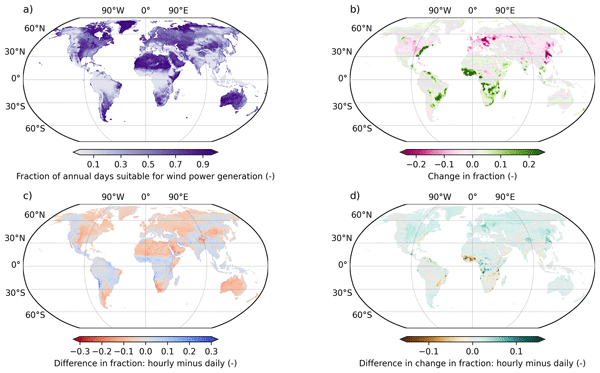
Michel Bechtold, Benjamin Poschlod, Christian Otto, Jan Volkholz, Matthias Büchner, and Florian Zabel
Earth Syst. Sci. Data, 18, 6637–6648, https://doi.org/10.5194/essd-18-6637-2026, https://doi.org/10.5194/essd-18-6637-2026, 2026
Short summary
Short summary
Many climate impacts depend on what happens within a day: heat stress peaks in the afternoon and solar or wind power rise and fall hour by hour. Yet global climate projections are usually published only as daily averages. We converted them into hourly data for global land areas, covering 1850 to 2100 and several future scenarios. The dataset is freely available and lets researchers estimate impacts on health, water and energy far more realistically.
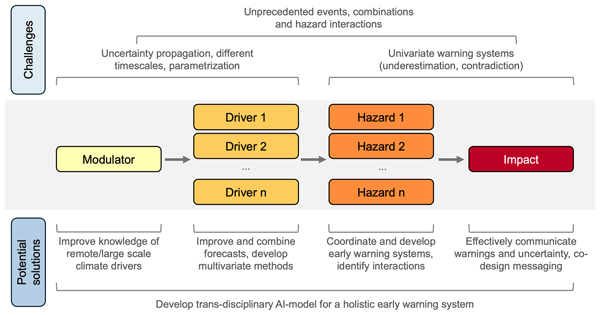
Kai Kornhuber, Emanuele Bevacqua, Mariana Madruga de Brito, Wiebke S. Jäger, Pauline Rivoire, Cassandra D. W. Rogers, Fabiola Banfi, Fulden Batibeniz, James Carruthers, Carlo De Michele, Silvia De Angeli, Cristina Deidda, Marleen C. de Ruiter, Andreas H. Fink, Henrique M. D. Goulart, Katharina Küpfer, Patrick Ludwig, Douglas Maraun, Gabriele Messori, Shruti Nath, Fiachra O'Loughlin, Joaquim G. Pinto, Benjamin Poschlod, Alexandre M. Ramos, Colin Raymond, Andreia F. S. Ribeiro, Deepti Singh, Laura Suarez Gutierrez, Philip J. Ward, and Christopher J. White
Nat. Hazards Earth Syst. Sci., 26, 4309–4334, https://doi.org/10.5194/nhess-26-4309-2026, https://doi.org/10.5194/nhess-26-4309-2026, 2026
Short summary
Short summary
Impacts from extreme weather events may become more severe due to increased likelihood of compounding events under global warming, which challenge present day climate modelling and forecasting capacities. In this perspective we reflect on the usability of compound event research to bridge the gap between academic research and real-world applications.
Jingkun Yang, Benjamin Poschlod, and Felix Ament
EGUsphere, https://doi.org/10.5194/egusphere-2026-4111, https://doi.org/10.5194/egusphere-2026-4111, 2026
Short summary
Short summary
Heavy rainfall is becoming more severe, yet common measures capture only its peak strength, not how long it lasts or how wide an area it covers. Using high-resolution climate simulations for Germany, we rank the 200 most extreme events across past, present and future. We found that future events are not only more intense but also last longer and spread over larger areas. This means future rainfall hazards will be more complex, and assessments must consider strength, duration and extent together.
Marc Lennartz, Benjamin Poschlod, and Bruno Merz
Nat. Hazards Earth Syst. Sci., 26, 3273–3289, https://doi.org/10.5194/nhess-26-3273-2026, https://doi.org/10.5194/nhess-26-3273-2026, 2026
Short summary
Short summary
Predicting hourly rainfall extremes under climate change is crucial yet highly uncertain. Using convection-permitting climate model data over Germany, we compare stationary and non-stationary general extreme value (GEV) and simplified metastatistical extreme value (sMEV) methods. We show that the sMEV approach exhibits lower uncertainty across return periods. Moreover, the non-stationary sMEV better captures climate-change-induced changes, though care is needed when projecting future extremes.
Anastasia Vogelbacher, Malte von Szombathely, Marc Lennartz, Benjamin Poschlod, and Jana Sillmann
Nat. Hazards Earth Syst. Sci., 26, 2765–2783, https://doi.org/10.5194/nhess-26-2765-2026, https://doi.org/10.5194/nhess-26-2765-2026, 2026
Short summary
Short summary
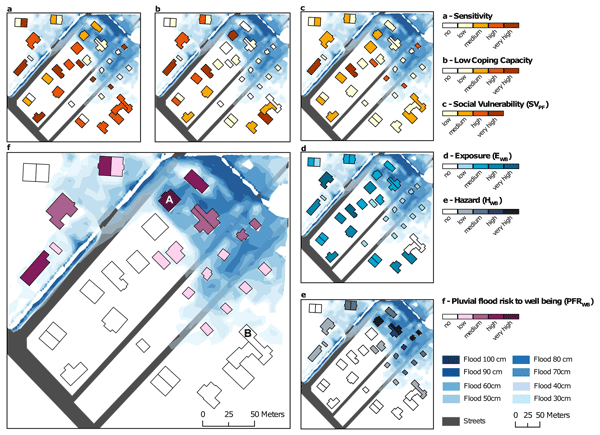
In this study we address risk to pluvial floods by following the risk definition of the Intergovernmental Panel on Climate Change (IPCC), developed in co-operation with stakeholders of the city of Hamburg. We identify buildings in urban areas where residents face higher flood risk due to greater social vulnerability, increased exposure, or elevated flood hazard. We present the development and application of a Python-based ArcGIS toolbox for estimating pluvial flood risk at building scale.
Timothy Tiggeloven, Colin Raymond, Marleen C. de Ruiter, Jana Sillmann, Annegret H. Thieken, Sophie L. Buijs, Roxana Ciurean, Emma Cordier, Julia M. Crummy, Lydia Cumiskey, Kelley De Polt, Melanie Duncan, Davide M. Ferrario, Wiebke S. Jäger, Elco E. Koks, Nicole van Maanen, Heather J. Murdock, Jaroslav Mysiak, Sadhana Nirandjan, Benjamin Poschlod, Peter Priesmeier, Nivedita Sairam, Pia-Johanna Schweizer, Tristian R. Stolte, Marie-Luise Zenker, James E. Daniell, Alexander Fekete, Christian M. Geiß, Marc J. C. van den Homberg, Sirkku K. Juhola, Christian Kuhlicke, Karen Lebek, Robert Šakić Trogrlić, Stefan Schneiderbauer, Silvia Torresan, Cees J. van Westen, Judith N. Claassen, Bijan Khazai, Virginia Murray, Julius Schlumberger, and Philip J. Ward
Geosci. Commun., 9, 185–221, https://doi.org/10.5194/gc-9-185-2026, https://doi.org/10.5194/gc-9-185-2026, 2026
Short summary
Short summary
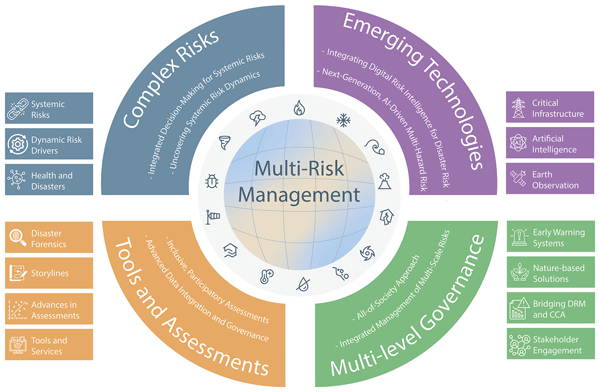
Natural hazards like floods, earthquakes, and landslides are often interconnected which may create bigger problems than when they occur alone. We studied expert discussions from an international conference to understand how scientists and policymakers can better prepare for these multi-hazards and use new technologies to protect its communities while contributing to dialogues about future international agreements beyond the Sendai Framework and supporting global sustainability goals.
Benjamin Poschlod, Laura Sailer, Alexander Sasse, Anastasia Vogelbacher, and Ralf Ludwig
Hydrol. Earth Syst. Sci., 30, 1165–1188, https://doi.org/10.5194/hess-30-1165-2026, https://doi.org/10.5194/hess-30-1165-2026, 2026
Short summary
Short summary
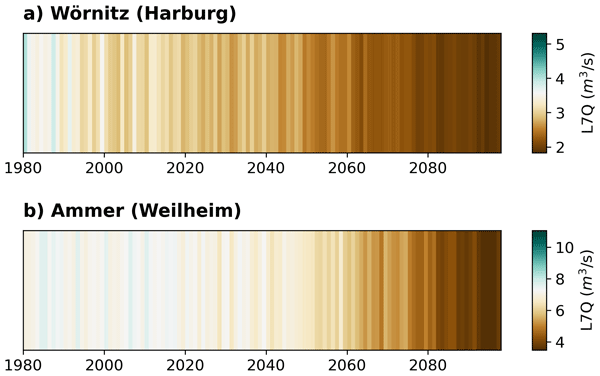
Europe was hit by severe droughts in recent years resulting in extreme low flow conditions in rivers. Here, we investigate future climate change effects on river droughts in Bavaria. We find increasing severity for the low peak discharge and low flow duration in a warmer climate. This is caused by hotter and drier summers, where the joint occurrence of heat and drought intensifies. Further, we show that conditions in the year before the drought gain more importance in a warmer climate.
Alexander Lee Rischmuller, Benjamin Poschlod, and Jana Sillmann
Adv. Stat. Clim. Meteorol. Oceanogr., 12, 1–19, https://doi.org/10.5194/ascmo-12-1-2026, https://doi.org/10.5194/ascmo-12-1-2026, 2026
Short summary
Short summary
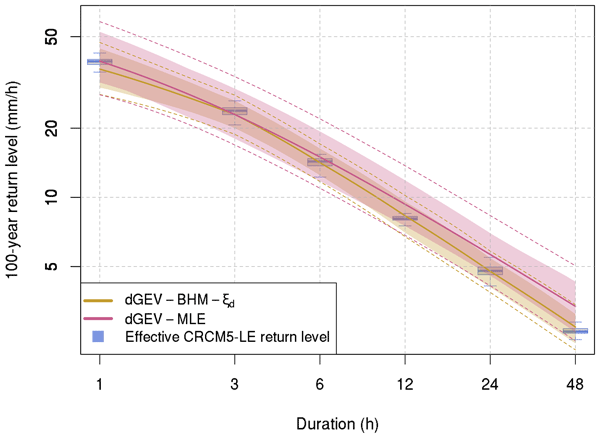
Extreme precipitation probability estimation is vital for hazard protection design but has high uncertainty. We tested six statistical models using 2000 years of climate data. Our Bayesian hierarchical duration-dependent Generalized Extreme Value model shows the highest accuracy and robustness for sample sizes between 30 and 100 years, making it highly promising for use with limited observational records.
Florian Zabel, Matthias Knüttel, and Benjamin Poschlod
Geosci. Model Dev., 18, 1067–1087, https://doi.org/10.5194/gmd-18-1067-2025, https://doi.org/10.5194/gmd-18-1067-2025, 2025
Short summary
Short summary
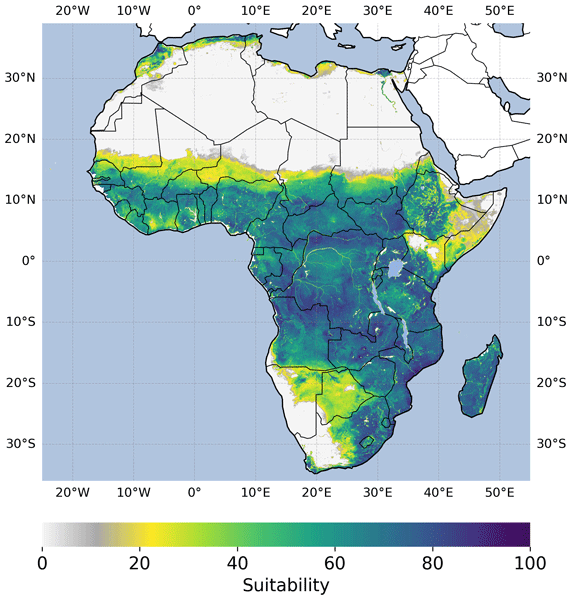
CropSuite is a new open-source crop suitability model. It provides a GUI and a wide range of options, including a spatial downscaling of climate data. We apply CropSuite to 48 staple and opportunity crops at a 1 km spatial resolution in Africa. We find that climate variability significantly impacts suitable areas but also affects optimal sowing dates and multiple cropping potential. The results provide valuable information for climate impact assessments, adaptation, and land-use planning.
Benjamin Poschlod and Anne Sophie Daloz
The Cryosphere, 18, 1959–1981, https://doi.org/10.5194/tc-18-1959-2024, https://doi.org/10.5194/tc-18-1959-2024, 2024
Short summary
Short summary
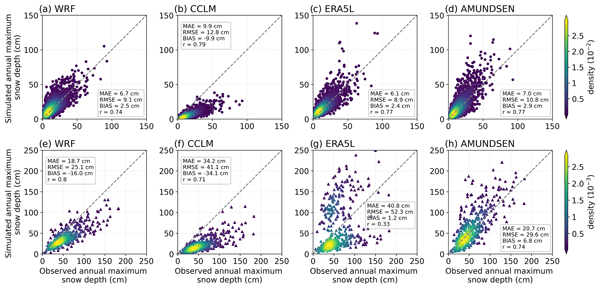
Information about snow depth is important within climate research but also many other sectors, such as tourism, mobility, civil engineering, and ecology. Climate models often feature a spatial resolution which is too coarse to investigate snow depth. Here, we analyse high-resolution simulations and identify added value compared to a coarser-resolution state-of-the-art product. Also, daily snow depth extremes are well reproduced by two models.
Florian Zabel and Benjamin Poschlod
Geosci. Model Dev., 16, 5383–5399, https://doi.org/10.5194/gmd-16-5383-2023, https://doi.org/10.5194/gmd-16-5383-2023, 2023
Short summary
Short summary
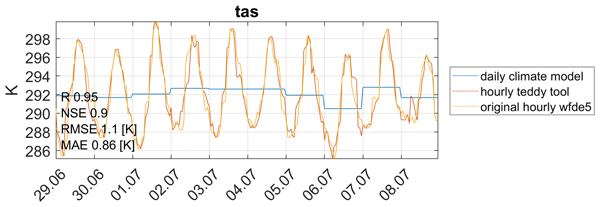
Today, most climate model data are provided at daily time steps. However, more and more models from different sectors, such as energy, water, agriculture, and health, require climate information at a sub-daily temporal resolution for a more robust and reliable climate impact assessment. Here we describe and validate the Teddy tool, a new model for the temporal disaggregation of daily climate model data for climate impact analysis.
Natalia Castillo Bautista, Marco Gaetani, Leonard F. Borchert, Benjamin Poschlod, Lukas Brunner, Jana Sillmann, and Mario L. V. Martina
Weather Clim. Dynam., 7, 2107–2132, https://doi.org/10.5194/wcd-7-2107-2026, https://doi.org/10.5194/wcd-7-2107-2026, 2026
Short summary
Short summary
When hot temperatures and drought occur together (compound events), they can cause harmful impacts on crops and society. Using six decades of climate data, we show that such compound events repeatedly occurred in three breadbaskets of the Northern Hemisphere. These events are linked to atmospheric circulation patterns that favor heat and dryness, which in turn interact to amplify the impact. Our study contributes to understand the drivers of these events to support climate impact assessment.
Henrique M. D. Goulart, Lily-belle Sweet, Axel Deijns, Seth Bryant, and Benjamin Poschlod
EGUsphere, https://doi.org/10.5194/egusphere-2026-5735, https://doi.org/10.5194/egusphere-2026-5735, 2026
This preprint is open for discussion and under review for Hydrology and Earth System Sciences (HESS).
Short summary
Short summary
Floods are changing as the climate warms, but different types of floods may respond differently. We used a data-driven method to identify flood types and study how they change in four Bavarian catchments. Rainfall-driven floods become more frequent and severe, while floods linked to snowmelt decline. These changes shift flood risk from spring towards rainfall-driven flooding throughout the year, with implications for preparedness and infrastructure.
Michel Bechtold, Benjamin Poschlod, Christian Otto, Jan Volkholz, Matthias Büchner, and Florian Zabel
Earth Syst. Sci. Data, 18, 6637–6648, https://doi.org/10.5194/essd-18-6637-2026, https://doi.org/10.5194/essd-18-6637-2026, 2026
Short summary
Short summary
Many climate impacts depend on what happens within a day: heat stress peaks in the afternoon and solar or wind power rise and fall hour by hour. Yet global climate projections are usually published only as daily averages. We converted them into hourly data for global land areas, covering 1850 to 2100 and several future scenarios. The dataset is freely available and lets researchers estimate impacts on health, water and energy far more realistically.
Kai Kornhuber, Emanuele Bevacqua, Mariana Madruga de Brito, Wiebke S. Jäger, Pauline Rivoire, Cassandra D. W. Rogers, Fabiola Banfi, Fulden Batibeniz, James Carruthers, Carlo De Michele, Silvia De Angeli, Cristina Deidda, Marleen C. de Ruiter, Andreas H. Fink, Henrique M. D. Goulart, Katharina Küpfer, Patrick Ludwig, Douglas Maraun, Gabriele Messori, Shruti Nath, Fiachra O'Loughlin, Joaquim G. Pinto, Benjamin Poschlod, Alexandre M. Ramos, Colin Raymond, Andreia F. S. Ribeiro, Deepti Singh, Laura Suarez Gutierrez, Philip J. Ward, and Christopher J. White
Nat. Hazards Earth Syst. Sci., 26, 4309–4334, https://doi.org/10.5194/nhess-26-4309-2026, https://doi.org/10.5194/nhess-26-4309-2026, 2026
Short summary
Short summary
Impacts from extreme weather events may become more severe due to increased likelihood of compounding events under global warming, which challenge present day climate modelling and forecasting capacities. In this perspective we reflect on the usability of compound event research to bridge the gap between academic research and real-world applications.
Jingkun Yang, Benjamin Poschlod, and Felix Ament
EGUsphere, https://doi.org/10.5194/egusphere-2026-4111, https://doi.org/10.5194/egusphere-2026-4111, 2026
Short summary
Short summary
Heavy rainfall is becoming more severe, yet common measures capture only its peak strength, not how long it lasts or how wide an area it covers. Using high-resolution climate simulations for Germany, we rank the 200 most extreme events across past, present and future. We found that future events are not only more intense but also last longer and spread over larger areas. This means future rainfall hazards will be more complex, and assessments must consider strength, duration and extent together.
Marc Lennartz, Benjamin Poschlod, and Bruno Merz
Nat. Hazards Earth Syst. Sci., 26, 3273–3289, https://doi.org/10.5194/nhess-26-3273-2026, https://doi.org/10.5194/nhess-26-3273-2026, 2026
Short summary
Short summary
Predicting hourly rainfall extremes under climate change is crucial yet highly uncertain. Using convection-permitting climate model data over Germany, we compare stationary and non-stationary general extreme value (GEV) and simplified metastatistical extreme value (sMEV) methods. We show that the sMEV approach exhibits lower uncertainty across return periods. Moreover, the non-stationary sMEV better captures climate-change-induced changes, though care is needed when projecting future extremes.
Anastasia Vogelbacher, Malte von Szombathely, Marc Lennartz, Benjamin Poschlod, and Jana Sillmann
Nat. Hazards Earth Syst. Sci., 26, 2765–2783, https://doi.org/10.5194/nhess-26-2765-2026, https://doi.org/10.5194/nhess-26-2765-2026, 2026
Short summary
Short summary
In this study we address risk to pluvial floods by following the risk definition of the Intergovernmental Panel on Climate Change (IPCC), developed in co-operation with stakeholders of the city of Hamburg. We identify buildings in urban areas where residents face higher flood risk due to greater social vulnerability, increased exposure, or elevated flood hazard. We present the development and application of a Python-based ArcGIS toolbox for estimating pluvial flood risk at building scale.
Timothy Tiggeloven, Colin Raymond, Marleen C. de Ruiter, Jana Sillmann, Annegret H. Thieken, Sophie L. Buijs, Roxana Ciurean, Emma Cordier, Julia M. Crummy, Lydia Cumiskey, Kelley De Polt, Melanie Duncan, Davide M. Ferrario, Wiebke S. Jäger, Elco E. Koks, Nicole van Maanen, Heather J. Murdock, Jaroslav Mysiak, Sadhana Nirandjan, Benjamin Poschlod, Peter Priesmeier, Nivedita Sairam, Pia-Johanna Schweizer, Tristian R. Stolte, Marie-Luise Zenker, James E. Daniell, Alexander Fekete, Christian M. Geiß, Marc J. C. van den Homberg, Sirkku K. Juhola, Christian Kuhlicke, Karen Lebek, Robert Šakić Trogrlić, Stefan Schneiderbauer, Silvia Torresan, Cees J. van Westen, Judith N. Claassen, Bijan Khazai, Virginia Murray, Julius Schlumberger, and Philip J. Ward
Geosci. Commun., 9, 185–221, https://doi.org/10.5194/gc-9-185-2026, https://doi.org/10.5194/gc-9-185-2026, 2026
Short summary
Short summary
Natural hazards like floods, earthquakes, and landslides are often interconnected which may create bigger problems than when they occur alone. We studied expert discussions from an international conference to understand how scientists and policymakers can better prepare for these multi-hazards and use new technologies to protect its communities while contributing to dialogues about future international agreements beyond the Sendai Framework and supporting global sustainability goals.
Detlef P. Van Vuuren, Brian C. O'Neill, Claudia Tebaldi, Benjamin M. Sanderson, Louise P. Chini, Pierre Friedlingstein, Tomoko Hasegawa, Keywan Riahi, Bala Govindasamy, Nico Bauer, Veronika Eyring, Cheikh M. N. Fall, Katja Frieler, Matthew J. Gidden, Laila K. Gohar, Annika Högner, Andrew D. Jones, Jarmo Kikstra, Andrew King, Reto Knutti, Elmar Kriegler, Peter Lawrence, Chris Lennard, Jason Lowe, Camilla Mathison, Shahbaz Mehmood, Zebedee Nicholls, Luciana F. Prado, Qiang Zhang, Steven K. Rose, Alex C. Ruane, Marit Sandstad, Carl-Friedrich Schleussner, Roland Seferian, Jana Sillmann, Chris Smith, Anna A. Sörensson, Swapna Panickal, Kaoru Tachiiri, Naomi Vaughan, Saritha S. Vishwanathan, Tokuta Yokohata, Marco Zecchetto, and Tilo Ziehn
Geosci. Model Dev., 19, 2627–2656, https://doi.org/10.5194/gmd-19-2627-2026, https://doi.org/10.5194/gmd-19-2627-2026, 2026
Short summary
Short summary
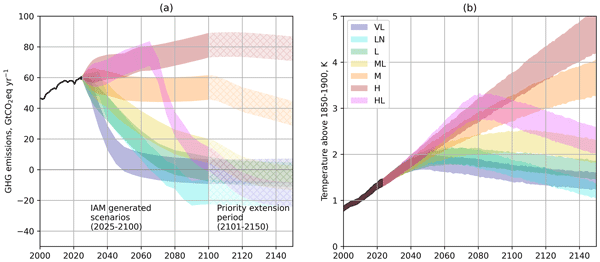
We propose a set of seven plausible 21st century emission scenarios, and their multi-century extensions, that will be used by the international community of climate modeling centers to produce the next generation of climate projections. These projections will support climate, impact and mitigation researchers, provide information to practitioners to address future risks from climate change, and contribute to policymakers’ considerations of the trade-offs among various levels of mitigation.
Philip J. Ward, Sophie L. Buijs, Roxana Ciurean, Judith N. Claassen, James Daniell, Kelley De Polt, Melanie Duncan, Stefania Gottardo, Stefan Hochrainer-Stigler, Robert Šakić Trogrlić, Julius Schlumberger, Timothy Tiggeloven, Silvia Torresan, Nicole van Maanen, Andrew Warren, Carmen D. Álvarez-Albelo, Vanessa Banks, Benjamin Blanz, Veronica Casartelli, Jordan Correa, Julia Crummy, Anne Sophie Daloz, Marleen C. de Ruiter, Juan José Díaz-Hernández, Jaime Díaz-Pacheco, Pedro Dorta Antequera, Davide Ferrario, David Geurts, Sara García-González, Joel C. Gill, Raúl Hernández-Martín, Wiebke S. Jäger, Abel López-Díez, Lin Ma, Jaroslav Mysiak, Diep Ngoc Nguyen, Noemi Padrón Fumero, Eva-Cristina Petrescu, Karina Reiter, Jana Sillmann, Lara Smale, and Tristian Stolte
Nat. Hazards Earth Syst. Sci., 26, 1325–1345, https://doi.org/10.5194/nhess-26-1325-2026, https://doi.org/10.5194/nhess-26-1325-2026, 2026
Short summary
Short summary
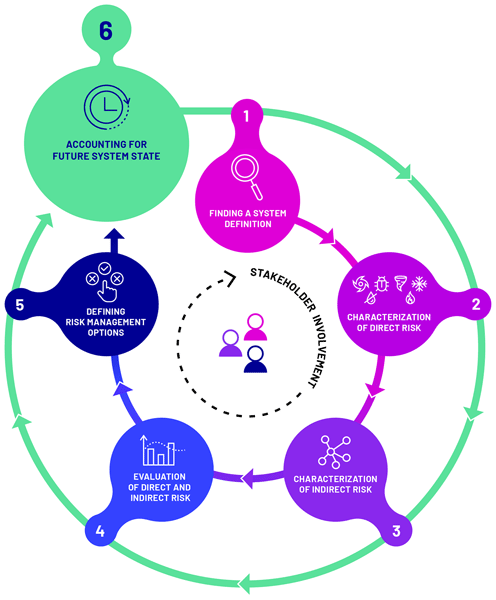
Disasters often result from interactions between different hazards, like floods triggering landslides, or earthquakes followed by tropical cyclones, so-called multi-hazards. People and societies are increasingly exposed and vulnerable to these multi-hazards. Assessing these aspects is referred to as multi-risk assessment and management. In this paper we synthesise key learnings from the MYRIAD-EU (Multi-hazard and sYstemic framework for enhancing Risk-Informed mAnagement and Decision-making in the E.U.) project, reflecting on progress and challenges faced in addressing multi-hazards and multi-risk.
Benjamin Poschlod, Laura Sailer, Alexander Sasse, Anastasia Vogelbacher, and Ralf Ludwig
Hydrol. Earth Syst. Sci., 30, 1165–1188, https://doi.org/10.5194/hess-30-1165-2026, https://doi.org/10.5194/hess-30-1165-2026, 2026
Short summary
Short summary
Europe was hit by severe droughts in recent years resulting in extreme low flow conditions in rivers. Here, we investigate future climate change effects on river droughts in Bavaria. We find increasing severity for the low peak discharge and low flow duration in a warmer climate. This is caused by hotter and drier summers, where the joint occurrence of heat and drought intensifies. Further, we show that conditions in the year before the drought gain more importance in a warmer climate.

Maša Ann, Jörn Behrens, and Jana Sillmann
Nonlin. Processes Geophys., 33, 85–102, https://doi.org/10.5194/npg-33-85-2026, https://doi.org/10.5194/npg-33-85-2026, 2026
Short summary
Short summary
We present a new framework based on Dynamic Mode Decomposition (DMD) to better detect outliers and model extremes. Unlike standard DMD, which focuses on average system behaviour, our approach targets rare, exceptional dynamics. Applied to climate data, it improves extreme event approximation and reveals meaningful spatiotemporal patterns. The method may generalise to other types of extremes.
Eva Holtanová, Jan Koláček, and Lukas Brunner
Earth Syst. Dynam., 17, 181–198, https://doi.org/10.5194/esd-17-181-2026, https://doi.org/10.5194/esd-17-181-2026, 2026
Short summary
Short summary
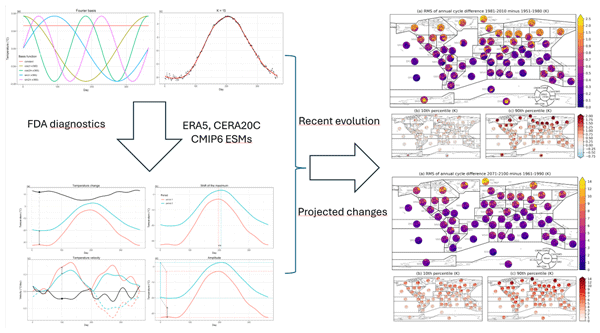
We introduce Functional Data Analysis (FDA) as a new approach to diagnose changes in the temperature seasonal cycle. FDA allows the analysis without needing any prior assumptions about the cycle shape. We evaluate past and future changes based on two reanalyses and five CMIP6 models. We discuss regions of robust changes with datasets’ agreement, e.g., a delayed maximum in the south and east of Europe, while highlighting areas of larger dataset differences, mainly in polar and equatorial regions.

Nina Schuhen, Carley E. Iles, Marit Sandstad, Viktor Ananiev, and Jana Sillmann
Nat. Hazards Earth Syst. Sci., 26, 753–773, https://doi.org/10.5194/nhess-26-753-2026, https://doi.org/10.5194/nhess-26-753-2026, 2026
Short summary
Short summary
As climate changes, extremes are becoming increasingly frequent. We investigate the time of emergence for a large range of different extremes, meaning the earliest time when a significant change in these extremes can be detected beyond natural variability, whether in the past or in the future. The results are based on 21 global climate models and show considerable differences between regions, types of indices and emissions scenarios, as well as between temperature and precipitation extremes.

Arim Yoon, Cathy Hohenegger, Jiawei Bao, and Lukas Brunner
Earth Syst. Dynam., 17, 167–179, https://doi.org/10.5194/esd-17-167-2026, https://doi.org/10.5194/esd-17-167-2026, 2026
Short summary
Short summary
We studied how removing the Amazon rainforest impacts extreme weather by using an advanced global model that resolves convection. Our results show deforestation significantly intensifies short but severe rainfall, leading to more frequent droughts and flooding. Temperatures rise sharply, creating dangerous heat conditions harmful to human health and productivity. Wind speeds drastically increase. These findings provide a stark warning of the effects of continuing deforestation of the Amazon.
Alexander Lee Rischmuller, Benjamin Poschlod, and Jana Sillmann
Adv. Stat. Clim. Meteorol. Oceanogr., 12, 1–19, https://doi.org/10.5194/ascmo-12-1-2026, https://doi.org/10.5194/ascmo-12-1-2026, 2026
Short summary
Short summary
Extreme precipitation probability estimation is vital for hazard protection design but has high uncertainty. We tested six statistical models using 2000 years of climate data. Our Bayesian hierarchical duration-dependent Generalized Extreme Value model shows the highest accuracy and robustness for sample sizes between 30 and 100 years, making it highly promising for use with limited observational records.
Iris Mužić, Øivind Hodnebrog, Yeliz A. Yilmaz, Terje K. Berntsen, Jana Sillmann, David M. Lawrence, and Paul A. Dirmeyer
Adv. Stat. Clim. Meteorol. Oceanogr., 11, 273–292, https://doi.org/10.5194/ascmo-11-273-2025, https://doi.org/10.5194/ascmo-11-273-2025, 2025
Short summary
Short summary
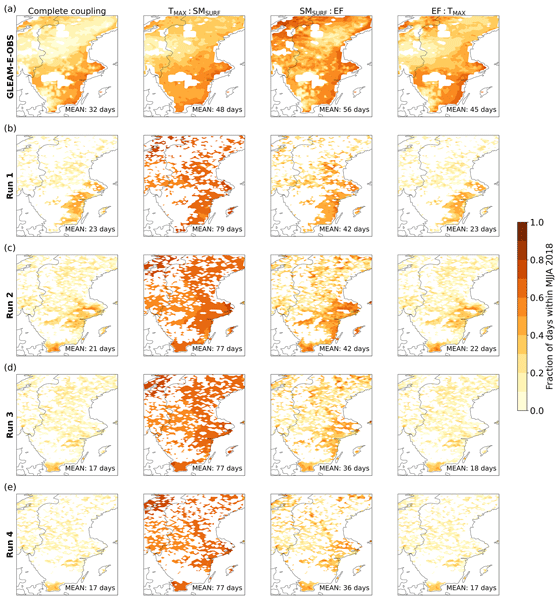
This study investigates soil moisture–temperature coupling during the extreme warm conditions in May–August 2018 in southern and central Sweden using the merged GLEAM-E-OBS dataset and four simulations from the Weather Research and Forecasting model coupled with the Community Terrestrial Systems Model (WRF-CTSM). Based on changes in surface soil moisture, evaporative fraction, and daily maximum 2 m temperature, on average across the region and five datasets, the coupling lasted for 22 d.
Hans Segura, Xabier Pedruzo-Bagazgoitia, Philipp Weiss, Sebastian K. Müller, Thomas Rackow, Junhong Lee, Edgar Dolores-Tesillos, Imme Benedict, Matthias Aengenheyster, Razvan Aguridan, Gabriele Arduini, Alexander J. Baker, Jiawei Bao, Swantje Bastin, Eulàlia Baulenas, Tobias Becker, Sebastian Beyer, Hendryk Bockelmann, Nils Brüggemann, Lukas Brunner, Suvarchal K. Cheedela, Sushant Das, Jasper Denissen, Ian Dragaud, Piotr Dziekan, Madeleine Ekblom, Jan Frederik Engels, Monika Esch, Richard Forbes, Claudia Frauen, Lilli Freischem, Diego García-Maroto, Philipp Geier, Paul Gierz, Álvaro González-Cervera, Katherine Grayson, Matthew Griffith, Oliver Gutjahr, Helmuth Haak, Ioan Hadade, Kerstin Haslehner, Shabeh ul Hasson, Jan Hegewald, Lukas Kluft, Aleksei Koldunov, Nikolay Koldunov, Tobias Kölling, Shunya Koseki, Sergey Kosukhin, Josh Kousal, Peter Kuma, Arjun U. Kumar, Rumeng Li, Nicolas Maury, Maximilian Meindl, Sebastian Milinski, Kristian Mogensen, Bimochan Niraula, Jakub Nowak, Divya Sri Praturi, Ulrike Proske, Dian Putrasahan, René Redler, David Santuy, Domokos Sármány, Reiner Schnur, Patrick Scholz, Dmitry Sidorenko, Dorian Spät, Birgit Sützl, Daisuke Takasuka, Adrian Tompkins, Alejandro Uribe, Mirco Valentini, Menno Veerman, Aiko Voigt, Sarah Warnau, Fabian Wachsmann, Marta Wacławczyk, Nils Wedi, Karl-Hermann Wieners, Jonathan Wille, Marius Winkler, Yuting Wu, Florian Ziemen, Janos Zimmermann, Frida A.-M. Bender, Dragana Bojovic, Sandrine Bony, Simona Bordoni, Patrice Brehmer, Marcus Dengler, Emanuel Dutra, Saliou Faye, Erich Fischer, Chiel van Heerwaarden, Cathy Hohenegger, Heikki Järvinen, Markus Jochum, Thomas Jung, Johann H. Jungclaus, Noel S. Keenlyside, Daniel Klocke, Heike Konow, Martina Klose, Szymon Malinowski, Olivia Martius, Thorsten Mauritsen, Juan Pedro Mellado, Theresa Mieslinger, Elsa Mohino, Hanna Pawłowska, Karsten Peters-von Gehlen, Abdoulaye Sarré, Pajam Sobhani, Philip Stier, Lauri Tuppi, Pier Luigi Vidale, Irina Sandu, and Bjorn Stevens
Geosci. Model Dev., 18, 7735–7761, https://doi.org/10.5194/gmd-18-7735-2025, https://doi.org/10.5194/gmd-18-7735-2025, 2025
Short summary
Short summary
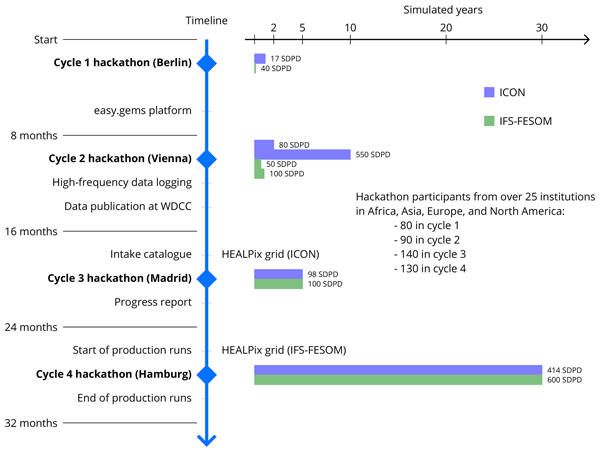
The Next Generation of Earth Modeling Systems project (nextGEMS) developed two Earth system models that use horizontal grid spacing of 10 km and finer, giving more fidelity to the representation of local phenomena, globally. In its fourth cycle, nextGEMS simulated the Earth System climate over the 2020–2049 period under the SSP3-7.0 scenario. Here, we provide an overview of nextGEMS, insights into the model development, and the realism of multi-decadal, kilometer-scale simulations.
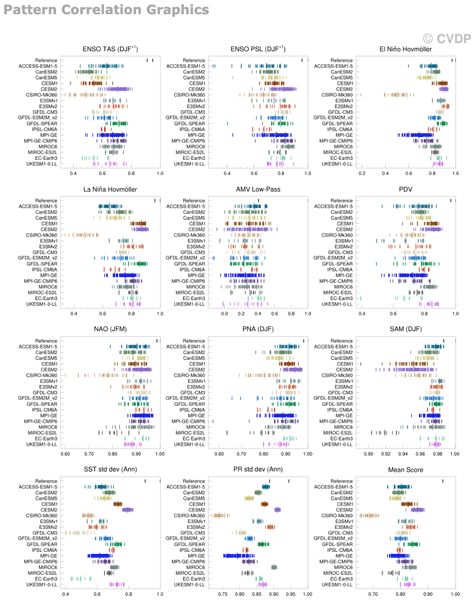
Nicola Maher, Adam S. Phillips, Clara Deser, Robert C. Jnglin Wills, Flavio Lehner, John Fasullo, Julie M. Caron, Lukas Brunner, Urs Beyerle, and Jemma Jeffree
Geosci. Model Dev., 18, 6341–6365, https://doi.org/10.5194/gmd-18-6341-2025, https://doi.org/10.5194/gmd-18-6341-2025, 2025
Short summary
Short summary
We present the new Multi-Model Large Ensemble Archive (MMLEAv2) and introduce the newly updated Climate Variability Diagnostics Package version 6 (CVDPv6), which is designed specifically for use with large ensembles. For highly variable quantities, we demonstrate that a model might perform evaluation poorly or favourably compared to the single realisation of the world that the observations represent, highlighting the need for large ensembles for model evaluation.
Florian Zabel, Matthias Knüttel, and Benjamin Poschlod
Geosci. Model Dev., 18, 1067–1087, https://doi.org/10.5194/gmd-18-1067-2025, https://doi.org/10.5194/gmd-18-1067-2025, 2025
Short summary
Short summary
CropSuite is a new open-source crop suitability model. It provides a GUI and a wide range of options, including a spatial downscaling of climate data. We apply CropSuite to 48 staple and opportunity crops at a 1 km spatial resolution in Africa. We find that climate variability significantly impacts suitable areas but also affects optimal sowing dates and multiple cropping potential. The results provide valuable information for climate impact assessments, adaptation, and land-use planning.
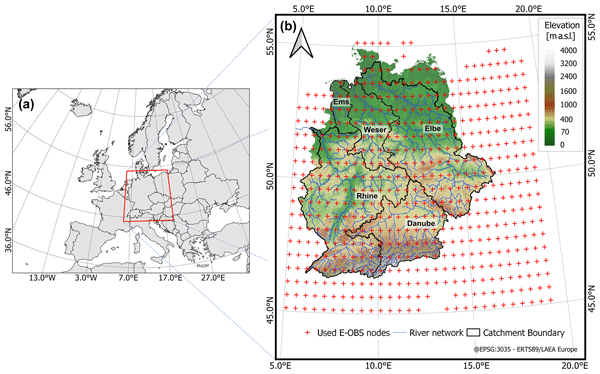
Viet Dung Nguyen, Sergiy Vorogushyn, Katrin Nissen, Lukas Brunner, and Bruno Merz
Adv. Stat. Clim. Meteorol. Oceanogr., 10, 195–216, https://doi.org/10.5194/ascmo-10-195-2024, https://doi.org/10.5194/ascmo-10-195-2024, 2024
Short summary
Short summary
We present a novel stochastic weather generator conditioned on circulation patterns and regional temperature, accounting for dynamic and thermodynamic atmospheric changes. We extensively evaluate the model for the central European region. It statistically downscales precipitation for future periods, generating long, spatially and temporally consistent series. Results suggest an increase in extreme precipitation over the region, offering key benefits for hydrological impact studies.
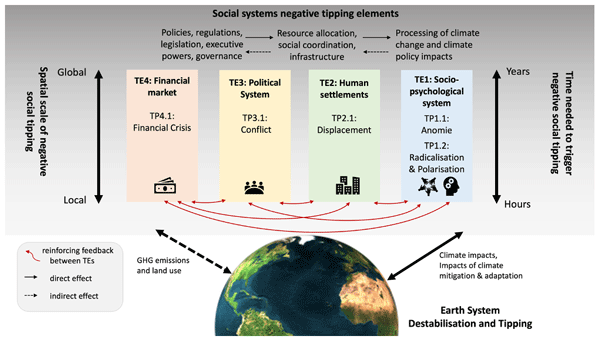
Viktoria Spaiser, Sirkku Juhola, Sara M. Constantino, Weisi Guo, Tabitha Watson, Jana Sillmann, Alessandro Craparo, Ashleigh Basel, John T. Bruun, Krishna Krishnamurthy, Jürgen Scheffran, Patricia Pinho, Uche T. Okpara, Jonathan F. Donges, Avit Bhowmik, Taha Yasseri, Ricardo Safra de Campos, Graeme S. Cumming, Hugues Chenet, Florian Krampe, Jesse F. Abrams, James G. Dyke, Stefanie Rynders, Yevgeny Aksenov, and Bryan M. Spears
Earth Syst. Dynam., 15, 1179–1206, https://doi.org/10.5194/esd-15-1179-2024, https://doi.org/10.5194/esd-15-1179-2024, 2024
Short summary
Short summary
In this paper, we identify potential negative social tipping points linked to Earth system destabilization and draw on related research to understand the drivers and likelihood of these negative social tipping dynamics, their potential effects on human societies and the Earth system, and the potential for cascading interactions and contribution to systemic risks.
Benjamin Poschlod and Anne Sophie Daloz
The Cryosphere, 18, 1959–1981, https://doi.org/10.5194/tc-18-1959-2024, https://doi.org/10.5194/tc-18-1959-2024, 2024
Short summary
Short summary
Information about snow depth is important within climate research but also many other sectors, such as tourism, mobility, civil engineering, and ecology. Climate models often feature a spatial resolution which is too coarse to investigate snow depth. Here, we analyse high-resolution simulations and identify added value compared to a coarser-resolution state-of-the-art product. Also, daily snow depth extremes are well reproduced by two models.
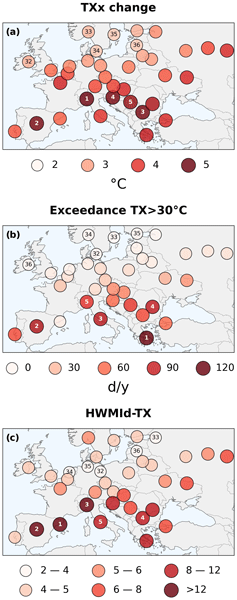
Clemens Schwingshackl, Anne Sophie Daloz, Carley Iles, Kristin Aunan, and Jana Sillmann
Nat. Hazards Earth Syst. Sci., 24, 331–354, https://doi.org/10.5194/nhess-24-331-2024, https://doi.org/10.5194/nhess-24-331-2024, 2024
Short summary
Short summary
Ambient heat in European cities will substantially increase under global warming, as projected by three heat metrics calculated from high-resolution climate model simulations. While the heat metrics consistently project high levels of ambient heat for several cities, in other cities the projected heat levels vary considerably across the three heat metrics. Using complementary heat metrics for projections of ambient heat is thus important for assessments of future risks from heat stress.
Florian Zabel and Benjamin Poschlod
Geosci. Model Dev., 16, 5383–5399, https://doi.org/10.5194/gmd-16-5383-2023, https://doi.org/10.5194/gmd-16-5383-2023, 2023
Short summary
Short summary
Today, most climate model data are provided at daily time steps. However, more and more models from different sectors, such as energy, water, agriculture, and health, require climate information at a sub-daily temporal resolution for a more robust and reliable climate impact assessment. Here we describe and validate the Teddy tool, a new model for the temporal disaggregation of daily climate model data for climate impact analysis.
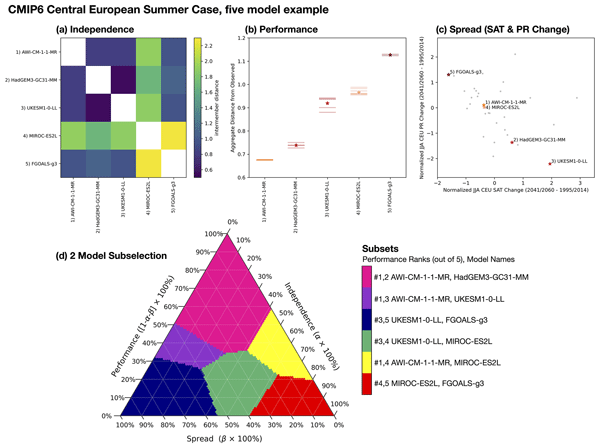
Anna L. Merrifield, Lukas Brunner, Ruth Lorenz, Vincent Humphrey, and Reto Knutti
Geosci. Model Dev., 16, 4715–4747, https://doi.org/10.5194/gmd-16-4715-2023, https://doi.org/10.5194/gmd-16-4715-2023, 2023
Short summary
Short summary
Using all Coupled Model Intercomparison Project (CMIP) models is unfeasible for many applications. We provide a subselection protocol that balances user needs for model independence, performance, and spread capturing CMIP’s projection uncertainty simultaneously. We show how sets of three to five models selected for European applications map to user priorities. An audit of model independence and its influence on equilibrium climate sensitivity uncertainty in CMIP is also presented.
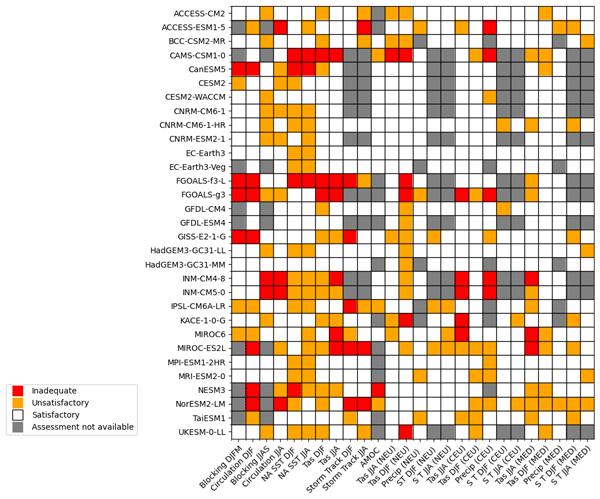
Tamzin E. Palmer, Carol F. McSweeney, Ben B. B. Booth, Matthew D. K. Priestley, Paolo Davini, Lukas Brunner, Leonard Borchert, and Matthew B. Menary
Earth Syst. Dynam., 14, 457–483, https://doi.org/10.5194/esd-14-457-2023, https://doi.org/10.5194/esd-14-457-2023, 2023
Short summary
Short summary
We carry out an assessment of an ensemble of general climate models (CMIP6) based on the ability of the models to represent the key physical processes that are important for representing European climate. Filtering the models with the assessment leads to more models with less global warming being removed, and this shifts the lower part of the projected temperature range towards greater warming. This is in contrast to the affect of weighting the ensemble using global temperature trends.
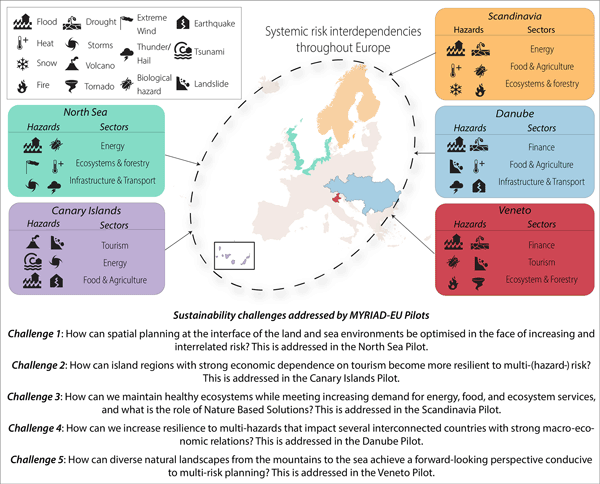
Philip J. Ward, James Daniell, Melanie Duncan, Anna Dunne, Cédric Hananel, Stefan Hochrainer-Stigler, Annegien Tijssen, Silvia Torresan, Roxana Ciurean, Joel C. Gill, Jana Sillmann, Anaïs Couasnon, Elco Koks, Noemi Padrón-Fumero, Sharon Tatman, Marianne Tronstad Lund, Adewole Adesiyun, Jeroen C. J. H. Aerts, Alexander Alabaster, Bernard Bulder, Carlos Campillo Torres, Andrea Critto, Raúl Hernández-Martín, Marta Machado, Jaroslav Mysiak, Rene Orth, Irene Palomino Antolín, Eva-Cristina Petrescu, Markus Reichstein, Timothy Tiggeloven, Anne F. Van Loon, Hung Vuong Pham, and Marleen C. de Ruiter
Nat. Hazards Earth Syst. Sci., 22, 1487–1497, https://doi.org/10.5194/nhess-22-1487-2022, https://doi.org/10.5194/nhess-22-1487-2022, 2022
Short summary
Short summary
The majority of natural-hazard risk research focuses on single hazards (a flood, a drought, a volcanic eruption, an earthquake, etc.). In the international research and policy community it is recognised that risk management could benefit from a more systemic approach. In this perspective paper, we argue for an approach that addresses multi-hazard, multi-risk management through the lens of sustainability challenges that cut across sectors, regions, and hazards.
Cited articles
AghaKouchak, A., Huning, L. S., Sadegh, M., Qin, Y., Markonis, Y., Vahedifard, F., Love, C. A., Mishra, A., Mehran, A., Obringer, R., Hjelmstad, A., Pallickara, S., Jiwa, S., Hanel, M., Zhao, Y., Pendergrass, A. G., Arabi, M., Davis, S. J., Ward, P. J., Svoboda, M., Pulwarty, R., and Kreibich, H.: Toward impact-based monitoring of drought and its cascading hazards, Nat. Rev. Earth Environ., 4, 582–595, https://doi.org/10.1038/s43017-023-00457-2, 2023.
Akinsanola, A. A., Jung, C., Wang, J., and Kotamarthi, V. R.: Evaluation of precipitation across the contiguous United States, Alaska, and Puerto Rico in multi-decadal convection-permitting simulations, Sci. Rep., 14, 1238, https://doi.org/10.1038/s41598-024-51714-3, 2024.
Ban, N., Caillaud, C., Coppola, E., Pichelli, E., Sobolowski, S., Adinolfi, M., Ahrens, B., Alias, A., Anders, I., Bastin, S., Belušić, D., Berthou, S., Brisson, E., Cardoso, R. M., Chan, S. C., Christensen, O. B., Fernández, J., Fita, L., Frisius, T., Gašparac, G., Giorgi, F., Goergen, K., Haugen, J. E., Hodnebrog, Ø., Kartsios, S., Katragkou, E., Kendon, E. J., Keuler, K., Lavin-Gullon, A., Lenderink, G., Leutwyler, D., Lorenz, T., Maraun, D., Mercogliano, P., Milovac, J., Panitz, H.-J., Raffa, M., Remedio, A. R., Schär, C., Soares, P. M. M., Srnec, L., Steensen, B. M., Stocchi, P., Tölle, M. H., Truhetz, H., Vergara-Temprado, J., De Vries, H., Warrach-Sagi, K., Wulfmeyer, V., and Zander, M. J.: The first multi-model ensemble of regional climate simulations at kilometer-scale resolution, part I: evaluation of precipitation, Clim. Dyn., 57, 275–302, https://doi.org/10.1007/s00382-021-05708-w, 2021.
Bandhauer, M., Isotta, F., Lakatos, M., Lussana, C., Båserud, L., Izsák, B., Szentes, O., Tveito, O. E., and Frei, C.: Evaluation of daily precipitation analyses in E-OBS (v19.0e) and ERA5 by comparison to regional high-resolution datasets in European regions, Int. J. Climatol., 42, 727–747, https://doi.org/10.1002/joc.7269, 2022.
Blauhut, V., Stoelzle, M., Ahopelto, L., Brunner, M. I., Teutschbein, C., Wendt, D. E., Akstinas, V., Bakke, S. J., Barker, L. J., Bartošová, L., Briede, A., Cammalleri, C., Kalin, K. C., De Stefano, L., Fendeková, M., Finger, D. C., Huysmans, M., Ivanov, M., Jaagus, J., Jakubínský, J., Krakovska, S., Laaha, G., Lakatos, M., Manevski, K., Neumann Andersen, M., Nikolova, N., Osuch, M., van Oel, P., Radeva, K., Romanowicz, R. J., Toth, E., Trnka, M., Urošev, M., Urquijo Reguera, J., Sauquet, E., Stevkov, A., Tallaksen, L. M., Trofimova, I., Van Loon, A. F., van Vliet, M. T. H., Vidal, J.-P., Wanders, N., Werner, M., Willems, P., and Živković, N.: Lessons from the 2018–2019 European droughts: a collective need for unifying drought risk management, Nat. Hazards Earth Syst. Sci., 22, 2201–2217, https://doi.org/10.5194/nhess-22-2201-2022, 2022.
Bourgault, P., Huard, D., Smith, T. J., Logan, T., Aoun, A., Lavoie, J., Dupuis, É., Rondeau-Genesse, G., Alegre, R., Barnes, C., Laperrière, A. B., Biner, S., Caron, D., Ehbrecht, C., Fyke, J., Keel, T., Labonté, M.-P., Lierhammer, L., Low, J.-F., Quinn, J., Roy, P., Squire, D., Stephens, A., Tanguy, M., and Whelan, C.: xclim: xarray-based climate data analytics, JOSS, 8, 5415, https://doi.org/10.21105/joss.05415, 2023.
Brienen, S., Haller, M., Brauch, J., Früh, B., and Deutscher Wetterdienst: HoKliSim-De (1.0), DWD [data set], https://doi.org/10.5676/DWD/HOKLISIM_V2022.01, 2022.
Brunner, L., Poschlod, B., Dutra, E., Fischer, E. M., Martius, O., and Sillmann, J.: A global perspective on the spatial representation of climate extremes from km-scale models, Environ. Res. Lett., 20, 074054, https://doi.org/10.1088/1748-9326/ade1ef, 2025.
Collier, E. and Mölg, T.: BAYWRF: a high-resolution present-day climatological atmospheric dataset for Bavaria, Earth Syst. Sci. Data, 12, 3097–3112, https://doi.org/10.5194/essd-12-3097-2020, 2020.
Copernicus Climate Change Service: ERA5 post-processed daily-statistics on single levels from 1940 to present, Copernicus Climate Change Service (C3S) Climate Data Store (CDS) [data set], https://doi.org/10.24381/cds.4991cf48, 2024.
Cressie, N. A. C.: Statistics for spatial data, Wiley, New York, 900 pp., https://doi.org/10.1002/9781119115151, 1993.
Dallan, E., Marra, F., Fosser, G., Marani, M., Formetta, G., Schär, C., and Borga, M.: How well does a convection-permitting regional climate model represent the reverse orographic effect of extreme hourly precipitation?, Hydrol. Earth Syst. Sci., 27, 1133–1149, https://doi.org/10.5194/hess-27-1133-2023, 2023.
Gebrechorkos, S. H., Peng, J., Dyer, E., Miralles, D. G., Vicente-Serrano, S. M., Funk, C., Beck, H. E., Asfaw, D. T., Singer, M. B., and Dadson, S. J.: Global high-resolution drought indices for 1981–2022, Earth Syst. Sci. Data, 15, 5449–5466, https://doi.org/10.5194/essd-15-5449-2023, 2023.
Gutowski, W. J., Ullrich, P. A., Hall, A., Leung, L. R., O'Brien, T. A., Patricola-DiRosario, C. M., Arritt, R. W., Bukovsky, M. S., Calvin, K. V., Feng, Z., Jones, A. D., Kooperman, G. J., Monier, E., Pritchard, M. S., Pryor, S. C., Qian, Y., Rhoades, A. M., Roberts, A. F., Sakaguchi, K., Urban, N., and Zarzycki, C.: The Ongoing Need for High-Resolution Regional Climate Models: Process Understanding and Stakeholder Information, Bull. Am. Meteorol. Soc., 101, E664–E683, https://doi.org/10.1175/BAMS-D-19-0113.1, 2020.
Harris, C. R., Millman, K. J., Van Der Walt, S. J., Gommers, R., Virtanen, P., Cournapeau, D., Wieser, E., Taylor, J., Berg, S., Smith, N. J., Kern, R., Picus, M., Hoyer, S., Van Kerkwijk, M. H., Brett, M., Haldane, A., Del Río, J. F., Wiebe, M., Peterson, P., Gérard-Marchant, P., Sheppard, K., Reddy, T., Weckesser, W., Abbasi, H., Gohlke, C., and Oliphant, T. E.: Array programming with NumPy, Nature, 585, 357–362, https://doi.org/10.1038/s41586-020-2649-2, 2020.
Hentgen, L., Ban, N., Kröner, N., Leutwyler, D., and Schär, C.: Clouds in Convection-Resolving Climate Simulations Over Europe, JGR Atmos., 124, 3849–3870, https://doi.org/10.1029/2018JD030150, 2019.
Hersbach, H., Bell, B., Berrisford, P., Hirahara, S., Horányi, A., Muñoz-Sabater, J., Nicolas, J., Peubey, C., Radu, R., Schepers, D., Simmons, A., Soci, C., Abdalla, S., Abellan, X., Balsamo, G., Bechtold, P., Biavati, G., Bidlot, J., Bonavita, M., De Chiara, G., Dahlgren, P., Dee, D., Diamantakis, M., Dragani, R., Flemming, J., Forbes, R., Fuentes, M., Geer, A., Haimberger, L., Healy, S., Hogan, R. J., Hólm, E., Janisková, M., Keeley, S., Laloyaux, P., Lopez, P., Lupu, C., Radnoti, G., De Rosnay, P., Rozum, I., Vamborg, F., Villaume, S., and Thépaut, J.: The ERA5 global reanalysis, Quart. J. Royal Meteorol. Soc., 146, 1999–2049, https://doi.org/10.1002/qj.3803, 2020.
Hoyer, S. and Hamman, J.: xarray: N-D labeled Arrays and Datasets in Python, JORS, 5, 10, https://doi.org/10.5334/jors.148, 2017.
Intergovernmental Panel On Climate Change (IPCC): Climate Change 2021 – The Physical Science Basis: Working Group I Contribution to the Sixth Assessment Report of the Intergovernmental Panel on Climate Change, 1st ed., Cambridge University Press, https://doi.org/10.1017/9781009157896, 2023.
Karki, R., ul Hasson, S., Gerlitz, L., Schickhoff, U., Scholten, T., and Böhner, J.: Quantifying the added value of convection-permitting climate simulations in complex terrain: a systematic evaluation of WRF over the Himalayas, Earth Syst. Dynam., 8, 507–528, https://doi.org/10.5194/esd-8-507-2017, 2017.
Kchouk, S., Melsen, L. A., Walker, D. W., and van Oel, P. R.: A geography of drought indices: mismatch between indicators of drought and its impacts on water and food securities, Nat. Hazards Earth Syst. Sci., 22, 323–344, https://doi.org/10.5194/nhess-22-323-2022, 2022.
Kendon, E. J., Prein, A. F., Senior, C. A., and Stirling, A.: Challenges and outlook for convection-permitting climate modelling, Phil. Trans. R. Soc. A., 379, 20190547, https://doi.org/10.1098/rsta.2019.0547, 2021.
Keune, J., Di Giuseppe, F., Barnard, C., Damasio Da Costa, E., and Wetterhall, F.: ERA5–Drought: Global drought indices based on ECMWF reanalysis, Sci. Data, 12, 616, https://doi.org/10.1038/s41597-025-04896-y, 2025.
Kreklow, J., Tetzlaff, B., Burkhard, B., and Kuhnt, G.: Radar-Based Precipitation Climatology in Germany—Developments, Uncertainties and Potentials, Atmosphere, 11, 217, https://doi.org/10.3390/atmos11020217, 2020.
Lavers, D. A., Simmons, A., Vamborg, F., and Rodwell, M. J.: An evaluation of ERA5 precipitation for climate monitoring, Quart. J. Royal Meteorol. Soc., 148, 3152–3165, https://doi.org/10.1002/qj.4351, 2022.
Lind, P., Belušić, D., Christensen, O. B., Dobler, A., Kjellström, E., Landgren, O., Lindstedt, D., Matte, D., Pedersen, R. A., Toivonen, E., and Wang, F.: Benefits and added value of convection-permitting climate modeling over Fenno-Scandinavia, Clim. Dyn., 55, 1893–1912, https://doi.org/10.1007/s00382-020-05359-3, 2020.
Liu, Y., Shan, F., Yue, H., Wang, X., and Fan, Y.: Global analysis of the correlation and propagation among meteorological, agricultural, surface water, and groundwater droughts, J. Environ. Manage., 333, 117460, https://doi.org/10.1016/j.jenvman.2023.117460, 2023.
Lucas-Picher, P., Argüeso, D., Brisson, E., Tramblay, Y., Berg, P., Lemonsu, A., Kotlarski, S., and Caillaud, C.: Convection-permitting modeling with regional climate models: Latest developments and next steps, WIREs Clim. Change, 12, e731, https://doi.org/10.1002/wcc.731, 2021.
Monteiro, D., Caillaud, C., Lafaysse, M., Napoly, A., Fructus, M., Alias, A., and Morin, S.: Improvements in the land surface configuration to better simulate seasonal snow cover in the European Alps with the CNRM-AROME (cycle 46) convection-permitting regional climate model, Geosci. Model Dev., 17, 7645–7677, https://doi.org/10.5194/gmd-17-7645-2024, 2024.
Petrova, I. Y., Miralles, D. G., Brient, F., Donat, M. G., Min, S.-K., Kim, Y.-H., and Bador, M.: Observation-constrained projections reveal longer-than-expected dry spells, Nature, 633, 594–600, https://doi.org/10.1038/s41586-024-07887-y, 2024.
Poschlod, B.: Data and Code for: LESSONS report: Fine-scale representation of consecutive dry days, Zenodo [data set and code], https://doi.org/10.5281/ZENODO.21219565, 2026.
Poschlod, B. and Daloz, A. S.: Snow depth in high-resolution regional climate model simulations over southern Germany – suitable for extremes and impact-related research?, The Cryosphere, 18, 1959–1981, https://doi.org/10.5194/tc-18-1959-2024, 2024.
Poschlod, B. and Koh, J.: Convection-Permitting Climate Models Can Support Observations to Generate Rainfall Return Levels, Water Res. Resour., 60, e2023WR035159, https://doi.org/10.1029/2023WR035159, 2024.
Pulkkinen, S., Nerini, D., Pérez Hortal, A. A., Velasco-Forero, C., Seed, A., Germann, U., and Foresti, L.: Pysteps: an open-source Python library for probabilistic precipitation nowcasting (v1.0), Geosci. Model Dev., 12, 4185–4219, https://doi.org/10.5194/gmd-12-4185-2019, 2019.
Rauthe, M., Steiner, H., Riediger, U., Mazurkiewicz, A., and Gratzki, A.: A Central European precipitation climatology Part I: Generation and validation of a high-resolution gridded daily data set (HYRAS), METZ, 22, 235–256, https://doi.org/10.1127/0941-2948/2013/0436, 2013.
Ravuri, S., Lenc, K., Willson, M., Kangin, D., Lam, R., Mirowski, P., Fitzsimons, M., Athanassiadou, M., Kashem, S., Madge, S., Prudden, R., Mandhane, A., Clark, A., Brock, A., Simonyan, K., Hadsell, R., Robinson, N., Clancy, E., Arribas, A., and Mohamed, S.: Skilful precipitation nowcasting using deep generative models of radar, Nature, 597, 672–677, https://doi.org/10.1038/s41586-021-03854-z, 2021.
Rybka, H., Haller, M., Brienen, S., Brauch, J., Früh, B., Junghänel, T., Lengfeld, K., Walter, A., and Winterrath, T.: Convection-permitting climate simulations with COSMO-CLM for Germany: Analysis of present and future daily and sub-daily extreme precipitation, METZ, 32, 91–111, https://doi.org/10.1127/metz/2022/1147, 2023.
Schulzweida, U.: CDO Release 2.6.0, https://code.mpimet.mpg.de/projects/cdo/embedded/cdo.pdf (last access: 19 October 2026), 2026.
Sinclair, S. and Pegram, G. G. S.: Empirical Mode Decomposition in 2-D space and time: a tool for space-time rainfall analysis and nowcasting, Hydrol. Earth Syst. Sci., 9, 127–137, https://doi.org/10.5194/hess-9-127-2005, 2005.
Van Loon, A. F. and Van Lanen, H. A. J.: A process-based typology of hydrological drought, Hydrol. Earth Syst. Sci., 16, 1915–1946, https://doi.org/10.5194/hess-16-1915-2012, 2012.
Weigel, K., Bock, L., Gier, B. K., Lauer, A., Righi, M., Schlund, M., Adeniyi, K., Andela, B., Arnone, E., Berg, P., Caron, L.-P., Cionni, I., Corti, S., Drost, N., Hunter, A., Lledó, L., Mohr, C. W., Paçal, A., Pérez-Zanón, N., Predoi, V., Sandstad, M., Sillmann, J., Sterl, A., Vegas-Regidor, J., von Hardenberg, J., and Eyring, V.: Earth System Model Evaluation Tool (ESMValTool) v2.0 – diagnostics for extreme events, regional and impact evaluation, and analysis of Earth system models in CMIP, Geosci. Model Dev., 14, 3159–3184, https://doi.org/10.5194/gmd-14-3159-2021, 2021.
Wille, J. D., Koch, R., Becker, T., and Fischer, E.: Extreme Precipitation Depiction in Convection-Permitting Earth System Models Within the nextGEMS Project, J. Adv. Model. Earth Syst., 17, e2024MS004840, https://doi.org/10.1029/2024MS004840, 2025.
Winterrath, T., Brendel, C., Hafer, M., Junghänel, T., Klameth, A., Walawender, E., Weigl, E., and Becker, A.: Erstellung einer radargestützten Niederschlagsklimatologie, Berichte des Deutschen Wetterdienstes, 251, DWD, Offenbach am Main, https://opendata.dwd.de/climate_environment/GPCC/radarklimatologie/Dokumente/Endbericht_Radarklimatologie_final.pdf (last access: 6 May 2026), 2017.
Zhang, X., Alexander, L., Hegerl, G. C., Jones, P., Tank, A. K., Peterson, T. C., Trewin, B., and Zwiers, F. W.: Indices for monitoring changes in extremes based on daily temperature and precipitation data, WIREs Clim. Change, 2, 851–870, https://doi.org/10.1002/wcc.147, 2011.
Short summary
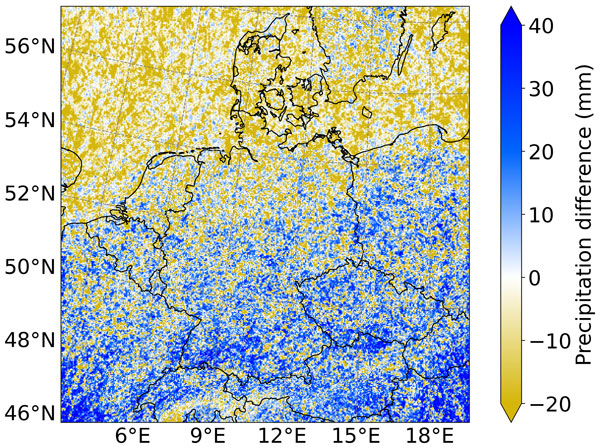
Scientists often measure drought by counting the longest run of days without meaningful rain. Comparing high-resolution climate models, radar, and station data across Germany, we found that fine-scale maps show sharp, patchy patterns, because a small shower can break the dry streak in one place but not the next. The high-resolution climate model matches what radar observes, but yearly counts are so sensitive to chance rainfall that they are an unreliable basis for tracking drought.
Scientists often measure drought by counting the longest run of days without meaningful rain....


Altmetrics
Final-revised paper
Preprint