
Articles | Volume 30, issue 21
https://doi.org/10.5194/hess-30-7007-2026
© Author(s) 2026. This work is distributed under
the Creative Commons Attribution 4.0 License.
the Creative Commons Attribution 4.0 License.
https://doi.org/10.5194/hess-30-7007-2026
© Author(s) 2026. This work is distributed under
the Creative Commons Attribution 4.0 License.
the Creative Commons Attribution 4.0 License.
Research article
| 
13 Nov 2026
Research article |
| 13 Nov 2026
| 13 Nov 2026
Improving weather radar rainfall estimates by merging with commercial microwave link data: a fully reproducible, large-scale method intercomparison
Erlend Øydvin
Faculty of Science and Technology, Norwegian University of Life Sciences, Ås, Norway
Elia Covi
Hydro-Meteo-Climate Structure, Arpae Emilia-Romagna, Bologna, Italy
Maximilian Graf
Department of Hydrometeorology, Deutscher Wetterdienst, Offenbach, Germany
Christian Chwala
CORRESPONDING AUTHOR

Institute of Meteorology and Climate Research (IMK-IFU), Karlsruhe Institute of Technology, Garmisch-Partenkirchen, Germany
Related authors
Christian Chwala, Aart Overeem, Erlend Øydvin, Louise Petersson Wårdh, Jochen Seidel, Maximilian Graf, Bas Walraven, Elia Covi, Hai Victor Habi, Martin Fencl, Lotte de Vos, Filippo Giannetti, Amy Green, Tess O’Hara, Nico Blettner, Tom Keel, Georges Schutz, Abbas El Hachem, Nicholas Illich, Julius Polz, Taoufiq Shit, Lukáš Kaleta, Damaris Zulkarnaen, and Vojtěch Bareš
EGUsphere, https://doi.org/10.5194/egusphere-2025-5438, https://doi.org/10.5194/egusphere-2025-5438, 2026
Short summary
Short summary
Data from so called opportunistic sensors, devices that have not been designed to provide reliable weather data, can offer valuable rainfall information. But good data processing is crucial. For this task, we created the OpenSense software ecosystem, featuring new specialized tools built on a shared foundation. These new tools allow us to collaboratively advance research and improve the operational usage of opportunistic rainfall data to provide more accurate rainfall maps.
Erlend Øydvin, Renaud Gaban, Jafet Andersson, Remco (C. Z.) van de Beek, Mareile Astrid Wolff, Nils-Otto Kitterød, Christian Chwala, and Vegard Nilsen
Atmos. Meas. Tech., 18, 2279–2293, https://doi.org/10.5194/amt-18-2279-2025, https://doi.org/10.5194/amt-18-2279-2025, 2025
Short summary
Short summary
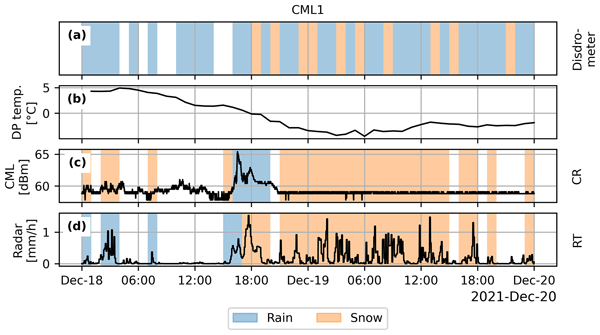
We present a novel method for classifying rain and snow by combining data from commercial microwave links (CMLs) with weather radar. We compare this to a reference method using dew point temperature for precipitation type classification. Evaluations with nearby disdrometers show that CMLs improve the classification of dry snow and rainfall, outperforming the reference method.
Erlend Øydvin, Maximilian Graf, Christian Chwala, Mareile Astrid Wolff, Nils-Otto Kitterød, and Vegard Nilsen
Hydrol. Earth Syst. Sci., 28, 5163–5171, https://doi.org/10.5194/hess-28-5163-2024, https://doi.org/10.5194/hess-28-5163-2024, 2024
Short summary
Short summary
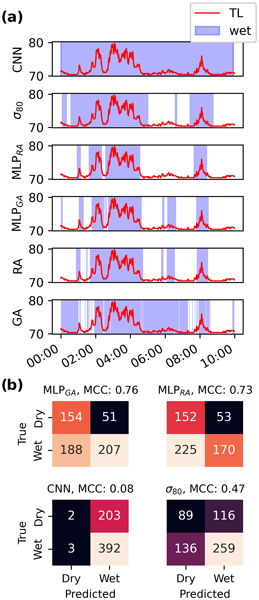
Two simple neural networks are trained to detect rainfall events using signal loss from commercial microwave links. Whereas existing rainfall event detection methods have focused on hourly resolution reference data, this study uses weather radar and rain gauges with 5 min and 1 min temporal resolutions, respectively. Our results show that the developed neural networks can detect rainfall events with a higher temporal precision than existing methods.
Roberto Nebuloni, Maximilian Graf, Greta Cazzaniga, François Mercier, and Maxime Turko
Earth Syst. Sci. Data, 18, 7455–7473, https://doi.org/10.5194/essd-18-7455-2026, https://doi.org/10.5194/essd-18-7455-2026, 2026
Short summary
Short summary
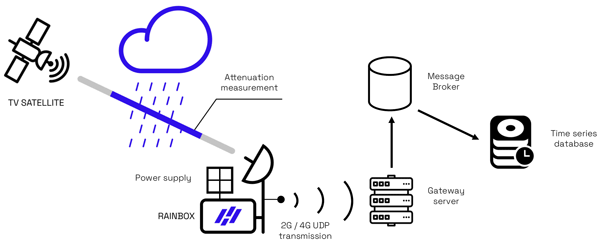
We describe the OpenSat4Weather public dataset, which provides time series of received power from 215 TV-SAT satellite microwave links located in Southern France over a five-month observation period and at 1-min resolution. These data can be processed to gather indirect rainfall intensity measurements. OpenSat4Weather also includes concurrent data from operational rain gauges and weather radars, and ERA5 0°C isotherm height data, to derive the wet fraction of the satellite-to-ground path.
Selina Janner, Julius Polz, Luca Glawion, Harald Kunstmann, and Christian Chwala
EGUsphere, https://doi.org/10.5194/egusphere-2026-4000, https://doi.org/10.5194/egusphere-2026-4000, 2026
Short summary
Short summary
To improve rainfall monitoring from geostationary satellite observations, we developed and artificial intelligence model that estimates rainfall from geostationary satellite infrared images. The model produced more realistic rainfall patterns and intensities at more accurate locations than a widely used operational product. However the model still struggles for example with overestimating rare extreme intensities. Future work should test this approach across more geographically diverse regions.
Taoufiq Shit, Martin Fencl, Christian Chwala, and Vojtěch Bareš
EGUsphere, https://doi.org/10.5194/egusphere-2026-3905, https://doi.org/10.5194/egusphere-2026-3905, 2026
Short summary
Short summary
Rain is still hard to track accurately in places with few gauges or radars. We combined satellite cloud observations with signal changes from mobile phone microwave links using machine learning. The combined approach detected more real rain than link data alone, preserved up to 89 % of rainfall volume, and reduced missed rain to 8 %. This can improve rainfall monitoring and flood warning in regions where standard observations are limited.
Christian Chwala, Aart Overeem, Erlend Øydvin, Louise Petersson Wårdh, Jochen Seidel, Maximilian Graf, Bas Walraven, Elia Covi, Hai Victor Habi, Martin Fencl, Lotte de Vos, Filippo Giannetti, Amy Green, Tess O’Hara, Nico Blettner, Tom Keel, Georges Schutz, Abbas El Hachem, Nicholas Illich, Julius Polz, Taoufiq Shit, Lukáš Kaleta, Damaris Zulkarnaen, and Vojtěch Bareš
EGUsphere, https://doi.org/10.5194/egusphere-2025-5438, https://doi.org/10.5194/egusphere-2025-5438, 2026
Short summary
Short summary
Data from so called opportunistic sensors, devices that have not been designed to provide reliable weather data, can offer valuable rainfall information. But good data processing is crucial. For this task, we created the OpenSense software ecosystem, featuring new specialized tools built on a shared foundation. These new tools allow us to collaboratively advance research and improve the operational usage of opportunistic rainfall data to provide more accurate rainfall maps.
Erlend Øydvin, Renaud Gaban, Jafet Andersson, Remco (C. Z.) van de Beek, Mareile Astrid Wolff, Nils-Otto Kitterød, Christian Chwala, and Vegard Nilsen
Atmos. Meas. Tech., 18, 2279–2293, https://doi.org/10.5194/amt-18-2279-2025, https://doi.org/10.5194/amt-18-2279-2025, 2025
Short summary
Short summary
We present a novel method for classifying rain and snow by combining data from commercial microwave links (CMLs) with weather radar. We compare this to a reference method using dew point temperature for precipitation type classification. Evaluations with nearby disdrometers show that CMLs improve the classification of dry snow and rainfall, outperforming the reference method.

Jonas Tiede, Christian Chwala, Uwe Siart, and Thomas F. Eibert
Adv. Radio Sci., 23, 13–19, https://doi.org/10.5194/ars-23-13-2025, https://doi.org/10.5194/ars-23-13-2025, 2025
Short summary
Short summary
A hand sprayer is used to deposit droplets on the radome of an antenna. Before and during the drying process, measurements of the antenna reflection coefficient are performed repeatedly over time and frequency using a vector network analyzer. Continuous drifts from the wet state back to the initial dry state are demonstrated for individual antennas and frequency ranges. The obtained insights qualify the antenna reflection coefficient to be a promising indicator of momentary radome wetness.
Erlend Øydvin, Maximilian Graf, Christian Chwala, Mareile Astrid Wolff, Nils-Otto Kitterød, and Vegard Nilsen
Hydrol. Earth Syst. Sci., 28, 5163–5171, https://doi.org/10.5194/hess-28-5163-2024, https://doi.org/10.5194/hess-28-5163-2024, 2024
Short summary
Short summary
Two simple neural networks are trained to detect rainfall events using signal loss from commercial microwave links. Whereas existing rainfall event detection methods have focused on hourly resolution reference data, this study uses weather radar and rain gauges with 5 min and 1 min temporal resolutions, respectively. Our results show that the developed neural networks can detect rainfall events with a higher temporal precision than existing methods.
Maximilian Graf, Andreas Wagner, Julius Polz, Llorenç Lliso, José Alberto Lahuerta, Harald Kunstmann, and Christian Chwala
Atmos. Meas. Tech., 17, 2165–2182, https://doi.org/10.5194/amt-17-2165-2024, https://doi.org/10.5194/amt-17-2165-2024, 2024
Short summary
Short summary
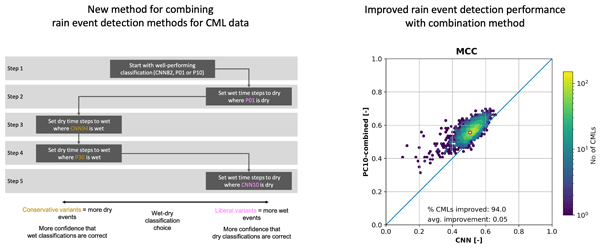
Commercial microwave links (CMLs) can be used for rainfall retrieval. The detection of rainy periods in their attenuation time series is a crucial processing step. We investigate the usage of rainfall data from MSG SEVIRI for this task, compare this approach with existing methods, and introduce a novel combined approach. The results show certain advantages for SEVIRI-based methods, particularly for CMLs where existing methods perform poorly. Our novel combination yields the best performance.
Cited articles
Aldana, M., Pulkkinen, S., von Lerber, A., Kumjian, M. R., and Moisseev, D.: Benchmarking KDP in rainfall: a quantitative assessment of estimation algorithms using C-band weather radar observations, Atmos. Meas. Tech., 18, 793–816, https://doi.org/10.5194/amt-18-793-2025, 2025. a
Andersson, J. C. M., Olsson, J., van de Beek, R., and Hansryd, J.: OpenMRG: Open data from Microwave links, Radar, and Gauges for rainfall quantification in Gothenburg, Sweden, Earth Syst. Sci. Data, 14, 5411–5426, https://doi.org/10.5194/essd-14-5411-2022, 2022. a, b, c, d
Blettner, N., Chwala, C., Haese, B., Hörning, S., and Kunstmann, H.: Combining Commercial Microwave Link and Rain Gauge Observations to Estimate Countrywide Precipitation: A Stochastic Reconstruction and Pattern Analysis Approach, Water Resour. Res., 58, https://doi.org/10.1029/2022WR032563, 2022. a, b
Blettner, N., Chwala, C., Wiegels, R., Lang, R., and Kunstmann, H.: Evaluating CML Rainfall Processing Methods on a Countrywide Scale in Zambia, J. Hydrometeorol., 26, 1603–1629, https://doi.org/10.1175/JHM-D-24-0157.1, 2025. a, b
Cecinati, F., Moreno-Ródenas, A. M., Rico-Ramirez, M. A., claire Ten Veldhuis, M., and Langeveld, J. G.: Considering Rain Gauge Uncertainty Using Kriging for Uncertain Data, Atmosphere, 9, 446, https://doi.org/10.3390/atmos9110446, 2018. a, b
Chwala, C. and Kunstmann, H.: Commercial microwave link networks for rainfall observation: Assessment of the current status and future challenges, Wiley Interdisciplinary Reviews: Water, 6, e1337, https://doi.org/10.1002/wat2.1337, 2019. a, b, c
Chwala, C., Graf, M., Polz, J., Blettner, N., DanSereb, Øydvin, E., keis f, overeem11, toufikshit, Kaleta, L., and yboose: pycomlink/pycomlink: v0.5.0, Zenodo [code], https://doi.org/10.5281/zenodo.17304578, 2025. a
Chwala, C., Overeem, A., Øydvin, E., Petersson Wårdh, L., Seidel, J., Graf, M., Walraven, B., Covi, E., Habi, H. V., Fencl, M., de Vos, L., Giannetti, F., Green, A., O’Hara, T., Blettner, N., Keel, T., Schutz, G., El Hachem, A., Illich, N., Polz, J., Shit, T., Kaleta, L., Zulkarnaen, D., and Bareš, V.: Open-source tools for processing opportunistic rainfall sensor data: An overview of existing tools and the new OpenSense software packages poligrain, pypwsqc and mergeplg, EGUsphere [preprint], https://doi.org/10.5194/egusphere-2025-5438, 2026. a
Covi, E. and Roversi, G.: OpenRainER, Zenodo [data set], https://doi.org/10.5281/zenodo.14731404, 2025. a, b, c
Covi, E., Graf, M., Chwala, C., and Øydvin, E.: Code for: Improving weather radar rainfall estimates by merging with commercial microwave link data: a fully reproducible, large-scale method intercomparison (v1.0.0), https://doi.org/10.5281/zenodo.23371884, 2026a. a, b, c
Covi, E., Roversi, G., and Nebuloni, R.: OpenRainER: an open-source dataset for studying the opportunistic sensing of rainfall in Emilia-Romagna, Italy, Earth Syst. Sci. Data Discuss. [preprint], https://doi.org/10.5194/essd-2026-160, in review, 2026b. a, b, c
Cristiano, E., ten Veldhuis, M.-C., and van de Giesen, N.: Spatial and temporal variability of rainfall and their effects on hydrological response in urban areas – a review, Hydrol. Earth Syst. Sci., 21, 3859–3878, https://doi.org/10.5194/hess-21-3859-2017, 2017. a
Delrieu, G., Wijbrans, A., Boudevillain, B., Faure, D., Bonnifait, L., and Kirstetter, P.-E.: Geostatistical radar–raingauge merging: A novel method for the quantification of rain estimation accuracy, Adv. Water Resour., 71, 110–124, https://doi.org/10.1016/j.advwatres.2014.06.005, 2014. a, b, c, d
Djibo, M., Chwala, C., Graf, M., Polz, J., Kunstmann, H., and Zougmoré, F.: High-Resolution Rainfall Maps from Commercial Microwave Links for a Data-Scarce Region in West Africa, J. Hydrometeorol., 24, 1847–1861, https://doi.org/10.1175/JHM-D-23-0015.1, 2023. a, b
Eshel, A., Alpert, P., and Messer, H.: Estimating the Parameters of the Spatial Autocorrelation of Rainfall Fields by Measurements From Commercial Microwave Links, IEEE T. Geosci. Remote, 60, 1–11, https://doi.org/10.1109/TGRS.2022.3165309, 2022. a
Fencl, M., Nebuloni, R., C. M. Andersson, J., Bares, V., Blettner, N., Cazzaniga, G., Chwala, C., Colli, M., de Vos, L., El Hachem, A., Galdies, C., Giannetti, F., Graf, M., Jacoby, D., Victor Habi, H., Musil, P., Ostrometzky, J., Roversi, G., Sapienza, F., Seidel, J., Spackova, A., van de Beek, R., Walraven, B., Wilgan, K., and Zheng, X.: Data formats and standards for opportunistic rainfall sensors [version 2], Open Research Europe, 3, https://doi.org/10.12688/openreseurope.16068.2, 2024. a
Goovaerts, P.: Kriging and Semivariogram Deconvolution in the Presence of Irregular Geographical Units, Math. Geosci., 40, 101–128, https://doi.org/10.1007/s11004-007-9129-1, 2008. a, b
Graf, M., Chwala, C., Polz, J., and Kunstmann, H.: Rainfall estimation from a German-wide commercial microwave link network: optimized processing and validation for 1 year of data, Hydrol. Earth Syst. Sci., 24, 2931–2950, https://doi.org/10.5194/hess-24-2931-2020, 2020. a, b
Graf, M., Hachem, A. E., Eisele, M., Seidel, J., Chwala, C., Kunstmann, H., and Bárdossy, A.: Rainfall estimates from opportunistic sensors in Germany across spatio-temporal scales, J. Hydrol.: Regional Studies, 37, 100 883, https://doi.org/10.1016/j.ejrh.2021.100883, 2021. a, b
Green, A. C., Kilsby, C., and Bárdossy, A.: A framework for space–time modelling of rainfall events for hydrological applications of weather radar, J. Hydrol., 630, 130630, https://doi.org/10.1016/j.jhydrol.2024.130630, 2024. a
Hänsler, A. and Weiler, M.: Enhancing the usability of weather radar data for the statistical analysis of extreme precipitation events, Hydrol. Earth Syst. Sci., 26, 5069–5084, https://doi.org/10.5194/hess-26-5069-2022, 2022. a, b
Ingebrigtsen, R., Lindgren, F., Steinsland, I., and Martino, S.: Estimation of a non-stationary model for annual precipitation in southern Norway using replicates of the spatial field, Spat. Stat.-Neth., 14, 338–364, https://doi.org/10.1016/j.spasta.2015.07.003, 2015. a
Leblois, E. and Creutin, J.-D.: Space-time simulation of intermittent rainfall with prescribed advection field: Adaptation of the turning band method, Water Resour. Res., 49, 3375–3387, https://doi.org/10.1002/wrcr.20190, 2013. a
Lussana, C., Nipen, T. N., Seierstad, I. A., and Elo, C. A.: Ensemble-based statistical interpolation with Gaussian anamorphosis for the spatial analysis of precipitation, Nonlin. Processes Geophys., 28, 61–91, https://doi.org/10.5194/npg-28-61-2021, 2021. a
Lussana, C., Nipen, T. N., Ménétrier, B., and Seierstad, I. A.: Ensemble‐based statistical interpolation of atmospheric variables near the surface, Q. J. Roy. Meteor. Soc., 151, e5046, https://doi.org/10.1002/qj.5046, 2025. a
Marshall, J. S. and Palmer, W. M. K.: The distribution of raindrops with size, J. Meteorol., 5, 165–166, https://doi.org/10.1175/1520-0469(1948)005<0165:TDORWS>2.0.CO;2, 1948. a, b
Messer, H. and Sendik, O.: A New Approach to Precipitation Monitoring: A critical survey of existing technologies and challenges, IEEE Signal Proc. Mag., 32, 110–122, https://doi.org/10.1109/MSP.2014.2309705, 2015. a
Murphy, B., Yurchak, R., and Müller, S.: GeoStat-Framework/PyKrige: v1.7.3, Zenodo [code], https://doi.org/10.5281/zenodo.17372225, 2025. a
Nešpor, V. and Sevruk, B.: Estimation of Wind-Induced Error of Rainfall Gauge Measurements Using a Numerical Simulation, J. Atmos. Ocean. Tech., 16, 450–464, https://doi.org/10.1175/1520-0426(1999)016<0450:EOWIEO>2.0.CO;2, 1999. a
Nielsen, J., van de Beek, C., Thorndahl, S., Olsson, J., Andersen, C., Andersson, J., Rasmussen, M., and Nielsen, J.: Merging weather radar data and opportunistic rainfall sensor data to enhance rainfall estimates, Atmos. Res., 300, 107228, https://doi.org/10.1016/j.atmosres.2024.107228, 2024. a, b, c, d, e
O, S. and Foelsche, U.: Assessment of spatial uncertainty of heavy rainfall at catchment scale using a dense gauge network, Hydrol. Earth Syst. Sci., 23, 2863–2875, https://doi.org/10.5194/hess-23-2863-2019, 2019. a
Olsson, J., Horváth-Varga, L., van de Beek, R., Graf, M., Overeem, A., Szaton, M., Bareš, V., Bezak, N., Chwala, C., Michele, C. D., Fencl, M., Seidel, J., and Todorović, A.: How Close Are Opportunistic Rainfall Observations to Providing Societal Benefit?, J. Hydrometeorol., 26, 1585–1602, https://doi.org/10.1175/JHM-D-25-0043.1, 2025. a
Overeem, A., Leijnse, H., van Leth, T. C., Bogerd, L., Priebe, J., Tricarico, D., Droste, A., and Uijlenhoet, R.: Tropical rainfall monitoring with commercial microwave links in Sri Lanka, Environ. Res. Lett., 16, 074058, https://doi.org/10.1088/1748-9326/ac0fa6, 2021. a
Overeem, A., van den Besselaar, E., van der Schrier, G., Meirink, J. F., van der Plas, E., and Leijnse, H.: EURADCLIM: the European climatological high-resolution gauge-adjusted radar precipitation dataset, Earth Syst. Sci. Data, 15, 1441–1464, https://doi.org/10.5194/essd-15-1441-2023, 2023. a
Overeem, A., Leijnse, H., de Vos, L., and Silver, M.: RAINLINK, Zenodo [code], https://doi.org/10.5281/zenodo.12211069, 2024a. a
Overeem, A., Leijnse, H., van der Schrier, G., van den Besselaar, E., Garcia-Marti, I., and de Vos, L. W.: Merging with crowdsourced rain gauge data improves pan-European radar precipitation estimates, Hydrol. Earth Syst. Sci., 28, 649–668, https://doi.org/10.5194/hess-28-649-2024, 2024b. a, b
Overeem, A., Walraven, B., Leijnse, H., and Uijlenhoet, R.: Four-year commercial microwave link dataset for the Netherlands, 4TU.ResearchData [data set], https://doi.org/10.4121/be252844-b672-471e-8d69-27269a862ec1.v1, 2024c. a, b
Øydvin, E., Graf, M., Chwala, C., Wolff, M. A., Kitterød, N.-O., and Nilsen, V.: Technical note: A simple feedforward artificial neural network for high-temporal-resolution rain event detection using signal attenuation from commercial microwave links, Hydrol. Earth Syst. Sci., 28, 5163–5171, https://doi.org/10.5194/hess-28-5163-2024, 2024. a, b
Øydvin, E., Gaban, R., Andersson, J., van de Beek, R., Wolff, M. A., Kitterød, N.-O., Chwala, C., and Nilsen, V.: Combining commercial microwave links and weather radar for classification of dry snow and rainfall, Atmos. Meas. Tech., 18, 2279–2293, https://doi.org/10.5194/amt-18-2279-2025, 2025. a
Øydvin, E., Chwala, C., Covi, E., and Graf, M.: OpenSenseAction/mergeplg: v0.2.0, Zenodo [code], https://doi.org/10.5281/zenodo.23366659, 2026a. a, b, c, d
Øydvin, E., Covi, E., Graf, M., and Chwala, C.: Radar rainfall fields merged with commercial microwave link data for OpenMRG and OpenRainER (Version v1.0.0), Zenodo [data set], https://doi.org/10.5281/zenodo.23367571 (last access: 30 October 2026), 2026b. a
Pastorek, J., Fencl, M., Rieckermann, J., and Bares, V.: Precipitation Estimates From Commercial Microwave Links: Practical Approaches to Wet-Antenna Correction, IEEE T. Geosci. Remote, 60, 1–9, https://doi.org/10.1109/TGRS.2021.3110004, 2022. a
Roksvåg, T., Steinsland, I., and Engeland, K.: Estimation of annual runoff by exploiting long-term spatial patterns and short records within a geostatistical framework, Hydrol. Earth Syst. Sci., 24, 4109–4133, https://doi.org/10.5194/hess-24-4109-2020, 2020. a
Rombeek, N., Hrachowitz, M., Droste, A., and Uijlenhoet, R.: Evaluation of high-intensity rainfall observations from personal weather stations in the Netherlands, Hydrol. Earth Syst. Sci., 29, 4585–4606, https://doi.org/10.5194/hess-29-4585-2025, 2025. a
Schleiss, M., Olsson, J., Berg, P., Niemi, T., Kokkonen, T., Thorndahl, S., Nielsen, R., Ellerbæk Nielsen, J., Bozhinova, D., and Pulkkinen, S.: The accuracy of weather radar in heavy rain: a comparative study for Denmark, the Netherlands, Finland and Sweden, Hydrol. Earth Syst. Sci., 24, 3157–3188, https://doi.org/10.5194/hess-24-3157-2020, 2020. a, b
Sideris, I. V., Gabella, M., Erdin, R., and Germann, U.: Real‐time radar–rain‐gauge merging using spatio‐temporal co‐kriging with external drift in the alpine terrain of Switzerland, Q. J. Roy. Meteor. Soc., 140, 1097–1111, https://doi.org/10.1002/qj.2188, 2014. a, b, c
Uijlenhoet, R., Overeem, A., and Leijnse, H.: Opportunistic remote sensing of rainfall using microwave links from cellular communication networks, WIREs Water, 5, https://doi.org/10.1002/wat2.1289, 2018. a
van de Beek, C., Leijnse, H., Torfs, P., and Uijlenhoet, R.: Seasonal semi-variance of Dutch rainfall at hourly to daily scales, Adv. Water Resour., 45, 76–85, https://doi.org/10.1016/j.advwatres.2012.03.023, 2012. a, b, c, d
Van Weverberg, K., Neutens, N., De Corte, S., Passtoors, A., Calderan, S., Ghilain, N., Reinoso-Rondinel, R., Reyniers, M., Overeem, A., Van de Vyver, H., Van Schaeybroeck, B., De Wit, B., and Uijlenhoet, R.: Country-wide rainfall estimates from a commercial microwave link network in Belgium, EGUsphere [preprint], https://doi.org/10.5194/egusphere-2026-457, 2026. a
Velasco-Forero, C. A., Sempere-Torres, D., Cassiraga, E. F., and Gómez-Hernández, J. J.: A non-parametric automatic blending methodology to estimate rainfall fields from rain gauge and radar data, Adv. Water Resour., 32, 986–1002, https://doi.org/10.1016/j.advwatres.2008.10.004, 2009. a
Western, A. W. and Blöschl, G.: On the spatial scaling of soil moisture, J. Hydrol., 217, 203–224, https://doi.org/10.1016/S0022-1694(98)00232-7, 1999. a, b
Short summary
We developed an open-source tool to combine weather radar and commercial microwave link data, tested on large, public datasets. Merging these measurements produced more accurate rainfall estimates than radar alone, and we show which methods work best in different situations to support improved rainfall monitoring and applications.
We developed an open-source tool to combine weather radar and commercial microwave link data,...


Altmetrics
Final-revised paper
Preprint