
Articles | Volume 30, issue 2
https://doi.org/10.5194/hess-30-433-2026
© Author(s) 2026. This work is distributed under
the Creative Commons Attribution 4.0 License.
the Creative Commons Attribution 4.0 License.
https://doi.org/10.5194/hess-30-433-2026
© Author(s) 2026. This work is distributed under
the Creative Commons Attribution 4.0 License.
the Creative Commons Attribution 4.0 License.
Research article
| 
28 Jan 2026
Research article |
| 28 Jan 2026
| 28 Jan 2026
Questioning the Endorheic Paradigm: water balance dynamics in the Salar del Huasco basin, Chile

Department of Hydraulic and Environmental Engineering, Pontificia Universidad Católica de Chile, Santiago, Chile
School of GeoSciences, University of Edinburgh, Edinburgh, UK
Oscar Hartogensis
Meteorology and Air Quality, Wageningen University, Wageningen, the Netherlands
Pedro Bonacic-Vera
Department of Hydraulic and Environmental Engineering, Pontificia Universidad Católica de Chile, Santiago, Chile
Francisco Suárez
Department of Hydraulic and Environmental Engineering, Pontificia Universidad Católica de Chile, Santiago, Chile
Centro de Desarrollo Urbano Sustentable (CEDEUS), Santiago, Chile
Centro UC Desierto de Atacama (CDA), Santiago, Chile
Related authors
No articles found.
Vicente Espinoza, Oscar Hartogensis, Felipe Lobos-Roco, and Jordi Vilà-Guerau de Arellano
EGUsphere, https://doi.org/10.5194/egusphere-2026-4980, https://doi.org/10.5194/egusphere-2026-4980, 2026
This preprint is open for discussion and under review for Atmospheric Chemistry and Physics (ACP).
Short summary
Short summary
Marine low clouds from the Southeast Pacific enter the Atacama Desert coastal region as fog. Understanding the dynamics of this transition is vital as fog is the sole source of fresh water in this hyper-arid region. We study how sinking air motions and dry-air mixing shape the cloud layer in its transition from ocean to land. We show that along the transition, the cloud layer weakens, governed by the interplay of these processes, whose relative importance shifts spatially.
Felipe Lobos-Roco, Vicente Espinoza, Klaus Keim-Vera, Francisca Muñoz, Francisco Suárez, and Oscar Hartogensis
EGUsphere, https://doi.org/10.5194/egusphere-2026-2396, https://doi.org/10.5194/egusphere-2026-2396, 2026
Short summary
Short summary
The transport of marine clouds from the Pacific into the Atacama Desert forms extensive, semi-permanent fog banks along the coastal mountain range. They provide the sole water input for xeric ecosystems and are a potential resource for human activities. Through airborne and surface observations gathered during a field experiment called StraToFog, we study the water-energy exchange between humid marine air and a hyperarid desert as stratocumulus transitions to land fog.
Anna C. Huitema, Vincent S. de Feiter, Raquel González-Armas, Oscar K. Hartogensis, Hella van Asperen, Cleo Quaresma Dias-Júnior, and Jordi Vilà-Guerau de Arellano
EGUsphere, https://doi.org/10.5194/egusphere-2026-684, https://doi.org/10.5194/egusphere-2026-684, 2026
Short summary
Short summary
We investigated nighttime CO2 exchange within and above the Amazon rainforest canopy using observations from the CloudRoots-Amazon22 campaign. Two atmospheric regimes were identified: a turbulent state, in which CO2 exchange between the within- and above-canopy layers was enhanced, and a calm state, with little turbulence and minimal exchange between the layers. Our results indicate that accounting for these two regimes is essential to reproduce nighttime CO2 dynamics correctly.
Gijsbert A. Vis, Oscar K. Hartogensis, Marie-Claire ten Veldhuis, Bas J. H. van de Wiel, and Miriam Coenders-Gerrits
EGUsphere, https://doi.org/10.5194/egusphere-2025-6125, https://doi.org/10.5194/egusphere-2025-6125, 2026
Short summary
Short summary
Heat exchange between land and air mainly happens through turbulence. Usually turbulence is measured at one location over time, but it also happens over space. In this study, we use fiber optic cables (DTS) that can measure temperature to capture turbulence over time, as well as directly over space. If compared with conventional instruments, we found a good correlation but also an underestimation. We recommend using DTS alongside with conventional instruments so they can complement each other.
Luuk D. van der Valk, Oscar K. Hartogensis, Miriam Coenders-Gerrits, Rolf W. Hut, and Remko Uijlenhoet
Hydrol. Earth Syst. Sci., 29, 6589–6606, https://doi.org/10.5194/hess-29-6589-2025, https://doi.org/10.5194/hess-29-6589-2025, 2025
Short summary
Short summary
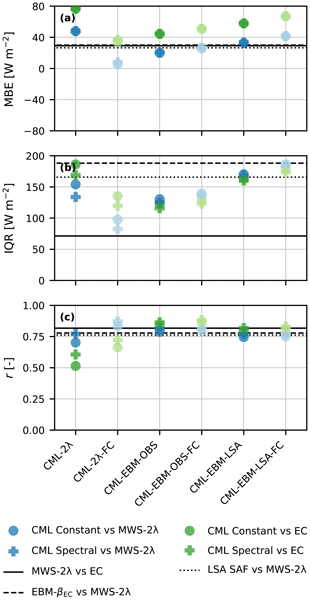
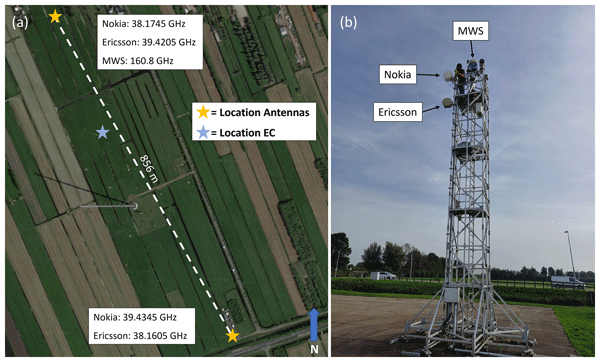
Commercial microwave links (CMLs), part of mobile phone networks, transmit comparable signals as instruments specially designed to estimate evaporation. Therefore, we investigate if CMLs could be used to estimate evaporation, even though they have not been designed for this purpose. Our results illustrate the potential of using CMLs to estimate evaporation, especially given their global coverage, but also outline some major drawbacks, often a consequence of unfavourable design choices for CMLs.
Luuk D. van der Valk, Oscar K. Hartogensis, Miriam Coenders-Gerrits, Rolf W. Hut, Bas Walraven, and Remko Uijlenhoet
Atmos. Meas. Tech., 18, 6143–6165, https://doi.org/10.5194/amt-18-6143-2025, https://doi.org/10.5194/amt-18-6143-2025, 2025
Short summary
Short summary
Commercial microwave links (CMLs), part of mobile phone networks, transmit comparable signals to instruments specially designed to estimate evaporation. Therefore, we investigate if CMLs could be used to estimate evaporation, even though they have not been designed for this purpose. Our results illustrate the potential for using CMLs to estimate evaporation, especially given their global coverage, but also outline some major drawbacks, often a consequence of unfavourable design choices for CMLs.
Robbert P. J. Moonen, Getachew A. Adnew, Jordi Vilà-Guerau de Arellano, Oscar K. Hartogensis, David J. Bonell Fontas, Shujiro Komiya, Sam P. Jones, and Thomas Röckmann
Atmos. Chem. Phys., 25, 12197–12212, https://doi.org/10.5194/acp-25-12197-2025, https://doi.org/10.5194/acp-25-12197-2025, 2025
Short summary
Short summary
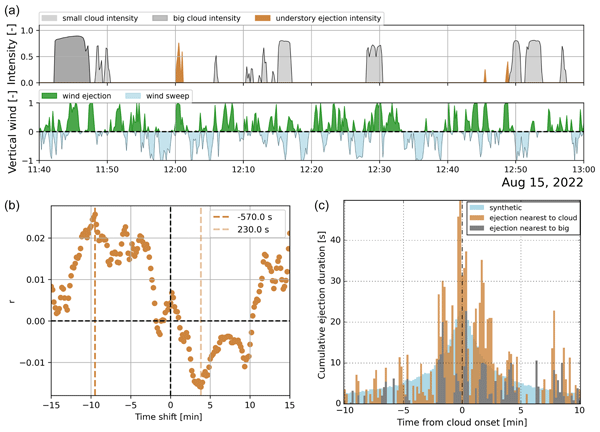
Understory ejections are distinct turbulent features emerging in prime tall-forest ecosystems. We share a method to isolate understory ejections based on H2O–CO2 anomaly quadrants. From these, we calculate the flux contributions of understory ejections and all flux quadrants. In addition, we show that a distinctly depleted isotopic composition can be found in the ejected water vapour. Finally, we explored the role of clouds as a potential trigger for understory ejections.
Mary Rose Mangan, Jordi Vilà-Guerau de Arellano, Bart J. H. van Stratum, Marie Lothon, Guylaine Canut-Rocafort, and Oscar K. Hartogensis
Atmos. Chem. Phys., 25, 8959–8981, https://doi.org/10.5194/acp-25-8959-2025, https://doi.org/10.5194/acp-25-8959-2025, 2025
Short summary
Short summary
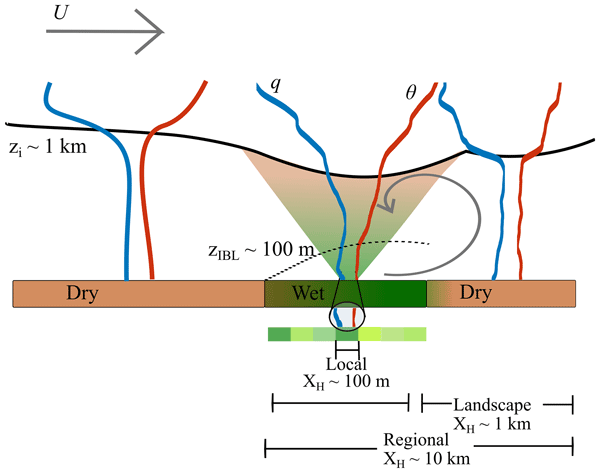
Using observations and high-resolution turbulence modeling, we examine the influence of irrigation-driven surface heterogeneity on the atmospheric boundary layer (ABL). We use a multi-scale approach for characterizing surface heterogeneity to explore how its influence on the ABL within a grid cell would change with higher-resolution models. We find that the height of the ABL is variable across short distances and that the surface heterogeneity is felt least strongly in the middle of the ABL.
Raquel González-Armas, Jordi Vilà-Guerau de Arellano, Mary Rose Mangan, Oscar Hartogensis, and Hugo de Boer
Biogeosciences, 21, 2425–2445, https://doi.org/10.5194/bg-21-2425-2024, https://doi.org/10.5194/bg-21-2425-2024, 2024
Short summary
Short summary
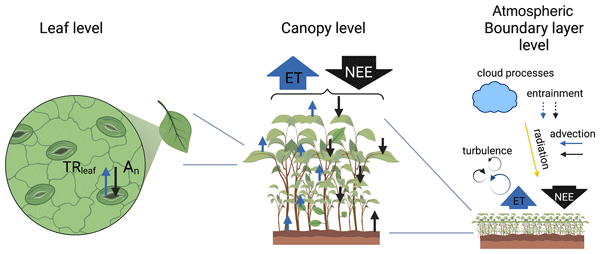
This paper investigates the water and CO2 exchange for an alfalfa field with observations and a model with spatial scales ranging from the stomata to the atmospheric boundary layer. To relate the environmental factors to the leaf gas exchange, we developed three equations that quantify how many of the temporal changes of the leaf gas exchange occur due to changes in the environmental variables. The novelty of the research resides in the capacity to dissect the dynamics of the leaf gas exchange.
Robbert P. J. Moonen, Getachew A. Adnew, Oscar K. Hartogensis, Jordi Vilà-Guerau de Arellano, David J. Bonell Fontas, and Thomas Röckmann
Atmos. Meas. Tech., 16, 5787–5810, https://doi.org/10.5194/amt-16-5787-2023, https://doi.org/10.5194/amt-16-5787-2023, 2023
Short summary
Short summary
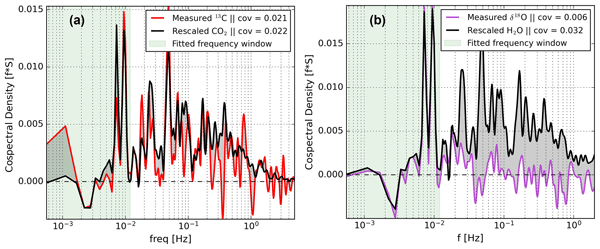
Isotope fluxes allow for net ecosystem gas exchange fluxes to be partitioned into sub-components like plant assimilation, respiration and transpiration, which can help us better understand the environmental drivers of each partial flux. We share the results of a field campaign isotope fluxes were derived using a combination of laser spectroscopy and eddy covariance. We found lag times and high frequency signal loss in the isotope fluxes we derived and present methods to correct for both.
Felipe Lobos-Roco, Oscar Hartogensis, Francisco Suárez, Ariadna Huerta-Viso, Imme Benedict, Alberto de la Fuente, and Jordi Vilà-Guerau de Arellano
Hydrol. Earth Syst. Sci., 26, 3709–3729, https://doi.org/10.5194/hess-26-3709-2022, https://doi.org/10.5194/hess-26-3709-2022, 2022
Short summary
Short summary
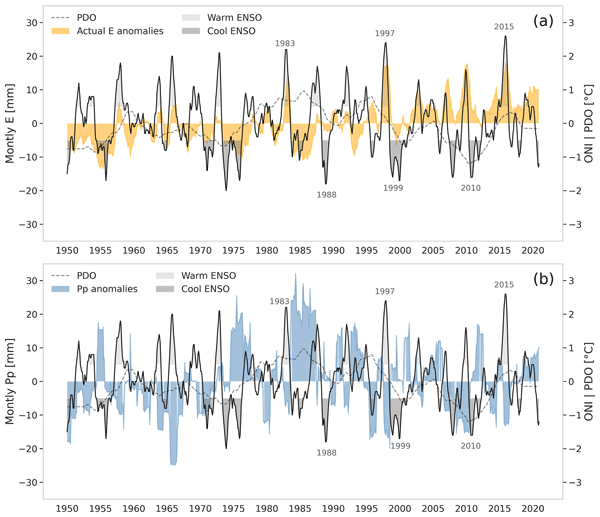
This research brings a multi-scale temporal analysis of evaporation in a saline lake of the Atacama Desert. Our findings reveal that evaporation is controlled differently depending on the timescale. Evaporation is controlled sub-diurnally by wind speed, regulated seasonally by radiation and modulated interannually by ENSO. Our research extends our understanding of evaporation, contributing to improving the climate change assessment and efficiency of water management in arid regions.
Cited articles
Aguirre-Correa, F., Hartogensis, O., Bonacic Vera, P., and Suárez, F.: Data of “Questioning the Endorheic Paradigm: Water Balance dynamics in the Salar del Huasco basin, Chile”, OSF [data set], https://doi.org/10.17605/OSF.IO/6BG2W, 2026. a
Alcalá, F. J., Martín-Martín, M., Guerrera, F., Martínez-Valderrama, J., and Robles-Marín, P.: A feasible methodology for groundwater resource modelling for sustainable use in sparse-data drylands: application to the Amtoudi Oasis in the northern Sahara, Sci. Total Environ., 630, 1246–1257, https://doi.org/10.1016/j.scitotenv.2018.02.294, 2018. a, b
Allen, R., Tasumi, M., and Trezza, R.: Satellite-based energy balance for mapping evapotranspiration with internalized calibration (METRIC)–model, J. Irrig. Drain. E., 133, https://doi.org/10.1061/(ASCE)0733-9437(2007)133:4(380), 2007. a, b
Alvarez-Campos, O., Olson, E. J., Welp, L. R., Frisbee, M. D., Zuñiga Medina, S. A., Díaz Rodríguez, J., Roque Quispe, W. R., Salazar Mamani, C. I., Arenas Carrión, M. R., Jara, J. M., Ccanccapa-Cartagena, A., and Jafvert, C. T.: Evidence for high-elevation salar recharge and interbasin groundwater flow in the Western Cordillera of the Peruvian Andes, Hydrol. Earth Syst. Sci., 26, 483–503, https://doi.org/10.5194/hess-26-483-2022, 2022. a
Alvarez-Garreton, C., Mendoza, P. A., Boisier, J. P., Addor, N., Galleguillos, M., Zambrano-Bigiarini, M., Lara, A., Puelma, C., Cortes, G., Garreaud, R., McPhee, J., and Ayala, A.: The CAMELS-CL dataset: catchment attributes and meteorology for large sample studies – Chile dataset, Hydrol. Earth Syst. Sci., 22, 5817–5846, https://doi.org/10.5194/hess-22-5817-2018, 2018. a
Aryalekshmi, B., Biradar, R. C., Chandrasekar, K., and Mohammed Ahamed, J.: Analysis of various surface energy balance models for evapotranspiration estimation using satellite data, The Egyptian Journal of Remote Sensing and Space Science, 24, 1119–1126, https://doi.org/10.1016/j.ejrs.2021.11.007, 2021. a
Baig, F., Ali, L., Faiz, M. A., Chen, H., and Sherif, M.: From bias to accuracy: transforming satellite precipitation data in arid regions with machine learning and topographical insights, J. Hydrol., 653, 132801, https://doi.org/10.1016/j.jhydrol.2025.132801, 2025. a
Belcher, W. R., Bedinger, M., Back, J. T., and Sweetkind, D. S.: Interbasin flow in the Great Basin with special reference to the southern Funeral Mountains and the source of Furnace Creek springs, Death Valley, California, US, J. Hydrol., 369, 30–43, https://doi.org/10.1016/j.jhydrol.2009.02.048, 2009. a, b
Blin, N., Hausner, M., Leray, S., Lowry, C., and Suárez, F.: Potential impacts of climate change on an aquifer in the arid Altiplano, northern Chile: the case of the protected wetlands of the Salar del Huasco basin, J. Hydrol., 39, 100996, https://doi.org/10.1016/j.ejrh.2022.100996, 2022. a, b, c, d, e, f, g, h, i
Boisier, J. P., Alvarez-Garretón, C., Cepeda, J., Osses, A., Vásquez, N., and Rondanelli, R.: CR2MET: a high-resolution precipitation and temperature dataset for hydroclimatic research in Chile, in: EGU General Assembly Conference Abstracts, EGU General Assembly Conference Abstracts, https://meetingorganizer.copernicus.org/EGU2018/EGU2018-19739.pdf (last access: December 2025), 19739, 2018. a, b, c
Bouchaou, L., El Alfy, M., Shanafield, M., Siffeddine, A., and Sharp, J.: Groundwater in arid and semi-arid areas, Geosciences, 14, https://doi.org/10.3390/geosciences14120332, 2024. a
Boushaki, F. I., Hsu, K.-L., Sorooshian, S., Park, G.-H., Mahani, S., and Shi, W.: Bias adjustment of satellite precipitation estimation using ground-based measurement: a case study evaluation over the southwestern United States, J. Hydrometeorol., 10, 1231–1242, https://doi.org/10.1175/2009JHM1099.1, 2009. a
Boutt, D., Hynek, S., Munk, L., and Corenthal, L.: Rapid recharge of fresh water to the halite-hosted brine aquifer of Salar de Atacama, Chile: rapid recharge of fresh water to the Salar de Atacama, Chile, Hydrol. Process., 30, https://doi.org/10.1002/hyp.10994, 2016. a
Carroll, R. W., Pohll, G. M., Morton, C. G., and Huntington, J. L.: Calibrating a basin-scale groundwater model to remotely sensed estimates of groundwater evapotranspiration, J. Am. Water Resour. As., 51, 1114–1127, https://doi.org/10.1111/jawr.12285, 2015. a
Cifuentes, J. L., López V., L., Fuentes C., F., Troncoso V., R., Cervetto S., M., and Neira S., H.: Hidrogeología del Salar del Huasco y su relación con el acuífero de Pica, Región de Tarapacá, in: Resumenes, 15to Congreso Geológico Chileno, Concepción, Chile, abstract, Región de Tarapacá, Hidrogeología, p. 636, , https://repositorio.sernageomin.cl/handle/0104/25392 (last access: 20 June 2025), 2018. a
de la Fuente, A. and Meruane, C.: Spectral model for longterm computation of thermodynamics and potential evaporation in shallow wetlands, Water Resour. Res., 53, 7696–7715, https://doi.org/10.1002/2017WR020515, 2017. a
de la Fuente, A., Meruane, C., and Suárez, F.: Long-term spatiotemporal variability in high Andean wetlands in northern Chile, Sci. Total Environ., 756, 143830, https://doi.org/10.1016/j.scitotenv.2020.143830, 2021. a, b, c
Derardja, B., Khadra, R., Abdelmoneim, A., El-Shirbeny, M., Valsamidis, T., Pasquale, V., Deflorio, A., and Volden, E.: Advancements in remote sensing for evapotranspiration estimation: a comprehensive review of temperature-based models, Remote Sens.-Basel, 16, 1927, https://doi.org/10.3390/rs16111927, 2024. a
DGA: Sistema Piloto I Región: Salar del Huasco, In Levantamieno hidrogeológico para el desarrollo de nuevas fuentes de agua en áreas prioritarias de la zona norte de Chile, Regiones XV, I, II y III, Tech. rep., Dirección General de Aguas, Chile, https://dga.dconsultores.cl/items/a1cb83c9-20bf-4dc5-8f1f-3b21a9f5416e (last access: June 2025), 2009. a, b, c
Diouf, O. C., Weihermüller, L., Diedhiou, M., Vereecken, H., Faye, S. C., Faye, S., and Sylla, S. N.: Modelling groundwater evapotranspiration in a shallow aquifer in a semi-arid environment, J. Hydrol., 587, 124967, https://doi.org/10.1016/j.jhydrol.2020.124967, 2020. a
Falvey, M. and Garreaud, R.: Moisture variability over the South American Altiplano during the South American Low Level Jet Experiment (SALLJEX) observing season, J. Geophys. Res., 110, 1–12, https://doi.org/10.1029/2005JD006152, 2005. a
Feldman, A. D.: Hydrologic modeling system HEC-HMS: technical reference manual, US Army Corps of Engineers, Hydrologic Engineering Center, https://www.hec.usace.army.mil/software/hec-hms/documentation/HEC-HMS_Technical Reference Manual_(CPD-74B).pdf (last access: May 2025), 2000. a
Gao, G., Shen, Q., Zhang, Y., Pan, N., Ma, Y., Jiang, X., and Fu, B.: Determining spatio-temporal variations of ecological water consumption by natural oases for sustainable water resources allocation in a hyper-arid endorheic basin, J. Clean. Prod., 185, 1–13, https://doi.org/10.1016/j.jclepro.2018.03.025, 2018. a
Garreaud, R. and Aceituno, P.: Interannual rainfall variability over the South American Altiplano, J. Climate, 14, 2779–2789, https://doi.org/10.1175/1520-0442(2001)014<2779:IRVOTS>2.0.CO;2, 2001. a
Garreaud, R., Vuille, M., and Clement, A. C.: The climate of the altiplano: observed current conditions and mechanisms of past changes, Palaeogeogr. Palaeocl., 194, 5–22, https://doi.org/10.1016/S0031-0182(03)00269-4, 2003. a, b, c
Hammond, M. and Han, D.: Issues of using digital maps for catchment delineation, Proceedings of the Institution of Civil Engineers – Water Management, 159, 45–51, https://doi.org/10.1680/wama.2006.159.1.45, 2006. a
Hernández-López, M. F., Gironás, J., Braud, I., Suárez, F., and Muñoz, J. F.: Assessment of evaporation and water fluxes in a column of dry saline soil subject to different water table levels, Hydrol. Process., 28, 3655–3669, https://doi.org/10.1002/hyp.9912, 2014. a
Herrera, C., Custodio, E., Chong, G., Lambán, L. J., Riquelme, R., Wilke, H., Jódar, J., Urrutia, J., Urqueta, H., Sarmiento, A., Gamboa, C., and Lictevout, E.: Groundwater flow in a closed basin with a saline shallow lake in a volcanic area: Laguna Tuyajto, northern Chilean Altiplano of the Andes, Sci. Total Environ., 541, 303–318, https://doi.org/10.1016/j.scitotenv.2015.09.060, 2016. a
Houston, J.: Evaporation in the Atacama Desert: an empirical study of spatio-temporal variations and their causes, J. Hydrol., 330, 402–412, https://doi.org/10.1016/j.jhydrol.2006.03.036, 2006a. a
Houston, J.: Variability of precipitation in the Atacama Desert: its causes and hydrological impact, Int. J. Climatol., 26, 2181–2198, https://doi.org/10.1002/joc.1359, 2006b. a
Hydrologic Engineering Center US (HEC): The Hydrologic Modeling System (HEC-HMS), https://www.hec.usace.army.mil/software/hec-hms/documentation/CPD-74A_2001Jan.pdf (last access: June 2025), 2001. a
Johnson, E., Yáñez, J., and Ortiz, C.: Evaporation from shallow groundwater in closed basins in the Chilean Altiplano, Hydrolog. Sci. J., 55, 624–635, https://doi.org/10.1080/02626661003780458, 2010. a
Jordan, T., Lameli, C. H., Kirk-Lawlor, N., and Godfrey, L.: Architecture of the aquifers of the Calama Basin, Loa catchment basin, northern Chile, Geosphere, 11, 1438–1474, https://doi.org/10.1130/GES01176.1, 2015. a
Le Moine, N., Andréassian, V., Perrin, C., and Michel, C.: How can rainfall-runoff models handle intercatchment groundwater flows? Theoretical study based on 1040 French catchments, Water Resour. Res., 43, https://doi.org/10.1029/2006WR005608, 2007. a
Leavesley, G., Lichty, R., Troutman, B., and Saindon, L.: Precipitation-runoff modeling system, user's manual, Water-Resources Investigations Report, US Geological Survey, Water Resources Division, https://doi.org/10.3133/wri834238, 83–4238, 1983. a
Legesse, D., Vallet-Coulomb, C., and Gasse, F.: Hydrological response of a catchment to climate and land use changes in Tropical Africa: case study South Central Ethiopia, J. Hydrol., 275, 67–85, https://doi.org/10.1016/S0022-1694(03)00019-2, 2003. a
Li, X., Cheng, G., Ge, Y., Li, H., Han, F., Hu, X., Tian, W., Tian, Y., Pan, X., Nian, Y., Zhang, Y., Ran, Y., Zheng, Y., Gao, B., Yang, D., Zheng, C., Wang, X., Liu, S., and Cai, X.: Hydrological cycle in the Heihe River Basin and its implication for water resource management in endorheic basins, J. Geophys. Res.-Atmos., 123, 890–914, https://doi.org/10.1002/2017JD027889, 2018. a
Li, Y., Zhang, C., and Zhang, X.: Substantial inorganic carbon sink in closed drainage basins globally, Nat. Geosci., 10, https://doi.org/10.1038/NGEO2972, 2017. a
Lima, J., Sánchez-Tomás, J., G., Piqueras, J., Sobrinho, J., C., Viana, P., and S. Alves, A.: Evapotranspiration of sorghum from the energy balance by METRIC and STSEB, Rev. Bras. Eng. Agr. Amb., 24, 24–30, https://doi.org/10.1590/1807-1929/agriambi.v24n1p24-30, 2020. a, b
Liu, Z.: Causes of changes in actual evapotranspiration and terrestrial water storage over the Eurasian inland basins, Hydrol. Process., 36, e14482, https://doi.org/10.1002/hyp.14482, 2022. a
Lobos-Roco, F., Hartogensis, O., Vilà-Guerau de Arellano, J., de la Fuente, A., Muñoz, R., Rutllant, J., and Suárez, F.: Local evaporation controlled by regional atmospheric circulation in the Altiplano of the Atacama Desert, Atmos. Chem. Phys., 21, 9125–9150, https://doi.org/10.5194/acp-21-9125-2021, 2021. a, b, c, d
Lobos-Roco, F., Hartogensis, O., Suárez, F., Huerta-Viso, A., Benedict, I., de la Fuente, A., and Vilà-Guerau de Arellano, J.: Multi-scale temporal analysis of evaporation on a saline lake in the Atacama Desert, Hydrol. Earth Syst. Sci., 26, 3709–3729, https://doi.org/10.5194/hess-26-3709-2022, 2022. a, b, c, d, e, f
Madugundu, R., Al-Gaadi, K. A., Tola, E., Hassaballa, A. A., and Patil, V. C.: Performance of the METRIC model in estimating evapotranspiration fluxes over an irrigated field in Saudi Arabia using Landsat-8 images, Hydrol. Earth Syst. Sci., 21, 6135–6151, https://doi.org/10.5194/hess-21-6135-2017, 2017. a, b
Montgomery, E. L., Rosko, M. J., Castro, S. O., Keller, B. R., and Bevacqua, P. S.: Interbasin underflow between closed Altiplano basins in Chile, Groundwater, 41, 523–531, 2003. a
Moran, B. J., Boutt, D. F., and Munk, L. A.: Stable and radioisotope systematics reveal fossil water as fundamental characteristic of arid orogenic-scale groundwater systems, Water Resour. Res., 55, 11295–11315, https://doi.org/10.1029/2019WR026386, 2019. a, b
Moya, C. E. and Scheihing, K. W.: Caracterización hidrogeológica del sistema geotermal de Pica, Región de Tarapacá, in: Resumenes, 15to Congreso Geológico Chileno, p. 645, Concepción, Chile, abstract, Región de Tarapacá, Hidrogeología, Acuíferos, Sistema geotermal, Chile, https://www.congresogeologicochileno.cl/assets/Libro-de-Actas-XVCongresoGeologicoChileno2018-2-D3-i3nsi.pdf (last access: January 2026), 2018. a
Muñoz, J. F., Suárez, F., Alcayaga, H., McRostie, V., and Fernández, B.: Introduction to the Silala River and its hydrology, WIREs Water, 11, e1644, https://doi.org/10.1002/wat2.1644, 2024. a
Nisa, Z., Khan, M., Govind, A., Marchetti, M., Lasserre, B., Magliulo, V., and Manco, A.: Evaluation of SEBS, METRIC-EEFlux, and QWaterModel actual evapotranspiration for a Mediterranean cropping system in Southern Italy, Agronomy, 11, 345, https://doi.org/10.3390/agronomy11020345, 2021. a, b
Peach, D. and Taylor, A.: The development of a hydrogeological conceptual model of groundwater and surface water flows in the Silala River Basin, WIREs Water, 11, e1676, https://doi.org/10.1002/wat2.1676, 2024. a
Petch, S., Dong, B., Quaife, T., King, R. P., and Haines, K.: Precipitation explains GRACE water storage variability over large endorheic basins in the 21st century, Frontiers in Environmental Science, 11, https://doi.org/10.3389/fenvs.2023.1228998, 2023. a
Risacher, F., Alonso, H., and Salazar, C.: The origin of brines and salts in Chilean salars: a hydrochemical review, Earth-Sci. Rev., 63, 249–293, https://doi.org/10.1016/S0012-8252(03)00037-0, 2003. a
Satgé, F., Espinoza, R., Zolá, R. P., Roig, H., Timouk, F., Molina, J., Garnier, J., Calmant, S., Seyler, F., and Bonnet, M.-P.: Role of climate variability and human activity on Poopó Lake droughts between 1990 and 2015 assessed using remote sensing data, Remote Sens.-Basel, 9, https://doi.org/10.3390/rs9030218, 2017. a
Satgé, F., Hussain, Y., Xavier, A., Zolá, R. P., Salles, L., Timouk, F., Seyler, F., Garnier, J., Frappart, F., and Bonnet, M.-P.: Unraveling the impacts of droughts and agricultural intensification on the Altiplano water resources, Agr. Forest Meteorol., 279, 107710, https://doi.org/10.1016/j.agrformet.2019.107710, 2019. a
Scanlon, B. R., Keese, K. E., Flint, A. L., Flint, L. E., Gaye, C. B., Edmunds, W. M., and Simmers, I.: Global synthesis of groundwater recharge in semiarid and arid regions, Hydrol. Process., 20, 3335–3370, https://doi.org/10.1002/hyp.6335, 2006. a
Shah, N., Nachabe, M., and Ross, M.: Extinction depth and evapotranspiration from ground water under selected land covers, Groundwater, 45, 329–338, https://doi.org/10.1111/j.1745-6584.2007.00302.x, 2007. a
Sutanudjaja, E. H., van Beek, L. P. H., de Jong, S. M., van Geer, F. C., and Bierkens, M. F. P.: Calibrating a large-extent high-resolution coupled groundwater-land surface model using soil moisture and discharge data, Water Resour. Res., 50, 687–705, https://doi.org/10.1002/2013WR013807, 2014. a
Suárez, F., Lobos, F., de la Fuente Stranger, A., Arellano, J., Prieto, A., Meruane, C., and Hartogensis, O.: E-DATA: a comprehensive field campaign to investigate evaporation enhanced by advection in the hyper-arid Altiplano, Water-Sui., 12, 745, https://doi.org/10.3390/w12030745, 2020. a, b
Uribe, J., Gironás, J., Oyarzun, R., Aguirre, E., and Aravena, R.: Assessing groundwater recharge in an Andean closed basin using isotopic characterization and a rainfall-runoff model: Salar del Huasco basin, Chile, Hydrogeol. J., 23, https://doi.org/10.1007/s10040-015-1300-z, 2015. a, b, c, d, e, f, g, h, i, j, k, l, m
Valdivia, C., Thibeault, J., Gilles, J. L., García, M., and Seth, A.: Climate trends and projections for the Andean Altiplano and strategies for adaptation, Adv. Geosci., 33, 69–77, https://doi.org/10.5194/adgeo-33-69-2013, 2013. a
Vuille, M.: Atmospheric circulation over the Bolivian Altiplano during dry and wet periods and extreme phases of the Southern Oscillation, Int. J. Climatol., 19, 1579–1600, https://doi.org/10.1002/(SICI)1097-0088(19991130)19:14<1579::AID-JOC441>3.0.CO;2-N, 1999. a
Vuille, M. and Keimig, F.: Interannual variability of summertime convective cloudiness and precipitation in the Central Andes derived from ISCCP-B3 data, J. Climate, 17, 3334–3348, https://doi.org/10.1175/1520-0442(2004)017<3334:IVOSCC>2.0.CO;2, 2004. a
Wasti, S.: Estimation of land surface Evapotranspiration in Nepal using Landsat based METRIC model, arXiv [preprint], https://doi.org/10.48550/arXiv.2007.13922, 2020. a, b
Welham, A., van Rooyen, J., Watson, A., Miller, J., and Chow, R.: Assessing inter-basin groundwater input to the Verlorenvlei estuarine lake using stable isotopes and hydrochemistry, J. Hydrol., 57, 102081, https://doi.org/10.1016/j.ejrh.2024.102081, 2025. a
Wheater, H. S., Peach, D. W., Suárez, F., and Muñoz, J. F.: Understanding the Silala River—Scientific insights from the dispute over the status and use of the waters of the Silala (Chile v. Bolivia), WIREs Water, 11, e1663, https://doi.org/10.1002/wat2.1663, 2024. a
Yapiyev, V., Sagintayev, Z., Inglezakis, V. J., Samarkhanov, K., and Verhoef, A.: Essentials of endorheic basins and lakes: a review in the context of current and future water resource management and mitigation activities in Central Asia, Water-Sui., 9, https://doi.org/10.3390/w9100798, 2017. a
Yáñez-Morroni, G., Suárez, F., Muñoz, J. F., and Lagos, M. S.: Hydrological modeling of the Silala River basin. 1. Model development and long-term groundwater recharge assessment, WIREs Water, 11, e1690, https://doi.org/10.1002/wat2.1690, 2024a. a, b, c
Yáñez-Morroni, G., Suárez, F., Muñoz, J. F., and Lagos, M. S.: Hydrological modeling of the Silala River basin. 2. Validation of hydrological fluxes with contemporary data, WIREs Water, 11, e1696, https://doi.org/10.1002/wat2.1696, 2024b. a, b, c
Zhang, K., Kimball, J. S., and Running, S. W.: A review of remote sensing based actual evapotranspiration estimation, WIREs Water, 3, 834–853, https://doi.org/10.1002/wat2.1168, 2016. a
Zhang, Y., Chen, J., Chen, J., and Wang, W.: Inter-basin groundwater flow in the Ordos Basin: Evidence of environmental isotope and hydrological investigations, Geosci. Front., 16, 101967, https://doi.org/10.1016/j.gsf.2024.101967, 2025. a
Short summary
We studied an arid, endorheic basin in the Chilean Altiplano to understand how rainfall and evaporation affect groundwater and water availability. Using a rainfall-runoff model and 40 years of satellite data, we found that much of the water evaporates and less reaches the aquifers than expected. Our results challenge the idea that the basin is fully closed and suggest that current water budget estimates may need revision, an urgent task under a changing climate.
We studied an arid, endorheic basin in the Chilean Altiplano to understand how rainfall and...


