Articles | Volume 30, issue 6
https://doi.org/10.5194/hess-30-1675-2026
© Author(s) 2026. This work is distributed under
the Creative Commons Attribution 4.0 License.
https://doi.org/10.5194/hess-30-1675-2026
© Author(s) 2026. This work is distributed under
the Creative Commons Attribution 4.0 License.
Elucidating loessal landslide initiation in wood- and shrub-land by hydro-mechanical heterogeneity

Ruijie Yang
School of Soil and Water Conservation, Beijing Forestry University, Beijing 100083, PR China
Xi Yang
School of Soil and Water Conservation, Beijing Forestry University, Beijing 100083, PR China
Yan Zhang
School of Soil and Water Conservation, Beijing Forestry University, Beijing 100083, PR China
Liqun Lyu
School of Soil and Water Conservation, Beijing Forestry University, Beijing 100083, PR China
Xinying Wang
School of Soil and Water Conservation, Beijing Forestry University, Beijing 100083, PR China
Related authors
No articles found.
Chao Ma, Shoupeng Wang, Dongshuo Zheng, Yan Zhang, Jie Tang, Yanru Wen, and Jie Dong
Hydrol. Earth Syst. Sci., 29, 823–839, https://doi.org/10.5194/hess-29-823-2025, https://doi.org/10.5194/hess-29-823-2025, 2025
Short summary
Short summary
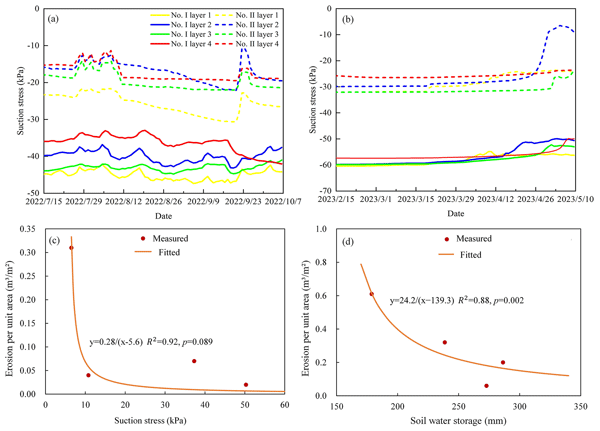
Soil loss results from the hydrological and hydromechanical responses. The soil loss intensity theoretically relates to the soil water storage and the suction stress. This work contributes to exhibiting the close relationship between erosion intensity in the bed and on the slope and the soil water storage and suction stress. The results of this work highlight that antecedent precipitation should be considered in predicting soil loss in the permanent gully rather than solely from rainfall amount.
Chao Ma, Shoupeng Wang, Dongshuo Zheng, Yan Zhang, Jie Tang, Yanru Wen, and Jie Dong
EGUsphere, https://doi.org/10.5194/egusphere-2024-795, https://doi.org/10.5194/egusphere-2024-795, 2024
Preprint archived
Short summary
Short summary
In the study domain of soil and water conservation, the prediction of gravitational mass-wasting is often not satisfied. In fact, they occur by the mechanics of soil strength decrease due to water infiltration. Alternatively, this work adopts some basic concepts of Unsaturated Soil Mechanics, together with the field observations of soil moisture, rainfall records and temperature, to examine the potential relationship between erosion intensity and hydrological and hydro-mechanical response.
Yanglin Guo and Chao Ma
Hydrol. Earth Syst. Sci., 27, 1667–1682, https://doi.org/10.5194/hess-27-1667-2023, https://doi.org/10.5194/hess-27-1667-2023, 2023
Short summary
Short summary
In a localized area with the same vegetation, an overwhelming propensity of shallow landslides on the south-facing slope over the north-facing slope could not be attributed to plant roots. We provide new evidence from the pore water pressure of failing mass, unsaturated hydraulic conductivity, water storage, and drainage and the hillslope stability fluctuation to prove that the infinite slope model may be suitable for elucidating the aspect-dependent landslide distribution in the study area.
Cited articles
An, J., Gao, G., Yuan, C., Pinos, J., and Fu, B.: Inter- and intra-event rainfall partitioning dynamics of two typical xerophytic shrubs in the Loess Plateau of China, Hydrol. Earth Syst. Sci., 26, 3885–3900, https://doi.org/10.5194/hess-26-3885-2022, 2022.
Bachmair, S., Weiler, M., and Troch, P. A.: Intercomparing hillslope hydrological dynamics: spatio-temporal variability and vegetation cover effects, Water Resour. Res., 48, W5537, https://doi.org/10.1029/2011WR011196, 2012.
Bai, R., Wang, X., Li, J., Yang, F., Shangguan, Z., and Deng, L.: The impact of vegetation reconstruction on soil erosion in the loess plateau, J. Environ. Manage., 363, 121382, https://doi.org/10.1016/j.jenvman.2024.121382, 2024.
Borrelli, P., Robinson, D. A., Panagos, P., Lugato, E., Yang, J. E., Alewell, C., Wuepper, D., Montanarella, L., and Ballabio, C.: Land use and climate change impacts on global soil erosion by water (2015–2070), P. Natl. Acad. Sci. USA, 117, 21994–22001, https://doi.org/10.1073/pnas.2001403117, 2020.
Cai, L., Wang, F., Lin, Y., Long, Q., Zhao, Y., Han, J., Ge, W., and Chen, H.: Changes in preferential flow caused by root effects in black locust plantations of different stand ages in the semi-arid region of the loess plateau, J. Hydrol., 634, 131086, https://doi.org/10.1016/j.jhydrol.2024.131086, 2024.
Chen, M., Yang, X., Zhang, X., Bai, Y., Shao, M., Wei, X., Jia, Y., Wang, Y., Jia, X., Zhu, Y., Zhang, Q., Zhu, X., and Li, T.: Response of soil water to long-term revegetation, topography, and precipitation on the chinese loess plateau, Catena, 236, 107711, https://doi.org/10.1016/j.catena.2023.107711, 2024.
Deng, J., Ma, C., and Zhang, Y.: Shallow landslide characteristics and its response to vegetation by example of july 2013, extreme rainstorm, central loess plateau, china, B. Eng. Geol. Environ., 81, 100, https://doi.org/10.1007/s10064-022-02606-1, 2022.
Dibiagio, A., Capobianco, V., Oen, A., and Tallaksen, L. M.: State-of-the-art: parametrization of hydrological and mechanical reinforcement effects of vegetation in slope stability models for shallow landslides, Landslides, 21, 2417–2446, https://doi.org/10.1007/s10346-024-02300-1, 2024.
Du, P., Chen, Y., Zhao, Y., Qu, L., Liu, H., Liu, Z., Xu, J., and Tian, X.: Formation process and depositional characteristics of mudballs in the loess plateau during extreme rainstorms: dual-threshold constraints on material sources and dynamic conditions, J. Environ. Manage., 391, 126590, https://doi.org/10.1016/j.jenvman.2025.126590, 2025.
Fan, L., Lehmann, P., Zheng, C., and Or, D.: Rainfall intensity temporal patterns affect shallow landslide triggering and hazard evolution, Geophys. Res. Lett., 47, e2019GL085994, https://doi.org/10.1029/2019GL085994, 2020.
Feng, X., Fu, B., Piao, S., Wang, S., Ciais, P., Zeng, Z., Lü, Y., Zeng, Y., Li, Y., Jiang, X., and Wu, B.: Revegetation in china's loess plateau is approaching sustainable water resource limits, Nat. Clim. Change, 6, 1019–1022, https://doi.org/10.1038/nclimate3092, 2016.
Franklin, S. M., Kravchenko, A. N., Vargas, R., Vasilas, B., Fuhrmann, J. J., and Jin, Y.: The unexplored role of preferential flow in soil carbon dynamics, Soil Biol. Biochem., 161, 108398, https://doi.org/10.1016/j.soilbio.2021.108398, 2021.
Fu, B., Wang, S., Liu, Y., Liu, J., Liang, W., and Miao, C.: Hydrogeomorphic ecosystem responses to natural and anthropogenic changes in the loess plateau of china, Annu. Rev. Earth Pl. Sc., 45, 223–243, https://doi.org/10.1146/annurev-earth-063016-020552, 2016.
Ghestem, M. and Sidle, R.: The influence of plant root systems on subsurface flow: implications for slope stability, Bioscience, 61, 869–879, https://doi.org/10.1525/bio.2011.61.11.6, 2011.
Gong, C., Ni, D., Liu, Y., Li, Y., Huang, Q., Tian, Y., and Zhang, H.: Herbaceous vegetation in slope stabilization: a comparative review of mechanisms, advantages, and practical applications, Sustainability-Basel, 16, 7620, https://doi.org/10.3390/su16177620, 2024.
Gu, C., Mu, X., Gao, P., Zhao, G., Sun, W., Tatarko, J., and Tan, X.: Influence of vegetation restoration on soil physical properties in the loess plateau, china, J. Soil. Sediment., 19, 716–728, https://doi.org/10.1007/s11368-018-2083-3, 2019.
Guan, N., Bi, H., Song, Y., Lu, S., Lin, D., and Han, J.: Vegetation restoration is affecting the characteristics and patterns of infiltration in the loess plateau, Catena, 243, 108190, https://doi.org/10.1016/j.catena.2024.108190, 2024.
Gyssels, G., Poesen, J., Bochet, E., and Li, Y.: Impact of plant roots on the resistance of soils to erosion by water: a review, Prog. Phys. Geog., 29, 189–217, https://doi.org/10.1191/0309133305pp443ra, 2005.
Hao, M., Jin, Z., Luo, D., Cao, G., Jiang, C., Han, H., Yang, S., and Zhang, J.: Rainstorm erosion difference and topographical changes induced by heavy rainfall between afforestation and grassland restoration catchments on the chinese loess plateau, Geomorphology, 457, 109243, https://doi.org/10.1016/j.geomorph.2024.109243, 2024.
Hu, J., Ren, Y., Tang, M., Zhang, Z., Yang, K., Zhen, Q., and Han, F.: Effects of vegetation restoration on infiltration patterns and preferential flow in semi-arid areas with shallowly buried soft bedrock (pisha sandstone) in china, J. Hydrol., 661, 133546, https://doi.org/10.1016/j.jhydrol.2025.133546, 2025.
Lan, H., Zhao, X., Macciotta, R., Peng, J., Li, L., Wu, Y., Zhu, Y., Liu, X., Zhang, N., and Liu, S.: The cyclic expansion and contraction characteristics of a loess slope and implications for slope stability., Sci. Rep., 11, 2250, https://doi.org/10.1038/s41598-021-81821-4, 2021.
Lann, T., Bao, H., Lan, H., Zheng, H., Yan, C., and Peng, J.: Hydro-mechanical effects of vegetation on slope stability: a review, Sci. Total Environ., 926, 171691, https://doi.org/10.1016/j.scitotenv.2024.171691, 2024.
Laycock, W. A.: Distribution of roots and rhizomes in different soil types in the pine barrens of New Jersey, U.S. Geological Survey Professional Paper 563-C, Washington, https://doi.org/10.3133/pp563C, 1967.
Li, F., Song, X., Tang, C., Liu, C., Yu, J., and Zhang, W.: Tracing infiltration and recharge using stable isotope in taihang mt., North china, Environ. Geol., 53, 687–696, https://doi.org/10.1007/s00254-007-0683-0, 2007.
Li, J., Cui, P., and Yin, Y.: Field observation and micro-mechanism of roots-induced preferential flow by infiltration experiment and phase-field method, J. Hydrol., 623, 129756, https://doi.org/10.1016/j.jhydrol.2023.129756, 2023.
Li, S., Zheng, C., Lu, T., Zhou, K., Gu, Y., Wang, B., and Lu, Y.: Characteristics and influencing factors of loess terraces' preferential flow under different typical vegetation cover, Plant Soil, 515, 2135–2153, https://doi.org/10.1007/s11104-025-07710-1, 2025.
Liang, H., Li, Y., An, X., Liu, J., Pan, N., and Li, Z.: Soil moisture dynamics and its temporal stability under different-aged caragana korshinskii shrubs in the loess hilly region of china, Water-Sui, 15, 2334, https://doi.org/10.3390/w15132334, 2023.
Liao, J., Wang, J., Jiao, J., Yan, Z., Li, J., Zhang, Z., Li, M., Xu, Q., Jiang, X., Zhao, W., Ling, Q., Sheng, H., Chen, Y., and Wu, T.: Rusle tends to overestimate soil erosion in revegetated conditions: evidence from long-term runoff plots monitoring on china's loess plateau, Catena, 258, 109285, https://doi.org/10.1016/j.catena.2025.109285, 2025.
Lin, Y., Jian, W., Wu, Y., Zhu, Z., Wang, H., Dou, H., and Lai, Z.: Effect of tree roots on heavy rainfall-induced shallow landslides, Geomat. Nat. Haz. Risk, 15, 2360002, https://doi.org/10.1080/19475705.2024.2360002, 2024.
Liu, X., Feng, T., Zhang, Y., Liu, Y., and Wang, P.: Vegetation restoration affects soil hydrological processes in typical natural and planted forests on the loess plateau, J. Hydrol., 650, 132465, https://doi.org/10.1016/j.jhydrol.2024.132465, 2025.
Löbmann, M. T., Geitner, C., Wellstein, C., and Zerbe, S.: The influence of herbaceous vegetation on slope stability – a review, Earth-Sci. Rev., 209, 103328, https://doi.org/10.1016/j.earscirev.2020.103328, 2020.
L Lu, N. and Godt, J. W. (Eds.): Hillslope hydrology and stability, Cambridge University Press, Cambridge, UK, ISBN 10 1107021065, 2013.
Lu, N., Calderon, A. R. A., Wayllace, A., Lovekin, J., and Crandall, A.: Suction stress–based rainfall intensity–duration method for slope instability prediction, J. Geotech. Geoenviron., 150, 4024069, https://doi.org/10.1061/JGGEFK.GTENG-12597, 2024.
Masi, E. B., Tofani, V., Rossi, G., Cuomo, S., Wu, W., Salciarini, D., Caporali, E., and Catani, F.: Effects of roots cohesion on regional distributed slope stability modelling, Catena, 222, 106853, https://doi.org/10.1016/j.catena.2022.106853, 2023.
Montgomery, D. R. and Dietrich, W. E.: A physically based model for the topographic control on shallow landsliding, Water Resour. Res., 30, 1153–1171, https://doi.org/10.1029/93WR02979, 1994a.
Montgomery, D. R. and Dietrich, W. E.: Landscape dissection and drainage area-slope thresholds, in: Process Models and Theoretical Geomorphology, John Wiley & Sons, Chichester, 221–246, ISBN 10 0471941042, 1994b.
Montgomery, D. R., Schmidt, K. M., Greenberg, H. M., and Dietrich, W. E.: Forest clearing and regional landsliding, Geology, 28, 311–314, https://doi.org/10.1130/0091-7613(2000)28<311:FCARL>2.0.CO;2, 2000.
Nimmo, J. R., Perkins, K. S., Schmidt, K. M., Miller, D. M., Stock, J. D., and Singha, K.: Hydrologic characterization of desert soils with varying degrees of pedogenesis: 1. Field experiments evaluating plant-relevant soil water behavior, Vadose Zone J., 8, 480–495, https://doi.org/10.2136/vzj2008.0052, 2009.
Niu, F., Pan, C., and Cui, Y.: Experimental investigation to the effect of different land-use on rainfall infiltration runoff patterns and preferential flow distribution in the loess area of western shanxi province, Acta Ecologica Sinica, 43, 4144–4166, https://doi.org/10.5846/stxb202204130989, 2023.
Rajão, P., Berg, M., Cornelissen, J., and Dias, A.: The effects of leaf traits on litter rainfall interception with consequences for runoff and soil conservation, J. Ecol., 111, 2662–2675, https://doi.org/10.1111/1365-2745.14203, 2023.
Schwarz, M., Preti, F., Giadrossich, F., Lehmann, P., and Or, D.: Quantifying the role of vegetation in slope stability: a case study in tuscany (italy), Ecol. Eng., 36, 285–291, https://doi.org/10.1016/j.ecoleng.2009.06.014, 2010.
Sidle, R. C. and Bogaard, T. A.: Dynamic earth system and ecological controls of rainfall-initiated landslides, Earth-Sci. Rev., 159, 275–291, https://doi.org/10.1016/j.earscirev.2016.05.013, 2016.
Souza, L. F. T., Hirmas, D. R., Sullivan, P. L., Reuman, D. C., Kirk, M. F., Li, L., Ajami, H., Wen, H., Sarto, M. V. M., Loecke, T. D., Rudick, A. K., Rice, C. W., and Billings, S. A.: Root distributions, precipitation, and soil structure converge to govern soil organic carbon depth distributions, Geoderma, 437, 116569, https://doi.org/10.1016/j.geoderma.2023.116569, 2023.
Tang, B., Jiao, J., Zhang, Y., Chen, Y., Wang, N., and Bai, L.: The magnitude of soil erosion on hillslopes with different land use patterns under an extreme rainstorm on the northern loess plateau, china, Soil Till. Res., 204, 104716, https://doi.org/10.1016/j.still.2020.104716, 2020.
Tang, P., Zhang, J., Li, Y., Wei, G., Hu, Y., and Zhao, J.: Effects of extreme rainfall on the morphological characteristics and spatialdistribution of shallow landslides under different land use patterns in the loessregion of western shanxi province, northern china, Journal of Beijing Forestry University, 45, 109–117, https://doi.org/10.12171/j.1000-1522.20230070, 2023.
Wang, N. and Zhang, T.: Soil pore structure and its research methods: a review, Soil Water Res., 19, 1–24, https://doi.org/10.17221/64/2023-SWR, 2024.
Wang, R., Dong, Z., Zhou, Z., and Wang, P.: Temporal variation in preferential water flow during natural vegetation restoration on abandoned farmland in the loess plateau of china, Land, 8, 186, https://doi.org/10.3390/land8120186, 2019.
Wang, R., Dong, Z., Zhou, Z., Wang, N., Xue, Z., and Cao, L.: Effect of vegetation patchiness on the subsurface water distribution in abandoned farmland of the loess plateau, china, Sci. Total Environ., 746, 141416, https://doi.org/10.1016/j.scitotenv.2020.141416, 2020.
Wang, X., Ma, C., Lyu, L., and Zhang, Y.: Erosion characteristics of shallow landslides undervarious land-use conditions: an example of the caijiachuan landslide, Arid Zone Research, 41, 697–705, https://doi.org/10.13866/j.azr.2024.04.15, 2024.
Wang, Y., Dong, G., Qu, L., Wu, Z., Zhao, F., and Shao, C.: Ecosystem functioning of the loess plateau in china from vegetation restoration relied largely on climate, Forests, 14, 27, https://doi.org/10.3390/f14010027, 2022.
Wei, Y. Z., Yao, Z. H., Chong, X. L., Zhang, J. H., and Zhang, J.: Microstructure of unsaturated loess and its influence on strength characteristics, Sci. Rep., 12, 1502, https://doi.org/10.1038/s41598-022-05464-9, 2022.
Wen, S., Shao, M., and Wang, J.: Earthworm burrowing activity and its effects on soil hydraulic properties under different soil moisture conditions from the loess plateau, china, Sustainability-Basel, 12, 9303, https://doi.org/10.3390/su12219303, 2020.
Xiao, T., Li, P., Fei, W., and Wang, J.: Effects of vegetation roots on the structure and hydraulic properties of soils: a perspective review, Sci. Total Environ., 906, 167524, https://doi.org/10.1016/j.scitotenv.2023.167524, 2024.
Yamase, K., Ikeno, H., Hotta, N., Imawaka, M., Ohashi, M., Tanikawa, T., Todo, C., Dannoura, M., and Hirano, Y.: Effect of sprouting and corresponding root distribution of the shrub species eurya japonica on slope stability, Catena, 238, 107869, https://doi.org/10.1016/j.catena.2024.107869, 2024.
Yan, X., Nunes, J. P., Sun, J., Tang, D., Wen, Y., and Li, Z.: Restored vegetation dominates the decrease in surface and subsurface runoff on the loess plateau, J. Hydrol., 640, 131730, https://doi.org/10.1016/j.jhydrol.2024.131730, 2024.
Yang, B., Jiao, J., Ma, X., Zhao, W., Ling, Q., Zhang, X., Han, J., Du, P., Chen, Y., and Chen, H.: Distribution and formation of soil balls under heavy rainstorm conditions in the northern loess plateau, J. Hydrol., 625, 130103, https://doi.org/10.1016/j.jhydrol.2023.130103, 2023.
Yang, B., Ma, X., Jiao, J., Zhao, W., Ling, Q., Li, J., and Zhang, X.: Magnitude and hotspots of soil erosion types during heavy rainstorm events on the loess plateau: implications for watershed management, Catena, 246, 108365, https://doi.org/10.1016/j.catena.2024.108365, 2024.
Zhang, S., Liu, Y., Yang, M., Tian, P., Mu, X., and Zhao, G.: Impact of vegetation restoration on preferential flow and soil infiltration capacity in the hilly region of the loess plateau, Journal of Hydrology: Regional Studies, 59, 102333, https://doi.org/10.1016/j.ejrh.2025.102333, 2025.
Zhang, Y., Tang, Z., Zhang, J., Zhang, Z., and Zhang, M.: Visualizing preferential flow paths using dye tracer and species diversity theory methods to explore their correlation to soil properties with random forest algorithm, J. Hydrol., 638, 131570, https://doi.org/10.1016/j.jhydrol.2024.131570, 2024.
Zhao, M., Li, D., Huang, Y., Deng, Y., Yang, G., Lei, T., and Huang, Y.: Soil matrix infiltration characteristics in differently aged eucalyptus plantations in a southern subtropical area in china, Catena, 217, 106490, https://doi.org/10.1016/j.catena.2022.106490, 2022.
Zhou, Q., Zhou, X., Luo, Y., and Cai, M.: The effects of litter layer and topsoil on surface runoff during simulated rainfall in guizhou province, china: a plot scale case study, Water-Sui, 10, 915, https://doi.org/10.3390/w10070915, 2018.
Short summary
We carried out a series of field studies on woodland and shrubland slopes on China’s Loess Plateau. We found that woodland slopes allow water to move deeper into the ground, which helps them remain more stable, whereas shrubland slopes tend to hold more water near the surface and are more likely to fail. This means that landslides may play a bigger role in moving soil than previously thought, so soil loss on the Loess Plateau should be re-evaluated rather than linked only to surface runoff.
We carried out a series of field studies on woodland and shrubland slopes on China’s Loess...