Articles | Volume 30, issue 5
https://doi.org/10.5194/hess-30-1381-2026
© Author(s) 2026. This work is distributed under
the Creative Commons Attribution 4.0 License.
https://doi.org/10.5194/hess-30-1381-2026
© Author(s) 2026. This work is distributed under
the Creative Commons Attribution 4.0 License.
Extreme drought–accelerated dissolved carbon metabolism triggers pulsed CO2 outgassing in karst lakes

Maofei Ni
College of Eco-Environmental Engineering, Guizhou Minzu University, Guiyang 550025, China
Weijun Luo
State Key Laboratory of Environmental Geochemistry, Institute of Geochemistry, Chinese Academy of Sciences, Guiyang, 550081, China
Junbing Pu
Karst Research Team, Chongqing Key Laboratory of Carbon cycle and Carbon regulation of Mountain Ecosystem, School of Geography and Tourism, Chongqing Normal University, Chongqing, 401331, China
Guangneng Zeng
CORRESPONDING AUTHOR
College of Eco-Environmental Engineering, Guizhou Minzu University, Guiyang 550025, China
Jinxiao Long
College of Eco-Environmental Engineering, Guizhou Minzu University, Guiyang 550025, China
Jia Chen
State Key Laboratory of Environmental Geochemistry, Institute of Geochemistry, Chinese Academy of Sciences, Guiyang, 550081, China
Jing Zhang
Karst Research Team, Chongqing Key Laboratory of Carbon cycle and Carbon regulation of Mountain Ecosystem, School of Geography and Tourism, Chongqing Normal University, Chongqing, 401331, China
Xiaodan Wang
College of Eco-Environmental Engineering, Guizhou Minzu University, Guiyang 550025, China
Related authors
No articles found.
Yining Zang, Pauline C. Treble, Kei Yoshimura, Jayson Gabriel Pinza, Fengbo Zhang, Kübra Özdemir Çallı, Xiaojun Mei, Admin Husic, Alena Gessert, Andrej Stroj, Bartolomé Andreo, Bernard Ladouche, Christine Stumpp, Diana Mance, Eleni Zagana, Fen Huang, Giuseppe Sappa, Harald Kunstmann, Heike Brielmann, Hong Zhou, Huaying Wu, Jakob Garvelmann, James Berglund, Jean-Baptiste Charlier, Jens Lange, Juan Antonio Barberá Fornell, Junbing Pu, Konstantina Katsanou, Kun Ren, Laura Toran, Laurence Gill, Maria Filippini, Martin Kralik, Matías Mudarra Martínez, Min Zhao, Mingming Luo, Nico Goldscheider, Nikolaos Lambrakis, Pantaleone De Vita, Qiong Xiao, Shi Yu, Silvia Iacurto, Silvio Coda, Ted McCormack, Vincenzo Allocca, W. George Darling, Walter D’Alessandro, Xulei Guo, Yundi Hu, Zhijun Wang, Eva Kaminsky, Jiří Faimon, Marek Lang, Pavel Pracný, and Andreas Hartmann
Earth Syst. Sci. Data Discuss., https://doi.org/10.5194/essd-2025-812, https://doi.org/10.5194/essd-2025-812, 2026
Preprint under review for ESSD
Short summary
Short summary
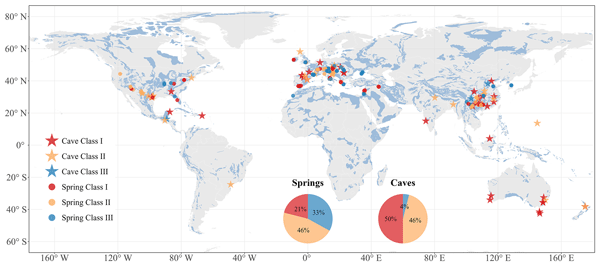
We developed the first global database of water from karst springs and cave drips that records different forms of oxygen and hydrogen, which naturally trace how rainwater moves through rocks. By gathering and checking thousands of measurements from around the globe and linking them with flow and rainfall data, the database provides a comprehensive view of water movement, allows scientists to compare regions, understand groundwater processes, and support sustainable water management worldwide.
Cited articles
American Public Health Association (APHA): Standard Methods for the Examination of Water and Wastewater, 16th edition, American Public Health Association, Washington, DC, 1268 pp., ISBN 0875531318, 1985.
An, Y., Hou, Y., Wu, Q., Qing, L., and Li, L.: Chemical weathering and CO2 consumption of a high-erosion-rate karstic river: a case study of the Sanchahe River, southwest China, Chin. J. Geochem., 34, 601–609, https://doi.org/10.1007/s11631-015-0074-2, 2015.
Binet, S., Probst, J. L., Batiot, C., Seidel, J. L., Emblanch, C., Peyraube, N., Charlier, J. B., Bakalowicz, M., and Probst, A.: Global warming and acid atmospheric deposition impacts on carbonate dissolution and CO2 fluxes in French karst hydrosystems: Evidence from hydrochemical monitoring in recent decades, Geochim. Cosmochim. Ac., 270, 184–200, https://doi.org/10.1016/j.gca.2019.11.021, 2020.
Bogard, M. J., Kuhn, C. D., Johnston, S. E., Striegl, R. G., Holtgrieve, G. W., Dornblaser, M. M., Spencer, R. G. M., Wickland, K. P., and Butman, D. E.: Negligible cycling of terrestrial carbon in many lakes of the arid circumpolar landscape, Nat. Geosci., 12, 180–185, https://doi.org/10.1038/s41561-019-0299-5, 2019.
Borges, A. V., Deirmendjian, L., Bouillon, S., Okello, W., Lambert, T., Roland, F. A. E., Razanamahandry, V. F., Voarintsoa, N. R. G., Darchambeau, F., Kimirei, I. A., Descy, J.-P., Allen, G. H., and Morana, C.: Greenhouse gas emissions from African lakes are no longer a blind spot, Sci. Adv., 8, eabi8716, https://doi.org/10.1126/sciadv.abi8716, 2022.
Cao, J., Wu, X., Huang, F., Hu, B., Groves, C., Yang, H., and Zhang, C.: Global significance of the carbon cycle in the karst dynamic system: evidence from geological and ecological processes, Chin. Geol., 1, 17–27, 2018.
Chen, H., Ju, P., Zhu, Q., Xu, X., Wu, N., Gao, Y., Feng, X., Tian, J., Niu, S., Zhang, Y., Peng, C., and Wang, Y.: Carbon and nitrogen cycling on the Qinghai–Tibetan Plateau, Nat. Rev. Earth Environ., 3, 701–716, https://doi.org/10.1038/s43017-022-00344-2, 2022.
Chen, L., Tan, L., Zhao, M., Sinha, A., Wang, T., and Gao, Y.: Karst carbon sink processes and effects: A review, Quatern. Int., 652, 63–73, https://doi.org/10.1016/j.quaint.2023.02.009, 2023.
D'Ettorre, U. S., Liso, I. S., and Parise, M.: Desertification in karst areas: A review, Earth-Sci. Rev., 253, 104786, https://doi.org/10.1016/j.earscirev.2024.104786, 2024.
Drake, T. W., Podgorski, D. C., Dinga, B., Chanton, J. P., Six, J., and Spencer, R. G. M.: Land-use controls on carbon biogeochemistry in lowland streams of the Congo Basin, Glob. Change Biol., 26, 1374–1389, https://doi.org/10.1111/gcb.14889, 2020.
Evans, C. D., Futter, M. N., Moldan, F., Valinia, S., Frogbrook, Z., and Kothawala, D. N.: Variability in organic carbon reactivity across lake residence time and trophic gradients, Nat. Geosci., 10, 832–835, https://doi.org/10.1038/ngeo3051, 2017.
Guo, Y., Gu, S., Wu, K., Tanentzap, A. J., Yu, J., Liu, X., Li, Q., He, P., Qiu, D., Deng, Y., Wang, P., Wu, Z., and Zhou, Q.: Temperature-mediated microbial carbon utilization in China's lakes, Glob. Change Biol., 29, 5044–5061, https://doi.org/10.1111/gcb.16840, 2023.
Harjung, A., Ejarque, E., Battin, T., Butturini, A., Sabater, F., Stadler, M., and Schelker, J.: Experimental evidence reveals impact of drought periods on dissolved organic matter quality and ecosystem metabolism in subalpine streams, Limnol. Oceanogr., 64, 46–60, https://doi.org/10.1002/lno.11018, 2019.
He, H., Wang, Y., Liu, Z., Bao, Q., Wei, Y., Chen, C., and Sun, H.: Lake metabolic processes and their effects on the carbonate weathering CO2 sink: Insights from diel variations in the hydrochemistry of a typical karst lake in SW China, Water Res., 222, 118907, https://doi.org/10.1016/j.watres.2022.118907, 2022a.
He, H., Liu, Z., Li, D., Liu, X., Han, Y., Sun, H., Zhao, M., Shao, M., Shi, L., Hao, P., and Lai, C.: Effects of carbon limitation and carbon fertilization on karst lake-reservoir productivity, Water Res., 261, 122036, https://doi.org/10.1016/j.watres.2024.122036, 2024.
He, Q., Xiao, Q., Fan, J., Zhao, H., Cao, M., Zhang, C., and Jiang, Y.: The impact of heterotrophic bacteria on recalcitrant dissolved organic carbon formation in a typical karstic river, Sci. Total Environ., 815, 152576, https://doi.org/10.1016/j.scitotenv.2021.152576, 2022b.
Hu, A., Choi, M., Tanentzap, A. J., Liu, J., Jang, K.-S., Lennon, J. T., Liu, Y., Soininen, J., Lu, X., Zhang, Y., Shen, J., and Wang, J.: Ecological networks of dissolved organic matter and microorganisms under global change, Nat. Commun., 13, 3600, https://doi.org/10.1038/s41467-022-31251-1, 2022.
Hu, J., Kang, L., Li, Z., Feng, X., Liang, C., Wu, Z., Zhou, W., Liu, X., Yang, Y., and Chen, L.: Photo-produced aromatic compounds stimulate microbial degradation of dissolved organic carbon in thermokarst lakes, Nat. Commun., 14, 3681, https://doi.org/10.1038/s41467-023-39432-2, 2023.
Kellerman, A. M., Dittmar, T., Kothawala, D. N., and Tranvik, L. J.: Chemodiversity of dissolved organic matter in lakes driven by climate and hydrology, Nat. Commun., 5, 3804, https://doi.org/10.1038/ncomms4804, 2014.
Leles, S. G. and Levine, N. M.: Mechanistic constraints on the trade-off between photosynthesis and respiration in response to warming, Sci. Adv., 9, eadh8043, https://doi.org/10.1126/sciadv.adh8043, 2023.
Li, X., Wang, J., Lin, J., Yin, W., Shi, Y. Y., Wang, L., Xiao, H. B., Zhong, Z. M., Jiang, H., and Shi, Z. H.: Hysteresis analysis reveals dissolved carbon concentration – discharge relationships during and between storm events, Water Res., 226, 119220, https://doi.org/10.1016/j.watres.2022.119220, 2022a.
Li, Y., Zhou, Y., Zhou, L., Zhang, Y., Xu, H., Jang, K.-S., Kothawala, D. N., Spencer, R. G. M., Jeppesen, E., Brookes, J. D., Davidson, T. A., and Wu, F.: Changes in water chemistry associated with rainstorm events increase carbon emissions from the inflowing river mouth of a major drinking water reservoir, Environ. Sci. Technol., 56, 16494–16505, https://doi.org/10.1021/acs.est.2c06405, 2022b.
Li, Y., Zhu, D., Niu, L., Zhang, W., Wang, L., Zhang, H., Zou, S., and Zhou, C.: Carbon-fixing bacteria in diverse groundwaters of karst area: Distribution patterns, ecological interactions, and driving factors, Water Res., 261, 121979, https://doi.org/10.1016/j.watres.2024.121979, 2024.
Lindström, E. S. and Bergström, A.-K.: Influence of inlet bacteria on bacterioplankton assemblage composition in lakes of different hydraulic retention time, Limnol. Oceanogr., 49, 125–136, https://doi.org/10.4319/lo.2004.49.1.0125, 2004.
Liu, S., Butman, D. E., and Raymond, P. A.: Evaluating CO2 calculation error from organic alkalinity and pH measurement error in low ionic strength freshwaters, Limnol. Oceanogr.-Meth., 18, 606–622, https://doi.org/10.1002/lom3.10388, 2020.
Liu, Z., Dreybrodt, W., and Wang, H.: A new direction in effective accounting for the atmospheric CO2 budget: Considering the combined action of carbonate dissolution, the global water cycle and photosynthetic uptake of DIC by aquatic organisms, Earth-Sci. Rev., 99, 162–172, https://doi.org/10.1016/j.earscirev.2010.03.001, 2010.
Liu, Z., Macpherson, G. L., Groves, C., Martin, J. B., Yuan, D., and Zeng, S.: Large and active CO2 uptake by coupled carbonate weathering, Earth-Sci. Rev., 182, 42–49, https://doi.org/10.1016/j.earscirev.2018.05.007, 2018.
Maberly, S. C., Barker, P. A., Stott, A. W., and De Ville, M. M.: Catchment productivity controls CO2 emissions from lakes, Nat. Clim. Change, 3, 391–394, https://doi.org/10.1038/nclimate1748, 2013.
Mendonça, R., Müller, R. A., Clow, D., Verpoorter, C., Raymond, P., Tranvik, L. J., and Sobek, S.: Organic carbon burial in global lakes and reservoirs, Nat. Commun., 8, 1694, https://doi.org/10.1038/s41467-017-01789-6, 2017.
Monteith, D. T., Henrys, P. A., Hruška, J., de Wit, H. A., Krám, P., Moldan, F., Posch, M., Räike, A., Stoddard, J. L., Shilland, E. M., Pereira, M. G., and Evans, C. D.: Long-term rise in riverine dissolved organic carbon concentration is predicted by electrolyte solubility theory, Sci. Adv., 9, eade3491, https://doi.org/10.1126/sciadv.ade3491, 2023.
Mu, C., Mu, M., Wu, X., Jia, L., Fan, C., Peng, X., Ping, C.-L., Wu, Q., Xiao, C., and Liu, J.: High carbon emissions from thermokarst lakes and their determinants in the Tibet Plateau, Glob. Change Biol., 29, 2732–2745, https://doi.org/10.1111/gcb.16658, 2023.
Ni, M., Ma, Y., Wang, Z., Wang, X., and Zhu, S.: A distinctive mode of dissolved organic carbon biodegradation in karst lakes and reservoirs: Evidence from trophic controls and compositional transformations, J. Clean. Prod., 368, 133217, https://doi.org/10.1016/j.jclepro.2022.133217, 2022.
Ni, M., Liu, R., Luo, W., Pu, J., Zhang, J., and Wang, X.: Unexpected shifts of dissolved carbon biogeochemistry caused by anthropogenic disturbances in karst rivers, Water Res., 247, 120744, https://doi.org/10.1016/j.watres.2023.120744, 2023.
Ni, M., Liu, R., Luo, W., Pu, J., Wu, S., Wang, Z., Zhang, J., Wang, X., and Ma, Y.: A comprehensive conceptual framework for signaling in-lake CO2 through dissolved organic matter, Water Res., 264, 122228, https://doi.org/10.1016/j.watres.2024.122228, 2024.
Ni, M. F., Li, S. Y., Luo, J. C., and Lu, X. X.: CO2 partial pressure and CO2 degassing in the Daning River of the upper Yangtze River, China, J. Hydrol., 569, 483–494, https://doi.org/10.1016/j.jhydrol.2018.12.017, 2019.
Ohno, T.: Fluorescence inner-filtering correction for determining the humification index of dissolved organic matter, Environ. Sci. Technol., 36, 742–746, https://doi.org/10.1021/es0155276, 2002.
Pi, X., Luo, Q., Feng, L., Xu, Y., Tang, J., Liang, X., Ma, E., Cheng, R., Fensholt, R., Brandt, M., Cai, X., Gibson, L., Liu, J., Zheng, C., Li, W., and Bryan, B. A.: Mapping global lake dynamics reveals the emerging roles of small lakes, Nat. Commun., 13, 5777, https://doi.org/10.1038/s41467-022-33239-3, 2022.
Raymond, P. A. and Hamilton, S. K.: Anthropogenic influences on riverine fluxes of dissolved inorganic carbon to the oceans, Limnol. Oceanogr. Lett., 3, 143–155, https://doi.org/10.1002/lol2.10069, 2018.
Raymond, P. A., Hartmann, J., Lauerwald, R., Sobek, S., McDonald, C., Hoover, M., Butman, D., Striegl, R., Mayorga, E., Humborg, C., Kortelainen, P., Durr, H., Meybeck, M., Ciais, P., and Guth, P.: Global carbon dioxide emissions from inland waters, Nature, 503, 355–359, https://doi.org/10.1038/nature12760, 2013.
Rehn, L., Sponseller, R. A., Laudon, H., and Wallin, M. B.: Long-term changes in dissolved inorganic carbon across boreal streams caused by altered hydrology, Limnol. Oceanogr., 68, 409–423, https://doi.org/10.1002/lno.12282, 2023.
Rodríguez-Cardona, B. M., Houle, D., Couture, S., Lapierre, J.-F., and del Giorgio, P. A.: Long-term trends in carbon and color signal uneven browning and terrestrialization of northern lakes, Commun. Earth Environ., 4, 338, https://doi.org/10.1038/s43247-023-00999-9, 2023.
Serikova, S., Pokrovsky, O. S., Laudon, H., Krickov, I. V., Lim, A. G., Manasypov, R. M., and Karlsson, J.: High carbon emissions from thermokarst lakes of Western Siberia, Nat. Commun., 10, 1552, https://doi.org/10.1038/s41467-019-09592-1, 2019.
Shangguan, Q., Payn, R. A., Hall Jr., R. O., Young, F. L., Valett, H. M., and DeGrandpre, M. D.: Divergent metabolism estimates from dissolved oxygen and inorganic carbon: Implications for river carbon cycling, Limnol. Oceanogr., 69, 2211–2228, https://doi.org/10.1002/lno.12666, 2024.
Song, K., Wen, Z., Xu, Y., Yang, H., Lyu, L., Zhao, Y., Fang, C., Shang, Y., and Du, J.: Dissolved carbon in a large variety of lakes across five limnetic regions in China, J. Hydrol., 563, 143–154, https://doi.org/10.1016/j.jhydrol.2018.05.072, 2018.
Sun, H., Han, C., Liu, Z., Wei, Y., Ma, S., Bao, Q., Zhang, Y., and Yan, H.: Nutrient limitations on primary productivity and phosphorus removal by biological carbon pumps in dammed karst rivers: Implications for eutrophication control, J. Hydrol., 607, 127480, https://doi.org/10.1016/j.jhydrol.2022.127480, 2022.
Sun, P., He, S., Yu, S., Pu, J., Yuan, Y., and Zhang, C.: Dynamics in riverine inorganic and organic carbon based on carbonate weathering coupled with aquatic photosynthesis in a karst catchment, Southwest China, Water Res., 189, 116658, https://doi.org/10.1016/j.watres.2020.116658, 2021.
Tranvik, L. J., Downing, J. A., Cotner, J. B., Loiselle, S. A., Striegl, R. G., Ballatore, T. J., Dillon, P., Finlay, K., Fortino, K., Knoll, L. B., Kortelainen, P., Kutser, T., Larsen, S. H. H., Laurion, I., Leech, D. M., McCallister, S. L., McKnight, D. M., Melack, J. M., Overholt, E. P., Porter, J. A., Prairie, Y. T., Renwick, W. H., Roland, F., Sherman, B., Schindler, D. W., Sobek, S., Tremblay, A., Vanni, M. J., Verschoor, A. M., von Wachenfeldt, E., and Weyhenmeyer, G. A.: Lakes and reservoirs as regulators of carbon cycling and climate, Limnol. Oceanogr., 54, 2298–2314, https://doi.org/10.4319/lo.2009.54.6_part_2.2298, 2009.
Tye, A. M., Williamson, J. L., Jarvie, H. P., Dise, N. B., Lapworth, D. J., Monteith, D., Sanders, R., Mayor, D. J., Bowes, M. J., Bowes, M., Burden, A., Callaghan, N., Farr, G., Felgate, S. L., Gibb, S., Gilbert, P. J., Hargreaves, G., Keenan, P., Kitidis, V., Jürgens, M. D., Martin, A., Mounteney, I., Nightingale, P. D., Gloria Pereira, M., Olszewska, J., Pickard, A., Rees, A. P., Spears, B., Stinchcombe, M., White, D., Williams, P., Worrall, F., and Evans, C. D.: Dissolved inorganic carbon export from rivers of Great Britain: Spatial distribution and potential catchment-scale controls, J. Hydrol., 615, 128677, https://doi.org/10.1016/j.jhydrol.2022.128677, 2022.
Wang, H., Zhang, Q., Chen, G., Li, X., Wang, Q., Gao, L., Wang, J., He, D., and Li, M.: The loss of dissolved organic matter from biological soil crust at various successional stages under rainfall of different intensities: Insights into the changes of molecular components at different rainfall stages, Water Res., 257, 121719, https://doi.org/10.1016/j.watres.2024.121719, 2024.
Wang, W., Li, S., Zhong, J., Slowinski, S., Li, S., Li, C., Su, J., Yi, Y., Dong, K., Xu, S., Van Cappellen, P., and Liu, C.: Carbonate mineral dissolution and photosynthesis-induced precipitation regulate inorganic carbon cycling along the karst river-reservoir continuum, SW China, J. Hydrol., 615, 128621, https://doi.org/10.1016/j.jhydrol.2022.128621, 2022.
Xi, N., Zhang, T., Zhao, W., Jia, Y., Fan, J., Li, R., Li, J., and Pu, J.: Metabolic processes drive spatio-temporal variations of carbon sink/source in a karst river, Environ. Res., 262, 119970, https://doi.org/10.1016/j.envres.2024.119970, 2024.
Xia, F., Liu, Z., Zhao, M., Li, Q., Li, D., Cao, W., Zeng, C., Hu, Y., Chen, B., Bao, Q., Zhang, Y., He, Q., Lai, C., He, X., Ma, Z., Han, Y., and He, H.: High stability of autochthonous dissolved organic matter in karst aquatic ecosystems: Evidence from fluorescence, Water Res., 220, 118723, https://doi.org/10.1016/j.watres.2022.118723, 2022.
Xu, H., Xiao, Q., Dai, Y., Chen, D., Zhang, C., Jiang, Y., and Xie, J.: Selected bacteria are critical for karst river carbon sequestration via integrating multi-omics and hydrochemistry data, Microb. Ecol., 86, 3043–3056, https://doi.org/10.1007/s00248-023-02307-6, 2023.
Xu, Y. Y., Pierrot, D., and Cai, W. J.: Ocean carbonate system computation for anoxic waters using an updated CO2SYS program, Mar. Chem., 195, 90–93, https://doi.org/10.1016/j.marchem.2017.07.002, 2017.
Yan, Z., Xin, Y., Zhong, X., Yi, Y., Li, P., Wang, Y., Zhou, Y., He, Y., He, C., Shi, Q., Xu, W., and He, D.: Evolution of dissolved organic nitrogen chemistry during transportation to the marginal sea: Insights from nitrogen isotope and molecular composition analyses, Water Res., 249, 120942, https://doi.org/10.1016/j.watres.2023.120942, 2024.
Yi, Y., Zhong, J., Bao, H., Mostofa, K. M. G., Xu, S., Xiao, H.-Y., and Li, S.-L.: The impacts of reservoirs on the sources and transport of riverine organic carbon in the karst area: A multi-tracer study, Water Res., 194, 116933, https://doi.org/10.1016/j.watres.2021.116933, 2021.
Yuan, Y., Liang, X., Li, Q., Deng, J., Zou, J., Li, G., Chen, G., Qin, W., and Dai, H.: Response of a source water quality through a heavy precipitation event: Nutrients, dissolved organic matter and their DBPs formation, J. Clean. Prod., 453, 142273, https://doi.org/10.1016/j.jclepro.2024.142273, 2024.
Zhang, W., Wang, W., Zhong, J., Chen, S., Yi, Y., Xu, X., Chen, S., and Li, S.: Carbon sequestration and decreased CO2 emission caused by biological carbon pump effect: Insights from diel hydrochemical variations in subtropical karst reservoirs, J. Hydrol., 632, 130909, https://doi.org/10.1016/j.jhydrol.2024.130909, 2024.
Zhao, R., Huang, S., Pu, J., He, Q., Wang, H., and Jiang, X.: Effects of rainfall on the karst-related carbon cycle due to carbonate rock weathering induced by H2SO4 and/or HNO3, J. Hydrol., 630, 130664, https://doi.org/10.1016/j.jhydrol.2024.130664, 2024.
Short summary
We captured an extreme drought and subsequent wet period, showing microbiomes track time-varying dissolved carbon metabolism and modulate carbon dioxide flux. Particularly, the drought boosts heterotrophs, accelerating dissolved organic carbon respiration and carbon dioxide emission. The biological carbon pump induces priming: rapid labile dissolved organic carbon loss but recalcitrant dissolved organic carbon accumulation, causing pulsed carbon dioxide after photosynthetic peaks.
We captured an extreme drought and subsequent wet period, showing microbiomes track time-varying...