
Articles | Volume 29, issue 23
https://doi.org/10.5194/hess-29-6935-2025
© Author(s) 2025. This work is distributed under
the Creative Commons Attribution 4.0 License.
the Creative Commons Attribution 4.0 License.
https://doi.org/10.5194/hess-29-6935-2025
© Author(s) 2025. This work is distributed under
the Creative Commons Attribution 4.0 License.
the Creative Commons Attribution 4.0 License.
Research article
| 
02 Dec 2025
Research article |
| 02 Dec 2025
| 02 Dec 2025
High-resolution snow water equivalent estimation: a data-driven method for localized downscaling of climate data
Institute of Earth Surface Dynamics, Faculty of Geosciences and Environment, University of Lausanne, Lausanne, Switzerland
Department of Environmental Science, Policy, and Management, University of California, Berkeley, Berkeley, CA, USA
Gregoire Mariethoz
Institute of Earth Surface Dynamics, Faculty of Geosciences and Environment, University of Lausanne, Lausanne, Switzerland
Manuela Girotto
Department of Environmental Science, Policy, and Management, University of California, Berkeley, Berkeley, CA, USA
Related authors
No articles found.
Harsh Beria, Lionel Benoit, Grégoire Mariethoz, Natalie Claire Ceperley, and Bettina Schaefli
EGUsphere, https://doi.org/10.5194/egusphere-2026-4249, https://doi.org/10.5194/egusphere-2026-4249, 2026
This preprint is open for discussion and under review for Hydrology and Earth System Sciences (HESS).
Short summary
Short summary
Mountain streams can rise within minutes of heavy rain, but much of the streamwater may have been stored underground for far longer. We combine hydrological measurements with stable water isotopes to simulate streamflow in a Swiss Alpine catchment. The simulations show that >80 % of summer streamflow came from groundwater, while direct rainfall contributions were small and brief. Fast stream rises therefore do not necessarily mean that rainwater moves quickly through the landscape.
Pau Wiersma, Jan Magnusson, Nadav Peleg, Bettina Schaefli, and Gregoire Mariethoz
Hydrol. Earth Syst. Sci., 30, 3331–3350, https://doi.org/10.5194/hess-30-3331-2026, https://doi.org/10.5194/hess-30-3331-2026, 2026
Short summary
Short summary
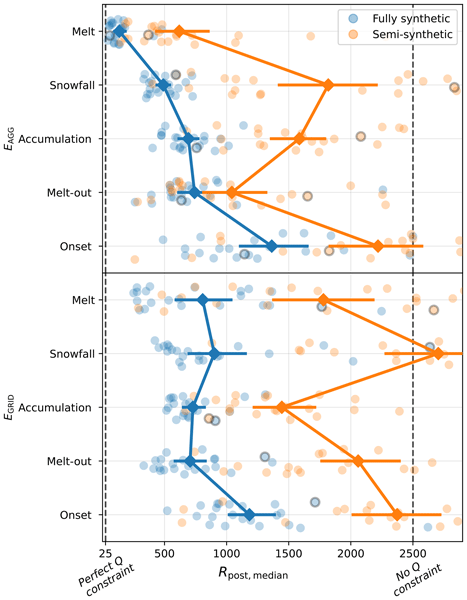
Streamflow observations contain information about snow, but their potential to constrain seasonal snow mass reconstructions remains underexplored. Using inverse hydrological modeling, we show that streamflow is particularly effective at constraining catchment-aggregated melt rates, but that non-uniqueness in the snow–streamflow relationship and uncertainties in the inverse modeling chain can easily limit inversion performance.
Steven A. Margulis, Maya Hildebrand, Xiaolan Xu, Manuela Girotto, Hans-Peter Marshall, Rashmi Shah, Elias Deeb, Simon Yueh, Dara Entekhabi, and Jessica Lundquist
EGUsphere, https://doi.org/10.5194/egusphere-2026-1594, https://doi.org/10.5194/egusphere-2026-1594, 2026
This preprint is open for discussion and under review for The Cryosphere (TC).
Short summary
Short summary
This paper demonstrates the feasibility of using a Bayesian framework for estimating snow water equivalent (SWE) from InSAR phase data at C-, L-, and P-band wavelengths. The Bayesian approach shows promise as a value-added approach to estimating SWE from phase delay measurements that are not only accurate at the measurement times, but interpolate between measurements and extrapolate beyond measurements and provide distributional (uncertainty) estimates for SWE.
Shima Azimi, Manuela Girotto, Riccardo Rigon, Gaia Roati, Silvia Barbetta, and Christian Massari
EGUsphere, https://doi.org/10.5194/egusphere-2026-793, https://doi.org/10.5194/egusphere-2026-793, 2026
Short summary
Short summary
Even ground-based precipitation observations, often considered the most reliable, can introduce substantial uncertainty into snow modeling due to sparse gauge coverage at high elevations in mountainous catchments.This challenge motivates the present study, in which we propose a data assimilation framework that integrates satellite-based snow depth into a hydrological model to correct snowfall estimates over the Italian Alps, with implications for water management in data-scarce mountain regions.
Francesco Avanzi, Stefano Terzi, Mariapina Castelli, Francesca Munerol, Margherita Andreaggi, Marta Galvagno, Andrea Galletti, Tessa Maurer, Christian Massari, Grace Carlson, Manuela Girotto, Giacomo Bertoldi, Edoardo Cremonese, Simone Gabellani, Umberto Morra di Cella, Marco Altamura, Lauro Rossi, and Luca Ferraris
EGUsphere, https://doi.org/10.22541/au.176055865.50800695/v2, https://doi.org/10.22541/au.176055865.50800695/v2, 2026
Short summary
Short summary
Snow droughts are periods with below-average snow accumulation and are becoming more frequent in a warming climate, yet their ecosystem and societal impacts remain poorly known. Using 13 years of data from 38 Italian catchments, we show that snow droughts reduced snow duration by ~50 %, doubled winter melt-out events, and cut summer runoff by ~50 %. Photosynthesis increased by up to 10 % due to earlier meltout. These events also caused widespread water-supply reductions, especially in foothills.
Leire Retegui-Schiettekatte, Manuela Girotto, Maike Schumacher, Mohammad Shamsudduha, Henrik Madsen, and Ehsan Forootan
EGUsphere, https://doi.org/10.5194/egusphere-2025-5625, https://doi.org/10.5194/egusphere-2025-5625, 2026
Short summary
Short summary
An improved method is used to integrate satellite-derived terrestrial water storage and surface soil moisture observations into a hydrological model within the Brahmaputra River basin (South Asia). This integration leads to a more realistic representation of the water stored in the land, allowing us to better understand its changes in space and time, which is crucial in this basin due to its increasing water demand and vulnerability to extreme events due to climate change.
Giulia Blandini, Francesco Avanzi, Lorenzo Campo, Simone Gabellani, Kristoffer Aalstad, Manuela Girotto, Satoru Yamaguchi, Hiroyuki Hirashima, and Luca Ferraris
The Cryosphere, 19, 4759–4783, https://doi.org/10.5194/tc-19-4759-2025, https://doi.org/10.5194/tc-19-4759-2025, 2025
Short summary
Short summary
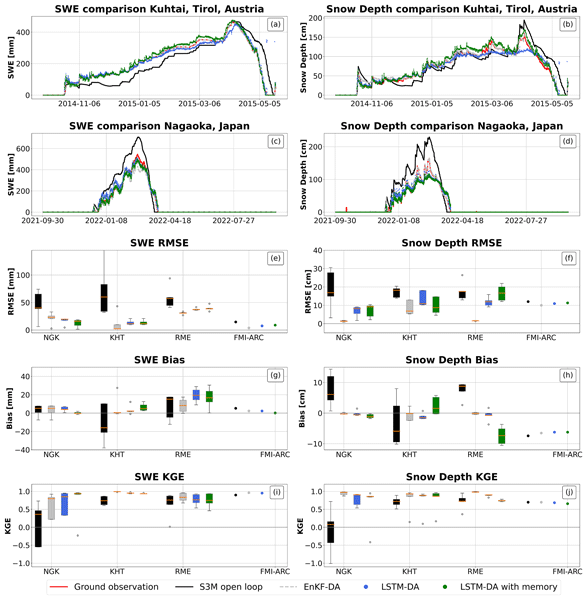
Reliable snow water equivalent and snow depth estimates are key for water management in snow regions. To tackle computational challenges in data assimilation, we propose a Long Short-Term Memory neural network for operational use in snow hydrology. Once trained, it reduces computational cost by 70 percent compared to the Ensemble Kalman Filter, with a slight decrease in performances. This deep learning approach provides a scalable, efficient, and cost-effective modeling solution for hydrology.
Mathieu Vrac, Denis Allard, Grégoire Mariéthoz, Soulivanh Thao, and Lucas Schmutz
Earth Syst. Dynam., 15, 735–762, https://doi.org/10.5194/esd-15-735-2024, https://doi.org/10.5194/esd-15-735-2024, 2024
Short summary
Short summary
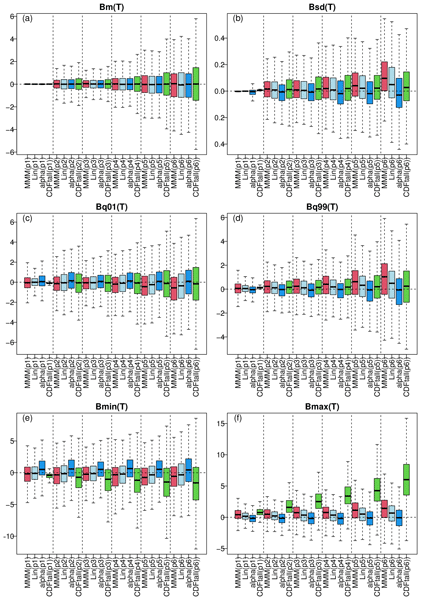
We aim to combine multiple global climate models (GCMs) to enhance the robustness of future projections. We introduce a novel approach, called "α pooling", aggregating the cumulative distribution functions (CDFs) of the models into a CDF more aligned with historical data. The new CDFs allow us to perform bias adjustment of all the raw climate simulations at once. Experiments with European temperature and precipitation demonstrate the superiority of this approach over conventional techniques.
Moctar Dembélé, Mathieu Vrac, Natalie Ceperley, Sander J. Zwart, Josh Larsen, Simon J. Dadson, Grégoire Mariéthoz, and Bettina Schaefli
Proc. IAHS, 385, 121–127, https://doi.org/10.5194/piahs-385-121-2024, https://doi.org/10.5194/piahs-385-121-2024, 2024
Short summary
Short summary
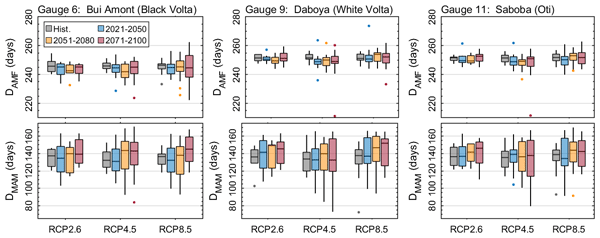
This study assesses the impact of climate change on the timing, seasonality and magnitude of mean annual minimum (MAM) flows and annual maximum flows (AMF) in the Volta River basin (VRB). Several climate change projection data are use to simulate river flow under multiple greenhouse gas emission scenarios. Future projections show that AMF could increase with various magnitude but negligible shift in time across the VRB, while MAM could decrease with up to 14 days of delay in occurrence.
Fabio Oriani, Gregoire Mariethoz, and Manuel Chevalier
Earth Syst. Sci. Data, 16, 731–742, https://doi.org/10.5194/essd-16-731-2024, https://doi.org/10.5194/essd-16-731-2024, 2024
Short summary
Short summary
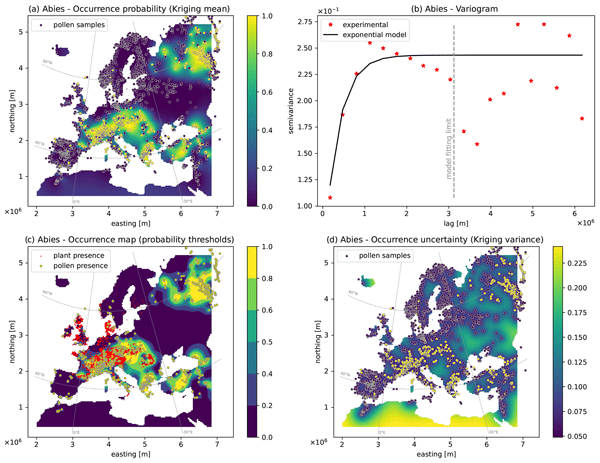
Modern and fossil pollen data contain precious information for reconstructing the climate and environment of the past. However, these data are only achieved for single locations with no continuity in space. We present here a systematic atlas of 194 digital maps containing the spatial estimation of contemporary pollen presence over Europe. This dataset constitutes a free and ready-to-use tool to study climate, biodiversity, and environment in time and space.
Mathieu Gravey and Grégoire Mariethoz
Geosci. Model Dev., 16, 5265–5279, https://doi.org/10.5194/gmd-16-5265-2023, https://doi.org/10.5194/gmd-16-5265-2023, 2023
Short summary
Short summary
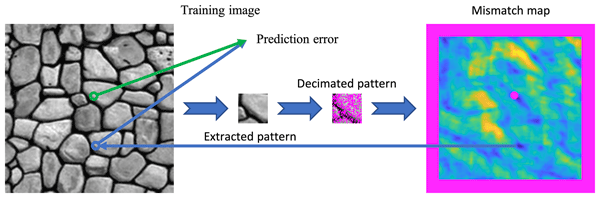
Multiple‐point geostatistics are widely used to simulate complex spatial structures based on a training image. The use of these methods relies on the possibility of finding optimal training images and parametrization of the simulation algorithms. Here, we propose finding an optimal set of parameters using only the training image as input. The main advantage of our approach is to remove the risk of overfitting an objective function.

Nadav Peleg, Herminia Torelló-Sentelles, Grégoire Mariéthoz, Lionel Benoit, João P. Leitão, and Francesco Marra
Nat. Hazards Earth Syst. Sci., 23, 1233–1240, https://doi.org/10.5194/nhess-23-1233-2023, https://doi.org/10.5194/nhess-23-1233-2023, 2023
Short summary
Short summary
Floods in urban areas are one of the most common natural hazards. Due to climate change enhancing extreme rainfall and cities becoming larger and denser, the impacts of these events are expected to increase. A fast and reliable flood warning system should thus be implemented in flood-prone cities to warn the public of upcoming floods. The purpose of this brief communication is to discuss the potential implementation of low-cost acoustic rainfall sensors in short-term flood warning systems.
Elias C. Massoud, Lauren Andrews, Rolf Reichle, Andrea Molod, Jongmin Park, Sophie Ruehr, and Manuela Girotto
Earth Syst. Dynam., 14, 147–171, https://doi.org/10.5194/esd-14-147-2023, https://doi.org/10.5194/esd-14-147-2023, 2023
Short summary
Short summary
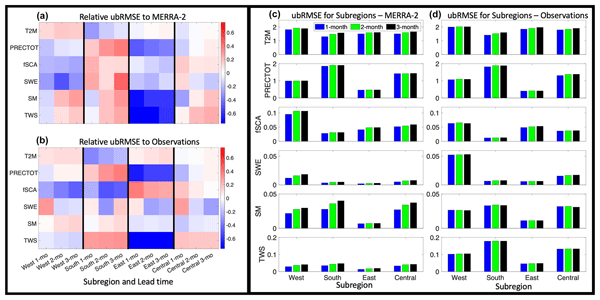
In this study, we benchmark the forecast skill of the NASA’s Goddard Earth Observing System subseasonal-to-seasonal (GEOS-S2S version 2) hydrometeorological forecasts in the High Mountain Asia (HMA) region. Hydrometeorological forecast skill is dependent on the forecast lead time, the memory of the variable within the physical system, and the validation dataset used. Overall, these results benchmark the GEOS-S2S system’s ability to forecast HMA hydrometeorology on the seasonal timescale.
Moctar Dembélé, Mathieu Vrac, Natalie Ceperley, Sander J. Zwart, Josh Larsen, Simon J. Dadson, Grégoire Mariéthoz, and Bettina Schaefli
Hydrol. Earth Syst. Sci., 26, 1481–1506, https://doi.org/10.5194/hess-26-1481-2022, https://doi.org/10.5194/hess-26-1481-2022, 2022
Short summary
Short summary
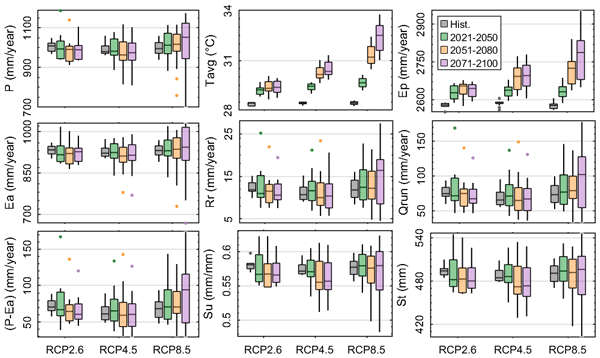
Climate change impacts on water resources in the Volta River basin are investigated under various global warming scenarios. Results reveal contrasting changes in future hydrological processes and water availability, depending on greenhouse gas emission scenarios, with implications for floods and drought occurrence over the 21st century. These findings provide insights for the elaboration of regional adaptation and mitigation strategies for climate change.
Cited articles
Abatzoglou, J. T.: Development of gridded surface meteorological data for ecological applications and modelling, Int. J. Climatol., 33, 121–131, 2013.
Abatzoglou, J. T. and Brown, T. J.: A comparison of statistical downscaling methods suited for wildfire applications, Int. J. Climatol., 32, 772–780, 2012.
Alonso-González, E., Aalstad, K., Pirk, N., Mazzolini, M., Treichler, D., Leclercq, P., Westermann, S., López-Moreno, J. I., and Gascoin, S.: Spatio-temporal information propagation using sparse observations in hyper-resolution ensemble-based snow data assimilation, Hydrol. Earth Syst. Sci., 27, 4637–4659, https://doi.org/10.5194/hess-27-4637-2023, 2023.
Bair, E. H., Rittger, K., Davis, R. E., Painter, T. H., and Dozier, J.: Validating reconstruction of snow water equivalent in California's Sierra Nevada using measurements from the NASA Airborne Snow Observatory, Water Resour. Res., 52, 8437–8460, 2016.
Bales, R. C., Molotch, N. P., Painter, T. H., Dettinger, M. D., Rice, R., and Dozier, J.: Mountain hydrology of the western United States, Water Resour. Res., 42, https://doi.org/10.1029/2005WR004387, 2006.
Belmecheri, S., Babst, F., Wahl, E. R., Stahle, D. W., and Trouet, V.: Multi-century evaluation of Sierra Nevada snowpack, Nat. Clim. Change, 6, 2–3, 2016.
Broxton, P., Zeng, X., and Dawson, N.: Daily 4 km Gridded SWE and Snow Depth from Assimilated In-Situ and Modeled Data over the Conterminous US, Version 1, NASA National Snow and Ice Data Center Distributed Active [data set], https://doi.org/10.5067/0GGPB220EX6A, 2019.
Caillouet, L., Vidal, J.-P., Sauquet, E., and Graff, B.: Probabilistic precipitation and temperature downscaling of the Twentieth Century Reanalysis over France, Clim. Past, 12, 635–662, https://doi.org/10.5194/cp-12-635-2016, 2016.
National Operational Hydrologic Remote Sensing Center: Snow Data Assimilation System (SNODAS) Data Products at NSIDC, Version 1, National Snow and Ice Data Center [data set], https://doi.org/10.7265/N5TB14TC, 2004.
Clow, D. W., Nanus, L., Verdin, K. L., and Schmidt, J.: Evaluation of SNODAS snow depth and snow water equivalent estimates for the Colorado Rocky Mountains, USA, Hydrol. Process., 26, 2583–2591, 2012.
Cover, T. and Hart, P.: Nearest neighbor pattern classification, IEEE T. Inform. Theory, 13, 21–27, 1967.
Dawadi, S. and Ahmad, S.: Changing climatic conditions in the Colorado River Basin: Implications for water resources management, J. Hydrol., 430, 127–141, 2012.
Dietz, A. J., Wohner, C., and Kuenzer, C.: European Snow Cover Characteristics between 2000 and 2011 Derived from Improved MODIS Daily Snow Cover Products, Remote Sensing, 4, 2432–2454, https://doi.org/10.3390/rs4082432, 2012.
EC-Earth Consortium (EC-Earth): EC-Earth-Consortium EC-Earth3-Veg model output prepared for CMIP6 ScenarioMIP, Earth System Grid Federation [data set], https://doi.org/10.22033/ESGF/CMIP6.727, 2019.
Eyring, V., Bony, S., Meehl, G. A., Senior, C. A., Stevens, B., Stouffer, R. J., and Taylor, K. E.: Overview of the Coupled Model Intercomparison Project Phase 6 (CMIP6) experimental design and organization, Geoscientific Model Development, 9, 1937–1958, https://doi.org/10.5194/gmd-9-1937-2016, 2016.
Fang, Y., Liu, Y., and Margulis, S. A.: A western United States snow reanalysis dataset over the Landsat era from water years 1985 to 2021, Scientific Data, 9, 677, https://doi.org/10.1038/s41597-022-01768-7, 2022a.
Fang, Y., Liu, Y., and Margulis, S. A.: Western United States UCLA Daily Snow Reanalysis, WUS_UCLA_SR, Version 1, NASA National Snow and Ice Data Center Distributed Active Archive Center [data set], https://doi.org/10.5067/PP7T2GBI52I2, 2022b.
Fang, Y., Liu, Y., Li, D., Sun, H., and Margulis, S. A.: Spatiotemporal snow water storage uncertainty in the midlatitude American Cordillera, The Cryosphere, 17, 5175–5195, https://doi.org/10.5194/tc-17-5175-2023, 2023.
Farr, T. G., Rosen, P. A., Caro, E., Crippen, R., Duren, R., Hensley, S., Kobrick, M., Paller, M., Rodriguez, E., and Roth, L.: The shuttle radar topography mission, Rev. Geophys., 45, https://doi.org/10.1029/2005RG000183, 2007.
Fiddes, J., Aalstad, K., and Westermann, S.: Hyper-resolution ensemble-based snow reanalysis in mountain regions using clustering, Hydrol. Earth Syst. Sci., 23, 4717–4736, https://doi.org/10.5194/hess-23-4717-2019, 2019.
Fleming, S. W., Zukiewicz, L., Strobel, M. L., Hofman, H., and Goodbody, A. G.: SNOTEL, the Soil Climate Analysis Network, and water supply forecasting at the Natural Resources Conservation Service: Past, present, and future, J. Am. Water Resour. As., 00, 1–15, https://doi.org/10.1111/1752-1688.13104, 2023.
Friedl, M. and Sulla-Menashe, D.: MCD12Q1 MODIS/Terra+Aqua Land Cover Type Yearly L3 Global 500m SIN Grid V061, NASA EOSDIS Land Processes DAAC [data set], https://doi.org/10.5067/MODIS/MCD12Q1.061, 2022.
Gangopadhyay, S., Clark, M., and Rajagopalan, B.: Statistical downscaling using k-nearest neighbors, Water Resour. Res., 41, W02024, https://doi.org/10.1029/2004WR003444, 2005.
Girotto, M., Musselman, K. N., and Essery, R. L.: Data assimilation improves estimates of climate-sensitive seasonal snow, Current Climate Change Reports, 6, 81–94, 2020.
Heldmyer, A. J., Bjarke, N. R., and Livneh, B.: A 21st-Century perspective on snow drought in the Upper Colorado River Basin, J. Am. Water Resour. As., 59, 396–415, 2023.
Henn, B., Musselman, K. N., Lestak, L., Ralph, F. M., and Molotch, N. P.: Extreme runoff generation from atmospheric river driven snowmelt during the 2017 Oroville Dam spillways incident, Geophys. Res. Lett., 47, e2020GL088189, https://doi.org/10.1029/2020GL088189, 2020.
Henson, R.: Flow Cytometry Data Reader and Visualization, MATLAB Central File Exchange [code], https://www.mathworks.com/matlabcentral/fileexchange/8430-flow-cytometry-data-reader-and-visualization (last access: January 2023), 2024.
Horton, P.: AtmoSwing: Analog Technique Model for Statistical Weather forecastING and downscalING (v2.1.0), Geosci. Model Dev., 12, 2915–2940, https://doi.org/10.5194/gmd-12-2915-2019, 2019.
Kouki, K., Räisänen, P., Luojus, K., Luomaranta, A., and Riihelä, A.: Evaluation of Northern Hemisphere snow water equivalent in CMIP6 models during 1982–2014, The Cryosphere, 16, 1007–1030, https://doi.org/10.5194/tc-16-1007-2022, 2022.
Lall, U. and Sharma, A.: A nearest neighbor bootstrap for resampling hydrologic time series, Water Resour. Res., 32, 679–693, 1996.
Largeron, C., Dumont, M., Morin, S., Boone, A., Lafaysse, M., Metref, S., Cosme, E., Jonas, T., Winstral, A., and Margulis, S. A.: Toward Snow Cover Estimation in Mountainous Areas Using Modern Data Assimilation Methods: A Review, Frontiers in Earth Science, 8, https://doi.org/10.3389/feart.2020.00325, 2020.
Lehning, M., Völksch, I., Gustafsson, D., Nguyen, T. A., Stähli, M., and Zappa, M.: ALPINE3D: a detailed model of mountain surface processes and its application to snow hydrology, Hydrological Processes: An International Journal, 20, 2111–2128, 2006.
Lievens, H., Demuzere, M., Marshall, H. P., Reichle, R. H., Brucker, L., Brangers, I., de Rosnay, P., Dumont, M., Girotto, M., Immerzeel, W. W., Jonas, T., Kim, E. J., Koch, I., Marty, C., Saloranta, T., Schober, J., and De Lannoy, G. J. M.: Snow depth variability in the Northern Hemisphere mountains observed from space, Nat. Commun., 10, 4629, https://doi.org/10.1038/s41467-019-12566-y, 2019.
Liston, G. E. and Sturm, M.: A snow-transport model for complex terrain, J. Glaciol., 44, 498–516, 1998.
Lundquist, J. D., Chickadel, C., Cristea, N., Currier, W. R., Henn, B., Keenan, E., and Dozier, J.: Separating snow and forest temperatures with thermal infrared remote sensing, Remote Sens. Environ., 209, 764–779, https://doi.org/10.1016/j.rse.2018.03.001, 2018.
Ma, X., Li, D., Fang, Y., Margulis, S. A., and Lettenmaier, D. P.: Estimating spatiotemporally continuous snow water equivalent from intermittent satellite observations: an evaluation using synthetic data, Hydrol. Earth Syst. Sci., 27, 21–38, https://doi.org/10.5194/hess-27-21-2023, 2023.
Margulis, S. A., Girotto, M., Cortés, G., and Durand, M.: A particle batch smoother approach to snow water equivalent estimation, J. Hydrometeorol., 16, 1752–1772, 2015.
Margulis, S. A., Cortés, G., Girotto, M., and Durand, M.: A Landsat-era Sierra Nevada snow reanalysis (1985–2015), J. Hydrometeorol., 17, 1203–1221, 2016.
Margulis, S. A., Liu, Y., and Baldo, E.: A joint landsat-and modis-based reanalysis approach for midlatitude montane seasonal snow characterization, Frontiers in Earth Science, 7, 272, https://doi.org/10.3389/feart.2019.00272, 2019.
Meehl, G. A., Moss, R., Taylor, K. E., Eyring, V., Stouffer, R. J., Bony, S., and Stevens, B.: Climate model intercomparisons: Preparing for the next phase, Eos, Transactions American Geophysical Union, 95, 77–78, 2014.
Mower, R., Gutmann, E. D., Liston, G. E., Lundquist, J., and Rasmussen, S.: Parallel SnowModel (v1.0): a parallel implementation of a distributed snow-evolution modeling system (SnowModel), Geosci. Model Dev., 17, 4135–4154, https://doi.org/10.5194/gmd-17-4135-2024, 2024.
Muñoz Sabater, J.: ERA5-Land hourly data from 1950 to present, Copernicus Climate Change Service (C3S) Climate Data Store (CDS) [data set], https://doi.org/10.24381/cds.e2161bac, 2019.
National Research Council: Future of the National Weather Service Cooperative Observer Network, Washington, DC, The National Academies Press, https://doi.org/10.17226/6197, 1998.
Painter, T. H., Bryant, A. C., and Skiles, S. M.: Radiative forcing by light absorbing impurities in snow from MODIS surface reflectance data, Geophys. Res. Lett., 39, L17502, https://doi.org/10.1029/2012gl052457, 2012.
Pflug, J. and Lundquist, J.: Inferring distributed snow depth by leveraging snow pattern repeatability: Investigation using 47 lidar observations in the Tuolumne watershed, Sierra Nevada, California, Water Resour. Res., 56, e2020WR027243, https://doi.org/10.1029/2021JD035699, 2020.
Pflug, J. M., Wrzesien, M. L., Kumar, S. V., Cho, E., Arsenault, K. R., Houser, P. R., and Vuyovich, C. M.: Extending the utility of space-borne snow water equivalent observations over vegetated areas with data assimilation, Hydrol. Earth Syst. Sci., 28, 631–648, https://doi.org/10.5194/hess-28-631-2024, 2024.
Pons, M., San-Martín, D., Herrera, S., and Gutiérrez, J. M.: Snow trends in Northern Spain: analysis and simulation with statistical downscaling methods, Int. J. Climatol., 30, 1795–1806, https://doi.org/10.1002/joc.2016, 2010.
Rahimi, S., Krantz, W., Lin, Y. H., Bass, B., Goldenson, N., Hall, A., Lebo, Z. J., and Norris, J.: Evaluation of a Reanalysis-Driven Configuration of WRF4 Over the Western United States From 1980 to 2020, J. Geophys. Res.-Atmos., 127, e2021JD035699, https://doi.org/10.1029/2021JD035699, 2022.
Rahimi, S., Huang, L., Norris, J., Hall, A., Goldenson, N., Krantz, W., Bass, B., Thackeray, C., Lin, H., Chen, D., Dennis, E., Collins, E., Lebo, Z. J., Slinskey, E., Graves, S., Biyani, S., Wang, B., Cropper, S., and the UCLA Center for Climate Science Team: An overview of the Western United States Dynamically Downscaled Dataset (WUS-D3), Geosci. Model Dev., 17, 2265–2286, https://doi.org/10.5194/gmd-17-2265-2024, 2024.
Rajagopalan, B. and Lall, U.: A k-nearest-neighbor simulator for daily precipitation and other weather variables, Water Resour. Res., 35, 3089–3101, 1999.
Ranzi, R., Colosio, P., and Galeati, G.: Climatology of snow depth and water equivalent measurements in the Italian Alps (1967–2020), Hydrol. Earth Syst. Sci., 28, 2555–2578, https://doi.org/10.5194/hess-28-2555-2024, 2024.
Rettie, F. M., Gayler, S., Weber, T. K., Tesfaye, K., and Streck, T.: High-resolution CMIP6 climate projections for Ethiopia using the gridded statistical downscaling method, Scientific data, 10, 442, https://doi.org/10.1038/s41597-023-02337-2, 2023.
Saberi, N., Kelly, R., Flemming, M., and Li, Q.: Review of snow water equivalent retrieval methods using spaceborne passive microwave radiometry, Int. J. Remote Sens., 41, 996–1018, 2020.
Seferian, R.: CNRM-CERFACS CNRM-ESM2-1 model output prepared for CMIP6 CMIP. Earth System Grid Federation [data set], https://doi.org/10.22033/ESGF/CMIP6.1391, 2018.
Shahriari, B., Swersky, K., Wang, Z., Adams, R. P., and De Freitas, N.: Taking the human out of the loop: A review of Bayesian optimization, P. IEEE, 104, 148–175, 2015.
Shi, J. and Dozier, J.: Inferring snow wetness using C-band data from SIR-C's polarimetric synthetic aperture radar, IEEE T. Geosci. Remote, 33, 905–914, 1995.
Shi, J. and Dozier, J.: Estimation of snow water equivalence using SIR-C/X-SAR. II. Inferring snow depth and particle size, IEEE T. Geosci. Remote, 38, 2475–2488, 2000.
Siirila-Woodburn, E. R., Rhoades, A. M., Hatchett, B. J., Huning, L. S., Szinai, J., Tague, C., Nico, P. S., Feldman, D. R., Jones, A. D., and Collins, W. D.: A low-to-no snow future and its impacts on water resources in the western United States, Nature Reviews Earth and Environmental, 2, 800–819, 2021a.
Siirila-Woodburn, E. R., Rhoades, A. M., Hatchett, B. J., Huning, L. S., Szinai, J., Tague, C., Nico, P. S., Feldman, D. R., Jones, A. D., Collins, W. D. J. N. R. E., and Environment: A low-to-no snow future and its impacts on water resources in the western United States, Nature Reviews Earth Environment, 2, 800–819, 2021b.
Skamarock, W. C., Klemp, J. B., Dudhia, J., Gill, D. O., Liu, Z., Berner, J., Wang, W., Powers, J. G., Duda, M. G., and Barker, D. M.: A description of the advanced research WRF model version 4, National Center for Atmospheric Research, Boulder, CO, USA, 145, 550, https://doi.org/10.5065/1dfh-6p97, 2019.
Snapir, B., Momblanch, A., Jain, S., Waine, T. W., and Holman, I. P.: A method for monthly mapping of wet and dry snow using Sentinel-1 and MODIS: Application to a Himalayan river basin, Int. J. Appl. Earth Obs., 74, 222–230, 2019.
Snoek, J., Larochelle, H., and Adams, R. P.: Practical bayesian optimization of machine learning algorithms, Adv. Neur. In., 25, https://proceedings.neurips.cc/paper/2012/file/05311655a15b75fab86956663e1819cd-Paper.pdf (last access: January 2023), 2012.
Sturm, M., Goldstein, M. A., and Parr, C.: Water and life from snow: A trillion dollar science question, Water Resour. Res., 53, 3534–3544, 2017.
Tabari, H., Paz, S. M., Buekenhout, D., and Willems, P.: Comparison of statistical downscaling methods for climate change impact analysis on precipitation-driven drought, Hydrol. Earth Syst. Sci., 25, 3493–3517, https://doi.org/10.5194/hess-25-3493-2021, 2021.
Thornton, M., Shrestha, R., Wei, Y., Thornton, P., Kao, S., and Wilson, B.: Daymet: daily surface weather data on a 1-km grid for North America, Version 4 R1, ORNL DAAC [data set], https://doi.org/10.3334/ORNLDAAC/2129, 2022.
Thrasher, B., Wang, W., Michaelis, A., Melton, F., Lee, T., and Nemani, R.: NASA global daily downscaled projections, CMIP6, Scientific data, 9, 262, https://doi.org/10.1038/s41597-022-01393-4, 2022.
Tsang, L., Durand, M., Derksen, C., Barros, A. P., Kang, D.-H., Lievens, H., Marshall, H.-P., Zhu, J., Johnson, J., King, J., Lemmetyinen, J., Sandells, M., Rutter, N., Siqueira, P., Nolin, A., Osmanoglu, B., Vuyovich, C., Kim, E., Taylor, D., Merkouriadi, I., Brucker, L., Navari, M., Dumont, M., Kelly, R., Kim, R. S., Liao, T.-H., Borah, F., and Xu, X.: Review article: Global monitoring of snow water equivalent using high-frequency radar remote sensing, The Cryosphere, 16, 3531–3573, https://doi.org/10.5194/tc-16-3531-2022, 2022.
U.S. Bureau of Reclamation (USBR): Emerging Technologies in Snow Monitoring,, Report to Congress, https://www.usbr.gov/research/docs/news/Emerging_Snow_Monitoring_Report_508.pdf (last access: January 2023), 2021.
Vionnet, V., Martin, E., Masson, V., Guyomarc'h, G., Naaim-Bouvet, F., Prokop, A., Durand, Y., and Lac, C.: Simulation of wind-induced snow transport and sublimation in alpine terrain using a fully coupled snowpack/atmosphere model, The Cryosphere, 8, 395–415, https://doi.org/10.5194/tc-8-395-2014, 2014.
Wieners, K.-H., Giorgetta, M., Jungclaus, J., Reick, C., Esch, M., Bittner, M., Legutke, S., Schupfner, M., Wachsmann, F., Gayler, V., Haak, H., de Vrese, P., Raddatz, T., Mauritsen, T., von Storch, J.-S., Behrens, J., Brovkin, V., Claussen, M., Crueger, T., Fast, I., Fiedler, S., Hagemann, S., Hohenegger, C., Jahns, T., Kloster, S., Kinne, S., Lasslop, G., Kornblueh, L., Marotzke, J., Matei, D., Meraner, K., Mikolajewicz, U., Modali, K., Müller, W., Nabel, J., Notz, D., Peters-von Gehlen, K., Pincus, R., Pohlmann, H., Pongratz, J., Rast, S., Schmidt, H., Schnur, R., Schulzweida, U., Six, K., Stevens, B., Voigt, A., and Roeckner, E.: MPI-M MPIESM1.2-LR model output prepared for CMIP6 CMIP, Earth System Grid Federation [data set], https://doi.org/10.22033/ESGF/CMIP6.742, 2019.
Wood, A. W., Leung, L. R., Sridhar, V., and Lettenmaier, D.: Hydrologic implications of dynamical and statistical approaches to downscaling climate model outputs, Climatic Change, 62, 189–216, 2004.
Wu, X., Naegeli, K., Premier, V., Marin, C., Ma, D., Wang, J., and Wunderle, S.: Evaluation of snow extent time series derived from Advanced Very High Resolution Radiometer global area coverage data (1982–2018) in the Hindu Kush Himalayas, The Cryosphere, 15, 4261–4279, https://doi.org/10.5194/tc-15-4261-2021, 2021.
Wundram, D. and Löffler, J.: High-resolution spatial analysis of mountain landscapes using a low-altitude remote sensing approach, Int. J. Remote Sens., 29, 961–974, 2008.
Yates, D., Gangopadhyay, S., Rajagopalan, B., and Strzepek, K.: A technique for generating regional climate scenarios using a nearest-neighbor algorithm, Water Resour. Res., 39, 1199, https://doi.org/10.1029/2002WR001769, 2003.
Yiou, P. and Déandréis, C.: Stochastic ensemble climate forecast with an analogue model, Geosci. Model Dev., 12, 723–734, https://doi.org/10.5194/gmd-12-723-2019, 2019.
Zakeri, F.: fatemehzakeri/SWE-Downscaling-High-Resolution-Snow-Water-Equivalent-Mapping: k-NN SWE Downscaling (Version V1), Zenodo [code], https://doi.org/10.5281/zenodo.17108974, 2025.
Zakeri, F. and Mariethoz, G.: Synthesizing long-term satellite imagery consistent with climate data: Application to daily snow cover, Remote Sens. Environ., 300, 113877, https://doi.org/10.1016/j.rse.2023.113877, 2024.
Zakeri, F., Mariethoz, G., and Girotto, M.: High-Resolution SWE Estimation for California: Using 'ec-earth3-veg' Estimator at 100 km Resolution, TIB AV Portal [video], https://doi.org/10.5446/68236, 2024a.
Zakeri, F., Mariethoz, G., and Girotto, M.: High-Resolution SWE Estimation for Colorado: Analysis Using 'cnrm-esm2-1' Model at 9 km Resolution, TIB AV Portal [video], https://doi.org/10.5446/68237, 2024b.
Zeng, X., Broxton, P., and Dawson, N.: Snowpack change from 1982 to 2016 over conterminous United States, Geophys. Res. Lett., 45, 12940–12947, 2018.
Zorita, E. and Von Storch, H.: The analog method as a simple statistical downscaling technique: Comparison with more complicated methods, J. Climate, 12, 2474–2489, 1999.
Short summary
Our study presents a method to estimate high-resolution snow water equivalent (HR-SWE) using low-resolution climate data (LR-CD). By using a data-driven approach, we analyze historical weather patterns from LR-CD to generate HR-SWE maps. Machine learning and statistical relationships between LR-CD and HR-SWE enable estimation for dates without HR-SWE data. This method enhances water resource management and climate impact assessments, especially in data-scarce regions.
Our study presents a method to estimate high-resolution snow water equivalent (HR-SWE) using...


