
Articles | Volume 29, issue 15
https://doi.org/10.5194/hess-29-3569-2025
© Author(s) 2025. This work is distributed under
the Creative Commons Attribution 4.0 License.
the Creative Commons Attribution 4.0 License.
https://doi.org/10.5194/hess-29-3569-2025
© Author(s) 2025. This work is distributed under
the Creative Commons Attribution 4.0 License.
the Creative Commons Attribution 4.0 License.
Research article
| Highlight paper
| 
07 Aug 2025
Research article | Highlight paper |
| 07 Aug 2025
| 07 Aug 2025
Consequences of the Aral Sea restoration for its present physical state: temperature, mixing, and oxygen regime
Georgiy B. Kirillin
CORRESPONDING AUTHOR
Department of Ecohydrology and Biogeochemistry, Leibniz Institute of Freshwater Ecology and Inland Fisheries (IGB), Berlin, Germany
Tom Shatwell
Department of Environmental Engineering and Applied Computer Science, Lemgo, Germany, Ostwestfalen-Lippe University of Applied Sciences and Arts, Germany
Alexander S. Izhitskiy
Shirshov Institute of Oceanology, Russian Academy of Sciences, Moscow, Russia
Related authors
Mengxiao Wang, Lijuan Wen, Zhaoguo Li, Matti Leppäranta, Victor Stepanenko, Yixin Zhao, Ruijia Niu, Liuyiyi Yang, and Georgiy Kirillin
The Cryosphere, 16, 3635–3648, https://doi.org/10.5194/tc-16-3635-2022, https://doi.org/10.5194/tc-16-3635-2022, 2022
Short summary
Short summary
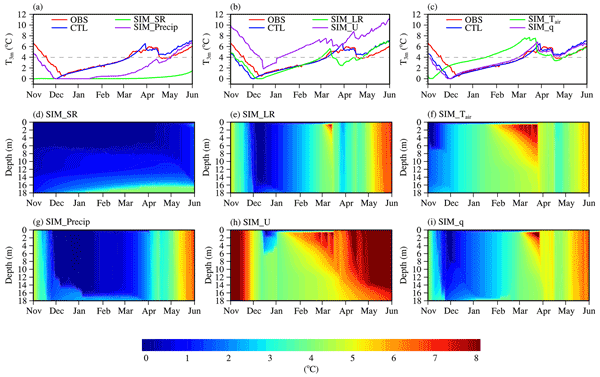
The under-ice water temperature of Ngoring Lake has been rising based on in situ observations. We obtained results showing that strong downward shortwave radiation is the main meteorological factor, and precipitation, wind speed, downward longwave radiation, air temperature, ice albedo, and ice extinction coefficient have an impact on the range and rate of lake temperature rise. Once the ice breaks, the lake body releases more energy than other lakes, whose water temperature remains horizontal.
Malgorzata Golub, Wim Thiery, Rafael Marcé, Don Pierson, Inne Vanderkelen, Daniel Mercado-Bettin, R. Iestyn Woolway, Luke Grant, Eleanor Jennings, Benjamin M. Kraemer, Jacob Schewe, Fang Zhao, Katja Frieler, Matthias Mengel, Vasiliy Y. Bogomolov, Damien Bouffard, Marianne Côté, Raoul-Marie Couture, Andrey V. Debolskiy, Bram Droppers, Gideon Gal, Mingyang Guo, Annette B. G. Janssen, Georgiy Kirillin, Robert Ladwig, Madeline Magee, Tadhg Moore, Marjorie Perroud, Sebastiano Piccolroaz, Love Raaman Vinnaa, Martin Schmid, Tom Shatwell, Victor M. Stepanenko, Zeli Tan, Bronwyn Woodward, Huaxia Yao, Rita Adrian, Mathew Allan, Orlane Anneville, Lauri Arvola, Karen Atkins, Leon Boegman, Cayelan Carey, Kyle Christianson, Elvira de Eyto, Curtis DeGasperi, Maria Grechushnikova, Josef Hejzlar, Klaus Joehnk, Ian D. Jones, Alo Laas, Eleanor B. Mackay, Ivan Mammarella, Hampus Markensten, Chris McBride, Deniz Özkundakci, Miguel Potes, Karsten Rinke, Dale Robertson, James A. Rusak, Rui Salgado, Leon van der Linden, Piet Verburg, Danielle Wain, Nicole K. Ward, Sabine Wollrab, and Galina Zdorovennova
Geosci. Model Dev., 15, 4597–4623, https://doi.org/10.5194/gmd-15-4597-2022, https://doi.org/10.5194/gmd-15-4597-2022, 2022
Short summary
Short summary
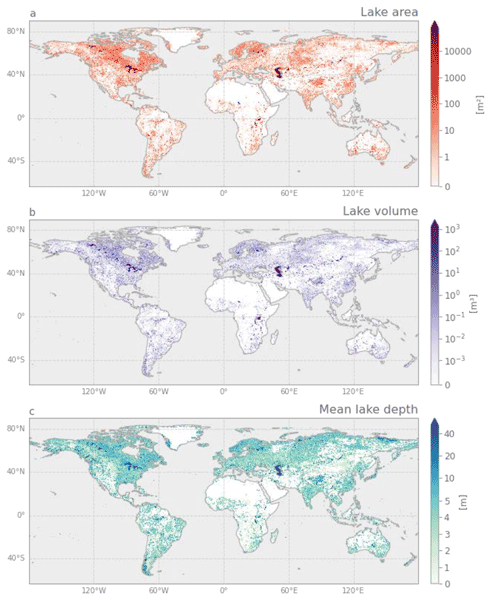
Lakes and reservoirs are warming across the globe. To better understand how lakes are changing and to project their future behavior amidst various sources of uncertainty, simulations with a range of lake models are required. This in turn requires international coordination across different lake modelling teams worldwide. Here we present a protocol for and results from coordinated simulations of climate change impacts on lakes worldwide.
Manuel C. Almeida, Yurii Shevchuk, Georgiy Kirillin, Pedro M. M. Soares, Rita M. Cardoso, José P. Matos, Ricardo M. Rebelo, António C. Rodrigues, and Pedro S. Coelho
Geosci. Model Dev., 15, 173–197, https://doi.org/10.5194/gmd-15-173-2022, https://doi.org/10.5194/gmd-15-173-2022, 2022
Short summary
Short summary
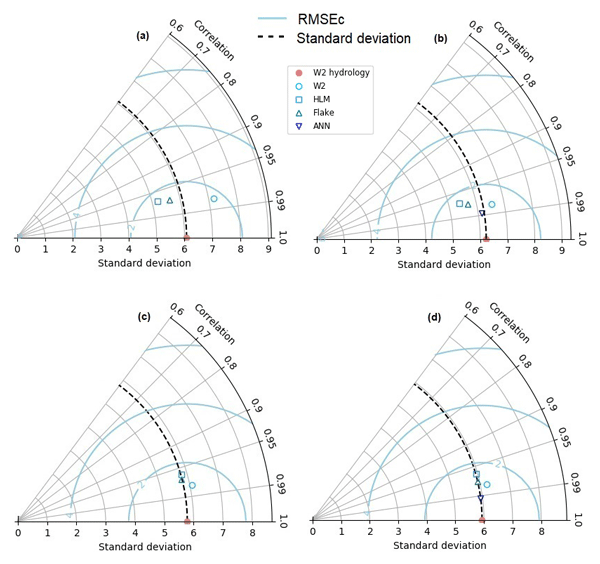
In this study, we have evaluated the importance of the input of energy conveyed by river inflows into lakes and reservoirs when modeling surface water energy fluxes. Our results suggest that there is a strong correlation between water residence time and the surface water temperature prediction error and that the combined use of process-based physical models and machine-learning models will considerably improve the modeling of air–lake heat and moisture fluxes.
Mengxiao Wang, Lijuan Wen, Zhaoguo Li, Matti Leppäranta, Victor Stepanenko, Yixin Zhao, Ruijia Niu, Liuyiyi Yang, and Georgiy Kirillin
The Cryosphere, 16, 3635–3648, https://doi.org/10.5194/tc-16-3635-2022, https://doi.org/10.5194/tc-16-3635-2022, 2022
Short summary
Short summary
The under-ice water temperature of Ngoring Lake has been rising based on in situ observations. We obtained results showing that strong downward shortwave radiation is the main meteorological factor, and precipitation, wind speed, downward longwave radiation, air temperature, ice albedo, and ice extinction coefficient have an impact on the range and rate of lake temperature rise. Once the ice breaks, the lake body releases more energy than other lakes, whose water temperature remains horizontal.
Malgorzata Golub, Wim Thiery, Rafael Marcé, Don Pierson, Inne Vanderkelen, Daniel Mercado-Bettin, R. Iestyn Woolway, Luke Grant, Eleanor Jennings, Benjamin M. Kraemer, Jacob Schewe, Fang Zhao, Katja Frieler, Matthias Mengel, Vasiliy Y. Bogomolov, Damien Bouffard, Marianne Côté, Raoul-Marie Couture, Andrey V. Debolskiy, Bram Droppers, Gideon Gal, Mingyang Guo, Annette B. G. Janssen, Georgiy Kirillin, Robert Ladwig, Madeline Magee, Tadhg Moore, Marjorie Perroud, Sebastiano Piccolroaz, Love Raaman Vinnaa, Martin Schmid, Tom Shatwell, Victor M. Stepanenko, Zeli Tan, Bronwyn Woodward, Huaxia Yao, Rita Adrian, Mathew Allan, Orlane Anneville, Lauri Arvola, Karen Atkins, Leon Boegman, Cayelan Carey, Kyle Christianson, Elvira de Eyto, Curtis DeGasperi, Maria Grechushnikova, Josef Hejzlar, Klaus Joehnk, Ian D. Jones, Alo Laas, Eleanor B. Mackay, Ivan Mammarella, Hampus Markensten, Chris McBride, Deniz Özkundakci, Miguel Potes, Karsten Rinke, Dale Robertson, James A. Rusak, Rui Salgado, Leon van der Linden, Piet Verburg, Danielle Wain, Nicole K. Ward, Sabine Wollrab, and Galina Zdorovennova
Geosci. Model Dev., 15, 4597–4623, https://doi.org/10.5194/gmd-15-4597-2022, https://doi.org/10.5194/gmd-15-4597-2022, 2022
Short summary
Short summary
Lakes and reservoirs are warming across the globe. To better understand how lakes are changing and to project their future behavior amidst various sources of uncertainty, simulations with a range of lake models are required. This in turn requires international coordination across different lake modelling teams worldwide. Here we present a protocol for and results from coordinated simulations of climate change impacts on lakes worldwide.
Manuel C. Almeida, Yurii Shevchuk, Georgiy Kirillin, Pedro M. M. Soares, Rita M. Cardoso, José P. Matos, Ricardo M. Rebelo, António C. Rodrigues, and Pedro S. Coelho
Geosci. Model Dev., 15, 173–197, https://doi.org/10.5194/gmd-15-173-2022, https://doi.org/10.5194/gmd-15-173-2022, 2022
Short summary
Short summary
In this study, we have evaluated the importance of the input of energy conveyed by river inflows into lakes and reservoirs when modeling surface water energy fluxes. Our results suggest that there is a strong correlation between water residence time and the surface water temperature prediction error and that the combined use of process-based physical models and machine-learning models will considerably improve the modeling of air–lake heat and moisture fluxes.
Cited articles
Adeniran, A. B. and Daniell, K. A.: Transaqua: power, political change and the transnational politics of a water megaproject, Int. J. Water Resour. D., 37, 234–255, 2021. a
Aladin, N., Crétaux, J.-F., Plotnikov, I. S., Kouraev, A. V., Smurov, A. O., Cazenave, A., Egorov, A. N., and Papa, F.: Modern hydro-biological state of the Small Aral sea, Environmetrics, 16, 375–392, https://doi.org/10.1002/env.709, 2005. a
Almeida, M. C., Shevchuk, Y., Kirillin, G., Soares, P. M. M., Cardoso, R. M., Matos, J. P., Rebelo, R. M., Rodrigues, A. C., and Coelho, P. S.: Modeling reservoir surface temperatures for regional and global climate models: a multi-model study on the inflow and level variation effects, Geosci. Model Dev., 15, 173–197, https://doi.org/10.5194/gmd-15-173-2022, 2022. a
Andrulionis, N. Y., Zavialov, P. O., and Izhitskiy, A. S.: Current evolution of the salt composition of waters in the western basin of the South Aral Sea, Oceanology, 61, 899–908, https://doi.org/10.1134/S0001437021060035, 2021. a
Asmar, B. N.: The science and politics of the Dead Sea: Red Sea canal or pipeline, J. Environ. Dev., 12, 325–339, 2003. a
Asmar, B. and Ergenzinger, P.: Prediction of the Dead Sea dynamic behaviour with the Dead Sea–Red Sea canal, Adv. Water Resour., 25, 783–791, 2002. a
Ayzel, G. and Izhitskiy, A.: Coupling physically based and data-driven models for assessing freshwater inflow into the Small Aral Sea, Proceedings of the International Association of Hydrological Sciences, 379, 151–158, 2018. a
Ayzel, G. and Izhitskiy, A.: Climate change impact assessment on freshwater inflow into the Small Aral Sea, Water-Sui., 11, 2377, https://doi.org/10.3390/w11112377 2019. a
Barenblatt, G. I.: On self-similarity of temperature and salinity distribution in upper thermocline, Izv. Atmos. Ocean. Phy.+., 14, 1160–1166, 1978. a
Bartosiewicz, M., Przytulska, A., Deshpande, B. N., Antoniades, D., Cortes, A., MacIntyre, S., Lehmann, M. F., and Laurion, I.: Effects of climate change and episodic heat events on cyanobacteria in a eutrophic polymictic lake, Sci. Total Environ., 693, 133414, https://doi.org/10.1016/j.scitotenv.2019.07.220 2019. a
Bengtsson, L.: Ice-covered lakes: environment and climate-required research, Hydrol. Process., 25, 2767–2769, https://doi.org/10.1002/hyp.8098, 2011. a
Bouffard, D., Ackerman, J. D., and Boegman, L.: Factors affecting the development and dynamics of hypoxia in a large shallow stratified lake: hourly to seasonal patterns: hypolimnion thickness and oxygen depletion, Water Resour. Res., 49, 2380–2394, https://doi.org/10.1002/wrcr.20241, 2013. a
Bouffard, D., Zdorovennova, G., Bogdanov, S., Efremova, T., Lavanchy, S., Palshin, N., Terzhevik, A., Vinnå, L. R., Volkov, S., Wüest, A., Zdorovennov R., and Ulloa, H. N.: Under-ice convection dynamics in a boreal lake, Inland Waters, 9, 142–161, 2019. a
Bryden, H. L.: New polynomials for thermal expansion, adiabatic temperature gradient and potential temperature of sea water, Deep Sea Research and Oceanographic Abstracts, 20, 401–408, 1973. a
Carlson, R. E.: A trophic state index for lakes 1, Limnol. Oceanogr., 22, 361–369, 1977. a
Csanady, G.: Large-scale motion in the Great Lakes, J. Geophys. Res., 72, 4151–4162, 1967. a
Danesh-Yazdi, M. and Ataie-Ashtiani, B.: Lake Urmia crisis and restoration plan: planning without appropriate data and model is gambling, J. Hydrol., 576, 639–651, 2019. a
Ermakhanov, Z. K., Plotnikov, I. S., Aladin, N. V., and Micklin, P.: Changes in the Aral Sea ichthyofauna and fishery during the period of ecological crisis, Lakes and Reservoirs: Science, Policy and Management for Sustainable Use, 17, 3–9, https://doi.org/10.1111/j.1440-1770.2012.00492.x, 2012. a
Farmer, D. M. and Carmack, E.: Wind mixing and restratification in a lake near the temperature of maximum density, J. Phys. Oceanogr., 11, 1516–1533, 1981. a
Feistel, R. and Hagen, E.: A Gibbs thermodynamic potential of sea ice, Cold Reg. Sci. Technol., 28, 83–142, 1998. a
Friedrich, J.: Uranium contamination of the Aral Sea, J. Marine Syst., 76, 322–335, https://doi.org/10.1016/j.jmarsys.2008.03.020, 2009. a, b
Friedrich, J. and Oberhänsli, H.: Hydrochemical properties of the Aral Sea water in summer 2002, J. Marine Syst., 47, 77–88, https://doi.org/10.1016/j.jmarsys.2003.12.010, 2004. a, b, c, d
Golosov, S., Maher, O. A., Schipunova, E., Terzhevik, A., Zdorovennova, G., and Kirillin, G.: Physical background of the development of oxygen depletion in ice-covered lakes, Oecologia, 151, 331–340, https://doi.org/10.1007/s00442-006-0543-8, 2007. a, b
Henderson-Sellers, B.: Calculating the surface energy balance for lake and reservoir modeling: a review, Rev. Geophys., 24, 625–649, 1986. a
Hersbach, H., Bell, B., Berrisford, P., Hirahara, S., Horányi, A., Muñoz-Sabater, J., Nicolas, J., Peubey, C., Radu, R., Schepers, D., Simmons, A., Soci, C., Abdalla, S., Abellan, X., Balsamo, G., Bechtold, P., Biavati, G., Bidlot, J., Bonavita, M., De Chiara, G., Dahlgren, P., Dee, D., Diamantakis, M., Dragani, R., Flemming, J., Forbes, R., Fuentes, M., Geer, A., Haimberger, L., Healy, S., Hogan, R. J., Hólm, E., Janisková, M., Keeley, S., Laloyaux, P., Lopez, P., Lupu, C., Radnoti, G., de Rosnay, P., Rozum, I., Vamborg, F., Villaume, S., and Thépaut, J.-N.: The ERA5 global reanalysis, Q. J. Roy. Meteor. Soc., 146, 1999–2049, 2020. a
Huang, W., Zhao, W., Zhang, C., Leppäranta, M., Li, Z., Li, R., and Lin, Z.: Sunlight penetration dominates the thermal regime and energetics of a shallow ice-covered lake in arid climate, The Cryosphere, 16, 1793–1806, https://doi.org/10.5194/tc-16-1793-2022, 2022. a
Huisman, J., van Oostveen, P., and Weissing, F. J.: Critical depth and critical turbulence: two different mechanisms for the development of phytoplankton blooms, Limnol. Oceanogr., 44, 1781–1787, 1999. a
Izhitskaya, E., Egorov, A., Zavialov, P., Yakushev, E., and Izhitskiy, A.: Dissolved methane in the residual basins of the Aral Sea, Environ. Res. Lett., 14, 065005, https://doi.org/10.1088/1748-9326/ab0391 2019. a, b, c
Izhitskiy, A. and Ayzel, G.: Water balance of the regulated arid lake as an indicator of climate change and anthropogenic impact: the North (Small) Aral Sea case study, Water-Sui., 15, 1464, https://doi.org/10.3390/w15081464, 2023. a, b
Izhitskiy, A. S., Kirillin, G. B., Goncharenko, I. V., Kurbaniyazov, A. K., and Zavialov, P. O.: The world's largest heliothermal lake newly formed in the Aral Sea basin, Environ. Res. Lett., 16, 115009, https://doi.org/10.1088/1748-9326/ac2d66, 2021. a, b, c
Kirillin, G.: The Aral Sea after restoration, IGB Leibniz-Institute of Freshwater Ecology and Inland Fisheries [data set], https://doi.org/10.18728/igb-fred-990.0, 2025. a
Kirillin, G., Engelhardt, C., Golosov, S., and Hintze, T.: Basin-scale internal waves in the bottom boundary layer of ice-covered Lake Müggelsee, Germany, Aquat. Ecol., 43, 641–651, https://doi.org/10.1007/s10452-009-9274-3, 2009. a, b
Kirillin, G., Leppäranta, M., Terzhevik, A., Granin, N., Bernhardt, J., Engelhardt, C., Efremova, T., Golosov, S., Palshin, N., Sherstyankin, P., Zdorovennova, G., and Zdorovennov, R.: Physics of seasonally ice-covered lakes: a review, Aquatic Sciences, 74, 659–682, https://doi.org/10.1007/s00027-012-0279-y, 2012. a
Kirillin, G., Wen, L., and Shatwell, T.: Seasonal thermal regime and climatic trends in lakes of the Tibetan highlands, Hydrol. Earth Syst. Sci., 21, 1895–1909, https://doi.org/10.5194/hess-21-1895-2017, 2017. a
Kirillin, G. B., Shatwell, T., and Wen, L.: Ice-covered lakes of Tibetan Plateau as solar heat collectors, Geophys. Res. Lett., 48, e2021GL093429, https://doi.org/10.1029/2021GL093429, 2021. a, b, c
Kitaigorodski, S. A. and Miropolski, Y. Z.: On the theory of the open ocean active layer, Izv. AN SSSR, Fiz. Atmos. Okeana, 6, 178–188, 1970. a
Kitoto, P. A. O.: Agricultural activities and restoration of Lake Chad, in: River Basin Management-Sustainability Issues and Planning Strategies, edited by: Simão, J. and Do Carmo, A., IntechOpen, https://doi.org/10.5772/intechopen.94753, 2021. a
Klimaszyk, P., Kuczyńska-Kippen, N., Szelag-Wasielewska, E., Marszelewski, W., Borowiak, D., Niedzielski, P., Nowiński, K., Kurmanbayev, R., Baikenzheyeva, A., and Rzymski, P.: Spatial heterogeneity of chemistry of the Small Aral Sea and the Syr Darya River and its impact on plankton communities, Chemosphere, 307, 135788, https://doi.org/10.1016/j.chemosphere.2022.135788, 2022. a, b, c
Kosarev, A. N. and Kostianoy, A. G.: The Aral Sea under natural conditions (till 1960), in: The Aral Sea Environment, edited by: Kostianoy, A. G. and Kosarev, A. N., vol. 7 of The Handbook of Environmental Chemistry, Springer, Berlin, Heidelberg, 45–63, https://doi.org/10.1007/698_2009_26, 2010. a
Kouraev, A. V. and Crétaux, J.-F.: Ice conditions from historical and satellite observations, in: The Aral Sea Environment, edited by: Kostianoy, A. G. and Kosarev, A. N., vol. 7 of The Handbook of Environmental Chemistry, Springer, Berlin, Heidelberg, 195–218, https://doi.org/10.1007/698_2009_9, 2010. a
Kouraev, A. V., Papa, F., Mognard, N. M., Buharizin, P. I., Cazenave, A., Cretaux, J.-F., Dozortseva, J., and Remy, F.: Sea ice cover in the Caspian and Aral Seas from historical and satellite data, J. Marine Syst., 47, 89–100, https://doi.org/10.1016/j.jmarsys.2003.12.011, 2004. a, b
Kraus, E. B.: Atmosphere-Ocean Interaction, Clarendon, Oxford, ISBN 0198516045, 1972. a
Kraus, E. B. and Turner, J. S.: A one-dimentional model of the seasonal thermocline: the general theory and its consequences, Tellus, 19, 98–106, 1967. a
Krupa, E., Grishaeva, O., and Balymbetov, K.: Structural variables of macrozoobenthos during stabilization and increase of the Small Aral Sea's level (1996-2008), J. Fish. Res., 3, 1988–1989, 2019. a
Leppi, J. C., Arp, C. D., and Whitman, M. S.: Predicting late winter dissolved oxygen levels in Arctic lakes using morphology and landscape metrics, Environ. Manage., 57, 463–473, https://doi.org/10.1007/s00267-015-0622-x, 2016. a
Malm, J.: Bottom buoyancy layer in an ice-covered lake, Water Resour. Res., 34, 2981–2993, https://doi.org/10.1029/98WR01904, 1998. a
Massakbayeva, A., Abuduwaili, J., Bissenbayeva, S., Issina, B., and Smanov, Z.: Water balance of the Small Aral Sea, Environ. Earth Sci., 79, 75, https://doi.org/10.1007/s12665-019-8739-5, 2020. a
Matthews, P. C. and Heaney, S. A.: Solar heating and its influence on mixing in ice-covered lakes, Freshwater Biol., 18, 135–149, 1987. a
McDougall, T. J.: Neutral surfaces, J. Phys. Oceanogr., 17, 1950–1964, 1987. a
McDougall, T. J. and Barker, P. M.: Getting Started with TEOS-10 and the Gibbs Seawater (GSW) Oceanographic Toolbox, Scor/Iapso WG, 28 pp., ISBN 978-0-646-55621-5, 2011. a
McPhee, M. G.: Turbulent heat flux in the upper ocean under sea ice, J. Geophys. Res.-Oceans, 97, 5365–5379, 1992. a
Micklin, P.: Efforts to revive the Aral Sea, in: The Aral Sea: The Devastation and Partial Rehabilitation of a Great Lake, edited by: Micklin, P., Aladin, N., and Plotnikov, I., Springer, Berlin, Heidelberg, https://doi.org/10.1007/978-3-642-02356-9_15, 361–380, 2014. a
Millero, F. J., Feistel, R., Wright, D. G., and McDougall, T. J.: The composition of Standard Seawater and the definition of the Reference-Composition Salinity Scale, Deep-Sea Res. Pt. I, 55, 50–72, 2008. a
Mironov, D.: Radiatively driven convection in ice-covered lakes: observations, scaling, and a mixed layer model, J. Geophys. Res., 107, 3032, https://doi.org/10.1029/2001JC000892, 2002. a, b, c, d
Mironov, D., Heise, E., Kourzeneva, E., Ritter, B., Schneider, N., and Terzhevik, A.: Implementation of the lake parameterisation scheme FLake into the numerical weather prediction model COSMO, Boreal Environ. Res., 15, 218–230, 2010. a
Parsinejad, M., Rosenberg, D. E., Ghale, Y. A. G., Khazaei, B., Null, S. E., Raja, O., Safaie, A., Sima, S., Sorooshian, A., and Wurtsbaugh, W. A.: 40-years of Lake Urmia restoration research: review, synthesis and next steps, Sci. Total Environ., 832, 155055, https://doi.org/10.1016/j.scitotenv.2022.155055 2022. a
Pawlowicz, R.: Calculating the conductivity of natural waters, Limnol. Oceanogr.-Meth., 6, 489–501, 2008. a
Perga, M., Minaudo, C., Doda, T., Arthaud, F., Beria, H., Chmiel, H. E., Escoffier, N., Lambert, T., Napolleoni, R., Obrador, B., Perolo, P., Rüegg, J., Ulloa, H., and Bouffard, D.: Near bed stratification controls bottom hypoxia in ice covered alpine lakes, Limnol. Oceanogr., 68, 1232–1246, https://doi.org/10.1002/lno.12341, 2023. a
Pieters, R. and Lawrence, G. A.: Effect of salt exclusion from lake ice on seasonal circulation, Limnol. Oceanogr., 54, 401–412, 2009. a
Pilla, R. M., Williamson, C. E., Overholt, E. P., Rose, K. C., Berger, S. A., Couture, R.-M., de Wit, H. A., Granados, I., Grossart, H.-P. F., Kirillin, G. B., Laas, A., Nejstgaard, J. C., Rusak, J. A., Swinton, M. W., Toro, M., and Yao, H.: Deepwater dissolved oxygen shows little ecological memory between lake phenological seasons, Inland Waters, 13, 327–338, https://doi.org/10.1080/20442041.2023.2265802, 2023. a
Plotnikov, I. S., Ermakhanov, Z. K., Aladin, N. V., and Micklin, P.: Modern state of the Small (Northern) Aral Sea fauna, Lakes and Reservoirs: Science, Policy and Management for Sustainable Use, 21, 315–328, https://doi.org/10.1111/lre.12149, 2016. a
Poole, H. and Atkins, W.: Photo-electric measurements of submarine illumination throughout the year, J. Mar. Biol. Assoc. UK, 16, 297–324, 1929. a
Read, J. S., Hamilton, D. P., Jones, I. D., Muraoka, K., Winslow, L. A., Kroiss, R., Wu, C. H., and Gaiser, E.: Derivation of lake mixing and stratification indices from high-resolution lake buoy data, Environ. Modell. Softw., 26, 1325–1336, 2011. a
Schwefel, R., MacIntyre, S., Cortés, A., and Sadro, S.: Oxygen depletion and sediment respiration in ice covered arctic lakes, Limnol. Oceanogr., 68, 1470–1489, https://doi.org/10.1002/lno.12357, 2023. a
Shatwell, T., Adrian, R., and Kirillin, G.: Planktonic events may cause polymictic-dimictic regime shifts in temperate lakes, Sci. Rep.-UK, 6, 24361, https://doi.org/10.1038/srep24361, 2016. a
Steinsberger, T., Schwefel, R., Wüest, A., and Müller, B.: Hypolimnetic oxygen depletion rates in deep lakes: effects of trophic state and organic matter accumulation, Limnol. Oceanogr., 65, 3128–3138, https://doi.org/10.1002/lno.11578, 2020. a
Su, D., Hu, X., Wen, L., Lyu, S., Gao, X., Zhao, L., Li, Z., Du, J., and Kirillin, G.: Numerical study on the response of the largest lake in China to climate change, Hydrol. Earth Syst. Sci., 23, 2093–2109, https://doi.org/10.5194/hess-23-2093-2019, 2019. a
Terzhevik, A. Y., Pal'shin, N. I., Golosov, S. D., Zdorovennov, R. E., Zdorovennova, G. E., Mitrokhov, A. V., Potakhin, M. S., Shipunova, E. A., and Zverev, I. S.: Hydrophysical aspects of oxygen regime formation in a shallow ice-covered lake, Water Resources, 37, 662–673, https://doi.org/10.1134/S0097807810050064, 2010. a
Thiery, W., Martynov, A., Darchambeau, F., Descy, J.-P., Plisnier, P.-D., Sushama, L., and van Lipzig, N. P. M.: Understanding the performance of the FLake model over two African Great Lakes, Geosci. Model Dev., 7, 317–337, https://doi.org/10.5194/gmd-7-317-2014, 2014a. a
Thiery, W., Stepanenko, V. M., Fang, X., Jöhnk, K. D., Li, Z., Martynov, A., Perroud, M., Subin, Z. M., Darchambeau, F., Mironov, D., and Van Lipzig, N. P. M.: LakeMIP Kivu: evaluating the representation of a large, deep tropical lake by a set of one-dimensional lake models, Tellus A, 66, 21390, https://doi.org/10.3402/tellusa.v66.21390, 2014b. a
Valerio, G., Pilotti, M., Lau, M. P., and Hupfer, M.: Oxycline oscillations induced by internal waves in deep Lake Iseo, Hydrol. Earth Syst. Sci., 23, 1763–1777, https://doi.org/10.5194/hess-23-1763-2019, 2019. a
Wang, J., Song, C., Reager, J. T., Yao, F., Famiglietti, J. S., Sheng, Y., MacDonald, G. M., Brun, F., Schmied, H. M., Marston, R. A., and Wada, Y.: Recent global decline in endorheic basin water storages, Nat. Geosci., 11, 926–932, https://doi.org/10.1038/s41561-018-0265-7, 2018. a
Yapiyev, V., Sagintayev, Z., Inglezakis, V. J., Samarkhanov, K., and Verhoef, A.: Essentials of endorheic basins and lakes: a review in the context of current and future water resource management and mitigation activities in Central Asia, Water-Sui., 9, 798, https://doi.org/10.3390/w9100798, 2017. a
Zavialov, P. O.: Physical Oceanography of the Dying Aral Sea, Springer Science and Business Media, https://doi.org/10.1007/b138791, 2007. a, b, c
Zilitinkevich, S., Chalikov, D., and Resnyansky, Y.: Modeling the oceanic upper layer, Oceanol. Acta, 2, 219–240, 1979. a
Editorial statement
The Aral Sea represents both an example of large-scale environmental degradation caused by human activity and a message of hope through its partial restoration. This follow-up study emphasizes that while the system appears healthy at present, it lacks resilience and small perturbations could significantly alter the entire ecosystem. The topic of the paper is of broad interest and the results of the analysis are also important for the management of the region.
The Aral Sea represents both an example of large-scale environmental degradation caused by human...
Short summary
The Aral Sea is both an example of large-scale environmental degradation caused by human activity and a message of hope through its partial restoration. Our study shows that the restored part of the Aral Sea is now healthy in terms of vertical mixing and oxygenation. However, small perturbations of water level or transparency could significantly alter the entire ecosystem. The results contribute to understanding the consequences of large-scale lake management worldwide.
The Aral Sea is both an example of large-scale environmental degradation caused by human...


